
TRT
October 18, 2026
TRT, acne and hair loss: what DHT explains and what it does not
On this page
A person can feel better after starting testosterone and still be unhappy about new spots across the shoulders or a changing hairline. Those changes deserve attention. They are not a trivial price everyone must accept, and they do not automatically mean the prescription is wrong.
The explanation often offered online is a single molecule: dihydrotestosterone, or DHT. Testosterone can be converted to DHT, and DHT has important effects in skin and hair follicles. But “DHT causes everything” leaves out the diagnosis, the tissue involved and the evidence for different treatments. Acne and patterned scalp thinning share some androgen biology while behaving quite differently.
DHT helps explain susceptibility to androgenetic hair loss, but neither a DHT result nor a testosterone result can diagnose every skin or hair change. The useful next step is to identify what is happening, review the timing and treatment exposure, and choose an approach with evidence for that particular condition. Research available through October 17, 2026 supports that more careful approach.
One hormone system, different tissue responses
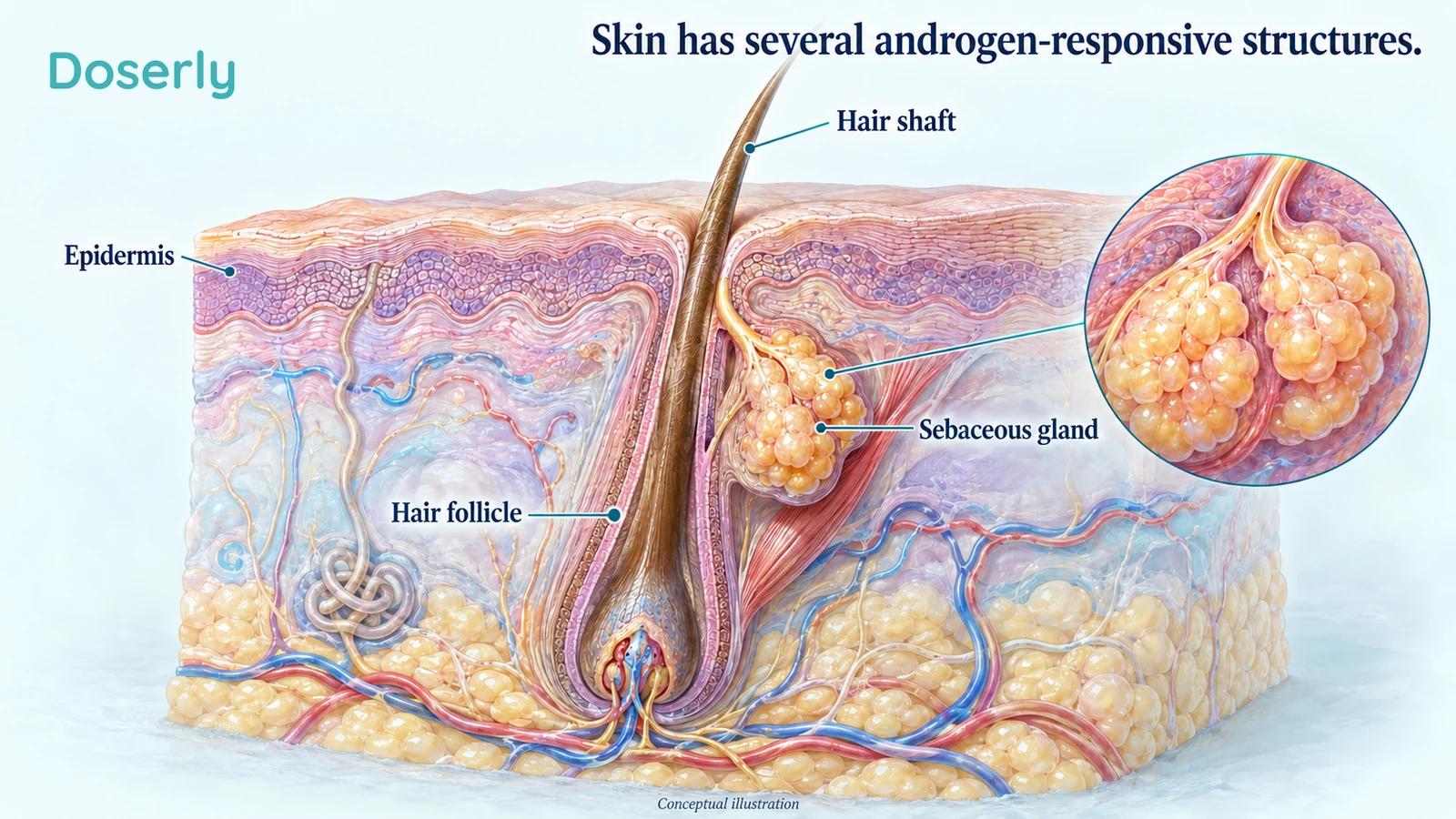
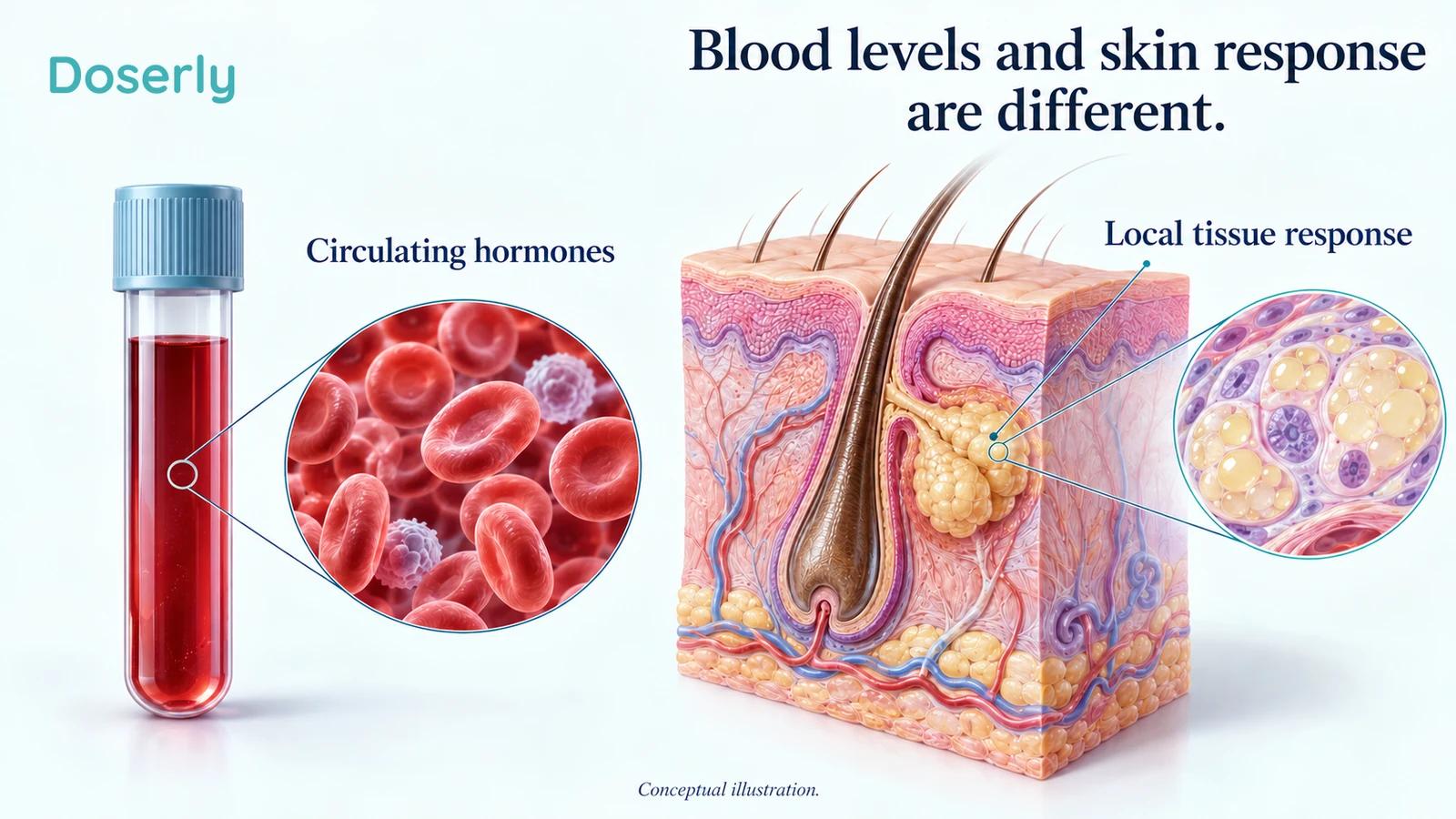
Testosterone and DHT both activate the androgen receptor. Enzymes called 5-alpha-reductases convert some testosterone to DHT within particular tissues. Local conversion and receptor responses help determine what happens after a hormone reaches the skin. A blood sample measures circulating hormone, not the full activity inside a particular scalp follicle.
Human sebaceous-gland research has examined androgen metabolism directly in skin tissue, including differences between people with and without acne. This supports the idea that the skin is an active participant in hormone metabolism rather than a passive reflection of a blood result. It does not establish a serum DHT cutoff that predicts who will develop acne on TRT. Human sebaceous-gland study
Think about the question being asked. “Is my testosterone exposure appropriate?” is a prescribing question. “Are these lesions acne?” is a dermatological question. “Is this patterned hair loss?” is another. They can inform one another, but answering one does not settle the others.
That distinction also protects against overinterpreting an apparently reassuring test. Someone with a result inside the laboratory interval can still have a skin condition requiring treatment. Conversely, an out-of-range result is a reason to review the circumstances and prescription, not proof that every symptom has the same cause.
Acne is more than extra oil
The hair follicle and attached sebaceous gland form the pilosebaceous unit. Sebum is the oily material the gland produces. Acne involves follicular plugging and inflammation as well as sebum and microbial factors. It can produce blackheads, whiteheads, inflamed bumps and deeper painful lesions. Reducing the whole condition to “too much oil” misses several useful treatment targets.
This is reflected in the American Academy of Dermatology's 2024 guideline. It recommends treatments with different actions, including topical retinoids, benzoyl peroxide and selected antibiotics; severe or otherwise appropriate cases may warrant isotretinoin. It also emphasizes combining suitable treatments and limiting systemic antibiotic use. These are choices made according to diagnosis and severity, not a universal sequence for every TRT user. AAD acne guideline
A practical description is more useful than calling a breakout “hormonal.” Where are the lesions? Are there comedones, painful nodules or scars? Did a new product, shaving practice or medication coincide with them? Photographs can help show distribution and change, particularly when the back is difficult to examine alone.
The point is to give the clinician enough information to distinguish acne from conditions that can resemble it. The same-looking red bump in a casual phone photograph need not have the same cause or treatment as another person's breakout.
What testosterone-exposure studies actually show
A 2021 electronic-record cohort followed 988 adults starting masculinizing hormone therapy. Recorded acne prevalence increased from 6.3% before treatment to 31.1% after initiation; the two-year incidence proportion was 25.1%. Younger participants were more likely to receive an acne diagnosis. This provides substantial human evidence that acne can emerge with testosterone exposure. Thoreson and colleagues
The population matters. These were predominantly young adults receiving gender-affirming treatment, not a trial of older cisgender men with confirmed hypogonadism. The study relied on clinical coding and had no randomized untreated comparison. Its percentages should not be presented as the chance that any man starting TRT will develop acne.
More recent biology is consistent with an androgen connection. A 2025 study assessed acne in 1,609 children and young people, with hormone measurements in a nested sample. DHT concentrations were higher in adolescents with acne. This was a secondary analysis of a puberty cohort, not a treatment experiment, and cannot tell us whether lowering DHT treats TRT-associated acne. Jakobsen and colleagues
Together, these studies support an association while leaving an important gap: the probability, severity and best prevention strategy for acne in a particular adult TRT population remain less certain. A clinician should not substitute adolescent biology or another treatment population's incidence for your own assessment.
Why blocking DHT is not a guaranteed acne solution
A particularly informative experiment was published in JAMA in 2012. Researchers suppressed endogenous testosterone production in healthy men, then assigned different testosterone exposures with either dutasteride, which inhibits both major 5-alpha-reductase types, or placebo. Of 139 randomized men, 102 completed the 20-week intervention. The primary outcome was fat-free mass, not acne. Bhasin and colleagues
Despite DHT suppression, sebum production and acne scores did not differ significantly between dutasteride and placebo groups. Acne occurred in 25 men in each set of groups. The experiment included testosterone exposures beyond ordinary replacement, was relatively short and was not designed as a definitive acne-treatment trial. Still, it directly challenges the promise that blocking testosterone's conversion to DHT necessarily prevents testosterone-associated acne.
The clinical implication is modest but useful: a plausible pathway is not enough to choose a medicine. Finasteride or dutasteride should not become an automatic acne add-on simply because they lower DHT. An acne treatment needs evidence about acne outcomes and a discussion of its own trade-offs.
Local androgen treatment has its own evidence
Clascoterone offers an instructive distinction. It is a topical androgen-receptor inhibitor studied for acne, rather than a medicine whose main purpose is to reduce DHT formation. Two randomized, vehicle-controlled phase 3 trials enrolled 1,440 people with facial acne and found better treatment success with clascoterone than with the vehicle cream. Original clascoterone trials
Those were acne trials, not trials specifically in men taking TRT. They support discussing an evidence-based dermatological option when appropriate; they do not show that every testosterone-associated breakout needs an antiandrogen. Availability, skin tolerance, other treatments and the person's goals still matter.
Nor should acne evidence be borrowed to justify using the same product for scalp hair loss. The concentration, formulation, application site and outcome all belong to the tested intervention. A medicine can have a convincing rationale for two conditions while having different evidence for each.
This is a helpful question whenever a product is marketed as a complete “DHT solution”: which diagnosis was studied, in which people, and what actually improved? Fewer inflammatory lesions, a higher scalp hair count and a lower blood DHT concentration are three different findings.
Patterned hair loss is a follicle problem, not a blood-test diagnosis
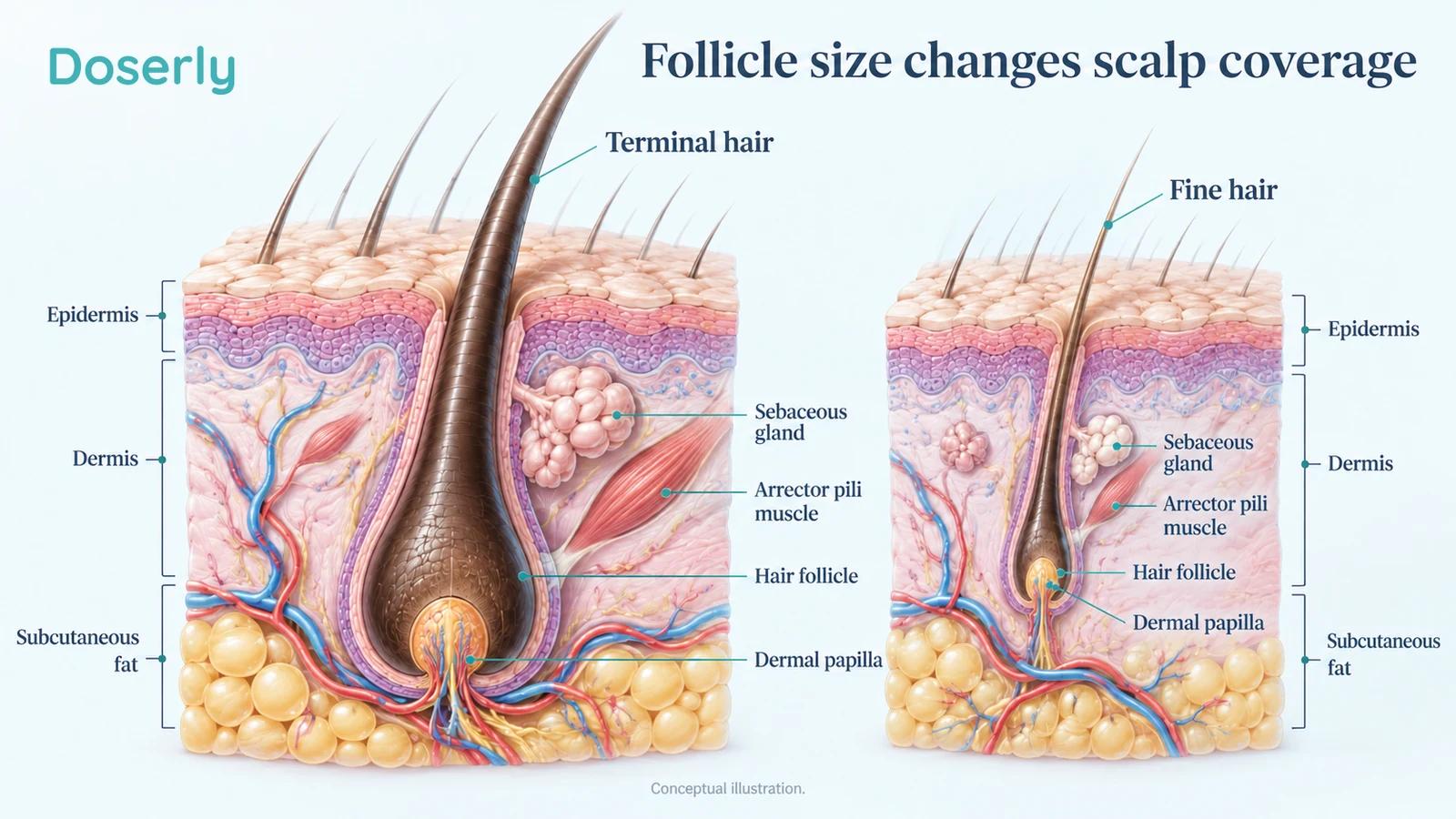
Androgenetic alopecia is the gradual miniaturization of susceptible scalp follicles. Over successive cycles, affected hairs become finer and contribute less coverage. In men, recession at the temples and thinning over the crown are common patterns, although appearance varies.
The role of DHT is supported by treatment experiments. Two pivotal one-year trials randomized 1,553 men aged 18–41 with male-pattern hair loss to finasteride or placebo; 1,215 continued into a second year. Finasteride improved hair-count and photographic outcomes compared with placebo. This was research involving a manufacturer-affiliated study group, and the population was selected for existing androgenetic alopecia. It was not a trial of routine prevention in everyone starting testosterone. Finasteride trials
That is stronger evidence than an online theory about a particular DHT number. It supports treating an established condition in appropriate patients. It does not mean all shedding is DHT-mediated, that every follicle responds identically or that treatment will restore a previous hairline completely.
A useful consultation therefore starts with scalp examination and history. Old photographs can show whether thinning began before TRT. Family history provides context, but a relative's experience cannot establish your diagnosis or timetable. The question is whether the pattern and examination fit androgenetic alopecia and whether anything else is occurring alongside it.
Sudden shedding needs a wider history
A shower drain full of hair can feel more alarming than slow recession, but it may represent a different process. Telogen effluvium is excessive shedding that can follow illness, fever, substantial weight loss or other physiological stress. It commonly becomes noticeable months after the trigger. Someone can have shedding and hereditary patterned hair loss together. AAD explanation of shedding
That delay can make the newest medication seem responsible even when an earlier illness is relevant. For example, a person might start TRT after a difficult period of illness and weight change, then notice shedding several weeks later. The sequence deserves investigation, but it does not isolate testosterone as the cause.
Bring a timeline that includes the months before the hair change, rather than only the week you first noticed it. Include new prescriptions, major dietary changes and scalp symptoms. A clinician can decide whether examination alone is sufficient or whether targeted testing is justified. Ordering a large hormone panel without a specific diagnostic question can add numbers without resolving the uncertainty.
Patchy loss, scalp pain or inflammation also changes the assessment. The aim is not to label every unusual presentation from a list online; it is to avoid assuming that all hair loss after a prescription has the same mechanism.
Hair treatments have benefits and trade-offs
Treatment selection depends on the cause, the desired outcome and willingness to continue treatment. The AAD describes topical minoxidil and prescription finasteride among options for appropriate patients with hair loss. Hair responses take time, and treatment expectations should be set in months rather than judged by a few days of shedding. AAD diagnosis and treatment information
For someone taking TRT, it is worth discussing sexual symptoms before adding a hair medicine. Otherwise, a later change can be difficult to interpret: was it present beforehand, related to the new treatment, related to the underlying condition or something else? A baseline description is more useful than assuming testosterone will cancel every potential effect of another drug.
The decision also involves priorities. One person may value preserving hair enough to accept daily treatment and uncertainty. Another may prefer observation after a diagnostic assessment. Neither needs a promise of complete regrowth to make a reasonable choice, but both need to know what success would look like and when to reassess it.
Avoid buying several products at once simply because each claims to act on DHT. That makes it harder to identify irritation, benefit or adverse effects. A plan with a named diagnosis, a chosen intervention and a review date produces much clearer information.
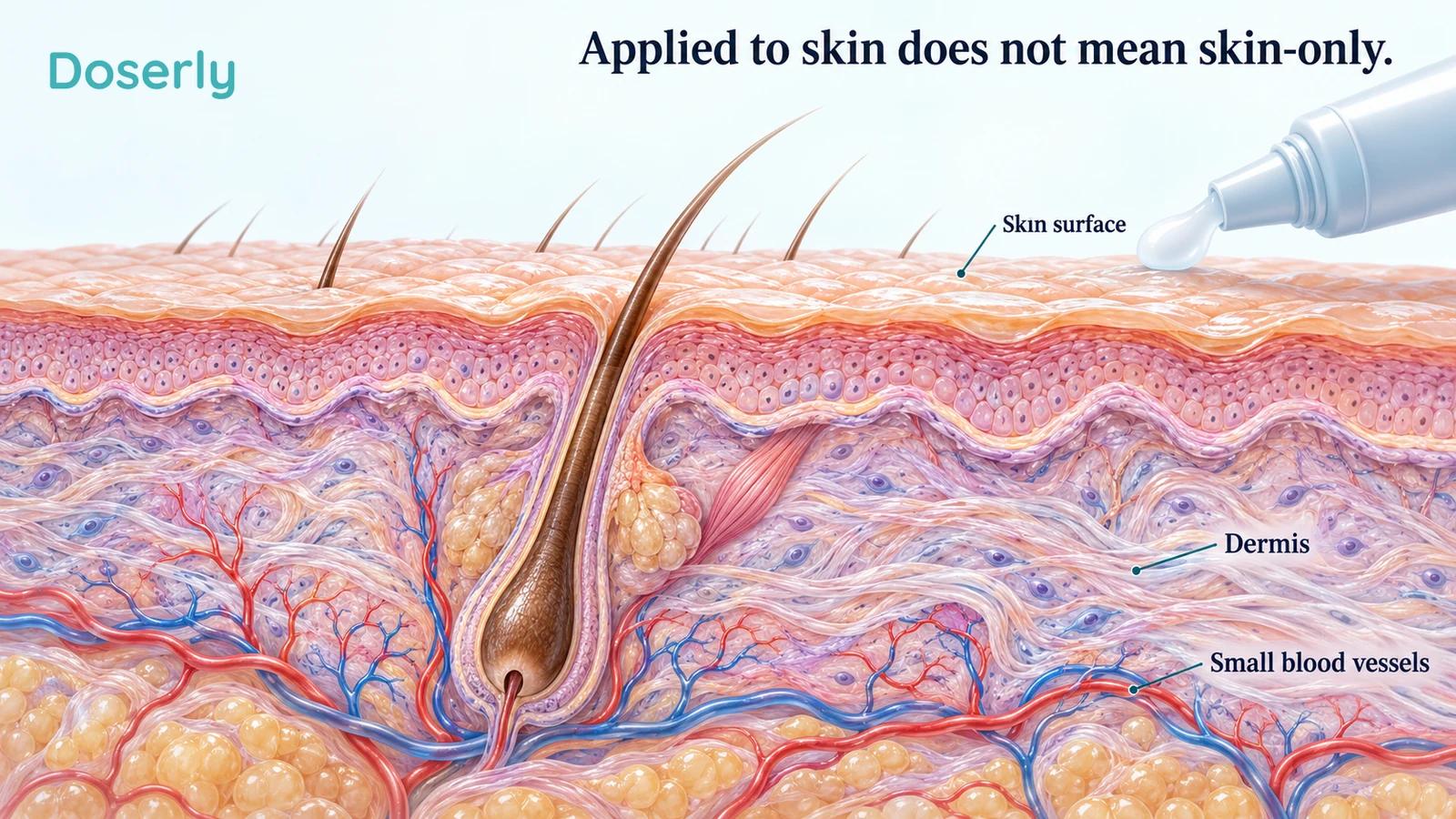
Topical does not necessarily mean confined to the scalp
A phase 3 study of a particular topical finasteride spray randomized 458 men with androgenetic alopecia. At 24 weeks, the adjusted target-area hair-count increase was greater with topical finasteride than placebo, and systemic drug exposure was lower than with oral finasteride. Serum DHT nevertheless decreased. Results for this studied formulation do not establish identical performance for every compounded spray or gel. Topical finasteride trial
In April 2025, the FDA warned about adverse-event reports involving compounded topical finasteride. The agency noted that systemic absorption is expected, that transfer to other people is possible, and that no topical finasteride formulation was FDA-approved at the time of its notice. Spontaneous reports cannot establish an incidence rate or prove causation in every case, but they contradict blanket assurances of zero systemic risk. FDA safety communication
The useful distinction is between evidence about a specific formulation and marketing about a route. Ask what is known about the actual product offered, including handling, exposure to others and how adverse effects will be assessed. The word “topical” alone cannot answer those questions.
Review the TRT prescription without chasing a cosmetic hormone target
The prescriber should know about new acne or hair changes, particularly if they are severe or appeared after a prescription change. Reviewing the product, actual use, laboratory timing and treatment goals can identify whether the current plan needs attention. This is different from adjusting testosterone repeatedly to chase a preferred DHT number.
The Endocrine Society recommends evaluating treatment response and adverse effects after testosterone is started. Its diagnostic approach requires compatible symptoms and consistently low testosterone before treatment; a cosmetic concern does not erase the original indication or replace that clinical assessment. Endocrine Society testosterone guidance
If someone suggests changing injection frequency solely to guarantee clear skin or preserved hair, ask for evidence measuring those outcomes. A smoother concentration curve is a pharmacokinetic claim. Whether that change meaningfully improves a person's acne or scalp coverage is a separate clinical question.
Coordinate the dermatology and hormone plans so each clinician knows what the other is treating. A useful review can address skin disease while preserving appropriate care for documented hypogonadism. It need not turn into a choice between ignoring distressing changes and abandoning treatment without a plan.
Make the next appointment specific
Bring the name and timing of every hormone and skin or hair product, dated photographs taken under similar lighting, and a brief description of what matters most: painful lesions, scarring, scalp symptoms, shedding or loss of coverage. Record changes rather than trying to diagnose their mechanism yourself.
Useful questions include:
- Does the examination fit acne, androgenetic alopecia, shedding or another condition?
- What evidence applies to this diagnosis and to the particular treatment being offered?
- Would a laboratory result change the plan, and how?
- What improvement should we look for, over what interval, and what adverse effects should prompt contact?
DHT is part of the explanation, especially for susceptible scalp follicles. It is not a universal diagnosis or a reason to add another medicine automatically. The most useful plan treats the skin or hair problem that is actually present, while keeping the benefits and adverse effects of TRT in view.
For more background on diagnosis, treatment options and monitoring, explore the Doserly TRT guides.