
Supplements
October 16, 2026
Tongkat ali and testosterone: which outcome actually improved?
On this page
A testosterone result can be interesting without explaining why someone feels tired, has less sexual interest or struggles in the gym. Tongkat ali sits directly in that gap. Some trials report changes in hormone concentrations; some also report changes in symptoms. Those findings deserve a careful reading, because the men enrolled, the extract used and the outcome measured are not interchangeable.
The useful question is therefore more specific than “Does tongkat ali boost testosterone?” It is whether a particular preparation helps people like you with a problem that matters, by enough to justify its uncertainties. Safety belongs in the same discussion: a European assessment identified a genotoxicity concern with one evaluated root extract, which short human trials cannot settle.
Start with the plant and the preparation
Tongkat ali usually refers to Eurycoma longifolia. Research has tested particular root extracts, including standardized aqueous preparations sold under a named ingredient brand. A capsule labeled with the plant name is not automatically the same intervention.
Extraction method, composition and daily amount can differ. A statement such as “200 mg of tongkat ali” omits enough information to make a clinical comparison unreliable. An impressive extract ratio also does not establish equivalence to a trial product. It describes an aspect of production, not a demonstrated clinical effect.
That distinction becomes especially important when a seller combines a trial of one extract with a safety statement about traditional use, then applies both to a different formulation. Each part needs its own support. The Doserly tongkat ali guide provides broader ingredient context; the discussion here focuses on reading the human trials and their limitations.
A diagnosis needs more than one testosterone number
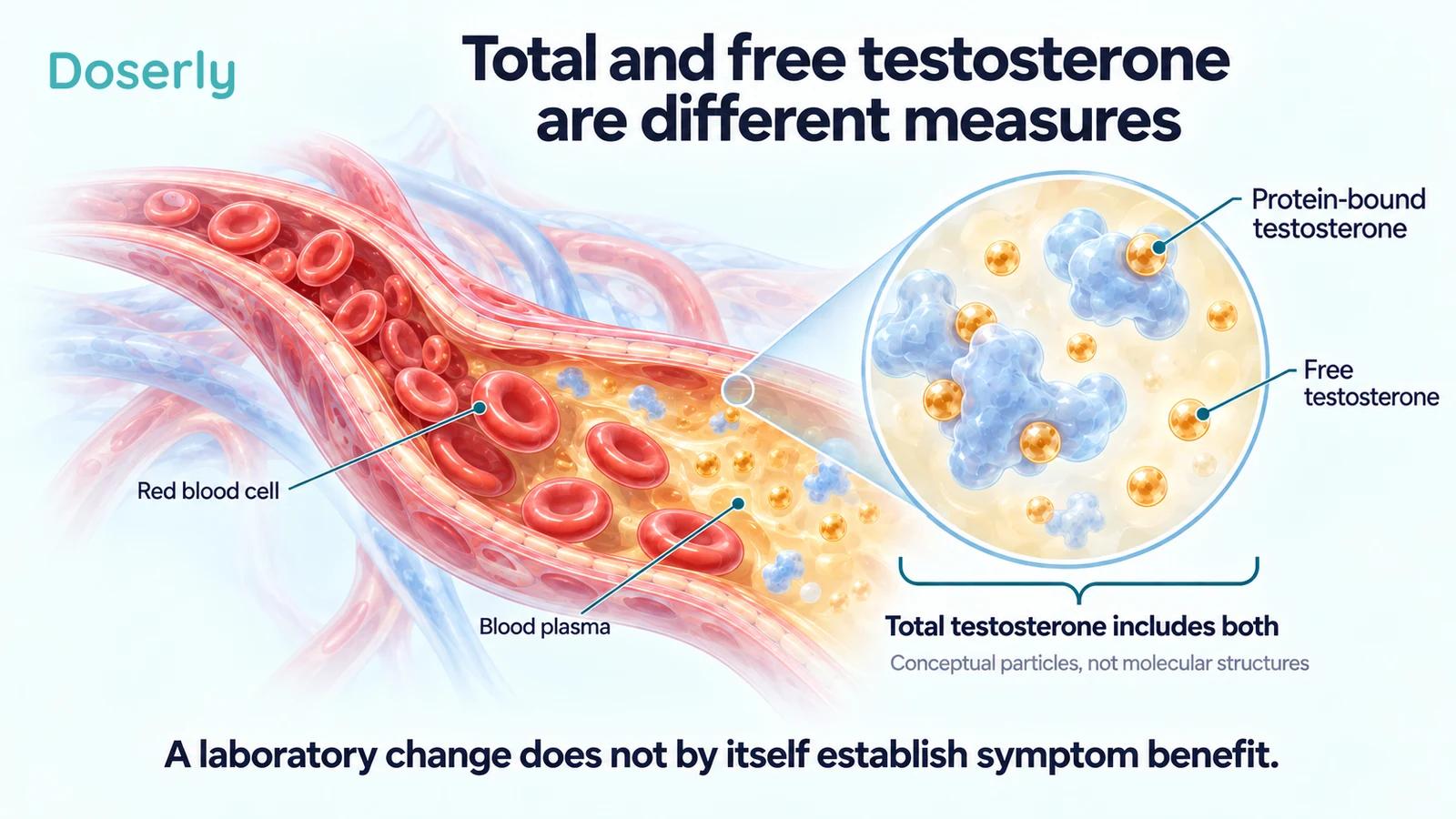
Total testosterone includes hormone attached to blood proteins as well as the unbound, or free, fraction. The measurements answer related questions, but a change in total testosterone is not proof of an equal change in free testosterone.
Clinical interpretation also considers symptoms, timing, repeat testing and conditions affecting the result. The Endocrine Society recommends diagnosing hypogonadism in men with compatible symptoms and unequivocally, consistently low testosterone concentrations, with confirmation by a repeat morning fasting measurement. Free testosterone testing is appropriate in particular circumstances, using suitable methods. A single low result after a difficult week does not complete that evaluation. Endocrine Society guideline.
This matters before a supplement trial starts. If the original result was unusually low, a later result may rise even without effective treatment. Comparing an extract with placebo helps separate treatment effects from that variation. Comparing your own two blood tests, taken under different conditions, cannot do the same job.
The older-men trial had a specific entry criterion
A 2021 randomized, double-blind, placebo-controlled study enrolled 105 men aged 50–70 whose testosterone was below 300 ng/dL. It compared a standardized aqueous root extract at 100 or 200 mg daily with placebo over 12 weeks. These amounts describe the experiment, not a recommendation for self-treatment. Primary trial.
The investigators reported statistically significant total-testosterone differences versus placebo at week 12 with the lower amount, and at weeks 4, 8 and 12 with the higher amount. However, free testosterone did not differ significantly between groups. The abstract also describes improvements in aging-male symptom and fatigue scores.
That combination is more informative than a headline saying testosterone increased. It suggests a signal for some measured outcomes in an older, selected population, while preserving an important negative result for another hormone measure. It does not establish that all testosterone-related outcomes improved or that younger men with typical starting levels should expect the same response.
The distinction between comparisons matters here. The abstract reports muscle-strength improvement relative to baseline; that alone is not evidence of a strength advantage over placebo. Likewise, a statistically significant symptom-score change does not tell a reader how many men experienced a worthwhile improvement unless the size and clinical interpretation of that change are also available.
The trial therefore supports further attention to its preparation and population. It does not support replacing an evaluation for symptomatic low testosterone with a supplement purchase.
A short study in younger men answers a different question
Another 2021 randomized trial involved 32 young men, averaging about 24 years old, who received 600 mg daily of an Eurycoma longifolia preparation or placebo for two weeks. It reported treatment-by-time differences in total testosterone, free testosterone and estradiol, while luteinizing hormone, follicle-stimulating hormone and sex hormone-binding globulin did not show significant changes. Primary trial.
Two weeks is enough to study a short-term laboratory response. It is not enough to demonstrate sustained gains in strength, fertility, sexual function or long-term health. A discussion about possible muscle-building effects remains a hypothesis unless the study measures a relevant functional outcome and demonstrates an advantage.
It would also be a mistake to combine this amount with the older-men trial and infer a simple dose-response curve. The participants, durations and preparations differ. More milligrams in one experiment do not prove that escalating a retail product produces more benefit.
For a healthy younger person, the practical uncertainty is substantial: even if a hormone concentration moves, what problem has been solved? A number that changes within a physiological range is not automatically a reason to continue taking something.
Sexual well-being has been studied directly, too
A 2012 randomized trial tested a freeze-dried water extract against placebo in 109 men aged 30–55 for 12 weeks. It assessed quality of life, sexual well-being, erectile function, semen measures and other outcomes. The investigators reported advantages in some measures, including physical functioning and the erectile-function domain. Primary trial.
Those are more directly relevant to sexual-health claims than a hormone-only experiment. They still need proportionate interpretation. A study assessing many endpoints can produce a mixture of results, and a positive domain on a questionnaire is not equivalent to demonstrating reliable treatment of every cause of erectile dysfunction.
Semen measurements also need their own boundary. A change in sperm motility or semen volume does not establish improved pregnancy or live-birth rates. Couples dealing with infertility need an evaluation that considers both partners rather than a supplement chosen from a semen-related headline.
There is a further distinction between sexual desire and erection quality. They can change together, but they are not the same symptom or measurement. A claim about “male performance” that slides between the two loses information the reader needs.
Exercise complicates the six-month study
A smaller 2021 study followed 45 middle-aged men over six months and evaluated tongkat ali alongside concurrent exercise training. The abstract describes improvements in erectile-function and testosterone outcomes, with the combination producing the strongest reported pattern. Primary trial.
The accessible abstract is not clear enough to support a precise claim about the extract’s independent contribution: its description of groups and its stated limitation are internally inconsistent. That is a reason to narrow the conclusion, not to fill in the missing interpretation.
At most, this report adds a signal from a small study in a particular setting. It cannot justify saying that an herb alone reproduces the result of an exercise-plus-supplement program. Nor does improvement in both testosterone and erectile-function scores prove that the hormone change caused the symptom change. Showing that pathway requires more than observing two outcomes move.
Short-term tolerability does not resolve the EFSA concern
The older-men trial reported no clinically relevant changes in the safety laboratory parameters it monitored over 12 weeks. That is useful information about those observations. It cannot establish the absence of rare, delayed or genetically mediated harm.
In 2021, the European Food Safety Authority evaluated a particular standardized water extract of Eurycoma longifolia root as a novel food. The assessment identified a concern about DNA damage, drawing on genotoxicity testing that included a positive in-vitro chromosomal-aberration test and an in-vivo comet assay. The panel concluded that the safety of the evaluated extract had not been established under any condition of use. EFSA assessment.
That conclusion should neither be softened into “no serious side effects reported” nor inflated into proof that tongkat ali causes cancer in humans. It concerns an evaluated preparation and a type of potential hazard. It does not quantify a person’s cancer risk, establish that every commercial extract has identical properties or substitute for a product-specific assessment.
The practical implication is still significant. A supplement considered for a modest or uncertain benefit needs a persuasive safety case. A short trial with reassuring routine blood tests does not cancel a concern those tests were not designed to investigate.
Match the claim to the problem you actually have
If the concern is persistent low sexual desire, a useful assessment considers more than testosterone. If the concern is erectile difficulty, diabetes, vascular disease, medicines and psychological factors can contribute. NIDDK’s clinical overview describes this range of causes; a supplement response would not rule them out. NIDDK on erectile dysfunction.
For someone worried about a low laboratory result, bringing the original report, collection time, symptoms and medication list to a clinician is more useful than chasing a target promoted online. The aim is to establish whether there is a persistent abnormality and, if so, why it is present.
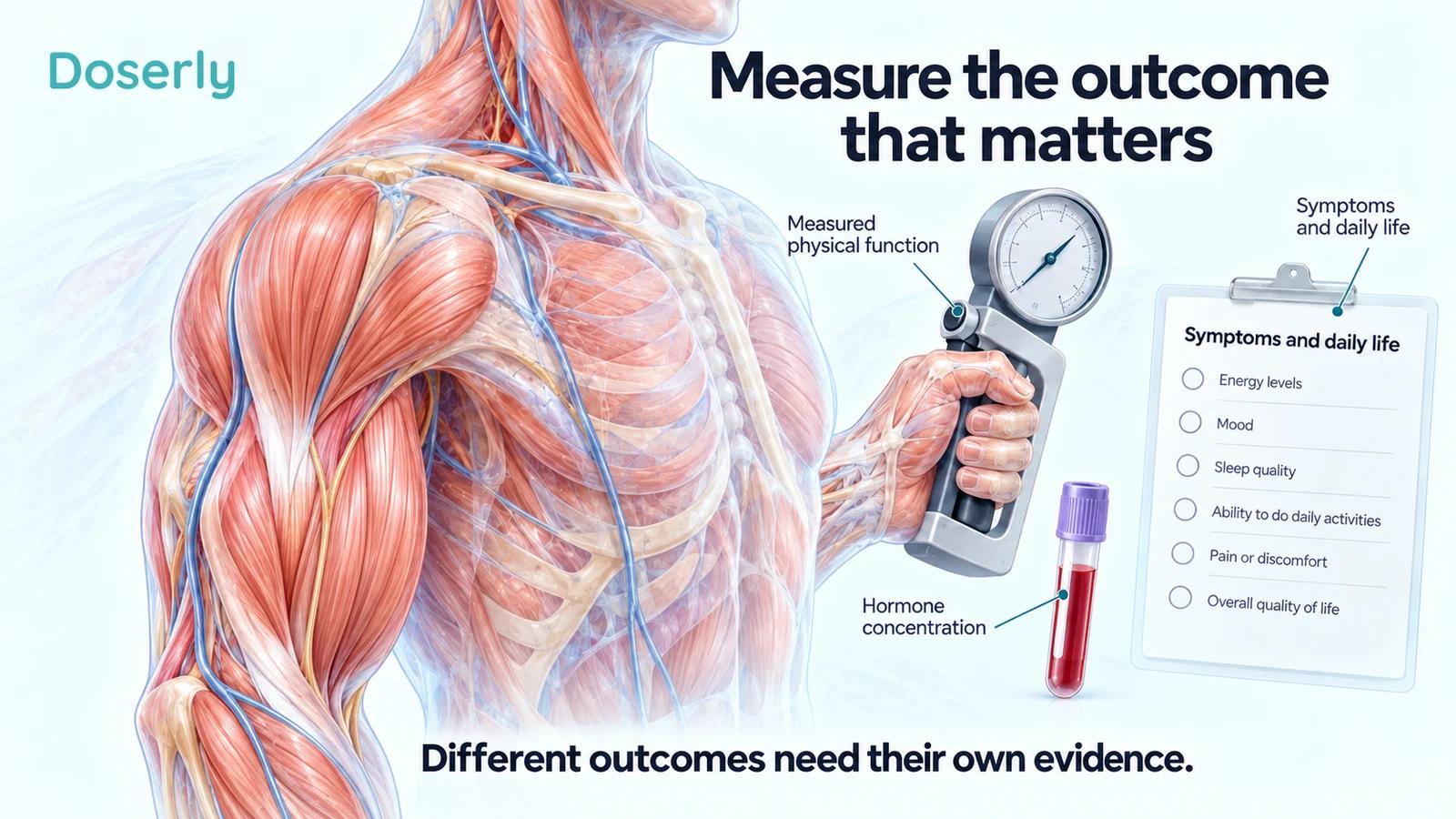
For someone interested in training, performance measures should be concrete: a repeatable strength test, training progression or recovery pattern. Feeling more motivated is worth describing accurately, but it does not prove a hormonal mechanism. Simultaneous changes in sleep, training and food intake also make personal attribution difficult.
A symptom record can support a discussion without pretending to be a controlled experiment. Note what changed, when it changed and what else changed at the same time. Do not use a perceived benefit as evidence that an extract has resolved its longer-term safety uncertainties.
Reading a label cannot close the evidence gaps
A useful product description identifies the botanical name, plant part, extraction method, amount per serving and any standardized constituents. Batch testing may help establish identity and selected quality measures. These details can reveal a mismatch with a published trial; they cannot by themselves prove effectiveness.
The same is true of a certificate reporting that selected contaminants were below specified limits. It answers the listed analytical questions for the tested sample. It does not establish that the plant’s own constituents are safe for every duration or population, and it does not reverse the EFSA assessment.
If marketing cites a clinical study, check the actual preparation and the outcome before accepting the claim. “Testosterone support” may refer to total testosterone, free testosterone, a symptom questionnaire or merely a proposed mechanism. Those are different propositions, and a credible explanation should say which one is supported.
A measured conclusion
Tongkat ali has more human research than a purely animal-based “testosterone booster,” including trials with symptom outcomes. The evidence is nevertheless specific, relatively short and uneven across measurements. Positive total-testosterone findings should be presented alongside the free-testosterone result, the population studied and the uncertainty about meaningful benefits.
The strongest personal decision is not built around whether a number can rise. It is built around an identified problem, evidence that an intervention improves that problem and a safety assessment adequate for the intended use. Tongkat ali’s current evidence does not make those steps optional.
Sources
- Standardized extract in older men, 2021
- Reproductive hormones in young men, 2021
- Quality of life and sexual well-being trial, 2012
- Concurrent training and tongkat ali trial, 2021
- EFSA novel-food safety assessment, 2021
- Endocrine Society testosterone guideline
- NIDDK: symptoms and causes of erectile dysfunction