
Peptides
October 16, 2026
The BPC-157 knee report: pain relief is not proof of repair
On this page
If knee pain eases, that matters. Walking, sleeping and getting through ordinary activities may become easier. But feeling better and rebuilding cartilage are different outcomes, and a study that measures one cannot automatically establish the other.
That distinction is central to a small 2021 report frequently cited in discussions of BPC-157. The researchers reviewed records from a private clinic, then contacted patients about their knee pain after injections. Most people reached reported improvement. The report did not demonstrate that cartilage, meniscus or tendon had regenerated. Original knee report
Understanding what was actually measured helps preserve both parts of the story: the reported symptom improvement deserves accurate description, and the claims of tissue repair go beyond the evidence. The BPC-157 guide provides the wider background on this experimental peptide and its limited human evidence.
Why the tissue matters before the treatment does
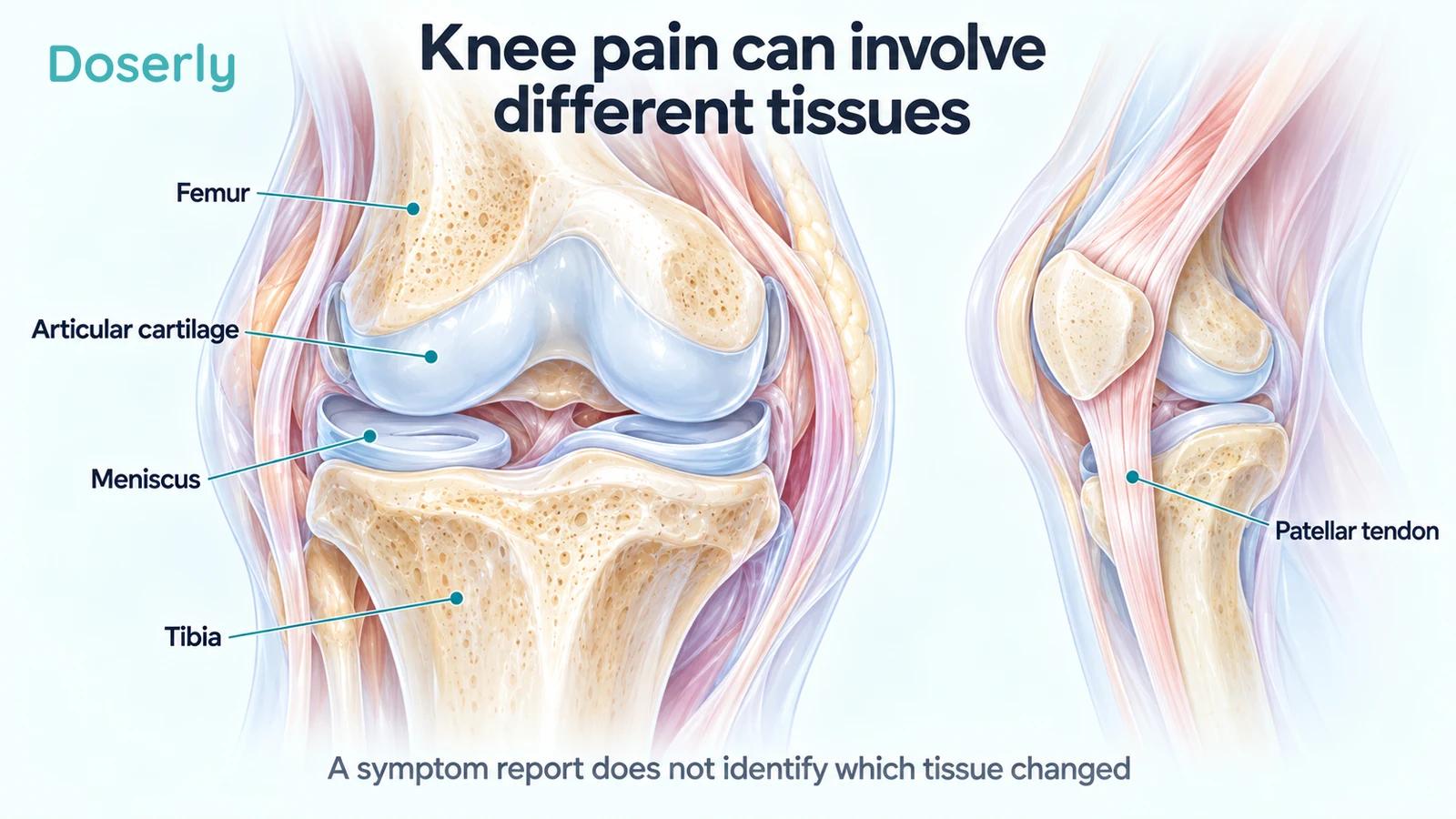
“Knee pain” describes a symptom in a region containing several different tissues. Articular cartilage covers the ends of the bones. Menisci help distribute load within the joint. Tendons connect muscle to bone, while ligaments stabilize the joint. The joint lining, underlying bone and surrounding tissues also contribute to knee health.
Osteoarthritis itself involves more than the loss of a smooth cartilage surface. The National Institute of Arthritis and Musculoskeletal and Skin Diseases describes changes across joint tissues, including bone and the joint lining. A painful knee therefore cannot be treated as a direct readout of how much cartilage remains. NIAMS overview of osteoarthritis
The same symptom can also occur in people with different diagnoses, injury histories and activity demands. A person recovering from a recent injury and someone with years of osteoarthritis may both say that stairs hurt, while having quite different reasons for that difficulty. A study combining several kinds of knee pain needs enough diagnostic detail to show which patients might have benefited.
This matters for interpreting a treatment response. A reduction in symptoms does not identify the tissue that changed, explain the mechanism of that change or establish that the original structural problem has resolved. Those questions require their own assessment.
What the knee report actually did
The study was a retrospective chart review covering patients seen in 2019–2020 at a private medical practice in Florida. The researchers identified 17 patients who had received injections for different types of knee pain. They reached 16 by telephone; one person could not be contacted.
Of the people reached, 12 had received BPC-157 alone. Eleven reported significant improvement in knee pain. Another four had received BPC-157 with thymosin beta-4, and three reported improvement. Across these two different treatment groups, that made 14 of 16 respondents reporting improvement. The combination group should not be presented as additional evidence about BPC-157 alone. Study population and findings
Those counts explain the frequently repeated percentages: about 92% in the BPC-157-only group and 88% when both groups are combined. In samples this small, counts are usually more informative than a polished-looking percentage. One person's answer changes the estimate appreciably.
The word “significant” also needs care. In this report, patients described improvement in their pain; the abstract does not establish a statistically significant treatment effect against a randomized comparison group. It would be misleading to turn that wording into a claim of proven superiority over placebo or usual care.
Most injections had occurred six months to a year before the telephone survey, with differing follow-up intervals. The authors reported that they had not used specific tools to measure function, quality of life, stiffness or activities of daily living. A later recollection of pain relief can provide a useful observation, but it is different from repeated, prespecified measurements collected in a controlled trial.
Why the percentages are not a treatment success rate
A result such as 11 of 12 is easy to read as a forecast: most people who receive this treatment will improve. The study design does not support that prediction.
The participants were people who had already received a treatment at one clinic. They were not randomly allocated to BPC-157 or a comparison treatment. There was no concurrent control group showing what would have happened over the same period with rehabilitation, usual care, another injection or no injection.
Without that comparison, several explanations remain open. Symptoms can fluctuate. People often seek an intervention when pain is particularly troublesome, and some improvement can follow as an unusually bad period settles. Changes in activity, other care and expectations can also affect a person's experience. These are possible explanations that the design could not separate; they are not a claim that any particular patient's improvement was imaginary.
Retrospective contact adds another limitation. People are recalling earlier symptoms and changes rather than completing the same assessment at a common schedule. The one unreachable patient also illustrates that the result applies to respondents, with that person's outcome unknown. In a group of 17, even a single missing result deserves to remain visible.
The useful conclusion is that this clinic observed a pattern worth testing. Establishing how much improvement BPC-157 itself caused would require a study built to distinguish the intervention from those other influences.
Pain relief and repair need different measurements
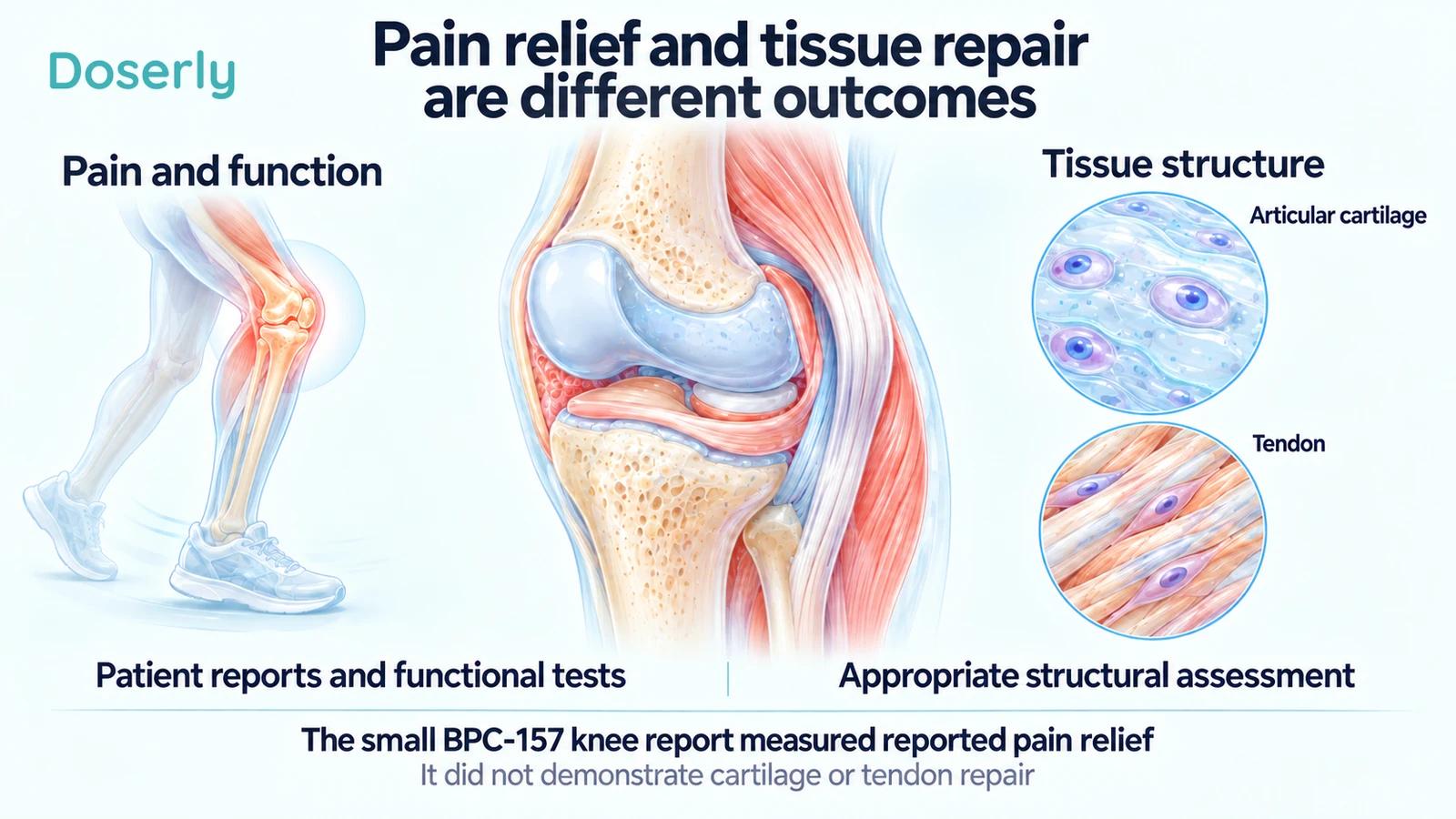
A symptom outcome asks how a person feels. A functional outcome asks what they can do. A structural outcome asks what has changed in the tissue. These can be related without being interchangeable.
For example, a person might report less pain yet still have the same structural abnormality on imaging. Someone else might have a measurable tissue change without a meaningful improvement in walking or daily life. A convincing treatment program should explain which outcomes changed and whether the changes mattered to patients.
The knee report did not provide serial structural evidence demonstrating cartilage regrowth, meniscus healing or tendon repair. Its authors proposed future research that could examine joint tissue with MRI. A proposal to measure repair in a later study is not evidence that repair occurred in the existing one. Original report and proposed future work
That does not mean everyone with knee pain needs an MRI. NICE recommends clinical diagnosis in typical osteoarthritis and advises against routinely using imaging to guide nonsurgical management. Routine patient care and a research claim of tissue regeneration have different requirements. If a study claims to rebuild a particular tissue, it needs an appropriate way to establish that tissue outcome. NICE osteoarthritis recommendations
What the animal experiments add—and what they do not
BPC-157 has been studied in animal injury models, which helps explain why repair claims circulate. In one original experiment, researchers surgically transected rat Achilles tendons and examined functional, mechanical and microscopic outcomes after treatment. The study reported improved healing measures compared with control treatment. Original rat Achilles tendon study
That is a more direct investigation of tissue healing than a telephone report of knee pain. It is also a different experiment: a specified injury in rats, a controlled setting and outcomes measured in tendon. It does not establish that injections restore human knee cartilage or explain the improvement reported by the clinic's patients.
The distinction is biological as well as methodological. Tendon and articular cartilage have different structures and roles. An experimentally cut Achilles tendon is not equivalent to a mixed group of chronic knee complaints. Evidence should travel with the species, tissue, injury and route that produced it.
Animal findings can justify a carefully designed human trial. They cannot supply the missing control group or structural measurements for a human report. Combining the two kinds of evidence into one persuasive narrative does not make the gaps disappear.
Safety is a separate question from whether pain improved
A report of improvement is not a demonstration that a treatment is acceptably safe. Small observational reports have limited ability to detect uncommon problems, distinguish treatment-related events from background illness or describe delayed effects.
The later intravenous BPC-157 pilot illustrates a different limitation. It followed just two people, both previously exposed to intravenous BPC-157, with short-term laboratory and vital-sign assessments. Its reassuring observations cannot establish the safety of injecting a product into a knee, or the safety of repeated treatment in a broader population. Two-person intravenous pilot
Product identity matters too. A study using a named peptide does not establish the identity, purity or sterility of every product sold under that name. FDA's 2026 BPC-157 briefing discusses limited human evidence and potential immunogenicity concerns involving peptide aggregation and impurities. These concerns are uncertainties to investigate, not a measured rate of harm from the knee report. FDA scientific review
The available evidence therefore leaves two important questions unresolved: whether a defined BPC-157 product improves a defined knee condition beyond an appropriate comparator, and whether its benefits outweigh its risks in that setting. A positive answer to one cannot be assumed from the other.
What a more informative knee study would need
A useful next trial would begin with a defined diagnosis. People with knee osteoarthritis, a specific tendon injury and a meniscal problem should not automatically be treated as a single population. The question should identify the condition, the product being tested and the comparison treatment.
Random allocation and blinding where feasible would help separate treatment effects from expectations and differences between groups. Repeated pain and function assessments would show whether improvement persisted and whether patients could do more of what mattered to them. Other treatment and rehabilitation would need to be recorded so that their contributions were visible.
If tissue repair were a stated objective, the study would need a prespecified structural outcome appropriate to that tissue. It would also need follow-up long enough to make the result interpretable. A change in an image should be connected to patient benefit rather than treated as sufficient on its own.
Safety reporting should include everyone exposed, what problems were sought, what occurred and how long participants were observed. A larger study would still have limits, but it could provide a much clearer account than retrospective reports from a small clinic group.
A useful way to discuss the evidence
When a treatment is described as “healing the knee,” three practical questions help: Which diagnosis was studied? Which outcome improved? What showed that the tissue itself changed? These questions make room for meaningful symptom relief without granting an unsupported regeneration claim.
For established osteoarthritis care, NICE recommends tailored therapeutic exercise and, when appropriate, support with weight management. The relevant care plan depends on the person's diagnosis and circumstances. An experimental injection report should not displace a proper assessment of why the knee hurts or how function can be supported. NICE management guidance
The BPC-157 knee report remains an observation of reported pain improvement in a small, uncontrolled group. It offers a reason for better research. It does not show that BPC-157 rebuilds a human knee, and it does not tell an individual patient how likely they are to benefit.
Sources
- Intra-Articular Injection of BPC 157 for Multiple Types of Knee Pain
- Osteoarthritis
- Osteoarthritis in over 16s: recommendations
- Gastric pentadecapeptide BPC157 accelerates healing of transected rat Achilles tendon
- Safety of Intravenous Infusion of BPC157 in Humans: A Pilot Study
- FDA briefing: BPC-157-related bulk drug substances