
Supplements
October 16, 2026
The COSMOS multivitamin result: what a slower aging clock means
On this page
A multivitamin supplies a mixture of nutrients involved in normal metabolism, blood-cell production and other everyday functions. Whether that mixture also slows the processes associated with aging is a much larger question. In March 2026, a COSMOS analysis brought it into focus by reporting small changes in two blood-based aging measures among older adults taking a daily multivitamin.
The result is interesting because the treatment was randomly assigned. It is more informative than simply observing that supplement users tend to have different health habits. But a difference in an aging-clock estimate is not a measurement of extra years alive. Understanding what researchers measured helps explain both the promise and the limits of the finding. COSMOS epigenetic-clock study.
For someone already taking a multivitamin, the practical question is whether this changes its purpose. Does it support filling a nutritional gap, justify a more expensive formula, or establish a longevity treatment? Those questions need different evidence. Our men's multivitamin guide explains formulation differences and nutrient considerations alongside the broader trial literature.
What an epigenetic clock measures
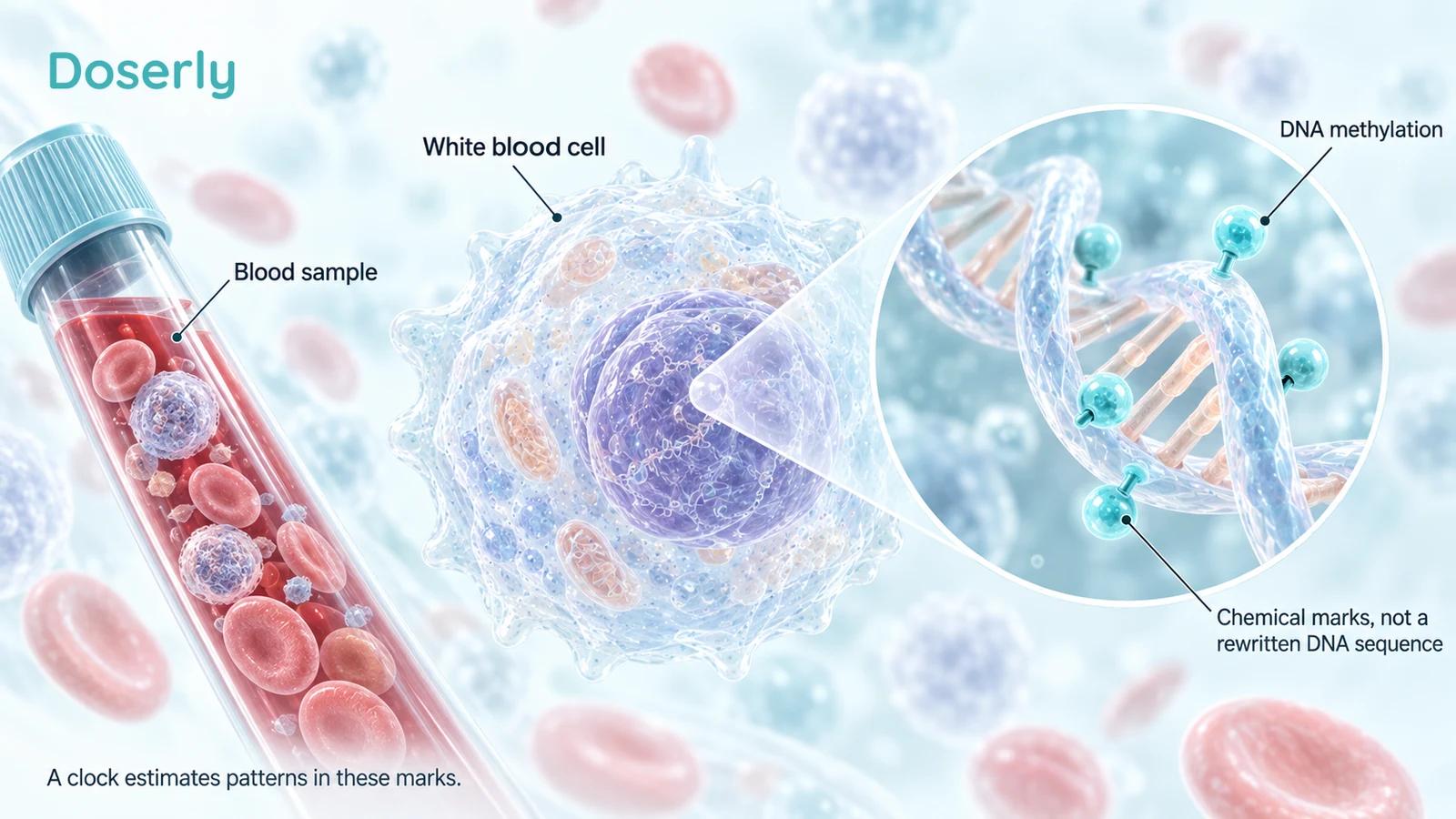
DNA contains the sequence of instructions a cell uses. Chemical marks on DNA help regulate how those instructions are used without rewriting the underlying sequence. One type of mark is DNA methylation. Researchers measure methylation at many sites and use mathematical models to summarize patterns associated with aging.
The model matters. Some clocks were developed to estimate chronological age. Others were trained using health-related measurements or mortality risk. DunedinPACE, for example, was developed from repeated measurements of organ-system change over two decades in a birth cohort. It estimates a pace of biological change rather than giving the same kind of age estimate as every other clock. DunedinPACE development study.
That means “the aging clock” is not one universal instrument. Two models can examine the same sample and answer somewhat different questions. Agreement across models may strengthen an observation, but disagreement is not automatically proof that the laboratory made a mistake. It can reflect differences in what the models were built to capture.
What the 2026 analysis found
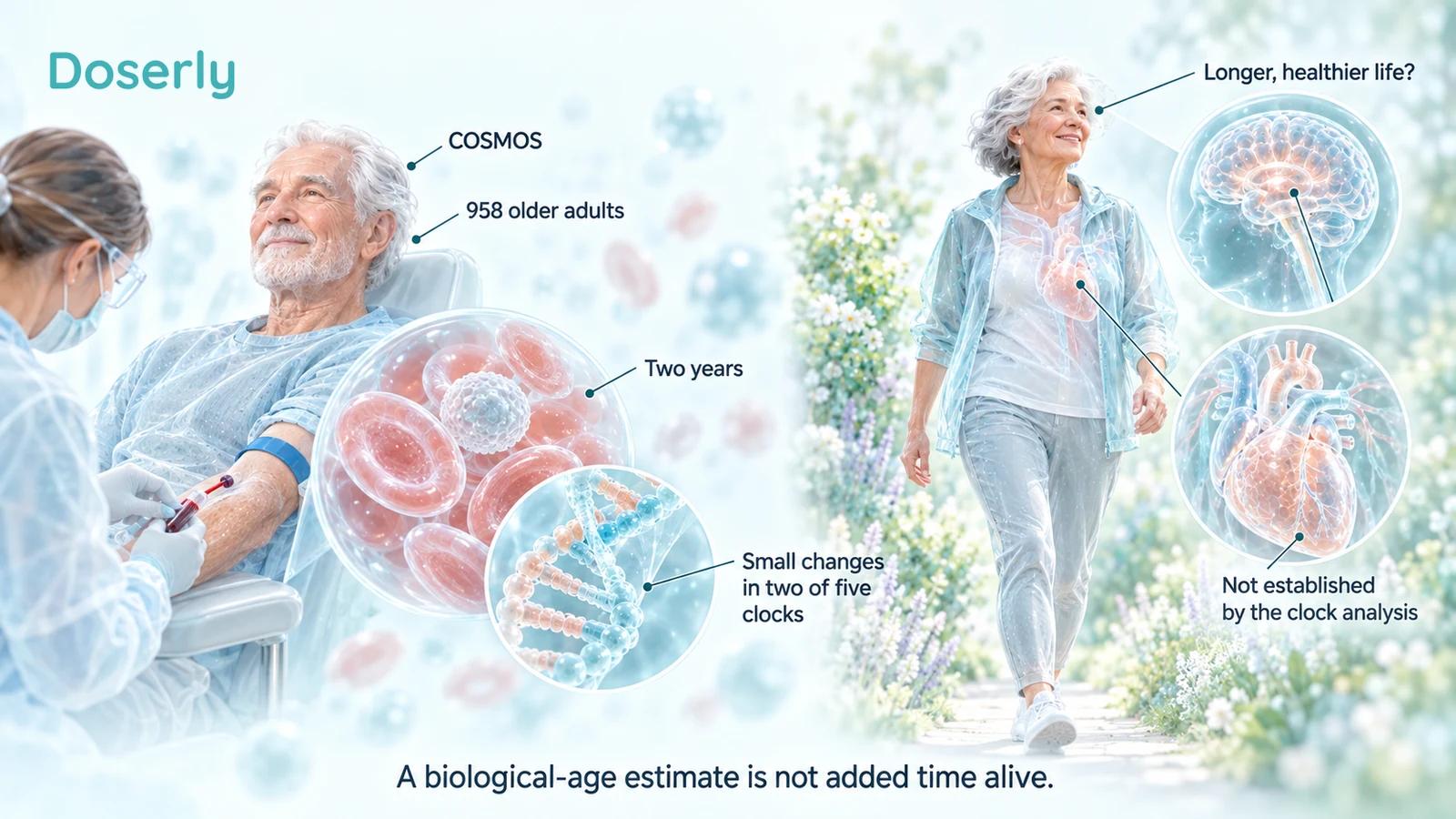
This prespecified ancillary analysis included 958 COSMOS participants, 482 women and 476 men, followed for two years. It compared a daily multivitamin–multimineral product, Centrum Silver, with placebo and separately assessed cocoa extract. Five methylation measures were tested. Multivitamin assignment produced smaller yearly increases in PCGrimAge by 0.113 years (95% CI 0.020–0.205 fewer) and PCPhenoAge by 0.214 years (0.019–0.410 fewer). Cocoa extract did not affect the five clocks. Primary clock report.
The names are technical, but the essential point is straightforward: the estimates changed modestly on two measures. The study did not find a uniform effect across all five. Its authors describe the clinical relevance as unresolved. This is a finding about the performance of specific biomarkers under a particular intervention.
The published differences are yearly changes on the models' scales. Multiplying 0.113 or 0.214 by 12 converts the units to approximately 1.4 or 2.6 clock-months per year. That arithmetic can make the size easier to visualize; it does not turn the result into months added to life. Adding the two values together would be inappropriate because they describe different estimates, not separate quantities of time saved.
Why the main COSMOS trial matters
The parent trial enrolled 21,442 US adults, with women aged at least 65 and men at least 60. Its multivitamin comparison followed participants for a median of 3.6 years. Invasive cancer occurred in 518 multivitamin participants and 535 placebo participants, giving a hazard ratio of 0.97 (95% CI 0.86–1.09). It did not show significant reductions in total cardiovascular disease or all-cause mortality either. COSMOS cancer and cardiovascular report.
A hazard ratio compares event rates over time. A value near 1 indicates little difference, while the confidence interval describes uncertainty around the estimate. Here, the cancer interval includes 1, so the result did not establish a reduction in the main cancer outcome.
These clinical findings do not make the clock analysis useless. The studies address different questions and use different follow-up periods and participant sets. But the biomarker finding should not replace the clinical findings when the claim is that a multivitamin prevents disease or extends life. The larger trial directly counted those events.
An ancillary study is an additional investigation within a broader research program. It may use stored samples or more intensive testing in a subset. The 958-person clock analysis was therefore not a second independent trial in another 21,442 people. Keeping the samples distinct avoids making the evidence sound larger than it is.
What about the reports of better memory?
COSMOS also generated cognitive studies using different assessment methods. A 2024 report combined 5,203 nonoverlapping participants from three cognitive substudies. It found a small benefit for global cognition, a mean difference of 0.07 standardized units (95% CI 0.03–0.11), and a benefit for episodic memory. The authors compared the global-cognition difference with approximately two years of cognitive aging. COSMOS cognitive analysis.
A standardized unit expresses a difference relative to the spread of scores in the study. It is not a percentage improvement and cannot be translated into “7% better memory.” Likewise, the comparison with years of cognitive aging is an interpretation of test-score differences. It does not mean participants regained two calendar years or that every person's memory improved by the same amount.
A separate COSMOS-Mind analysis counted new mild cognitive impairment and probable dementia. Over three years there were 110 incident cases of mild cognitive impairment and 14 of dementia, with no significant difference by supplement assignment; statistical power was limited. COSMOS-Mind clinical diagnoses.
These results fit together without requiring one to cancel another. A treatment could produce a small average difference on repeated tests while a study remains unable to establish a difference in less frequent diagnoses. The useful claim is the one each analysis actually supports. The cognitive findings also do not demonstrate that changes in methylation caused the cognitive effect.
Does a clock change identify the nutrient responsible?
A multivitamin is a combination. Testing it against placebo evaluates that combination at the amounts supplied. It does not isolate vitamin D, vitamin B12, zinc or another ingredient as the cause of an observed difference. Identifying a particular nutrient would require suitable comparisons or additional research.
The same limitation applies to product substitutions. “Multivitamin” is not a standardized formula; products differ in ingredients, quantities and intended users. NIH notes that these products can help people reach recommended nutrient intakes, but they cannot replace the variety of components supplied by food. NIH multivitamin fact sheet.
A formula with larger numbers on its label is not therefore a stronger version of the COSMOS intervention. Increasing several nutrients changes the exposure being evaluated. It may also change tolerability and the chance of exceeding appropriate intake limits when combined with fortified foods or other supplements.
This is especially relevant if a person already takes individual nutrients. Before adding a multivitamin, it is useful to look at the total intake from all products. The clock study offers no reason to double up on formulas or combine several products marketed for longevity.
Why personal clock testing does not reproduce the trial
A randomized trial estimates an average difference between groups. A before-and-after test in one person is a different exercise. Without a comparable untreated group, it is difficult to separate a product effect from ordinary variation, other changes or characteristics of the measurement itself.
There is also a distinction between predicting risk and showing that changing a predictor changes risk. A marker may help identify people with different future outcomes without being a validated treatment target. To make that stronger claim, researchers need evidence that intervention-driven changes reliably track meaningful clinical improvements.
Imagine that a commercial report shows a lower estimated biological age after you begin a multivitamin. It would be reasonable to record the result and ask how reproducible it is. It would not be reasonable to conclude that you have earned a fixed number of extra months or that a medical problem no longer needs care. The COSMOS analysis did not validate that personal decision rule.
How this changes a supplement decision
For a person with a dietary gap, the clearest initial question remains nutritional: what is missing, why, and what is the appropriate way to address it? A broad formula may be convenient in some situations, while a specific deficiency may call for a more targeted clinical plan. An aging-clock headline cannot identify that need on its own.
People taking medications should also check the actual ingredients. NIH highlights, for example, the relevance of vitamin K in multivitamins for people using warfarin. Other concerns depend on the person's diet, conditions and concurrent products. NIH formulation and safety considerations.
A useful conversation can start with three concrete points: the reason for taking the supplement, the exact label and the outcome you hope to improve. If the goal is memory, discuss the cognitive results and their modest average size. If the goal is disease prevention, look at the event-based trials. If the goal is correcting low intake, assess the diet and relevant clinical context.
The 2026 COSMOS finding adds a measurable biological signal to the multivitamin literature. It is a reason to investigate how nutrient combinations relate to aging biology and whether those changes have lasting consequences. It does not establish a lifespan benefit, identify an optimal longevity formula or make a personal clock score the best guide to care.
Explore the research
- Effects of daily multivitamin–multimineral and cocoa extract supplementation on epigenetic aging clocks in COSMOS (2026).
- DunedinPACE, a DNA methylation biomarker of the pace of aging (2022).
- Multivitamins in the prevention of cancer and cardiovascular disease: COSMOS (2022).
- COSMOS clinic cognitive study and meta-analysis of three substudies (2024).
- COSMOS-Mind: incident mild cognitive impairment and dementia (2023).
- NIH: Multivitamin/mineral Supplements.