
TRT
October 19, 2026
Testosterone injection calculator guide: TRT doses, concentrations and syringes
On this page
A testosterone prescription can contain three different numbers: the dose in milligrams, the concentration in milligrams per milliliter, and the volume to draw into a syringe. They describe different things. Confusing them is how a familiar-looking vial or an unchanged syringe mark can turn into the wrong amount.
The essential calculation is volume in mL = prescribed dose in mg ÷ concentration in mg/mL. For example, 50 mg from a 200 mg/mL vial occupies 0.25 mL. The same 50 mg from a 100 mg/mL vial occupies 0.50 mL. The dose is identical; the volume is different.
This guide explains that math, how it relates to different testosterone products, and how to interpret syringe capacity, markings, needle gauge and length. The numbers are educational examples, not suggested TRT regimens. Your prescriber determines the dose, route, formulation and schedule; the calculation translates those instructions into a volume.

If you already have those prescription details, open the Doserly TRT dose calculator. It converts dose and concentration into mL, shows the corresponding U-100 scale when selected, and helps check weekly totals and theoretical vial supply.
Read the label before doing the calculation
Milligrams (mg) describe the amount of medication. Milliliters (mL) describe the liquid volume. Milligrams per milliliter (mg/mL) describe how much medication is in each milliliter. A vial volume, such as 10 mL, describes the container's labeled contents, not the dose for one injection.
For a hypothetical vial labeled 200 mg/mL with 10 mL of solution, the total labeled drug content is 2,000 mg. That does not mean the vial contains ten injections. The theoretical number depends on the prescribed amount per injection, and the usable supply also depends on product instructions, discard dates and practical losses.
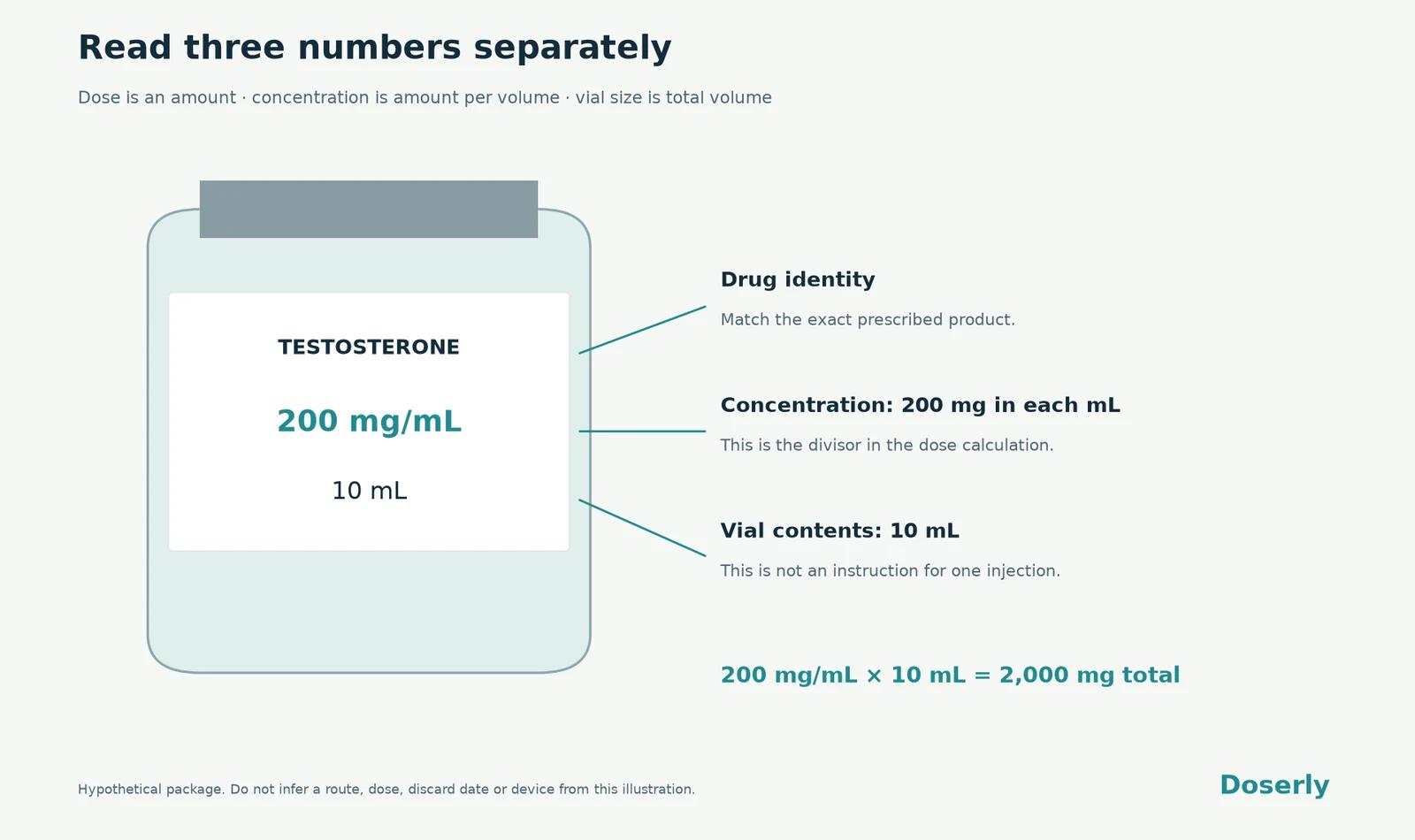
Always read the new package when a prescription is refilled. A change from 100 mg/mL to 200 mg/mL doubles the amount in the same volume. Keeping an old 0.50 mL draw would change the amount from 50 mg to 100 mg. Checking the label is therefore part of the calculation, even if the drug name looks unchanged.
Also distinguish a medication dose from a blood-test result. Serum testosterone reported in ng/dL or nmol/L is a concentration measured in blood, not an instruction to inject that number of milligrams. There is no direct syringe conversion from a blood level. Clinical assessment and monitoring determine how a regimen should be managed. Endocrine Society testosterone guideline.
Testosterone types: the same arithmetic does not make products interchangeable
Testosterone products differ in ester, formulation, device, route and instructions. Concentration is one characteristic; it does not describe the whole medicine. The examples below are verified product-label examples, not a complete list of strengths available in every country.
Product example
Cypionate
- Labeled strength
- DEPO-Testosterone: 100 or 200 mg/mL
- What needs attention
- The label specifies intramuscular administration.
Product example
Enanthate vial
- Labeled strength
- One US product: 200 mg/mL
- What needs attention
- Read the actual vial and route instructions.
Product example
Enanthate device
- Labeled strength
- XYOSTED: 50, 75 or 100 mg in 0.5 mL
- What needs attention
- A fixed-dose, single-use subcutaneous autoinjector.
Product example
Undecanoate
- Labeled strength
- AVEED: 750 mg in 3 mL
- What needs attention
- A clinician-administered product with special observation requirements.
Product example
Mixed esters
- Labeled strength
- Sustanon 250: 250 mg of esters per mL
- What needs attention
- A specific four-ester formulation with its own instructions.
Sources: DEPO-Testosterone label, testosterone enanthate vial label, XYOSTED label, AVEED label, Sustanon 250 product information.
Cypionate and enanthate
These names identify different testosterone esters. For a prescribed dose expressed on the same basis as the product label, the mg-to-mL calculation uses the labeled concentration. Do not apply an internet “ester correction” to a prescription independently. If the prescription and package appear to express strength differently, have the pharmacist reconcile them.
Enanthate also illustrates why the delivery system matters. XYOSTED's three strengths all occupy 0.5 mL. Dividing their labeled amounts by 0.5 mL gives different concentrations, but that mathematical fact is not an instruction to open the device or draw a partial dose. Its instructions specify a single-use autoinjector. XYOSTED prescribing information.
Undecanoate, propionate and mixed esters
A long-acting product should not be converted into a homemade weekly injection schedule simply because a calculator can divide its total milligrams. AVEED's label includes administration and post-injection observation requirements related to pulmonary oil microembolism and anaphylaxis. Its 750 mg/3 mL presentation equals 250 mg/mL arithmetically, but it remains a specific supervised treatment. AVEED prescribing information.
Sustanon 250 contains propionate, phenylpropionate, isocaproate and decanoate esters. Its product information distinguishes the 250 mg ester total from the corresponding testosterone amount. This is a reason to preserve the prescription's terminology, not to recalculate it without clinical direction. For standalone propionate or any other presentation, use its actual local label; the ester name alone does not establish a universal concentration. Sustanon product information.
Gels, oral products, patches and implants are also outside a vial-to-syringe conversion. Matching milligram numbers across routes does not establish equivalent treatment.
How to calculate testosterone injection volume
Use these three steps for a clinician-prescribed vial dose:
- Identify the amount for one injection, in mg.
- Read the current vial's concentration, in mg/mL.
- Divide the dose by the concentration to obtain mL.
For an illustrative 50 mg injection from 200 mg/mL solution:
50 mg ÷ 200 mg/mL = 0.25 mL.
The units help check the calculation: dividing mg by mg per mL leaves mL. You can reverse the calculation to verify it: 0.25 mL × 200 mg/mL = 50 mg.
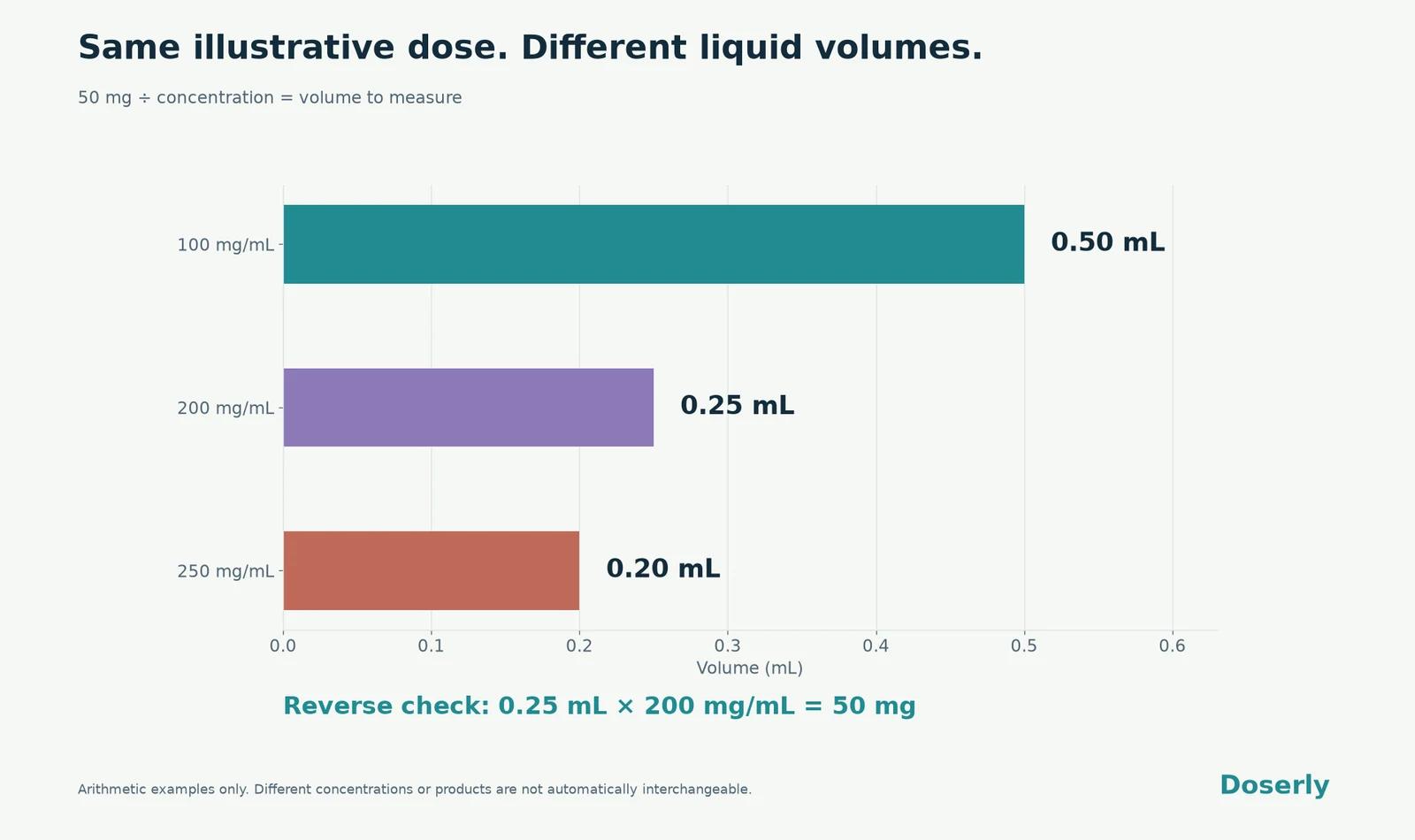
Concentration
100 mg/mL
- Volume for 50 mg
- 0.50 mL
- Reverse check
- 0.50 × 100 = 50 mg
Concentration
200 mg/mL
- Volume for 50 mg
- 0.25 mL
- Reverse check
- 0.25 × 200 = 50 mg
Concentration
250 mg/mL
- Volume for 50 mg
- 0.20 mL
- Reverse check
- 0.20 × 250 = 50 mg
The table deliberately keeps the example amount constant. A higher concentration reduces the volume needed for that amount; it does not mean that an unchanged volume delivers an unchanged dose.
A second example is 80 mg from a 200 mg/mL vial: 80 ÷ 200 = 0.40 mL. At 100 mg/mL, that same amount would require 0.80 mL. Writing the units alongside the numbers makes it harder to accidentally carry an old volume into a new concentration.
The testosterone injection calculator performs these conversions and makes the result easier to compare with a selected syringe. A result still needs to match the prescription, label and actual measuring device.
Weekly total versus dose per injection
“100 mg per week” and “100 mg per injection” are not interchangeable instructions. A calculator needs to know which one you are entering. If the prescription is unclear, the pharmacy should resolve it before you use the result.
For an illustrative prescription that explicitly specifies 100 mg per week divided into two equal injections, each injection contains 50 mg. At 200 mg/mL, each volume is 0.25 mL. The weekly sum is 0.50 mL and 100 mg. Entering 100 mg as each of two injections would instead produce 200 mg per week.
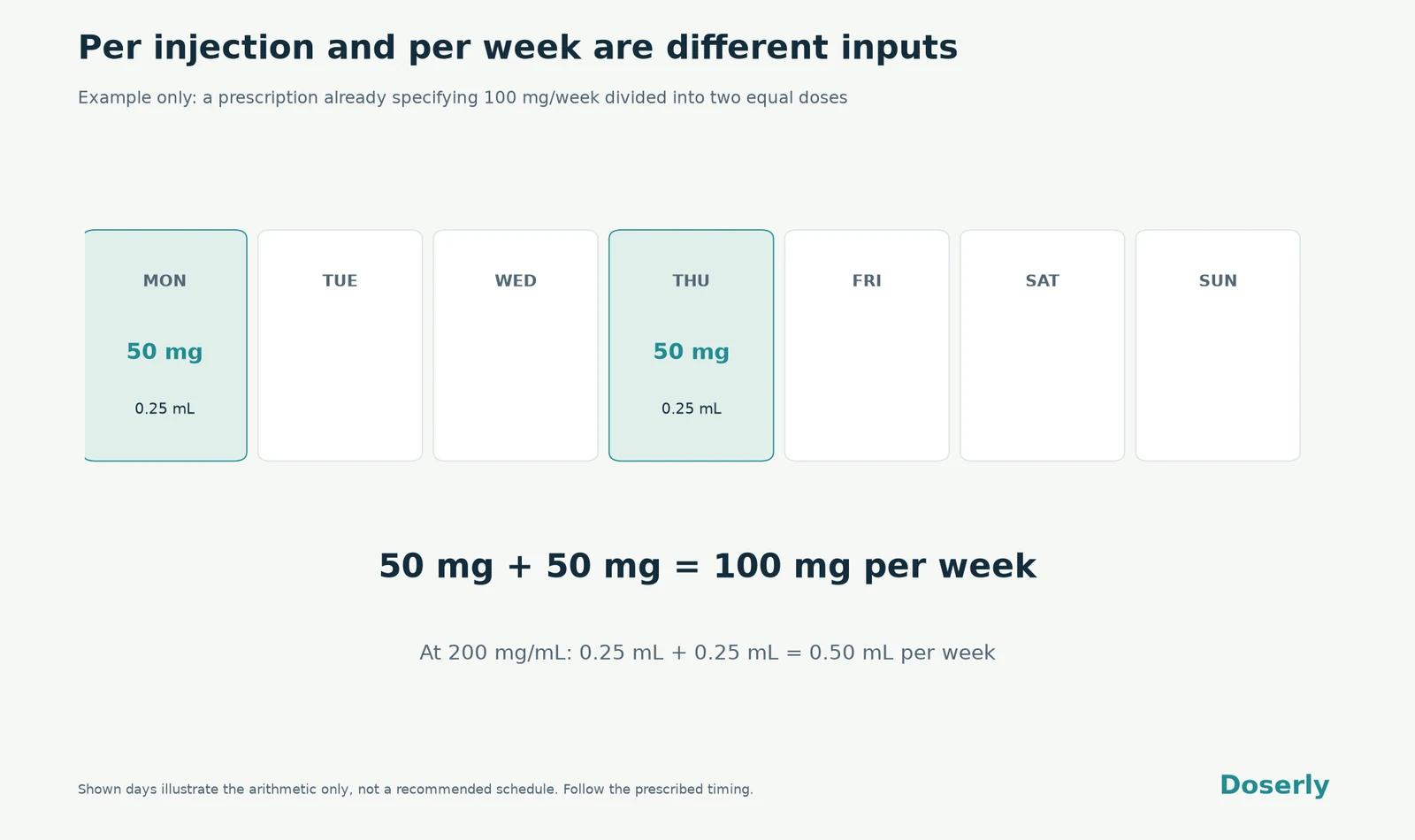
For equal doses on a fixed weekly schedule:
Weekly amount = amount per injection × injections per week.
Amount per injection = prescribed weekly amount ÷ injections per week.
Intervals measured in days need a different interpretation. Every other day averages 3.5 injections per week over time, rather than exactly three or four every calendar week. A 40 mg example every other day averages 140 mg per week. Individual weeks can contain different counts, so the average is a comparison tool, not a replacement for the actual calendar.
Similarly, every three days averages 7 ÷ 3 injections per week; it does not mean three injections per week. Every two weeks averages half an injection per week. Keep the interval attached to the amount whenever you record or discuss a regimen.
These calculations do not establish that two schedules have identical clinical effects. They only make the arithmetic comparable. Do not divide a fixed-dose device, change a long-acting product's interval, or alter a prescribed regimen because the weekly totals happen to match.
Understanding U-100 syringe markings
A U-100 insulin scale is calibrated so that 100 marked units correspond to 1 mL. When a clinician has selected that device for a medication measured by volume, the marks can be translated into mL. They do not become biological “units of testosterone.”
The volume conversion is:
U-100 scale reading = volume in mL × 100.
Thus 0.25 mL corresponds to the 25 mark, 0.40 mL to the 40 mark, and 0.50 mL to the 50 mark. At 200 mg/mL, 0.40 mL contains 80 mg. At 100 mg/mL, the same 40 mark contains 40 mg. Concentration still determines the medication amount.
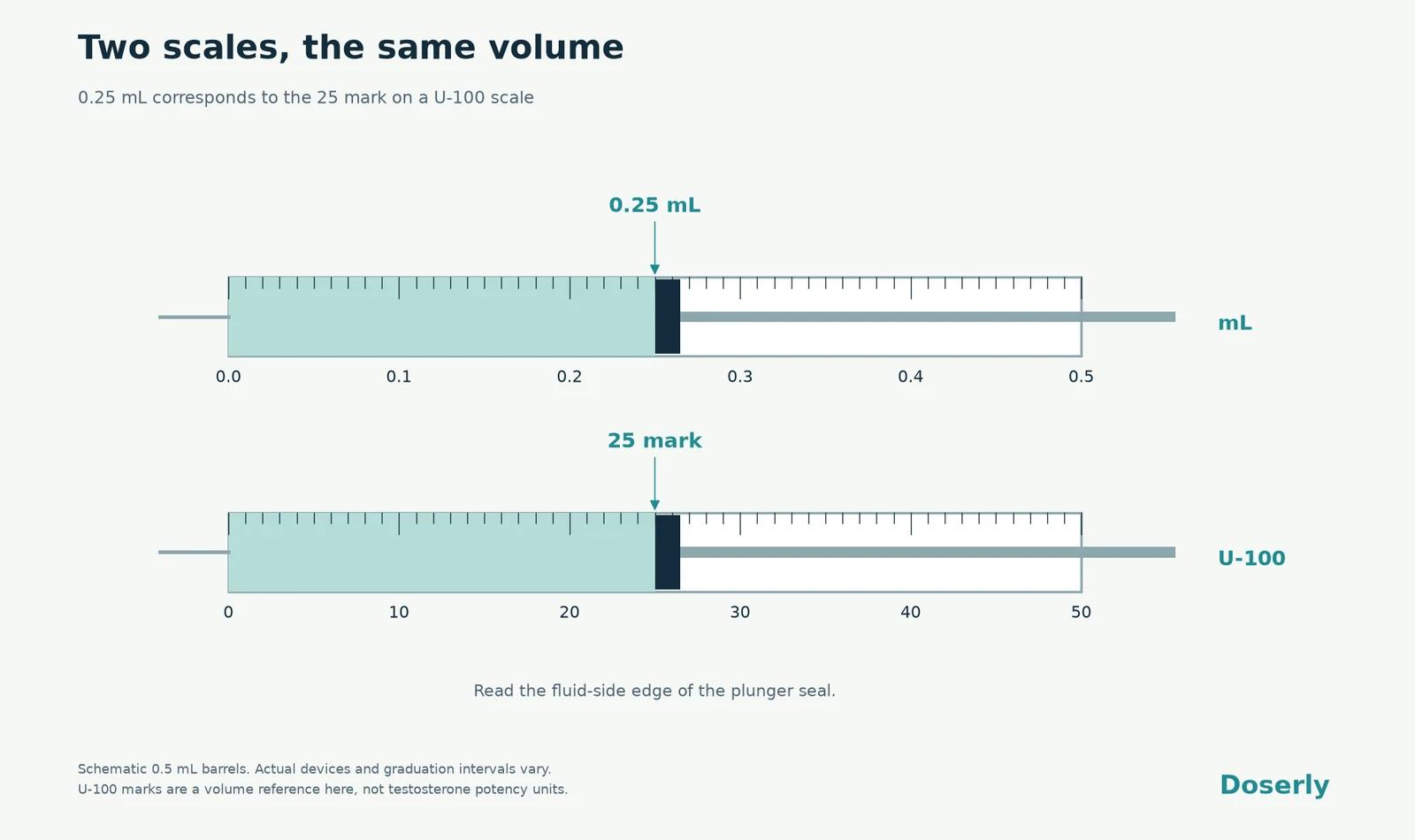
Do not apply this conversion to a U-40 syringe or another calibration. Also distinguish capacity from graduation size. A 0.3 mL U-100 syringe holds up to 30 marked units; a 0.5 mL holds 50; a 1 mL holds 100. Individual products can have different smallest increments, including half-unit scales on some smaller syringes. Read the actual barrel and packaging. BD insulin-syringe product catalog.
If you use a syringe marked directly in mL, read the mL result directly. A 1 mL tuberculin-style scale and a 1 mL U-100 scale can cover the same total volume while presenting different numbers. Copying a number without its unit is the error to avoid.
Choose a measurable volume, not just a large-enough syringe
A syringe must hold the prescribed volume, but capacity is only the first question. The graduation interval determines what can be read on its scale. A smaller appropriately graduated syringe can make a small volume easier to measure than a much larger barrel.
For example, BD's catalog lists certain 1 mL syringes with 0.01 mL graduations and certain 3 mL syringes with 0.1 mL graduations. Those are product examples, not a rule for every syringe of those capacities. BD hypodermic syringe catalog.
At 200 mg/mL, a 0.01 mL interval represents 2 mg, whereas a 0.1 mL interval represents 20 mg. That arithmetic shows why graduation size matters. It does not establish that every user can measure to a device's smallest line with identical accuracy.
If a calculated volume falls between markings, ask the pharmacist which device and measurement approach to use. Do not silently round the result or estimate an extra amount to compensate for liquid remaining in the equipment. Device dead space and administration technique require product-appropriate instruction.
Read the scale using the reference edge specified for the syringe. In many conventional syringes, this is the leading edge of the plunger seal nearest the needle. The diagram above marks that fluid-side boundary so the illustrated volume does not depend on the back edge of the stopper.
Needle gauges and lengths: two separate measurements
The gauge describes needle diameter. Within the usual hypodermic numbering system, a higher gauge number means a thinner needle: 25G is thinner than 18G. Length describes how far the needle extends, typically in inches or millimeters. A 25G needle is not a complete device description without its length and other relevant specifications.
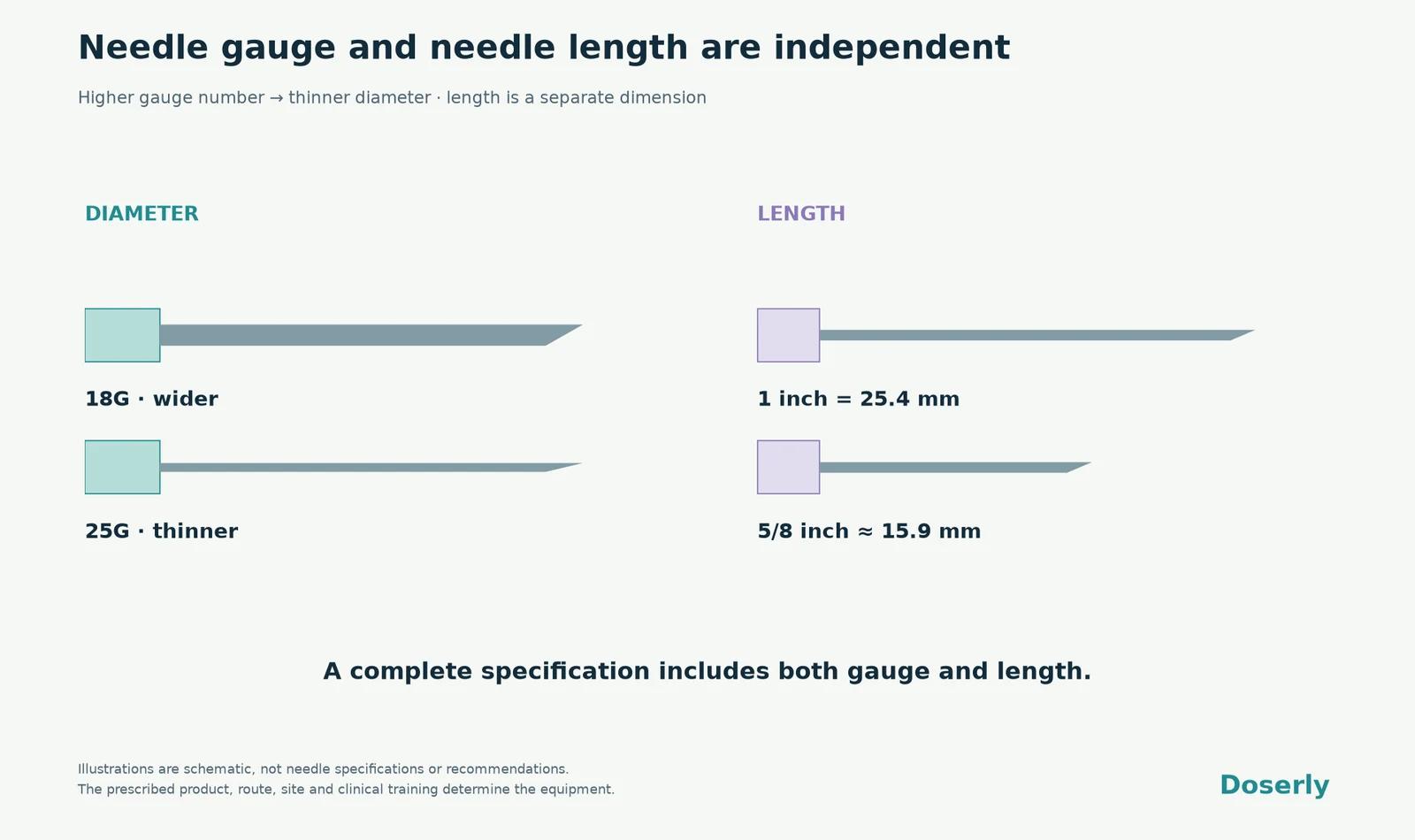
A drawing needle and an administration needle may serve different purposes. Route, injection site, tissue depth, formulation viscosity and the device all affect the choice. A wider needle may allow easier movement of an oil-based solution, but that does not make it the appropriate administration needle. A thinner needle is not automatically suitable for every route or preparation.
Clinical teaching materials illustrate this specificity. A Leeds and York NHS self-injection guide uses separate equipment and instructions for the testosterone preparation it addresses. Its method should be used in the context of the clinical training described, not converted into a universal needle rule for all TRT products. NHS testosterone self-injection guide.
Ask your clinician or pharmacist to specify the syringe capacity, graduation, needle gauge, needle length and route together. If the supplied equipment differs from what you were taught, resolve the mismatch before administration. A calculator's syringe illustration does not authorize a route change or select an injection site.
Vial duration: supply math is not an opened-vial expiry date
A hypothetical 10 mL vial at 200 mg/mL contains 2,000 mg. Dividing that by an illustrative 50 mg per injection gives 40 theoretical injections. At two injections per week, the arithmetic gives 20 weeks of nominal supply.
That calculation is deliberately theoretical. It is not a recommendation to use an opened vial for 20 weeks. It ignores practical losses, differences between nominal and withdrawable contents, and discard instructions. A single-dose container must not be treated as a multidose vial simply because liquid remains.
CDC guidance recommends dating an opened multidose vial and discarding it within 28 days unless the manufacturer specifies another period. The exact product's labeling and pharmacy instructions matter. That time limit and the amount of medication remaining are different questions. CDC injection-safety guidance.
Record the opening date and the applicable discard date separately from estimated remaining volume. If the theoretical supply extends beyond the allowed use period, the dispensing plan needs to account for that; arithmetic cannot extend the product's instructions.
Use the calculator, then keep a record of what actually happened
Start with the prescription and current package. In the TRT dose calculator, identify whether the amount is per injection or per week, select the prescribed frequency, enter the exact concentration and choose the appropriate syringe display. Compare the calculated mL with the actual device and check the weekly total.
Keep an unambiguous record such as “50 mg, 0.25 mL, 200 mg/mL,” together with the date and prescribed schedule. That example communicates much more than “25 units.” If a refill changes concentration, the old record remains understandable and the new calculation has a clear starting point.
The calculator solves the conversion. Doserly helps you follow and review the ongoing TRT routine. The app's tracking tools let you organize scheduled doses and reminders, log dose history, track inventory, record injection sites, and keep protocol changes visible over time.
For follow-up conversations, Doserly also brings symptom trends and lab information into the record. Energy, sleep and mood entries can help describe patterns; blood-test results and biomarker trends can be reviewed alongside dose history and health measurements. Those observations provide context for your clinician. They do not prove that testosterone caused a symptom or automatically determine a new dose.
Download Doserly to track your TRT schedule, injections and trends. Pairing a checked calculation with a consistent history makes it easier to answer practical questions: what was taken, when it was taken, which concentration was used, and what changed before the next follow-up.
Frequently asked testosterone calculation questions
How many mL is 100 mg of testosterone?
It depends on concentration: 1 mL at 100 mg/mL, 0.50 mL at 200 mg/mL, or 0.40 mL at 250 mg/mL. These are conversions, not a recommendation to take 100 mg or to substitute those products.
How many mg are in 0.5 mL?
Multiply by the concentration. At 200 mg/mL, 0.5 mL contains 100 mg. At 100 mg/mL, it contains 50 mg. “Half a milliliter” is a volume, not a complete dose description.
Is 20 units the same as 20 mg?
No. On a U-100 scale, the 20 mark corresponds to 0.20 mL. At 200 mg/mL, that volume contains 40 mg. At 100 mg/mL, it contains 20 mg. Always specify both the scale and the medication concentration.
What syringe or needle should I use for TRT?
Use the equipment selected for your prescribed product, route and volume. Capacity, graduation, gauge and length are different specifications. A device that makes the volume easy to read still needs to be appropriate for administration.
Can a testosterone calculator tell me the right TRT dose?
It can check conversions and totals from a prescribed regimen. It cannot diagnose testosterone deficiency, choose a treatment or interpret all the factors behind a dose change. The Endocrine Society guideline bases diagnosis and treatment on clinical assessment and appropriate laboratory evaluation, with ongoing monitoring. Clinical practice guideline.
Which Doserly tool should I open?
Use the TRT dose calculator for injection amounts, concentration and volume. Use testosterone lab calculators for the separate topic of interpreting calculated testosterone measures from lab inputs, and the TRT guide library for broader education. Use the Doserly app to keep the prescribed routine and its history organized.