
Supplements
October 16, 2026
Tart cherry for recovery: soreness, strength and training adaptation
On this page
Tart cherries contain polyphenols, plant compounds that include the anthocyanins responsible for much of their red color. Researchers have studied cherry juice, concentrates and powders around demanding exercise because these compounds may influence inflammation and oxidative processes involved in the response to exercise.
For an athlete facing another event soon, recovering strength or feeling less sore could be useful. But recovery has several meanings. A lower pain rating, a lower inflammatory marker and a better ability to produce force are not interchangeable. None, by itself, establishes that a person will build more muscle or improve endurance over months of training.
The human studies offer reasons for interest without supporting a universal recovery claim. Some small trials found less pain or faster return of strength. Others found no functional benefit. A 2026 marathon trial is especially instructive: a blood marker improved while soreness and physical performance did not.
What happens after unfamiliar or demanding exercise?
Exercise that places an unusual load on muscle can lead to temporary soreness and reduced force production. Eccentric contractions, where a muscle produces force while lengthening, are often used in experiments because they can reliably provoke these changes. Lowering a weight or controlling a downhill stride involves this type of action.
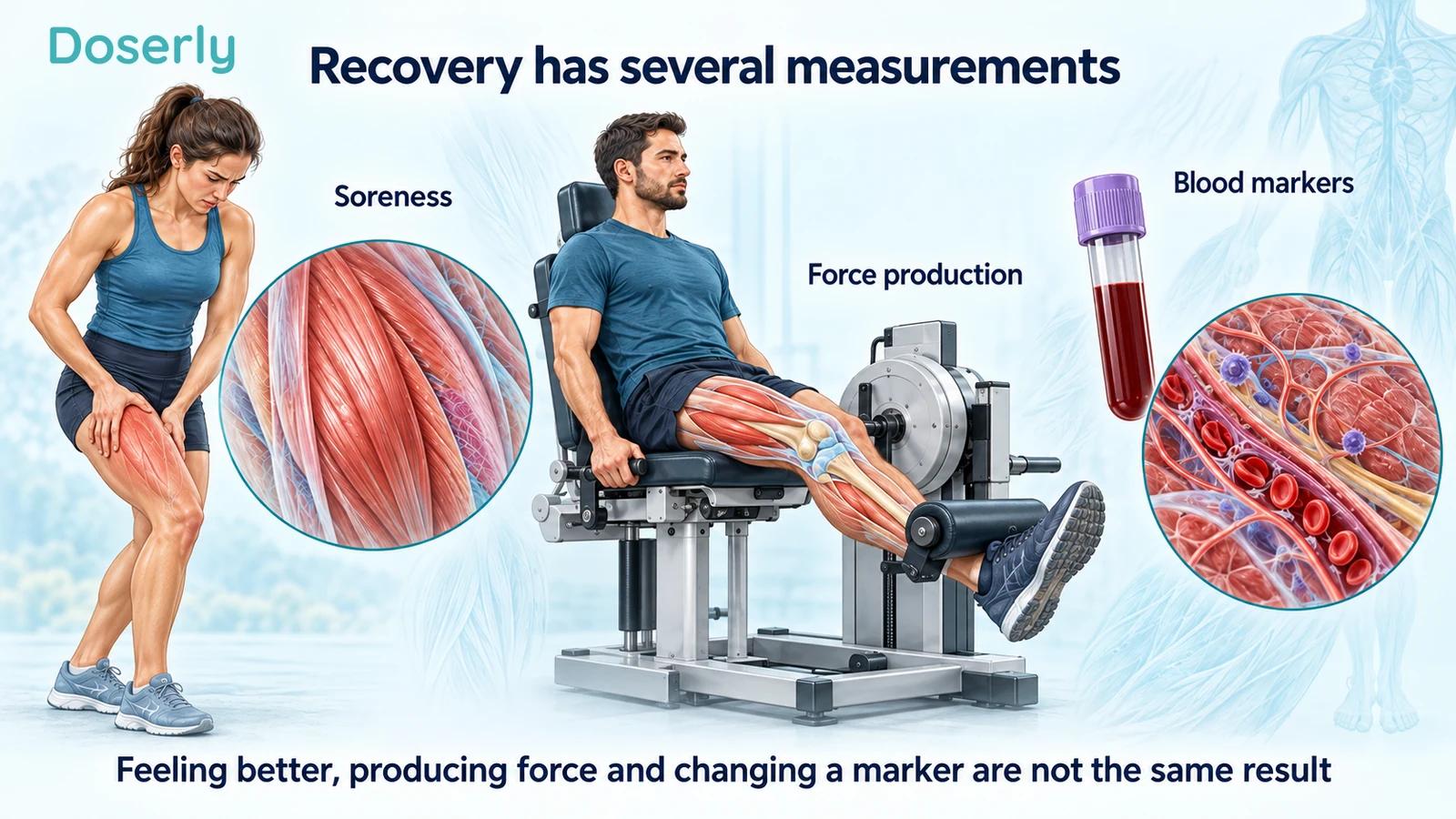
Researchers measure several aspects of recovery. Delayed-onset muscle soreness is the discomfort that develops after exercise. Maximum voluntary contraction measures how much force someone can produce in a standardized effort. Blood markers such as creatine kinase or C-reactive protein provide information about physiological responses, but they aren't direct pictures of repaired muscle.
This matters when a supplement is described as reducing “muscle damage.” The phrase may refer to a blood test, a strength measurement or a symptom score. The outcome needs to be named before deciding what it means for returning to training. The knee-extension experiment illustrates the distinction by measuring force and creatine kinase separately.
An early study found less strength loss and pain
A 2006 crossover trial studied fourteen male college students. They drank a tart-cherry juice blend or placebo for eight days, with a damaging elbow-flexion exercise session on day four. Researchers followed strength, pain, tenderness and relaxed elbow angle for four days afterward. The opposite arm was used during the second trial period to reduce the protective effect of having already completed the exercise.
Average strength loss across the following four days was 22% with placebo and 4% with cherry juice. Pain was also lower, while tenderness and elbow angle did not differ between conditions. Connolly and colleagues.
The effect on strength is more informative than a vague claim of better recovery. Yet it came from a small experiment using a specific juice blend and an unfamiliar, concentrated exercise challenge. It does not tell us how an experienced lifter responds after every ordinary session, and it doesn't show that muscle growth increased over a training block.
Marathon recovery showed a more selective pattern
A 2010 trial enrolled twenty recreational marathon runners. Participants consumed tart-cherry juice or placebo for five days before the race, on race day and for forty-eight hours afterward. The study measured isometric strength, soreness and several blood markers.
Strength recovered faster in the cherry group. Some inflammatory and oxidative-stress measures also favored cherry juice. However, the other muscle-damage indices did not differ significantly, including soreness. Howatson and colleagues, marathon study.
That last detail is easy to lose when this trial is used to support a general “less soreness” claim. It was a positive strength-recovery study with selective biomarker findings, not evidence that every recovery measure improved. For a runner concerned about walking downstairs comfortably, the soreness result matters. For a researcher interested in force restoration, the strength result matters.
The regimen also began before the marathon. It cannot establish that starting a different cherry product after soreness appears produces the same outcome. The timing was part of the tested intervention, even though it doesn't establish the only effective schedule.
Pain reduction has also been tested directly
A separate randomized trial involved fifty-four runners completing a long-distance relay, averaging about 26 kilometres over twenty-four hours. They consumed tart-cherry juice or a placebo drink twice daily for seven days before the event and on race day. Pain was recorded using a 100-millimetre visual analogue scale, on which participants mark how much pain they feel.
Both groups reported more pain after running. The increase averaged 12 millimetres with cherry juice and 37 millimetres with placebo. This was a difference in reported pain, not a measurement of tissue repair, race speed or future training adaptation. Kuehl and colleagues.
Pain is a meaningful outcome. It doesn't become unimportant because it is subjective. The qualification is simply that feeling better should retain its own meaning. A lower pain score cannot confirm that a muscle is ready for an unrestricted workload or that an injury has healed.
What a strength-recovery experiment adds
Ten well-trained men completed a crossover study of intensive single-leg knee extensions after cherry concentrate or an energy-matched fruit concentrate. Supplementation began seven days before exercise and continued through forty-eight hours afterward. At twenty-four hours, maximum voluntary force had recovered to about 91% of baseline with cherry versus 85% with the comparison drink; at forty-eight hours, the values were approximately 93% and 89%.
Creatine kinase rose after exercise but did not differ between treatments. Some oxidative-damage findings depended on the analysis used. Bowtell and colleagues.
The study provides a functional signal, but the participants had not necessarily returned completely to baseline at the reported assessments. “Faster recovery” does not mean “fully recovered.” It also illustrates why one blood test cannot replace a strength test: force recovery differed while creatine kinase did not.
These are small, short experiments. Their value is in describing a response to a particular exercise challenge, not proving protection from injury or a general need for a recovery supplement.
A newer marathon trial separated inflammation from function
In 2026, researchers reported a trial of a different tart-cherry cultivar, Vistula, supplied as freeze-dried powder. Thirty-five recreational marathon runners received the powder or a calorie-matched placebo for seven days, with the marathon on day five. Seventeen received cherry and eighteen placebo.
The marathon affected strength, jumping, soreness and blood markers in both groups. There was no clear treatment benefit for maximum voluntary contraction, countermovement jump, soreness or creatine kinase. High-sensitivity C-reactive protein, an inflammation marker, was lower during recovery: an average of 7.9 versus 12.5 milligrams per litre. Vistula marathon trial.
This result is directly relevant to product claims. A supplement can change an inflammatory marker without making someone less sore or more capable of producing force. The finding also should not be used to declare all tart-cherry preparations ineffective: the cultivar, formulation and protocol differed from earlier juice studies. The appropriate conclusion belongs to the outcomes and preparation actually tested.
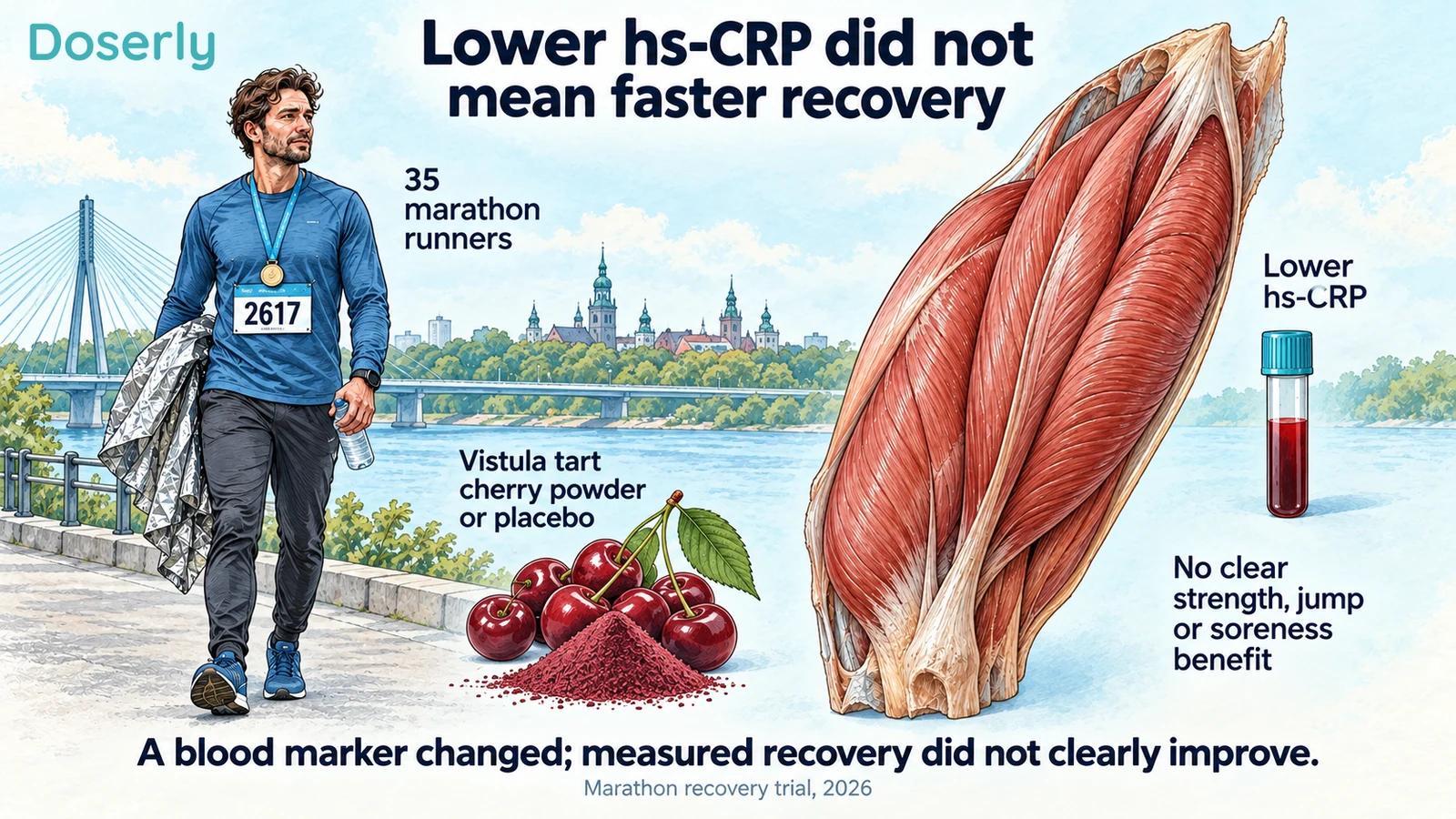
Image sources: Source
Team-sport recovery has not been consistently positive
A crossover trial in ten professional male soccer players compared cherry concentrate with an energy-matched control around a match and through the following recovery period. Researchers measured countermovement jump, reactive strength, soreness and subjective well-being. Cherry juice did not accelerate recovery on those outcomes. Abbott and colleagues.
Match play is less standardized than a laboratory knee-extension protocol. The amount of running, contact and individual fatigue can vary. That makes the real-world question important but also harder to study in a small sample. The negative finding does not erase the earlier strength experiments, and the earlier experiments do not make this negative result irrelevant.
For a team athlete, the practical question concerns readiness for the next match or training session. A claim based on elbow-flexor recovery in college students is less directly applicable than a study measuring jumping and soreness after match play, even if the first result sounds more impressive.
Does reducing soreness improve—or impair—adaptation?
Adaptation means the lasting changes produced by repeated training, such as improved endurance, strength or muscle size. Recovery is the return toward normal function after a particular stress. They overlap in time, but they aren't the same endpoint.
The cherry studies discussed here followed recovery over days. They did not compare months of otherwise equivalent training to establish whether routine cherry supplementation improves adaptation. Faster force recovery could help someone tolerate a dense competition schedule, but that possibility still needs to be demonstrated in the setting of interest.
The opposite claim also needs care. It is sometimes argued that any antioxidant intervention must blunt training because oxidative signals help coordinate adaptation. A human trial of high-dose vitamins C and E found differences in some cellular adaptations to endurance training, but it did not show a clear disadvantage in the measured oxygen-uptake and running-performance improvements. That intervention was not tart cherry. Different compounds, doses and physiological effects cannot be treated as interchangeable. Paulsen and colleagues, vitamin trial.
The honest conclusion is not that tart cherry definitely helps long-term gains or definitely blocks them. The short recovery studies don't settle that question. A dietary food, a cherry concentrate and high-dose isolated vitamins are different exposures, and each needs its own evidence.
Formulation and timing belong in the decision
“Equivalent to a number of cherries” is not a complete description of an intervention. Juice blends, concentrated juice, extracts and freeze-dried powders can differ in polyphenol content, energy, sugar and the compounds retained during processing. The Doserly tart-cherry guide provides broader background on these preparations.
The comparison drink matters as well. An energy-matched placebo helps separate a proposed cherry-specific effect from simply receiving more carbohydrate or calories. A study with a different comparator answers a somewhat different question. Neither the color nor the taste tells a reader whether two products are chemically equivalent.
Many positive studies began supplementation before the exercise challenge. That supports the tested preparation period; it doesn't establish a universal dose or show that more is better. It also doesn't justify treating an after-workout capsule as equivalent to several days of a studied juice.
If someone wants to evaluate a preparation with a sports dietitian, it helps to specify the purpose: a crowded event schedule, a predictable unusually demanding effort, or ordinary training soreness. Those goals may lead to different judgments about whether a possible short-term benefit is worth the cost and inconvenience.
Track function as well as comfort
A useful recovery record includes the exercise load, soreness under comparable conditions and a practical functional observation. Examples might be whether normal stairs are comfortable or whether a standardized training movement feels and performs as expected. Keep food, sleep and other recovery interventions in the record, because they can change alongside supplement use.
A lower soreness score is useful information, but it should not be the only permission to resume hard exercise. After an injury, worsening pain, substantial swelling or difficulty bearing weight warrant prompt assessment; symptoms that fail to improve also deserve review. NHS guidance on sprains and strains. The cherry trials were not treatment studies for acute injuries, and they don't show that masking discomfort makes continued loading safe.
The carbohydrate and energy content of juice also belong in the comparison. An extract may have a different nutritional profile, but that difference also means it isn't automatically the intervention supported by a juice study. Product details matter both for usefulness and tolerability.
Tart cherry has a credible short-term recovery research story, including some improvements in pain and force restoration. The strongest reading keeps those outcomes separate and includes the negative trials. Feeling better can be worthwhile; it is simply not proof of repaired tissue or better long-term adaptation.
Explore the research
- Elbow-flexor recovery, 2006: fourteen-person crossover study.
- Marathon recovery, 2010: strength and selective biomarker findings.
- Relay-running pain, 2010: fifty-four runners and pain scores.
- Intensive knee-extension recovery, 2011: force restoration in ten trained men.
- Vistula cherry marathon trial, 2026: lower hs-CRP without functional or soreness benefit.
- Professional soccer recovery, 2020: no advantage on measured recovery outcomes.
- Vitamins C and E with endurance training, 2014: different intervention; cannot establish tart-cherry effects.
- NHS sprains and strains guidance: when injury symptoms warrant assessment.