
TRT
October 16, 2026
Sustanon's four esters: what the blend changes and what it doesn't
On this page
Sustanon 250 is an injectable testosterone preparation containing four esters: propionate, phenylpropionate, isocaproate and decanoate. Each is testosterone with a different chemical attachment that affects its release from an oil depot. After the attachments are removed, all four supply the same active hormone.
The blend therefore has a pharmacological purpose. It combines components with different release properties. What it doesn't establish by itself is better symptom relief, better muscle recovery or fewer adverse effects than a preparation containing one ester.
For someone choosing treatment, the useful question is whether the complete preparation fits their diagnosis, response, monitoring and daily life. Our Sustanon guide covers the medicine more broadly. Here we'll examine the specific appeal of a multi-ester product and the human findings that help put it in context.
Four ingredients do not mean four separate hormonal benefits
The UK product information lists 30 mg propionate, 60 mg phenylpropionate, 60 mg isocaproate and 100 mg decanoate in a one-millilitre ampoule. The combined ester mass is 250 mg; the corresponding testosterone content is 176 mg. This difference reflects the mass of the attached chemical groups. It is a description of composition, not a dose recommendation. Sustanon product information
There isn't one component for energy, another for libido, another for muscle and another for mood. The components contribute testosterone exposure over time. Describing them as four separate therapeutic actions makes the formulation sound more biologically diverse than it is.
A medicine containing several active substances can sometimes have complementary effects. That general idea should not be assumed to apply here. Sustanon's components ultimately deliver the same hormone, so the relevant question is how their combined release behaves and what that means for a person receiving treatment.

The shapes represent different ester attachments conceptually, not actual chemical structures. All four provide testosterone after ester removal. The illustration does not show measured release rates or a sequence of treatments.
Does the blend produce a flat testosterone level?
A mixture of shorter and longer release characteristics may sound as though it should automatically produce constant exposure. The product's measured profile is more informative than that intuition.
The UK label describes a peak in total plasma testosterone roughly 24–48 hours after a single administration, followed by a decline toward the lower end of the normal male range over approximately 21 days. Those observations describe a rise and fall, not a perfectly level concentration. They also do not predict an individual person's results. Sustanon pharmacokinetics
The practical meaning of a peak depends on its magnitude, how long it lasts and the rest of the interval. A trough describes the low point before another administration. An average combines exposure over time. None of these numbers, alone, establishes whether a symptom will improve.
It is also misleading to describe the components as taking turns in neatly separated stages. Their contributions overlap. A conceptual explanation can show different release properties without inventing an exact four-part curve or promising that each component begins when another finishes.
Repeated treatment adds another layer. Hormone remaining from earlier administrations contributes to later exposure. A single-administration observation cannot simply be pasted onto every interval of an ongoing prescription.
A long duration doesn't require a blend
Single-ester preparations can also provide prolonged release. Injectable testosterone undecanoate, for example, is formulated as a long-lasting oil depot. The UK Nebido label describes its own administration, monitoring and release characteristics. Nebido product information
This doesn't make undecanoate superior. It shows why counting components is a poor shortcut for predicting duration. The properties of the ester, formulation and delivery system matter together.
Longer persistence can reduce treatment frequency, but it can also make a change in exposure slower to assess. A shorter interval may offer a different balance of flexibility and treatment burden. The appropriate choice depends on the goal and the person, not a contest between “simple” and “advanced” formulations.
Someone who needs help attending appointments may place a different value on duration than someone whose treatment is being reassessed. Neither preference can be resolved by the ingredient list alone.
What have human studies actually tested?
An older randomized crossover study compared three treatment approaches in 15 men with hypogonadism: mixed-ester injections, oral testosterone undecanoate and testosterone pellets. Each participant received the approaches in randomized sequence, separated by washout periods. Conway and colleagues, 1988
A crossover design can be useful because people act as their own comparison. Yet this study compared whole delivery systems. An injection, an oral preparation and implanted pellets differ in more than the number of ester components. The study cannot isolate “four esters versus one” as the explanation for every difference.
Its age also matters when applying it to modern treatment. Product selection, laboratory methods and clinical practice have changed. It provides direct human formulation research, but it should not be presented as a definitive ranking of every currently available option.
Another study examined testosterone esters in 15 men with asthma receiving long-term glucocorticoids. Researchers assessed bone density and body composition during treatment and control periods lasting 12 months, with a crossover after washout. They reported an increase in lumbar-spine bone density during testosterone treatment. Glucocorticoid-treated men study
That result addresses a particular clinical situation: men exposed to medicines that can affect bone and hormone physiology. It doesn't show that mixed esters outperform a single ester, prevent fractures, or offer the same benefit to a healthy person. Bone-density measurement and fracture prevention are related but distinct outcomes.
These studies give the blend a human research history. They do not provide a broad comparative advantage merely because the participants received Sustanon.
Can a rapid hormone rise improve performance immediately?
A more recent experiment offers a useful demonstration of the difference between a blood result and a functional result. In 2020, researchers randomized 19 healthy, recreationally active young men to mixed testosterone esters or placebo. Eighteen completed the post-treatment assessment. Testing occurred 24 hours after administration.
Blood testosterone rose markedly in the treated group, but the study did not find a clear acute improvement in jump height, cycle-sprint performance or the tested arm-strength measures. These were men with normal testosterone before treatment, not patients receiving long-term replacement for deficiency. Solheim and colleagues
The result doesn't mean testosterone cannot affect muscle over longer periods. It means a large short-term blood increase did not translate into the immediate performance effects tested here. The experiment also didn't assess recovery from an injury or prove safety for repeated nonmedical use.
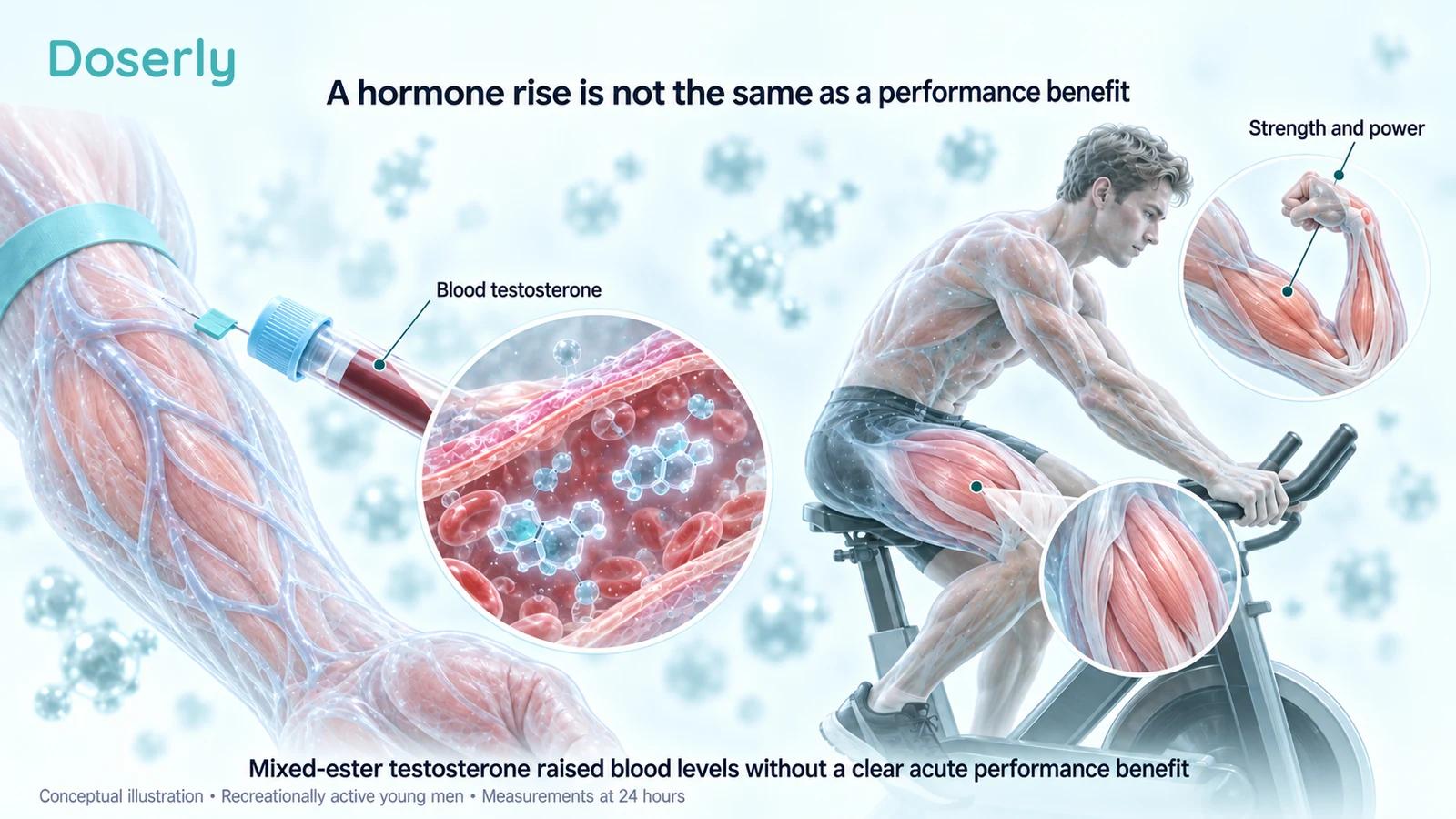
The illustrated tests refer to the small 24-hour experiment in healthy young men. They are not a forecast of long-term TRT response. No participant's anatomy, numerical performance result or treatment benefit is depicted.
Why a person might still prefer Sustanon
A treatment can be a sensible individual choice without winning a universal superiority contest. Availability, affordability, familiarity with administration and tolerability can all matter. A product that someone can obtain consistently may be more workable than a theoretically appealing alternative that is difficult to access.
Preferences are also outcomes worth discussing. Some people prioritize fewer treatment tasks; others prioritize flexibility or avoiding a particular preparation. A clinician can consider these alongside the reason testosterone is being prescribed and the response already observed.
The Endocrine Society guideline specifically includes patient preference, formulation-related adverse effects, treatment burden and cost when choosing a formulation. It does not recommend choosing by the number of esters. Clinical practice guideline
This gives a personal experience its appropriate place. “I tolerate this preparation well and can follow the plan” is useful information. “Four esters must work better for everyone” is a much broader claim that the experience does not establish.
The carrier and product details can matter more than the count
Sustanon's UK formulation contains refined arachis oil, derived from peanuts, and its labeling contraindicates use in people allergic to peanuts or soya. That is a concrete product characteristic with direct clinical relevance. It should not be overlooked during a discussion focused entirely on esters. Product contraindications and excipients
Other details include the concentration, packaging and approved route. Preparations with similar names should not be assumed to be identical across countries or manufacturers. The actual supplied product and its instructions are what the prescriber and pharmacist need to verify.
A change in injection discomfort doesn't necessarily reveal a difference in hormone action. Local tolerability can involve the preparation and administration circumstances. Persistent pain, swelling or another reaction should be described to the care team rather than used to infer that one ester is inherently “stronger.”
Likewise, the same volume is not a universal dose across testosterone products. If the preparation changes, confirm the new instructions instead of carrying over the old volume from memory.
Does the blend avoid testosterone's usual monitoring needs?
No. Delivering the same hormone through several esters doesn't remove the need to assess response and adverse effects. The Sustanon label includes monitoring for blood-count changes and warns about blood pressure and other relevant conditions. Sustanon safety information
Monitoring has several purposes. Hormone measurements help describe exposure. A blood count can identify an excessive rise in red-cell concentration. Blood-pressure assessment addresses a different physiological effect. Symptom review asks whether treatment is achieving something worthwhile.
A favorable result in one category doesn't guarantee a favorable result in the others. Nor should a symptom be attributed automatically to the blend simply because it started during treatment. Timing is important evidence, but clinical review may identify other explanations or contributors.
How to discuss a proposed switch
Begin with the reason for the change. Is the concern an end-of-interval symptom pattern, tolerability, inconsistent availability or a laboratory result outside the intended range? Naming the problem makes it easier to decide whether a different formulation is a reasonable way to address it.
Bring the actual product details and treatment history, including the timing of blood samples. If several things changed together, say so. That allows the clinician to distinguish a possible formulation effect from a change in exposure or measurement conditions.
Useful questions include how response will be assessed, when sampling should occur for the new preparation, and which safety findings would prompt another review. A dated record of a specific symptom is usually easier to interpret than a general impression that a blend feels more powerful.
The Sustanon guide and cypionate versus enanthate comparison can help you prepare. The blend is a way of delivering testosterone; its value comes from how well the complete treatment works for an appropriate clinical purpose.
Sources
- Sustanon 250 UK product information, updated 2026.
- Nebido UK product information, updated 2025.
- Conway and colleagues, randomized formulation crossover study, 1988.
- Testosterone in glucocorticoid-treated men, 1996.
- Solheim and colleagues, acute mixed-ester performance experiment, 2020.
- Endocrine Society clinical practice guideline, 2018.