
Peptides
October 16, 2026
Survodutide trial discontinuations: what the weight-loss headline leaves out
On this page
Survodutide reduced average body weight in its phase 3 obesity trial, but weight loss was only one part of the treatment experience. Some participants stopped the assigned injections. Many still attended follow-up visits. Others used an additional obesity medicine after stopping. Those different experiences affect what the final percentages mean.
For someone considering a long-term weight treatment, the practical question is broader than “How much can it reduce weight?” It also includes how often people can continue, why they stop, and what happened afterward. SYNCHRONIZE-1 provides a useful example because its publication reports both the weight outcomes and the participant experience behind them. Original phase 3 report
The aim here is to explain those findings without treating discontinuation as either a reason to dismiss the trial or a detail to overlook. Our survodutide guide describes the broader research program.
Who entered the trial?
SYNCHRONIZE-1 studied adults with obesity, or overweight with an obesity-related complication, without diabetes. Researchers randomized 726 people, and 725 received at least one dose and entered the main analysis. Participants received one of two once-weekly survodutide target regimens or placebo for up to 76 weeks, along with lifestyle counseling.
There were 241 treated participants in the 3.6 mg target group, 242 in the 6.0 mg group and 242 in the placebo group. Average starting weight was 108.8 kg and mean BMI was 37.9. This was a trial of selected adults receiving a monitored intervention, rather than an unrestricted sample of everyone seeking weight loss. Design and population
The dose names identify trial groups. They are not personal treatment recommendations. Participants could experience dose adjustments, interruptions or discontinuation, so assignment to a target group wasn't identical to receiving that exact amount continuously.
This distinction becomes important when interpreting a result described simply as “the 6 mg result.” That usually means an analysis associated with assignment to that regimen, with the handling of later events specified by the investigators.
Stopping injections is different from leaving the study
Overall, 91.3% completed the trial, but 63.4% were still receiving survodutide or placebo at week 76. In the two survodutide groups, 64.7% and 65.7% were still receiving treatment; the corresponding placebo figure was 59.9%. Participant disposition
A participant could stop taking the assigned drug and still provide a weight measurement at the final visit. That measurement remains informative. It helps describe what happened after starting the assigned treatment, including the consequences of being unable or unwilling to continue.
By contrast, leaving follow-up can create a missing measurement. Researchers then need an analysis that accounts for what is unknown. Treatment discontinuation and missing outcome data can overlap, but they are not the same event.
This is why describing the difference between 100% and the on-treatment percentage as “people lost to follow-up” is wrong. Many people who stopped treatment remained in contact with the trial team.

How often did adverse events lead to stopping?
In the 3.6 mg group, 57 of 241 participants, or 23.7%, stopped survodutide because of an adverse event. In the 6.0 mg group, the figure was 60 of 242, or 24.8%. With placebo, 13 of 242, or 5.4%, stopped for that reason.
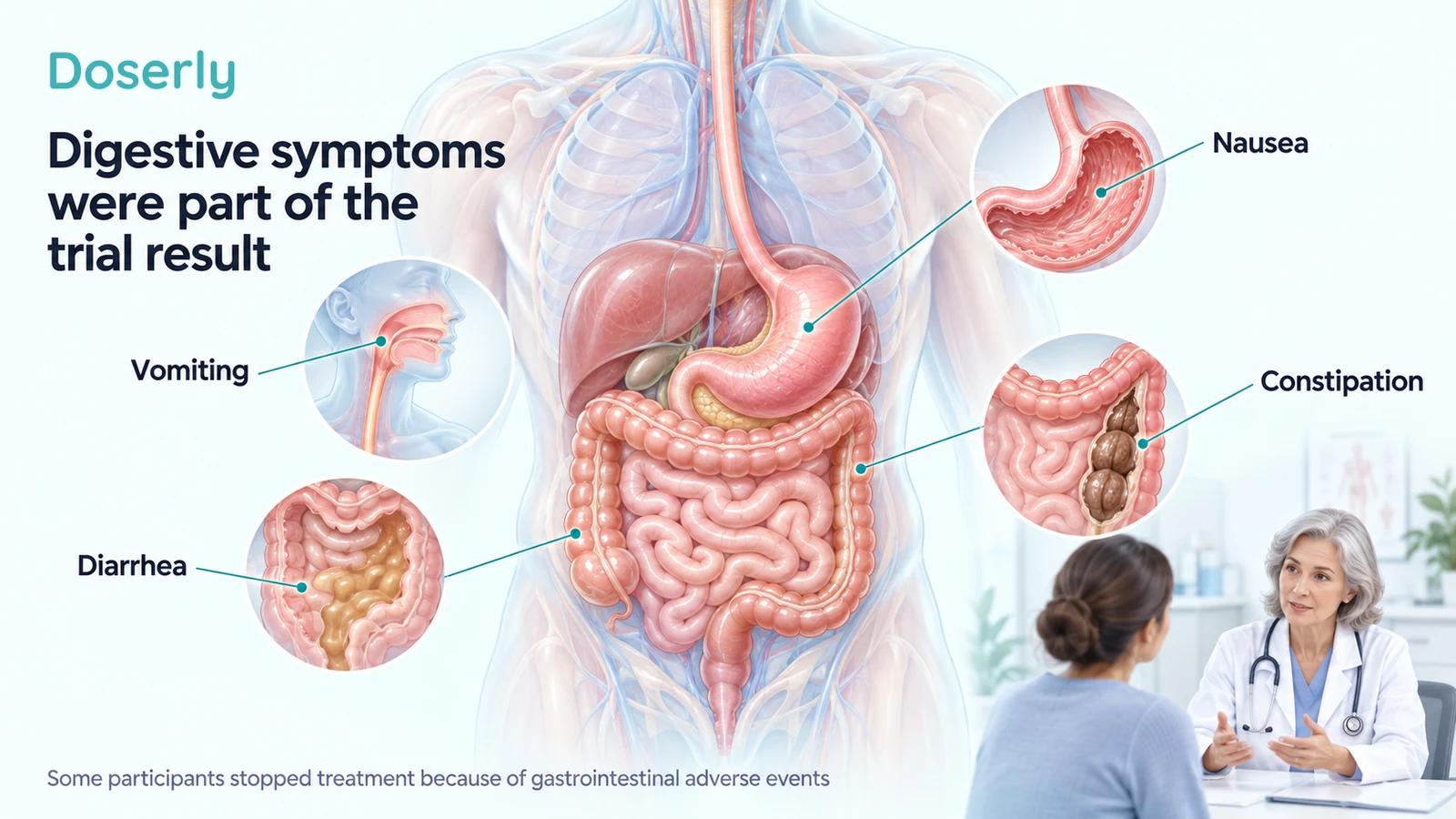
The gastrointestinal subset was smaller: 43 of 241, or 17.8%, in the lower target group; 49 of 242, or 20.2%, in the higher group; and 7 of 242, or 2.9%, with placebo. Original safety table
These are three different descriptions: stopping treatment for any reason, stopping because of any adverse event, and stopping because of gastrointestinal events. They must not be substituted for one another. The gastrointestinal percentage also shouldn't be presented as the proportion who had any digestive symptom; many people experienced symptoms without stopping.
A further distinction is the number who left the trial because of an adverse event: six, four and two participants across the three groups. Those counts are much smaller than the numbers who stopped treatment because of an adverse event. Continuing follow-up after discontinuation is part of the reason.
What were the digestive symptoms?
Nausea, vomiting, diarrhea and constipation were prominent. Gastrointestinal adverse events occurred in 80.9% of the lower-target survodutide group, 89.7% of the higher-target group and 47.9% of the placebo group. They occurred mainly during dose escalation and were generally classified as mild or moderate. Safety findings
“Mild or moderate” is a severity classification, not a statement that symptoms were trivial to the person experiencing them. A symptom can be nonserious in regulatory terminology and still interfere with meals, work, travel or willingness to continue.
Likewise, serious has a specific meaning in safety reporting and isn't simply another word for very unpleasant. Serious adverse events occurred in 8.3% of each survodutide group and 6.2% with placebo. Those figures should be discussed separately from common symptom frequency.
The study doesn't tell a future patient exactly which symptoms they will experience or whether they will be able to stay on treatment. It does provide a concrete reason to include tolerability in the discussion of expected benefit.
How did the trial handle interruptions?
The original protocol had rules that limited flexibility. Dose adjustments were initially limited to a specified part of the escalation period, and participants were to discontinue if three or more doses were missed. A later amendment allowed restarting, but most participants were already more than three quarters through treatment when that change occurred. Protocol features described in the publication
This matters because the observed discontinuation rate reflects both the medicine and the conditions under which it was used. A protocol rule can convert an interruption into permanent treatment discontinuation.
The authors discuss whether earlier flexibility might have improved persistence. The trial doesn't answer that counterfactual question. We shouldn't assume that a different schedule would eliminate discontinuations or simply replace the observed rate with a more favorable hypothetical one.
The useful development lesson is narrower: future studies can test whether a different approach produces a better combination of efficacy and tolerability. That requires new observations rather than reinterpretation of a symptom as unimportant.
Why did the study report two weight-loss estimates?
An estimand specifies the treatment-effect question a study aims to answer. Among other things, it defines how events after randomization, such as stopping treatment or taking another medicine, belong in that question. The international ICH E9(R1) guidance emphasizes making those choices explicit. ICH estimand guidance
For SYNCHRONIZE-1, the primary treatment-regimen estimand incorporated early discontinuation, prohibited obesity medicines and prolonged dose escalation. At week 76, average weight changes were −12.2%, −13.0% and −5.4% in the lower-target, higher-target and placebo groups.
The efficacy estimand addressed a hypothetical situation in which participants adhered to their assigned regimen and did not receive prohibited obesity therapy. It retained the effects of prolonged escalation. The corresponding estimates were −15.3%, −16.6% and −3.2%. Original analysis definitions and results
Both sets are legitimate answers to specified questions. The larger efficacy figure isn't simply the observed average for every person who completed treatment, and the treatment-regimen estimate isn't a guarantee of routine-care effectiveness. Each relies on the trial's data and analytic assumptions.
Another obesity medicine can change the placebo comparison
The paper reports that 2.5% and 3.7% of participants in the survodutide groups, and 16.5% in the placebo group, took another medicine with GLP-1 receptor activity while still participating in the trial. This most often occurred after stopping the assigned treatment. Concomitant therapy findings
That helps explain why a placebo group's outcome isn't necessarily the same as the outcome of receiving no active obesity therapy throughout follow-up. It also shows why the analysis strategy matters. One approach incorporates those events; another asks about a hypothetical scenario without them.
It would be wrong to subtract one analysis's placebo estimate from another analysis's survodutide estimate. For example, pairing the higher efficacy weight reduction with the treatment-regimen placebo reduction mixes questions.
It would also be wrong to assume all placebo weight loss came from additional medication. Participants received lifestyle counseling, responses varied, and the publication doesn't justify assigning every kilogram of change to one cause.
Missing measurements require assumptions
When a final weight is unavailable, a statistical model cannot recover the actual value with certainty. Researchers use prespecified methods to estimate the treatment effect while making assumptions about missing data. Sensitivity analyses examine whether conclusions change under other plausible assumptions.
The ICH guidance treats collecting follow-up after stopping treatment as valuable, particularly when the question concerns outcomes regardless of discontinuation. More observed information reduces reliance on guesses about what happened afterward. It doesn't remove every source of uncertainty. ICH E9(R1)
For readers, it isn't necessary to reproduce the model. It is enough to recognize that an estimated group outcome, an observed completer average and an individual forecast are different objects. A weight-loss headline rarely makes all three distinctions explicit.
The full supplementary statistical detail would be needed to independently reproduce the analysis. The main publication supports the stated interpretation, but this article is not a reanalysis of participant-level data.
Does discontinuation cancel the efficacy finding?
No. The primary treatment-regimen analysis still found greater average weight reduction with survodutide than placebo. Discontinuation is part of understanding the size and practical meaning of that benefit, rather than a reason to pretend the benefit didn't occur.
It also prevents the opposite mistake: presenting the largest hypothetical-adherence result as the experience of everyone who started. A person deciding whether a treatment is suitable needs both the benefit estimate and the chance that adverse effects may interfere with continued use.
Other survodutide studies also demonstrate why trial completion and treatment completion need separate attention. In the earlier 46-week obesity trial, only 60.4% of treated participants completed the treatment period. In SYNCHRONIZE-MASLD, all-cause treatment discontinuation was similar between groups even though gastrointestinal discontinuations were more common with survodutide. The reasons and trial designs differed. Phase 2 obesity trial, MASLD trial
What belongs in a treatment conversation?
A useful discussion includes the outcome you hope to improve, the likelihood of continuing treatment, and what would happen if symptoms made the plan difficult. Ask which trial estimate is being quoted and whether it incorporates discontinuation. Ask whether the participants resembled you, particularly regarding diabetes and other conditions.
A dated symptom and medication record can help distinguish when a problem began, whether it followed a treatment change, and how it affected eating or daily activities. It doesn't prove causation, but it gives a clinician better information than a general impression that treatment was “hard to tolerate.”
Survodutide's phase 3 result supports meaningful average weight reduction under the study conditions. Its discontinuation findings make that result more useful by showing how treatment unfolded. Both belong in the same conversation.
Sources
- Le Roux and colleagues, SYNCHRONIZE-1, 2026. Original publisher-hosted paper, including safety table and analysis definitions.
- ICH E9(R1), estimands and sensitivity analysis, 2020.
- Le Roux and colleagues, phase 2 obesity trial, 2024.
- Kaplan and colleagues, SYNCHRONIZE-MASLD, 2026.