
Peptides
October 16, 2026
Survodutide and MASH: why liver and weight results differ
On this page
Survodutide is being studied for obesity and metabolic liver disease because it activates receptors for both GLP-1 and glucagon. Those signals affect appetite and metabolism, including processes involving the liver. If you have been told that you have fatty liver, it is reasonable to wonder whether a treatment that reduces weight might also improve what is happening inside the organ.
Human trials have found improvements in several liver measurements. But weight loss, reduced liver fat, improvement in inflammation and improvement in scarring are different outcomes. They can occur together without being interchangeable. The most useful way to understand survodutide's liver research is to keep each measurement connected to the study that made it. Phase 2 MASH trial, SYNCHRONIZE-MASLD
This article compares the biopsy-based MASH study with the later trial of liver fat and weight. Our survodutide guide covers the wider development program and mechanism.
What is happening inside a fatty liver?
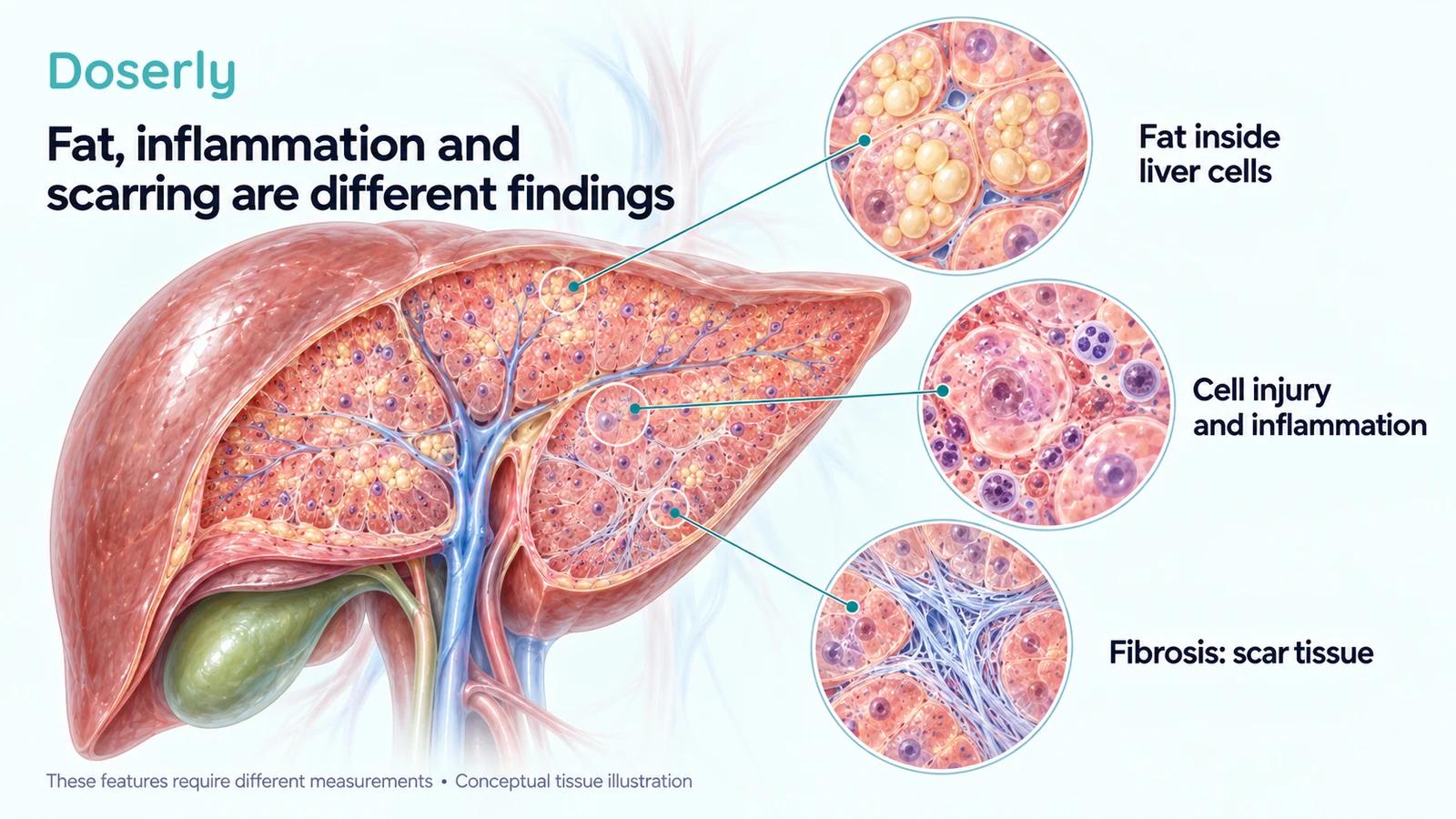
Metabolic dysfunction-associated steatotic liver disease, or MASLD, describes liver fat accumulation in a metabolic context. Metabolic dysfunction-associated steatohepatitis, or MASH, involves liver-cell injury and inflammation as well as fat. You may still see the older terms NAFLD and NASH in study titles or clinical documents.
Fat accumulates within liver cells. Inflammation involves immune activity and tissue injury. Fibrosis means scar tissue deposited in response to injury. A person can have substantial fat without the same degree of scarring as someone else, and a change in one feature need not mean that all the others have changed to the same extent. NIDDK diagnostic explanation
This is why a liver result needs a noun attached to it. “The liver improved” could refer to a lower enzyme value, less fat on a scan, a better inflammation score or less fibrosis in a tissue sample. Each is potentially useful, but each supports a different clinical statement.
The phase 2 study examined liver tissue
The 2024 phase 2 trial enrolled adults with biopsy-confirmed MASH and fibrosis stages F1–F3. Fibrosis stages describe the extent and pattern of scarring; this trial did not include the F4 stage of cirrhosis. In total, 293 randomized participants received at least one dose of survodutide or placebo.
The study lasted 48 weeks, with three once-weekly survodutide target doses compared with placebo. Its primary endpoint was improvement in MASH without worsening of fibrosis. This wording matters: it wasn't simply weight loss, less liver fat or complete disappearance of MASH. Original trial report
The endpoint used a decrease in a liver activity score, including improvement in inflammation or ballooning of injured liver cells, with no increase in fibrosis stage. A participant could meet that definition while still having some MASH and the same fibrosis stage as before treatment. “Improvement” should therefore not be rewritten as “cure” or “reversal of scarring.” Original paper's endpoint definition
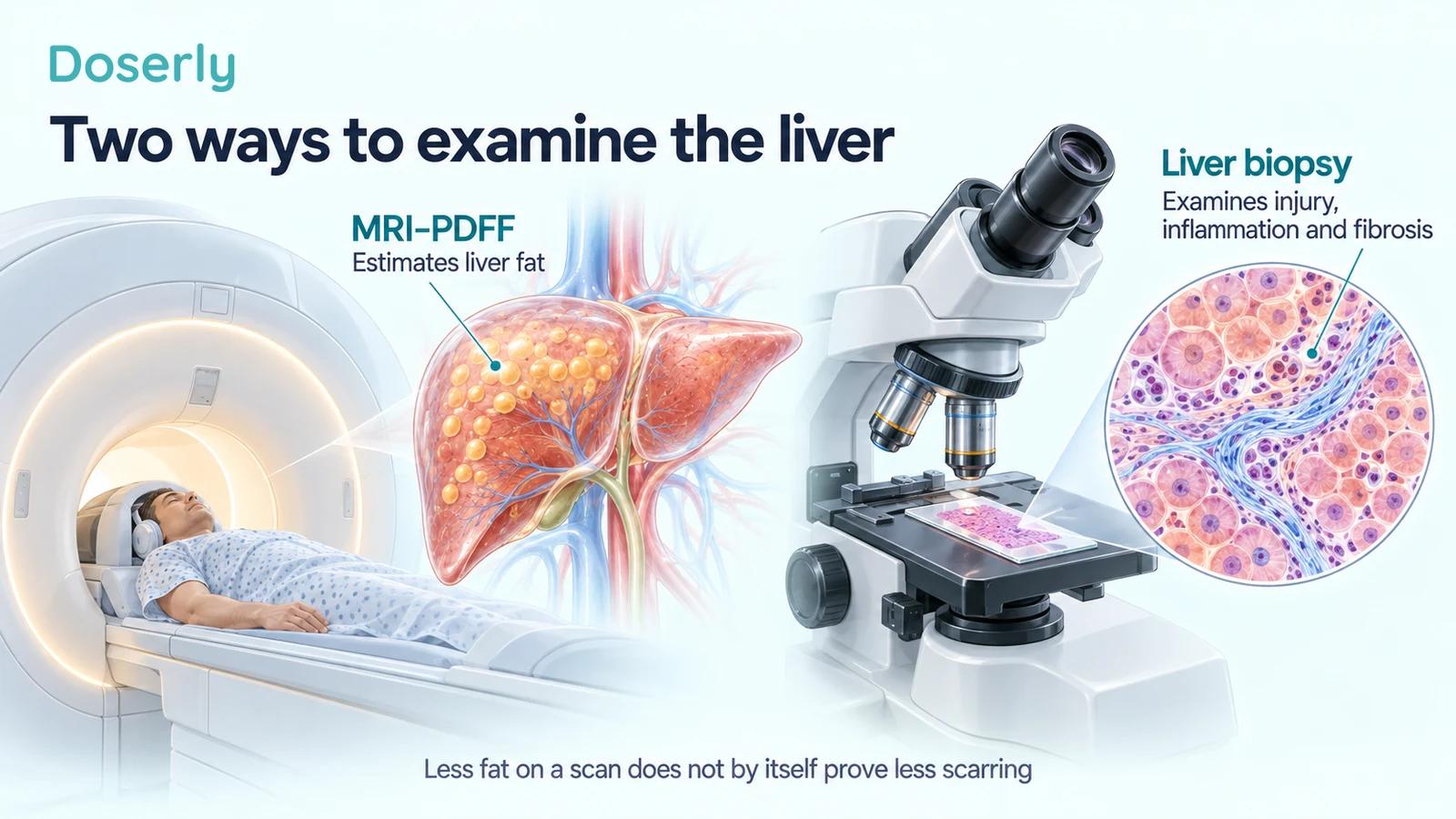
Biopsy provides information that a bathroom scale cannot. A pathologist examines a small tissue sample under a microscope, looking at cellular changes and fibrosis. It is also a sample rather than a view of every part of the organ. The procedure and its interpretation are different from simply repeating a blood test. NIDDK liver-biopsy explanation
What did the biopsy trial find?
In the primary analysis, improvement in MASH without worsening of fibrosis occurred in 47%, 62% and 43% of participants across the three survodutide groups, compared with 14% receiving placebo. The highest response percentage was in the middle target-dose group, so the result wasn't a simple progression in which more drug always produced more improvement.
A separate endpoint, improvement in fibrosis by at least one stage, occurred in 34%, 36% and 34%, compared with 22% with placebo. These secondary fibrosis figures describe a different outcome and should not be substituted for the primary result. Primary and secondary results
The difference is clinically important. A treatment that reduces active injury may be promising even before long-term complications can be studied. But showing less active disease is not identical to demonstrating that existing scar tissue has regressed, and neither automatically establishes fewer transplants or deaths.
The study also measured liver-fat responses. That gives researchers several views of what might be changing, but it doesn't merge those views into a single percentage of “liver recovery.” A participant's fat measurement, inflammation score and fibrosis stage remain separate observations.
The phase 3 MASLD trial asked a different question
SYNCHRONIZE-MASLD, published in 2026, included 216 treated adults with obesity or overweight plus a qualifying complication, and at-risk MASLD. It compared once-weekly survodutide with placebo over 48 weeks. Participants received dietary and activity counseling in both groups.
Most qualified through noninvasive tests suggesting liver inflammation or fibrosis, rather than a new biopsy demonstrating MASH. The study required liver fat of at least 8% on MRI-PDFF and additional evidence of risk, or a qualifying recent history of biopsy-confirmed MASH. Cirrhosis was excluded. Trial methods
Its two main outcomes were a relative reduction of at least 30% in MRI-measured liver fat and percentage change in body weight. MRI-PDFF stands for magnetic resonance imaging proton density fat fraction. It estimates the fat component of the liver's imaging signal; it does not directly count inflammatory cells or collagen fibers.
This makes the newer trial complementary to the earlier biopsy study. It provides evidence in a population selected more heavily through noninvasive testing, using outcomes that can be measured without repeated tissue sampling. Calling it phase 3 doesn't change what those outcomes mean.
Why are there two sets of phase 3 percentages?
The paper reports two prespecified ways of estimating the treatment effect. The treatment-regimen estimand, used for the primary evaluation, addresses the effect while accounting for events such as early treatment discontinuation. The efficacy estimand estimates what would happen if participants adhered to treatment and avoided prohibited obesity medicines. These are different statistical questions, not different trials.
Under the treatment-regimen analysis, 68.5% of survodutide participants and 28.6% of placebo participants achieved at least a 30% relative liver-fat reduction. Average weight changes were −8.7% and −1.4%, respectively.
Under the efficacy analysis, the liver-fat response proportions were 84.2% versus 24.3%, and average weight changes were −12.2% versus −1.0%. Both analyses in the original publication
The larger efficacy estimates don't mean that missing participants were observed achieving those results. Statistical models and missing-data assumptions are involved. The treatment-regimen result is also an estimate, not a guarantee of what everyone starting treatment outside a trial would experience.
When discussing the study, keep each pair together. Combining the larger efficacy liver-fat percentage with the treatment-regimen placebo weight change creates a comparison the trial did not report.
A 30% liver-fat reduction is not 30 percentage points
Consider an illustrative person whose MRI-PDFF value changes from 20% to 14%. The absolute difference is six percentage points. Relative to the starting value, that is a 30% reduction: six divided by twenty.
This example explains the calculation; it is not a participant record from the trial. It also shows why meeting the response threshold does not necessarily mean liver fat is now in a normal range. The final level depends on where the person began.
Similarly, the proportion achieving that threshold is different from the average amount of liver fat lost across the group. “68.5% reached a relative reduction of at least 30%” is a responder statement. It doesn't mean the average participant lost 68.5% of their liver fat, and it doesn't mean 68.5% of liver disease disappeared.
These distinctions are especially useful when an article places a weight-loss percentage beside a liver-fat percentage. Their denominators are different: total body mass, the person's initial imaging fat value, or the number of participants. Bigger-looking numbers may reflect a different measurement rather than a larger health benefit.
Did weight loss cause the liver improvement?
Randomization supports a comparison of the complete treatment with placebo. It doesn't separately randomize the amount of weight each person loses. People with greater weight change can also differ in treatment exposure, adherence, symptoms and baseline disease.
Consequently, finding that weight and liver measurements improve together doesn't tell us exactly how much of the liver effect occurred through weight loss. Direct effects of glucagon-receptor activity on liver metabolism are biologically plausible, but a trial of the dual drug alone cannot isolate that pathway.
A mediation analysis can explore how a treatment effect might be divided between changes associated with weight and other pathways. Such analyses require assumptions about relationships that weren't separately randomized. They are useful for research questions, but should not be translated into a claim that an exact fraction of one person's liver benefit was independent of weight.
For clinical interpretation, the secure starting point remains the observed outcome: the intervention improved specified measurements in the studied population. Understanding the mechanism is valuable, but it is a different task from establishing that treatment helped on a prespecified endpoint.
Not every liver measure moved convincingly
SYNCHRONIZE-MASLD reported a reduction in liver stiffness using vibration-controlled transient elastography, an ultrasound-based technique. However, the between-group change in stiffness measured with magnetic resonance elastography, or MRE, was not statistically significant. Secondary liver measurements
The authors discuss possible explanations, including relatively low starting MRE values, which leave less room to detect a reduction. That explanation is plausible rather than proven. It would be equally inappropriate to erase the nonsignificant finding or to use it alone to dismiss the successful liver-fat endpoint.
Different tests respond to different aspects of tissue and have different sources of variation. Their agreement can strengthen an interpretation; disagreement can reveal an unresolved question. In this study, the results do not justify describing every marker of liver fibrosis as clearly improved.
Tolerability and longer-term questions still matter
Gastrointestinal symptoms were common in both research programs. In SYNCHRONIZE-MASLD, gastrointestinal adverse events led to treatment discontinuation in 19.9% with survodutide and 4.3% with placebo. Overall treatment discontinuation was about 41% and 40%, respectively, so the reasons for stopping are as important as the total. Safety and participant disposition
A treatment that improves a scan has to be tolerable enough to use. The liver measurements also need to be connected to outcomes over longer periods. The ongoing LIVERAGE program is designed to examine histologic outcomes and later clinical events, while LIVERAGE-Cirrhosis addresses a separate population with compensated cirrhosis. Neither registry had posted results when checked on October 15, 2026. LIVERAGE registry, cirrhosis registry
If you have fatty liver, a useful question for your clinician is: “Which feature are we monitoring—fat, inflammation, fibrosis risk or a clinical complication?” That helps explain why your weight, enzymes and imaging results may not change in parallel. The survodutide guide can provide context for the research, while your own disease stage determines which evidence is most relevant.
Sources
- Sanyal and colleagues, phase 2 MASH and fibrosis trial, 2024.
- Kaplan and colleagues, SYNCHRONIZE-MASLD, 2026.
- NIDDK, diagnosis of fatty liver and steatohepatitis.
- NIDDK, liver biopsy.
- LIVERAGE, NCT06632444. Registered study plan; no results posted.
- LIVERAGE-Cirrhosis, NCT06632457. Registered study plan; no results posted.