
Peptides
October 16, 2026
Survodutide and energy expenditure: measured finding or proposed explanation?
On this page
Survodutide is often described as helping people eat less while also making them burn more energy. The first useful question is what researchers actually measured. A clinical trial can show that people assigned to a medicine lost more weight than those assigned to placebo without establishing how much of that difference came from lower food intake, higher energy expenditure, or changes in both.
For survodutide, glucagon-receptor activity provides a biological reason to investigate energy expenditure. Animal experiments support that investigation. Human experiments with other hormones provide additional context. Those findings do not turn the weight-loss percentage in a survodutide trial into a measured increase in human metabolic rate.
The practical distinction is between a plausible contributor to weight loss and a quantified effect in people taking the same treatment. That distinction matters when reading claims about a “metabolic boost,” preserved metabolism, or extra calories burned each day.
What would count as measuring energy expenditure?
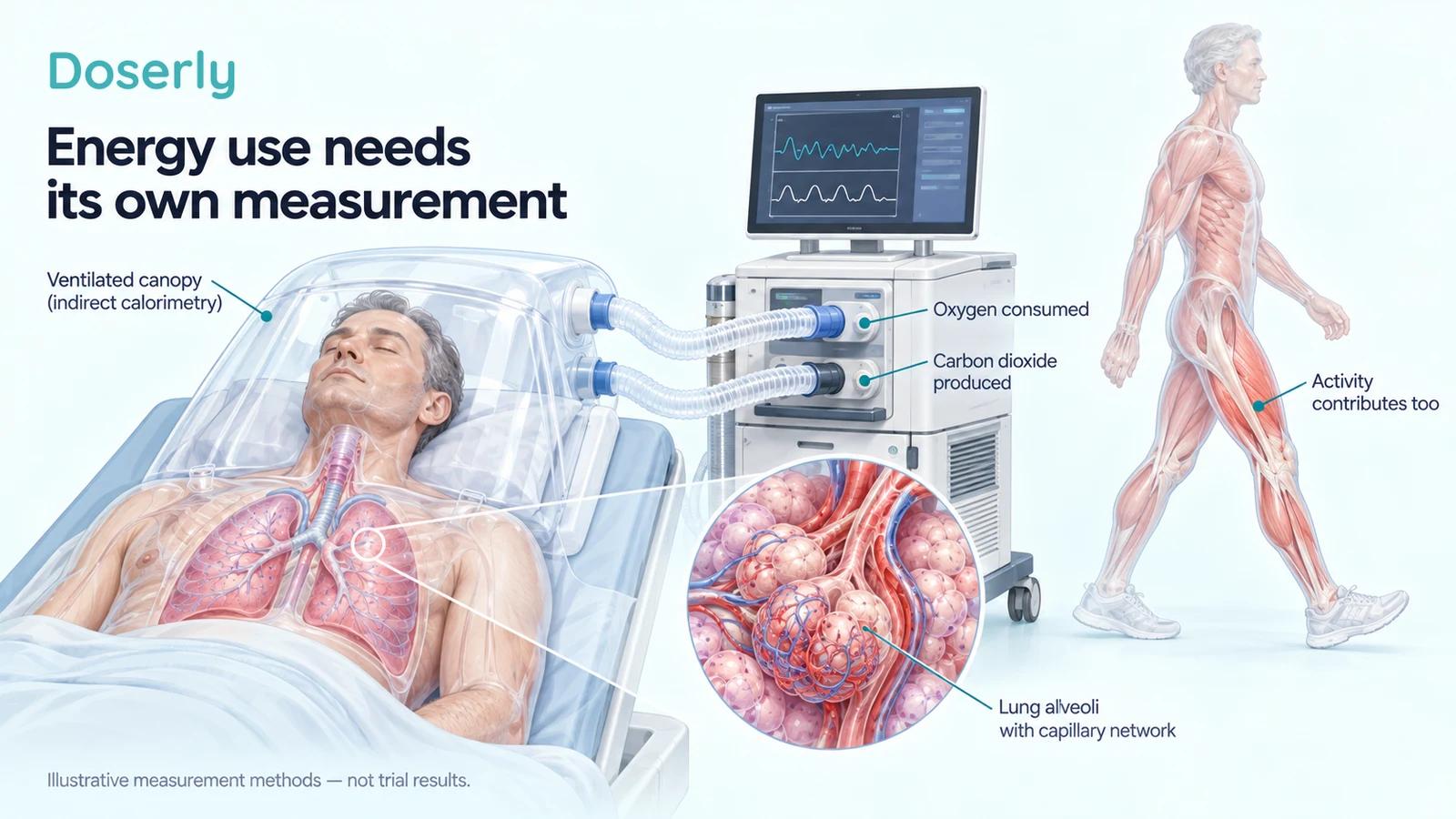
Energy expenditure describes energy used over time. It includes energy needed while resting and energy associated with activity, among other components. These are related quantities, but they are not interchangeable endpoints.
Researchers can assess gas exchange using indirect calorimetry: oxygen consumption and carbon dioxide production help estimate energy use under defined conditions. Activity monitoring can contribute information about movement outside a laboratory. A measured change during a controlled resting assessment answers a different question from an estimate of total daily expenditure in ordinary life.
The setting also matters. A brief infusion experiment can establish an acute physiological response. Repeated measurements during months of treatment are needed to characterize whether that response persists while body weight, food intake and activity change. An instrument reading is therefore more informative when its timing, conditions and comparison group are reported alongside it.
These distinctions appear in actual human hormone research. One experiment measured expenditure during glucagon infusion using indirect calorimetry. Another combined calorimetry with heart-rate and movement monitoring during short-term oxyntomodulin treatment. Neither simply inferred expenditure from the scale. Glucagon experiment, oxyntomodulin trial.
Why glucagon creates a reasonable hypothesis
Survodutide activates both glucagon and GLP-1 receptors. The combination was developed to bring together complementary metabolic effects, rather than to behave as a simple copy of either natural hormone.
In the original discovery research, investigators tested the compound, then called BI 456906, in cell systems and animal models. They reported weight effects in mice alongside reduced food intake and increased energy expenditure. Those experiments help explain why the glucagon component is of interest. They are direct preclinical evidence about the compound, not direct evidence that a person receiving it will burn a particular number of additional calories. Discovery and preclinical pharmacology study.
The distinction is substantive. A receptor experiment asks whether the molecule can engage a biological target. An animal experiment asks what happens in that model under its particular conditions. A human treatment study asks whether the proposed effect occurs in the people, exposure range and clinical setting of interest.
Evidence can connect those questions, but none makes the others unnecessary. “It activates the glucagon receptor” is a starting point for a mechanism claim. It is not itself a calorimetry result.
The same caution applies to a proposed liver pathway. Showing changes in metabolic signaling can support an explanation for altered fuel handling. It does not automatically establish the size of the whole-body energy-expenditure effect, or show that it persists during long-term treatment.
What human glucagon research contributes
A small study in healthy men provides a useful example of direct measurement. Eleven volunteers underwent assessments involving cold exposure, glucagon infusion and a control infusion. Energy expenditure increased by about 15% during glucagon infusion in that experimental setting.
The researchers also investigated brown adipose tissue, a tissue involved in heat production. They did not detect the same brown-fat activation response with glucagon that accompanied cold exposure. That finding cautions against treating “higher expenditure” and “activation of brown fat” as equivalent explanations. Original human glucagon study.
The experiment supports the proposition that glucagon can affect human energy expenditure. It does not establish a 15% increase with weekly survodutide. Native glucagon delivered acutely by infusion is a different intervention from a long-acting molecule that activates two receptors.
The participants and duration also differ from a chronic obesity trial. A short physiological experiment can be compelling within its own scope while remaining insufficient to predict an effect over many months. Applying its percentage directly to a person's daily calorie requirement would skip those differences.
Oxyntomodulin shows why the component matters
Another small human trial studied oxyntomodulin, a different hormone with relevance to the dual-receptor concept. Fifteen adults with overweight or obesity participated in a randomized crossover study involving four days of treatment.
The investigators assessed food intake and expenditure separately. Oxyntomodulin reduced intake at a study meal. It increased activity-related energy expenditure, while resting energy expenditure did not change. The reported activity-associated increase was about 143 calories per day, with substantial uncertainty around that estimate. Original oxyntomodulin trial.
This is an informative result because a loose description such as “boosted metabolism” would conceal which measurement changed. A person could hear that phrase and imagine a higher resting metabolic rate, although that was not the finding.
It also illustrates a limit on borrowing numbers across molecules. The study was small, short and involved oxyntomodulin, not survodutide. Its calorie estimate should not appear in a survodutide forecast, dosing discussion or weight-loss calculator. Its value here is methodological: measure intake and expenditure, then identify the specific component that changed.
Appetite research answers another part of the question
A 2026 survodutide study examined receptor expression and access to appetite-related brain regions. It included human postmortem tissue work and experiments in mice. The researchers investigated how the compound reached particular brain regions and activated neuronal populations associated with appetite regulation. Original brain-mechanism study.
That work can strengthen an explanation for reduced food intake. It does not measure daily energy expenditure in people receiving survodutide. Human tissue findings also do not turn the mouse dosing experiments into a clinical treatment study.
This distinction prevents two common shortcuts. First, an appetite-related signal should not be relabeled as proof of increased energy use. Second, a mechanism illustrated in a mouse brain should not be presented as a precise map of drug action in a living human brain.
For the wider receptor and development background, the Doserly survodutide guide provides context. The narrower question here remains whether the expenditure claim has its own matching human measurement.
What the large weight-loss trial establishes
SYNCHRONIZE-1 studied survodutide in adults with obesity, or overweight with a qualifying complication, without diabetes. Its primary outcomes concerned body-weight change and the proportion of participants reaching a weight-loss threshold after 76 weeks.
Under the primary treatment-regimen analysis, average weight change was −12.2% and −13.0% in the two survodutide groups, compared with −5.4% with placebo. Those results establish a treatment-group difference in the specified weight outcomes. They do not partition that difference into calories eaten less and calories expended more. SYNCHRONIZE-1 publication.
The paper also reported body-composition information from a selected MRI subgroup. Body composition is relevant because total weight includes more than fat. However, an MRI estimate of fat or lean-tissue volume is not a measurement of metabolic rate.
Nor can the effect of one receptor be isolated by looking at the total result of a dual-receptor medicine. To attribute a specific contribution to glucagon signaling, researchers need a design that can distinguish competing explanations. A placebo comparison establishes the combined treatment effect under the trial conditions; it does not automatically identify each biological ingredient's share.
Why the scale cannot solve the mechanism
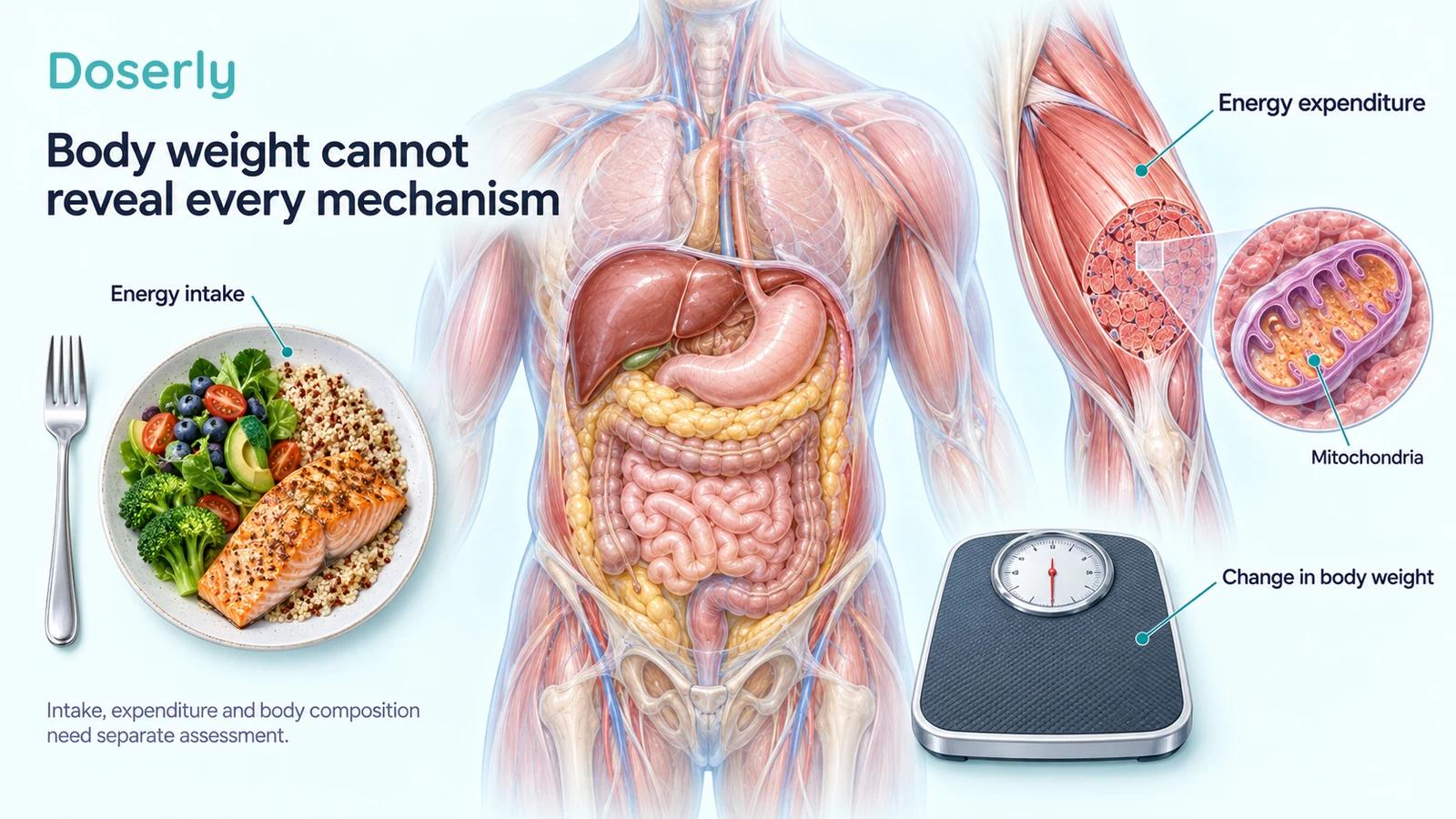
Imagine two hypothetical participants with the same reduction in body weight. One might have changed food intake more; the other might have changed activity more. Their scale readings would not reveal those differences. The example is conceptual, not a claim about particular survodutide participants.
Similarly, a stronger average weight response does not prove a larger energy-expenditure response. More persistent appetite effects, differences in adherence, tolerability, baseline characteristics and other aspects of treatment could contribute to an observed clinical difference.
A comparison between separate drug trials adds further uncertainty. Their populations, durations, lifestyle programs, doses and approaches to missing data may differ. Assigning the gap between their weight-loss percentages to “extra calorie burning” would require evidence those headline figures do not contain.
What would strengthen the human claim?
A more convincing survodutide-specific answer would come from a study that measures energy expenditure directly, defines the component of interest and includes an appropriate comparison group. Its report would also explain how food intake, activity and changing body composition were considered.
Several details would make the result interpretable:
- Timing: whether the finding occurs only soon after exposure or remains present after sustained treatment.
- Conditions: whether measurements reflect a standardized resting state, a meal response or ordinary daily activity.
- Population: whether participants resemble the patients to whom the claim is being applied.
- Magnitude and uncertainty: the estimated difference, its units and a confidence interval.
- Clinical context: whether the effect accompanies acceptable tolerability and meaningful outcomes.
These are criteria for evaluating future evidence, not a description of a completed trial. The goal is not to demand that every weight-management study measure every mechanism. It is to ensure that a mechanistic claim is supported by a study equipped to answer it.
An informative negative or mixed result would matter too. If resting expenditure did not rise but food intake fell, that would clarify how the treatment worked under those conditions. It would not erase the clinical weight result. Conversely, a measured expenditure increase would need its own assessment of durability and practical size.
How to interpret “metabolic boost” claims today
A useful reading habit is to translate a broad phrase into an answerable question. Does “boosts metabolism” mean increased resting expenditure, more activity-related expenditure, altered fuel use, reduced liver fat, or simply greater weight loss? Those are different claims.
Then identify the intervention and population behind the supporting citation. A mouse receiving survodutide, a healthy volunteer receiving glucagon, and a person in a long-term survodutide obesity trial provide different kinds of evidence. Combining them can build a research rationale; it cannot erase the gaps between them.
For someone discussing weight-management treatment with a clinician, the relevant conversation remains broader than a proposed calorie-burning pathway. Expected benefits, adverse effects, suitability and follow-up all matter. A mechanistic hypothesis does not justify changing food intake or activity targets by an assumed calorie amount.
The evidence reviewed here supports continued investigation of survodutide's effects on energy expenditure. It supports clinical weight-loss effects in the populations actually studied. It does not support presenting a fixed daily calorie-burning benefit, or a lasting increase in resting metabolic rate, as an established human survodutide result.
Sources
- BI 456906 discovery and preclinical pharmacology — cell and animal research, 2022.
- Glucagon and human energy expenditure — acute physiological experiment, 2016.
- Oxyntomodulin energy-expenditure trial — small randomized crossover trial, 2006.
- Survodutide brain-mechanism study — tissue and animal research, 2026.
- Survodutide in adults with obesity: SYNCHRONIZE-1 — phase 3 randomized trial, 2026.