
Supplements
October 16, 2026
St John’s wort: depression benefits and medication interactions
On this page
St John’s wort is a yellow-flowered plant whose extracts have been studied as treatments for depression. It is also an important example of why a supplement’s benefits and its compatibility with medicines need separate answers. A product can have a real effect on mood and still be unsuitable for someone’s existing treatment.
The broad clinical picture is that certain extracts may help mild or moderate depression, while evidence is less certain for severe depression and longer treatment periods. At the same time, St John’s wort can reduce the effects of important medicines or increase adverse effects when combined with drugs that influence serotonin. Those interactions belong at the center of the decision. NCCIH overview.
If you are considering it, the useful question is therefore more specific than “Does this herb work?” It is: what problem are we treating, which preparation has been studied, and how would it fit with the medicines I already use? Our St John’s wort guide provides background on the plant and its preparations.
Start with the kind of mood problem
Persistent depression is different from an occasional difficult day. It can affect sleep, concentration, appetite, enjoyment and the ability to manage ordinary responsibilities. A clinician also considers other possible explanations for these symptoms, including medical conditions and medication effects. Depression can occur in bipolar disorder, where episodes of unusually elevated mood or activity change the treatment discussion. NIMH depression information.
This assessment is useful even if you prefer a supplement. It establishes what improvement would mean: returning to work, sleeping more consistently, reconnecting with people or regaining interest in activities. “Mood support” on a bottle does not define any of those outcomes.
It also gives you a starting point for follow-up. Write down when symptoms began, which activities have become harder and what you have already tried. That description is more helpful than deciding in advance that the problem must be a deficiency that an herbal product can correct.
What do the depression trials show?
One major US trial, published in 2002, randomized 340 adults with major depression to a specified St John’s wort extract, sertraline or placebo for eight weeks. Participants had substantial symptoms at entry. Neither the extract nor sertraline differed significantly from placebo on the two primary outcomes. Primary trial.
That result does not establish that the two active treatments were equivalent or that all antidepressant treatment is ineffective. Because the established medicine also failed to separate from placebo on the main outcomes, this trial had difficulty demonstrating a treatment effect in its setting. What it does show is that a positive result for St John’s wort cannot be assumed simply because a product is popular or biologically active.
A different trial in Germany compared extract WS 5570 with paroxetine in 251 adults over six weeks. It was designed to test whether the extract was not unacceptably worse than the medicine, a design called a noninferiority trial. The investigators reported that the extract met that objective. There was no placebo arm, and the result concerns this particular extract and treatment setting. Szegedi and colleagues.
These studies help explain why an informed discussion can acknowledge potential benefit without offering a blanket endorsement. The extracts, comparators and participants differed. A favorable comparison over six weeks cannot establish that every retail product works equally well, that it treats all degrees of depression or that a person should replace an effective prescription.
Why the exact extract matters
An extract is a preparation made from the plant, rather than a single purified chemical. Trial names such as LI-160 and WS 5570 identify specific preparations. A bottle labeled “St John’s wort” gives you the plant’s name, but it does not by itself establish that the contents match a clinical trial.
When reading a study, keep the preparation attached to the result. Ask whether the manufacturer identifies the extract and whether the evidence cited actually tested that product. A statement about a standardized ingredient is not the same as documentation that the entire preparation is equivalent.
This is also why copying a trial’s milligram amount into a shopping decision is unreliable. Equal weights of different extracts do not necessarily mean equal exposure to their constituents. The trials above describe research treatments; they are not a self-treatment schedule.
A useful appointment question is, “If we considered this option, which evidence applies to this exact preparation?” It invites a concrete answer and makes it easier to recognize when the discussion is based mainly on the herb’s general reputation.
How can it change another medicine?
Medicines must reach their targets in adequate amounts. The intestine and liver participate in handling many drugs, and proteins can transport substances across cell membranes. Changing those processes can change exposure: the amount of medicine available in the body over time.
St John’s wort can increase activity in drug-handling pathways. A human study using midazolam as a probe measured increased apparent oral clearance after repeated St John’s wort use. “Clearance” describes how efficiently the body removes a drug from the measured circulation; a change can alter the concentration produced by an otherwise unchanged dose. CYP3A study.
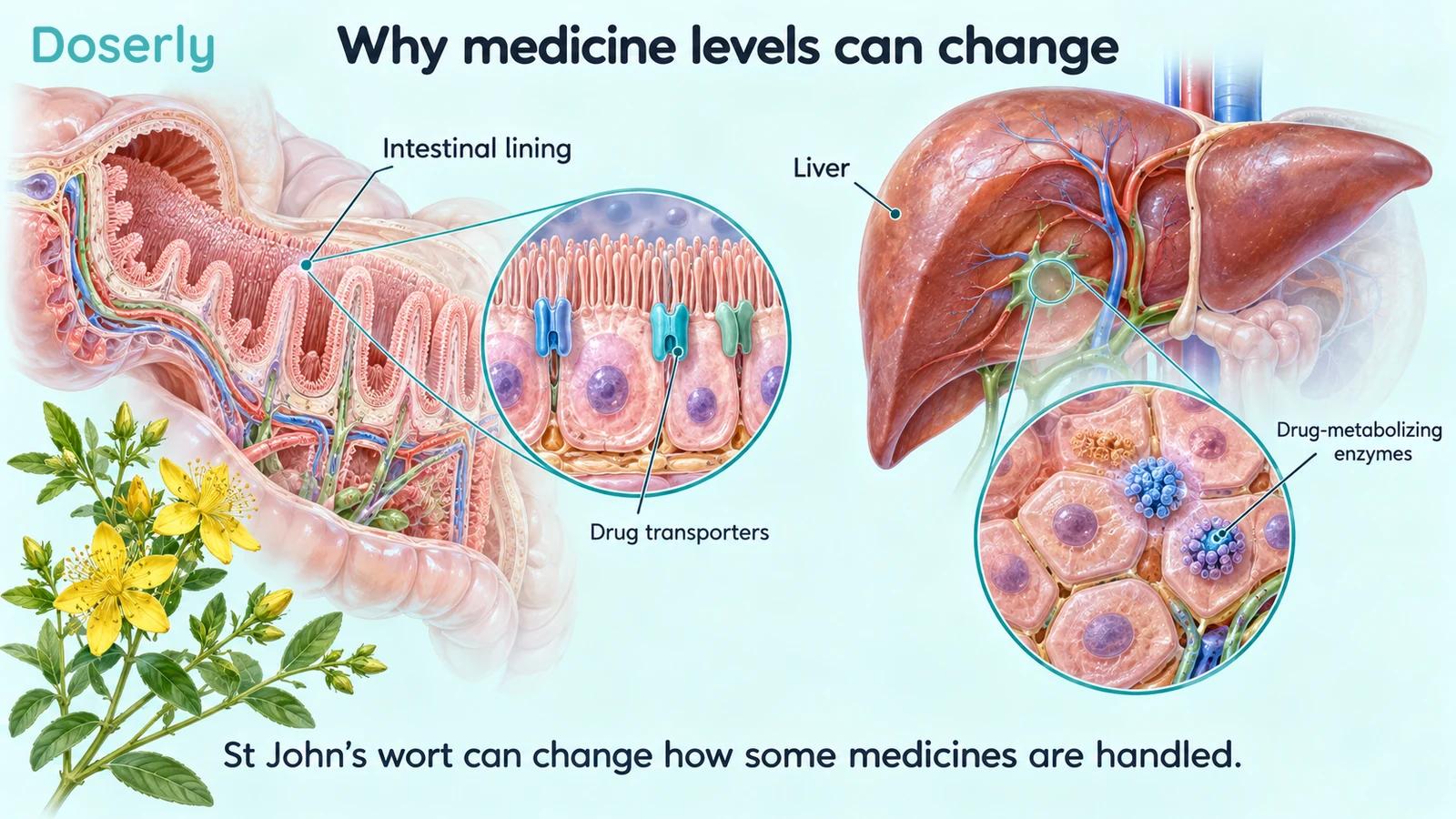
That creates a practical problem: a person may keep taking every prescription exactly as directed while receiving less effective exposure to one of them. Feeling well after adding the supplement is not enough to exclude an interaction, especially when a medicine is preventing an event rather than treating a symptom you can immediately feel.
A clear example from HIV medicine
In a 2000 pharmacokinetic study, St John’s wort reduced exposure to the HIV medicine indinavir by a mean of 57%, measured using the area under the concentration-time curve. Researchers also reported an 81% reduction in the extrapolated eight-hour trough concentration. Piscitelli and colleagues.
The area under the curve combines concentration measurements over time. The trough concerns the low concentration near the end of a dosing interval. Neither number is a percentage of people whose treatment failed: the experiment measured drug levels in healthy volunteers.
The size of those changes nevertheless shows why interaction concerns cannot be dismissed as theoretical. A medicine may depend on adequate exposure throughout its dosing interval. A supplement that substantially changes that exposure can undermine the assumptions behind the prescription.
This historical study should not be generalized to every modern HIV medicine or used to calculate a personal dose adjustment. Its lesson is to have the actual regimen checked, rather than assuming that an interaction percentage transfers from one drug to another.
What about hormonal contraception?
A small randomized interaction study enrolled 18 healthy women using a low-dose combined oral contraceptive. Adding St John’s wort increased bleeding between periods and reduced exposure to the active progestogen measured in the study. The bleeding analyses used 17 participants: bleeding occurred in 6 during the contraceptive-only cycle, compared with 13 and 15 during the two combination cycles. Pfrunder and colleagues.
Researchers did not find evidence of ovulation in that experiment. It would therefore be inaccurate to say the trial proved a particular pregnancy rate. It did show pharmacological changes and more bleeding, both relevant to contraceptive use.
Separately, the UK medicines regulator reported suspected interactions associated with unintended pregnancies, including reports involving contraceptive implants. Such reports cannot tell us how often an interaction occurs because there is no reliable denominator. They are still important safety signals. The regulator advises people using hormonal contraception for pregnancy prevention not to take St John’s wort, with method-specific considerations requiring professional advice. MHRA safety communication.
If you have already combined them, contact a pharmacist or contraceptive service promptly for advice appropriate to your method and timing. Do not wait for bleeding to decide whether a review is needed. A lack of visible symptoms is not a test of contraceptive protection.
Lower drug levels are only one kind of interaction
Some combinations raise concern because their effects overlap, rather than because one drug’s level falls. Serotonin is involved in signaling between nerve cells. Taking St John’s wort with certain antidepressants or other serotonin-affecting medicines can increase serotonin-related adverse effects, which may be serious. NCCIH also lists important interactions involving transplant, seizure, heart, cancer and other medicines. NCCIH safety information.
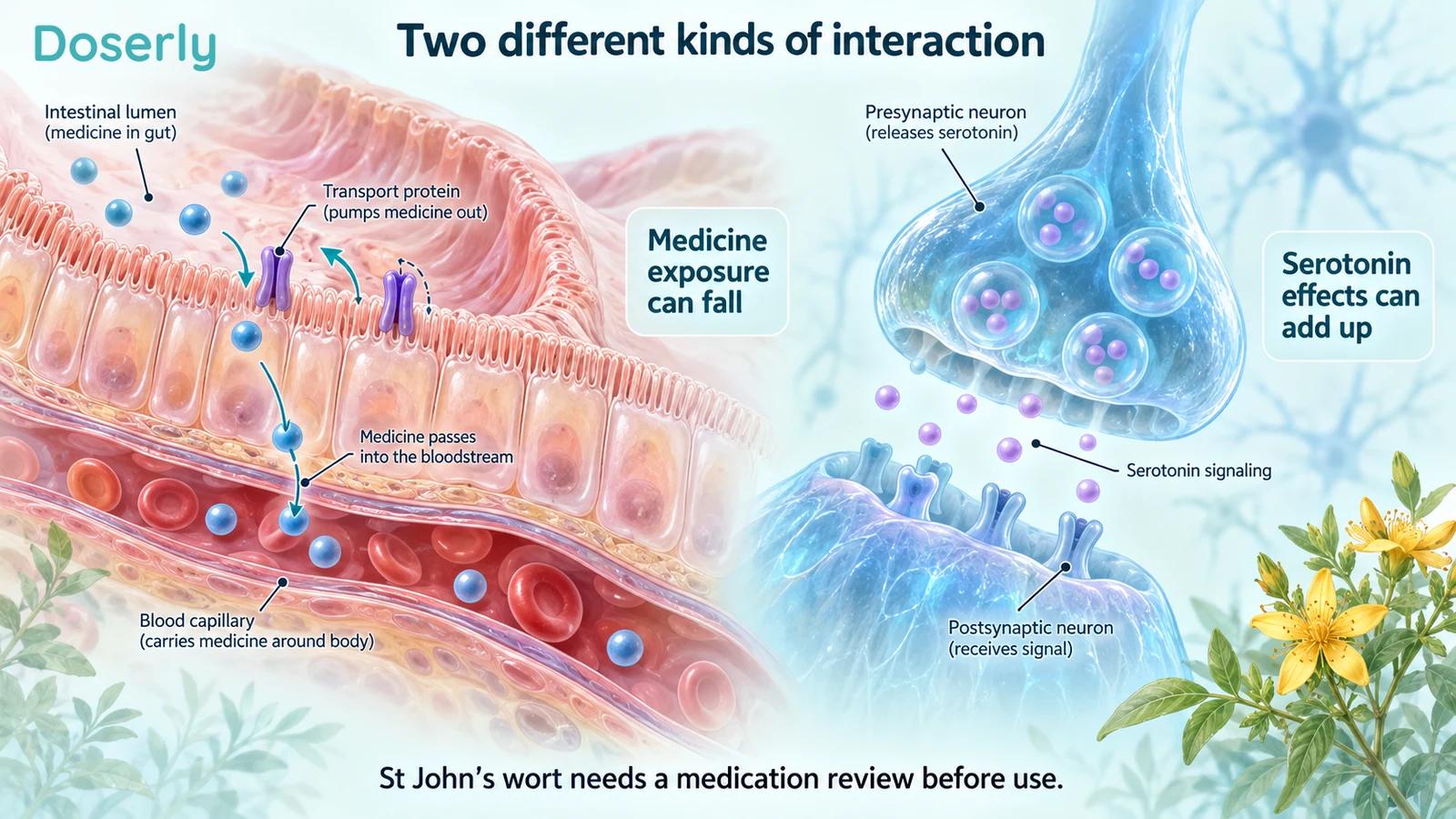
For a medication review, “antidepressant” is not enough detail. Bring the exact names, strengths and instructions, including medicines used occasionally. Include other supplements and combination products. A pharmacist can then check the actual pairings rather than relying on a broad category.
The same principle applies when someone proposes adding several mood supplements at once. More ingredients mean more questions about overlapping effects. The fact that each can be purchased separately does not establish the safety of their combination.
Why stopping also deserves attention
Interaction effects need not disappear when the final capsule leaves the stomach. In the midazolam study, 12 healthy men received St John’s wort for 14 days. Measured CYP3A activity returned progressively toward baseline about a week after stopping. Recovery study.
That finding is not a universal one-week waiting rule. The participants, preparation and probe medicine were specific. It does explain why simply separating tablets by a few hours may not solve an enzyme-mediated interaction.
It also means the clinician needs to know about stopping, not just starting. If another treatment has been adjusted while the supplement was present, changing the supplement can change the situation again. Avoid making several medication changes on your own in response to a worrying interaction list.
Record the date you started, the product used and any recent changes. If you have stopped already, say so clearly. A dated history can be more informative than an undated list of products. Include prescription-dose changes and newly added over-the-counter products, even if they seem unrelated to mood.
What would a useful treatment discussion include?
A good discussion can respect your interest in St John’s wort while keeping the whole treatment plan visible. Ask what degree and type of depression is being considered, what benefit would justify treatment and how that benefit would be assessed. Then review the preparation, medicine list and alternatives together.
Psychotherapy, medication and their combination are established parts of depression care; the appropriate plan depends on the person’s symptoms, preferences and circumstances. Persistent or worsening symptoms deserve assessment. If you may harm yourself, seek urgent help through local emergency or crisis services rather than waiting for a supplement trial. NIMH treatment information.
For routine follow-up, a simple record of mood, sleep, functioning and treatment changes can help you describe progress. It cannot prove which intervention caused a change, but it makes the conversation less dependent on remembering how you felt weeks earlier.
The decision is not settled by calling the herb natural, nor by dismissing all herbal research. St John’s wort has a clinical evidence base worth understanding. Its interaction evidence is equally relevant to whether it belongs in your own care. The complete guide can help you prepare specific questions about preparations, effects and compatibility.
Sources
- St. John’s Wort: Usefulness and Safety
- Effect of Hypericum perforatum (St John's wort) in major depressive disorder: a randomized controlled trial (2002)
- Acute treatment of moderate to severe depression with hypericum extract WS 5570: randomised controlled double blind non-inferiority trial versus paroxetine (2005)
- Indinavir concentrations and St John's wort (2000)
- Interaction of St John's wort with low-dose oral contraceptive therapy: a randomized controlled trial (2003)
- St John’s wort: interaction with hormonal contraceptives, including implants (2014)
- The recovery time-course of CYP3A after induction by St John's wort administration (2008)
- Depression