
Supplements
October 16, 2026
Senolytic supplement stacks: what cell-clearing research actually tested
On this page
Senolytic research asks whether selectively eliminating certain senescent cells can improve health. These cells have stopped dividing but can remain active, releasing substances that influence nearby tissue. The idea has attracted interest in diseases involving inflammation, scarring and age-related loss of function.
Supplement blends sometimes borrow this language, especially when they contain quercetin or fisetin. But “senolytic” describes a proposed biological action, not a guarantee shared by every product containing a familiar ingredient. Much of the human research concerns dasatinib plus quercetin, often abbreviated D+Q. Dasatinib is a prescription cancer medicine, so these studies are not ordinary trials of an antioxidant supplement blend.
The human findings are also more varied than either “proven rejuvenation” or “only mouse research” suggests. There are small tissue studies, a bone trial that missed its primary endpoint, and an October 2026 liver trial with a promising biopsy result. Understanding exactly what was tested makes those findings useful without assigning them to products the trials never examined.
Why scientists combined dasatinib and quercetin
Early experimental work investigated the survival pathways that help senescent cells resist programmed cell death, or apoptosis. Dasatinib and quercetin showed different activity across the cell types tested; combining them was intended to broaden that experimental activity. The foundational study included cultured cells and mice, rather than demonstrating a consumer anti-aging effect in people. Original senolytic discovery research
This is a specific reason for testing a specific combination. It does not imply that adding more plant compounds will reliably remove more senescent cells, or that ingredients with antioxidant properties can substitute for dasatinib. A blend could change absorption, tolerability or other pathways without reproducing the intended effect.
Our senolytics guide explains the broader category. The distinction to keep in mind here is between a substance's general biological activity and evidence that a particular intervention selectively changes a harmful cell population in a person.
What did the first human tissue study measure?
A 2019 open-label pilot treated nine people with diabetic kidney disease with D+Q for three days. Researchers collected fat tissue, skin and blood before treatment and again 11 days after it ended. They reported reductions in several senescence-related measures in fat and skin, alongside changes in circulating inflammatory factors. Hickson and colleagues
That was an important translational observation: the researchers examined biological material from treated people, rather than only exposing cells in a dish. However, there was no placebo group, and the study was very small. The sampled tissues were skin and fat; a reduction in markers there did not establish that damaged kidneys recovered or that future kidney failure became less likely.
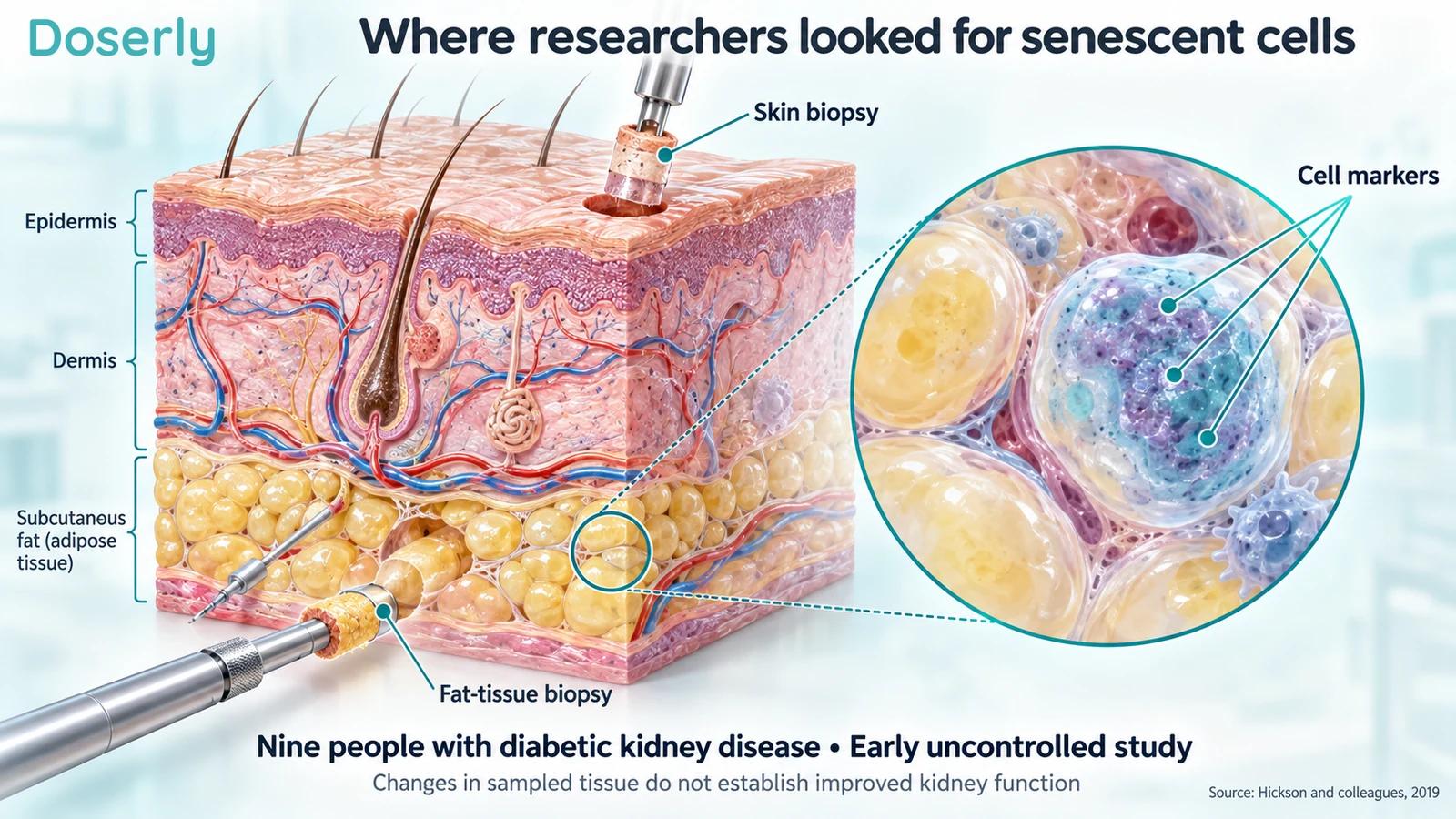
A biomarker is a measured feature that can help researchers understand a biological process. Several agreeing markers can strengthen an interpretation, but the clinical question remains separate: did patients feel better, function better or avoid a serious event? The tissue pilot supplied a reason to pursue those questions, not their final answer.
What happened in the randomized bone trial?
The 2024 phase 2 trial compared intermittent D+Q with a control group in 60 postmenopausal women over 20 weeks. The main endpoint concerned CTx, a blood marker associated with bone resorption, the breakdown side of bone remodeling. Median percentage changes were −4.1% with D+Q and −7.7% in controls, with P=.611. The primary comparison was not significant. Bone-metabolism trial
A marker of bone formation, P1NP, showed an early relative improvement, but the difference was not significant at 20 weeks. Exploratory analyses suggested that women with higher baseline senescence-related measurements might respond differently. Those subgroup findings need testing in a trial designed to evaluate that hypothesis.
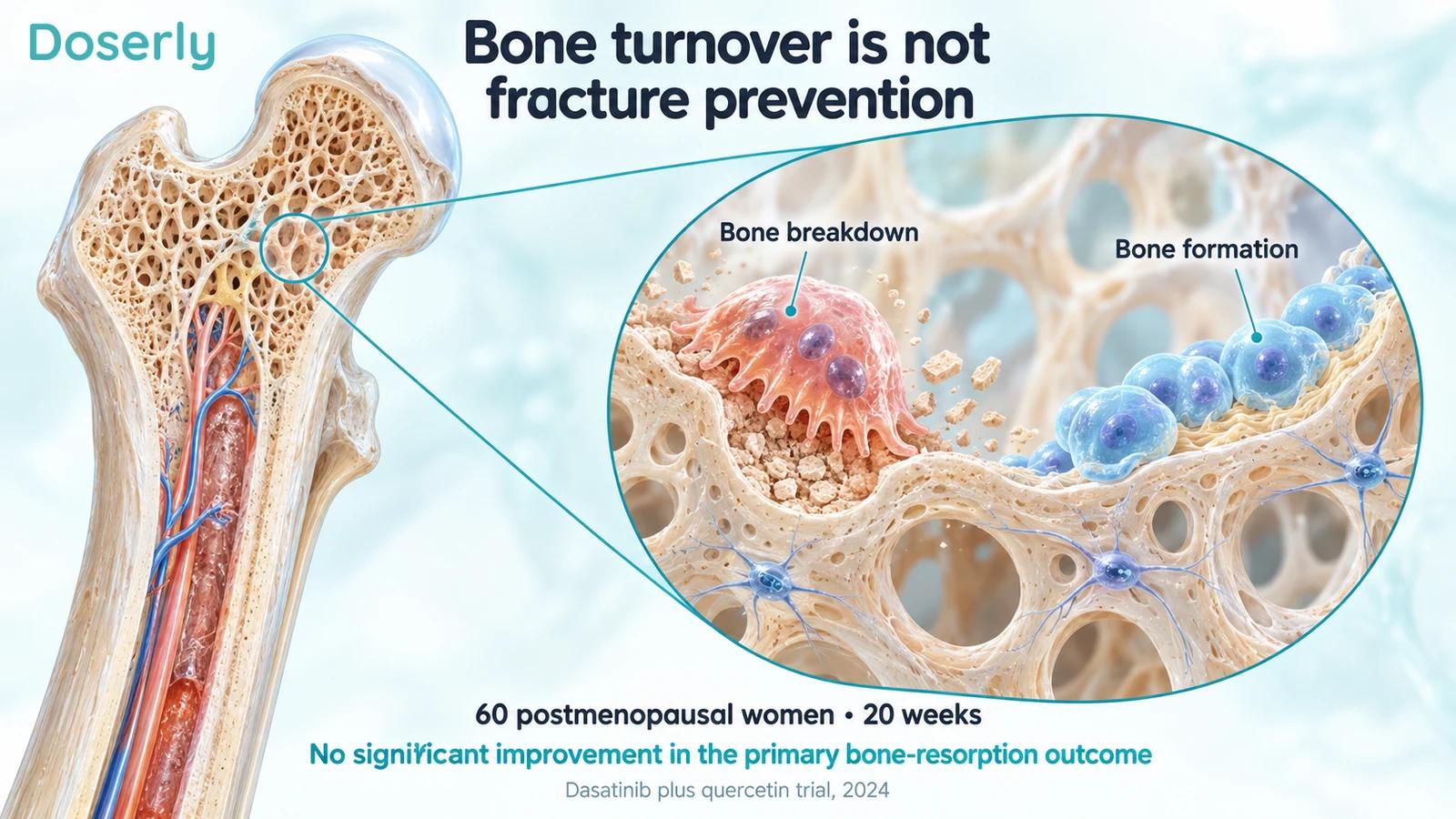
The trial is sometimes discussed as evidence that senolytics improve bone health. That description omits the negative primary endpoint and the difference between a short-term laboratory change and fracture prevention. For a person worried about osteoporosis, a transient marker response is not enough to replace an established assessment or treatment plan.
The subgroup result also doesn't provide a ready-made screening test for choosing a supplement. A measurement associated with response in an exploratory analysis must be validated before it can reliably identify who benefits. Otherwise, the apparent pattern may not repeat in a new group of patients.
Did the lung-disease research show better function?
A 2023 randomized pilot studied 12 people with idiopathic pulmonary fibrosis, a disease involving progressive lung scarring. Six received D+Q and six placebo over a three-week intervention. The main purpose was feasibility and tolerability, rather than a definitive test of whether the treatment improved breathing or physical function. Randomized pulmonary-fibrosis pilot
Participants completed the planned dosing and assessments. No serious adverse events were attributed to D+Q, but nonserious events were more numerous in the active-treatment group. The explored lung, frailty and physical-function measures did not appear meaningfully different between groups; the study was too small to provide a precise efficacy estimate.
This matters when an earlier uncontrolled improvement is used to promote a stack. A later placebo comparison can change the interpretation. Small feasibility studies help establish whether larger trials can be conducted, but “feasible” is not another word for “effective.” Nor can twelve participants rule out uncommon harms.
The October 2026 liver trial is a meaningful new result
A newer study tested D+Q in 31 people with fibrotic metabolic dysfunction-associated steatohepatitis, or MASH. This is a form of metabolic liver disease involving inflammation and liver-cell injury; fibrosis means scarring. The randomized, double-blind, placebo-controlled trial lasted 21 weeks and used paired liver biopsies. Koning and colleagues
The primary endpoint—improvement of at least one fibrosis stage without worsening MASH—occurred in 47% of the D+Q group and 7% of the placebo group. MASH resolution was reported in 53% and 7%, respectively. Adverse events were more common with D+Q, although the report describes them as self-limiting. This was a small proof-of-principle trial, not evidence of reduced liver-related death or a universal treatment effect.
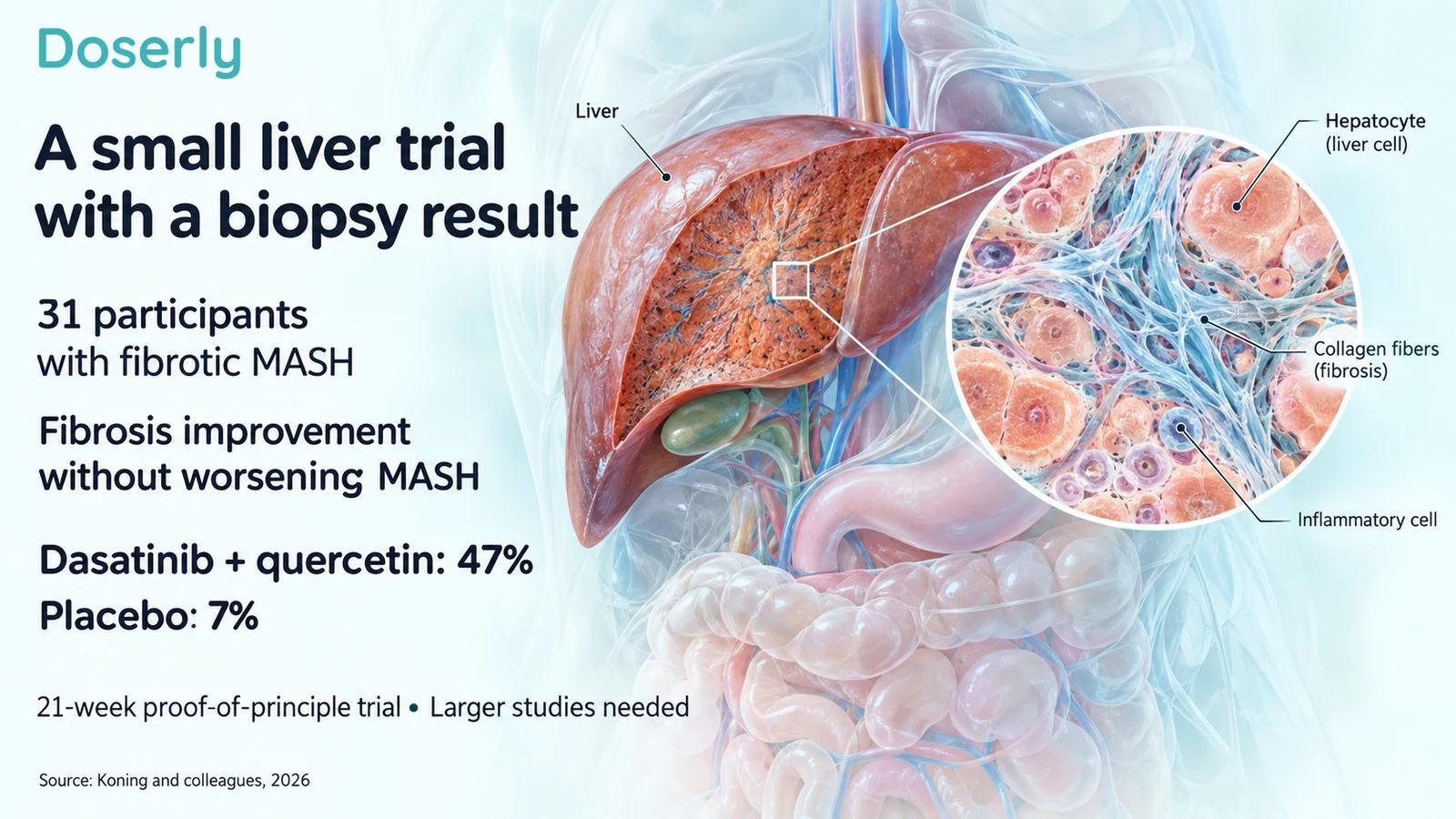
The result deserves attention because it measured a disease-related tissue outcome in a randomized comparison. It also illustrates why treatment specificity matters. These participants received dasatinib plus quercetin under a research protocol. A product containing quercetin, fisetin and several other supplements has not thereby been shown to reproduce the biopsy benefit.
Different diseases can also respond differently. A promising liver finding does not erase the bone trial's primary result or establish better lung function. Each organ, disease stage and patient group presents a distinct clinical question.
Does quercetin alone inherit the combination's evidence?
No. If a study tests two ingredients together, it estimates the effect of that tested combination against its comparator. It cannot tell us how much each ingredient contributed unless the design includes suitable single-ingredient comparisons.
For example, imagine a trial with four groups: neither ingredient, quercetin alone, dasatinib alone and both together. Such a design could help distinguish individual effects from an interaction. The human trials discussed here do not supply that complete comparison for every outcome. Replacing one component with another flavonoid introduces another unanswered question.
This is especially relevant to labels that cite D+Q research but sell only nutritional ingredients. The shared word “quercetin” creates a connection, but the intervention is materially different. Our quercetin guide covers studies of that compound in other settings; those results should be assessed on their own terms.
What about intermittent or “pulse” schedules?
Senolytic researchers have explored intermittent administration because the proposed action involves changing a cell population rather than maintaining constant occupancy of a receptor. Experimental schedules differ by study and have been accompanied by eligibility rules, monitoring and follow-up. Early human tissue study
That rationale doesn't identify a proven monthly routine for healthy adults. Questions about tissue exposure, which cells are affected, how long an effect lasts and when harms occur remain relevant even when treatment is brief. A few days of exposure is not automatically low risk, particularly when a prescription drug is involved.
It is also inappropriate to interpret a headache or a period of feeling unwell as evidence that senescent cells are being cleared. These are symptoms to evaluate. They do not measure target engagement, and calling them an expected “detox” response can obscure an adverse effect or an unrelated illness.
The prescription-drug risks are part of the evidence
Dasatinib's prescribing information warns about reduced blood-cell counts, serious bleeding, fluid retention and other adverse effects. It also describes clinically important interactions. Those warnings come largely from its use in cancer treatment; they cannot be used to calculate the exact risk of every experimental intermittent regimen. They do show why its presence changes the clinical decision substantially. Current dasatinib labeling
Likewise, the absence of serious events in a small senolytic trial does not cancel known drug risks. Researchers often exclude people with particular conditions or interacting treatments. A person buying a stack may not resemble the carefully selected participants, and a supplement-only blend has its own uncertainties rather than the combination's established profile.
The useful discussion with a clinician is specific: what is the target condition, what benefit is supported for this exact intervention, and what monitoring or alternative treatment is appropriate? The answer may be different for a person with serious disease considering a clinical trial than for a healthy person hoping to slow aging.
How to evaluate a product without mistaking it for the trial
Read the actual ingredient amounts and formulation rather than relying on the category name. Check whether the cited human study tested that product, the same combination or only one ingredient in another setting. A proprietary mixture can make this comparison particularly difficult if individual quantities aren't clear.
Next, identify the promised outcome. “Supports antioxidant defenses,” “lowers an inflammatory marker,” “reduces senescence markers” and “prevents disability” describe progressively different claims. Evidence for one does not silently establish the others. A useful product-specific trial would need to measure the benefit being advertised and report adverse effects, withdrawals and the comparison with its control group.
Finally, consider what would change your decision. A dated medication and symptom record can help a clinician assess tolerability. It won't show how many senescent cells are present or prove that a blend works. For a health concern such as worsening mobility or liver disease, the priority is a condition-specific evaluation rather than trying to infer a cellular diagnosis from symptoms.
The most promising part of senolytic research is its movement toward direct human tests. Those tests are beginning to produce both positive and negative findings. Keeping their interventions and outcomes intact is what allows the science to inform care; treating every supplement stack as equivalent would discard precisely the details that make the research useful.
Sources
- Original senolytic discovery experiments (2015)
- D+Q tissue pilot in diabetic kidney disease (2019)
- Randomized bone-metabolism trial (2024)
- Randomized pulmonary-fibrosis feasibility trial (2023)
- Randomized MASH proof-of-principle trial (2026)
- Dasatinib prescribing information