
Peptides
October 16, 2026
Semax and focus: what stroke studies can—and cannot—tell us
On this page
Semax is often described as a focus peptide, with stroke research offered as evidence that it helps the brain work better. That sounds plausible until you ask what “better” meant in the study. Recovering movement after a brain injury, changing a resting brain scan and sustaining attention during an ordinary workday are different outcomes.
There is human Semax research, including an older, small placebo-controlled performance experiment in healthy workers. It would be inaccurate to dismiss the literature as entirely animal research. It would be equally inaccurate to treat that collection of studies as proof of a reliable, broadly applicable focus benefit.
The most useful way to read it is to keep the population, comparison and measurement attached to each result. Our Semax guide covers the wider compound background; this article examines the particular leap from stroke recovery to healthy-adult enhancement.
Recovery starts from a different problem
A stroke study asks whether a treatment improves outcomes in people with an acute injury or persistent consequences of that injury. Participants may have impaired movement, speech or independence. Their care includes other treatments and, depending on the stage, rehabilitation.
A healthy-adult focus claim starts somewhere else. The person may want fewer distractions, more accurate work or less fatigue without having the neurological injury represented in the stroke trial. Even if an intervention helped an injured system, that would not establish an additional benefit in someone whose baseline function was different.
Consider a hypothetical study that improves the ability to dress independently after stroke. That would be a meaningful clinical result. But it would not show that an office worker finishes a complex report faster, makes fewer errors or remembers more of a meeting. The value of the first outcome does not make it a substitute for the second.
This is a question of applicability, not a judgment that one population matters more. Good evidence addresses the person and goal for which a claim is being made.
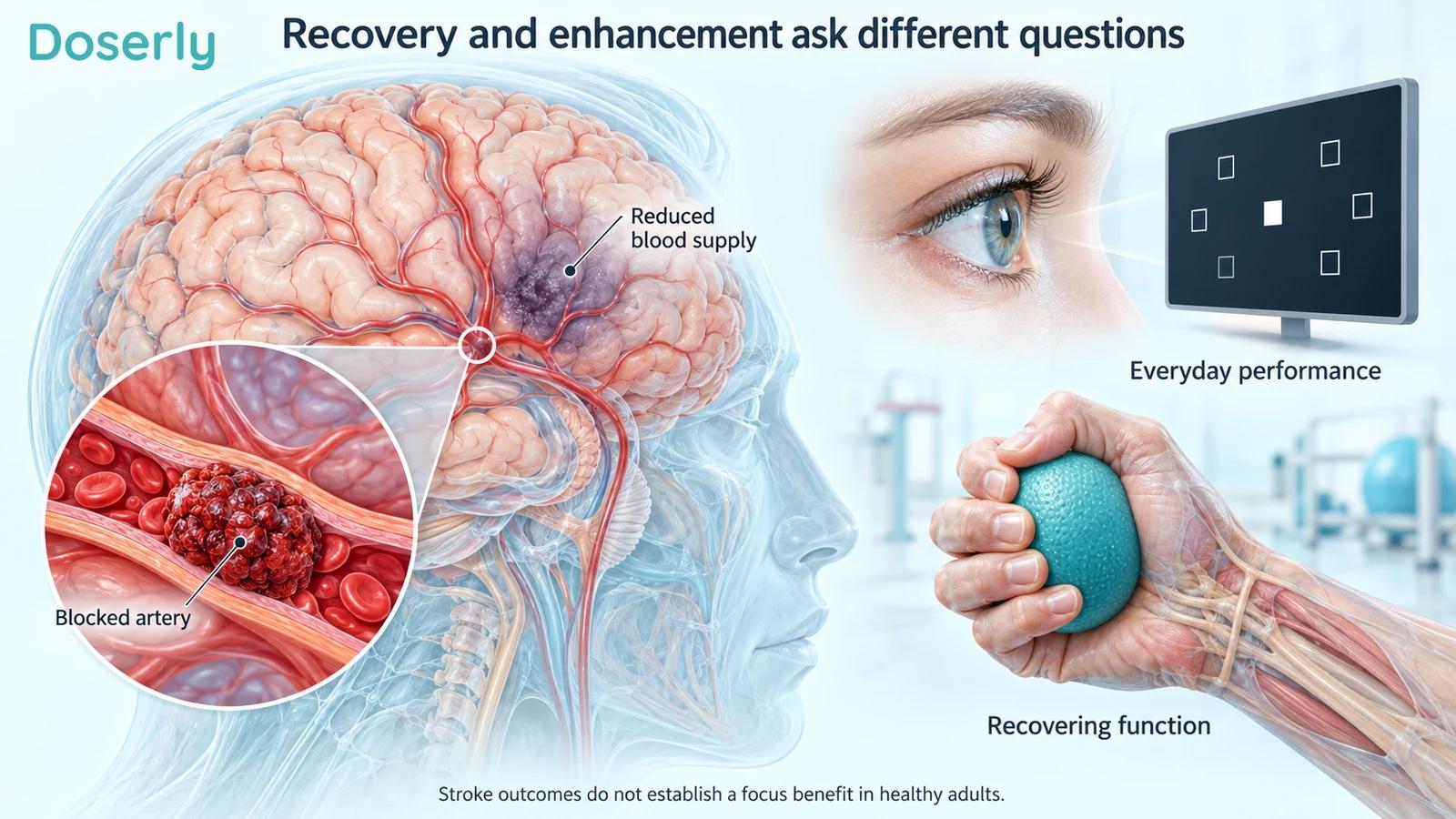
What the early stroke report measured
A 1997 primary report described 30 acute ischemic-stroke patients receiving Semax alongside background treatment and 80 control patients receiving background treatment. It assessed neurological scales and electrical measures of brain function, reporting faster recovery of some deficits, particularly movement-related problems. The full Russian report also included comparisons with previously studied treatments.
These are clinical observations in an acutely ill population. The methods available in that report do not justify relabeling it as a modern, fully blinded randomized trial. Matching or describing similar severity is not the same as demonstrating concealed random allocation. Original stroke report.
For interpretation, the relevant question is the difference between comparable groups receiving otherwise comparable care. Improvement within the treated group alone is insufficient because recovery can occur during follow-up. How patients enter each group, who knows the treatment and how outcomes are rated all affect confidence in the comparison.
The report is part of the history of Semax research. Its existence should be acknowledged without turning its conclusion into a blanket claim about cognitive enhancement.
Later rehabilitation research is still rehabilitation research
A 2018 study involved 110 people at different stages after ischemic stroke. It compared groups receiving or not receiving Semax within earlier and later rehabilitation periods. Outcomes included plasma brain-derived neurotrophic factor, motor scores and the Barthel Index, a measure of daily functioning. The authors reported higher BDNF and better recovery-related findings with treatment. Rehabilitation study.
The indexed abstract does not provide enough information to establish the strength of allocation concealment, blinding or a precise treatment effect with confidence intervals. That limits how confidently its favorable conclusion can be translated into a treatment estimate.
It also illustrates a second issue: a study can contain both a biomarker and a functional outcome without proving that the biomarker caused the functional change. A relationship between two measurements is not a demonstration that changing one necessarily produces the other.
Most importantly for a focus claim, this was not a study of healthy students, shift workers or adults seeking better concentration. The participants' injury, recovery stage and background care remain part of the finding.
There is an older healthy-worker experiment
A 1996 paper included a double-blind experiment in 16 male power-plant operators, with eight randomly assigned to Semax and eight to placebo. Participants completed a computerized number-recognition task across two working days. The authors reported favorable changes in some performance measures, while also describing a false-response finding they could not fully explain. Original performance paper.
That is more directly relevant to attention than a stroke motor score. It should not disappear from an honest evidence summary. But eight people per group and a short observation window leave substantial uncertainty about the size, consistency and generalizability of any benefit.
The paper does not establish improved work performance across occupations, ages or sexes, or the effects of repeated use over months. Its mixed task findings also caution against reducing several measurements to one label such as “better cognition.”
A reasonable description is an early human performance signal that warrants stronger replication. “No human evidence” is too broad; “proven focus enhancer” is much stronger than this experiment supports.
A brain scan can change without answering the focus question
In a 2018 healthy-volunteer study, 24 participants underwent resting-state functional MRI. Fourteen received Semax and ten received placebo. Scans before and shortly after administration examined components of the default mode network. The reported change concerned the extent or connectivity of a network component in the imaging analysis. It did not demonstrate new brain tissue or improved everyday attention. Default-mode-network study.
A 2020 connectomic study included 52 volunteers across Semax, Selank and placebo conditions. That total should not be presented as 52 Semax-treated participants. Its endpoints again involved functional connections measured at rest, rather than a demonstrated improvement in work, study or clinical symptoms. Connectomic study.
Imaging can help researchers investigate whether and how an intervention affects measured brain activity. It is not an automatic verdict on usefulness. A network's name can sound relevant to attention, but that does not make every increase or decrease beneficial.
Even a real biological effect may have no noticeable benefit, may help one task while impairing another, or may depend on the circumstances. Those possibilities need direct testing rather than interpretation from a colorful brain image.
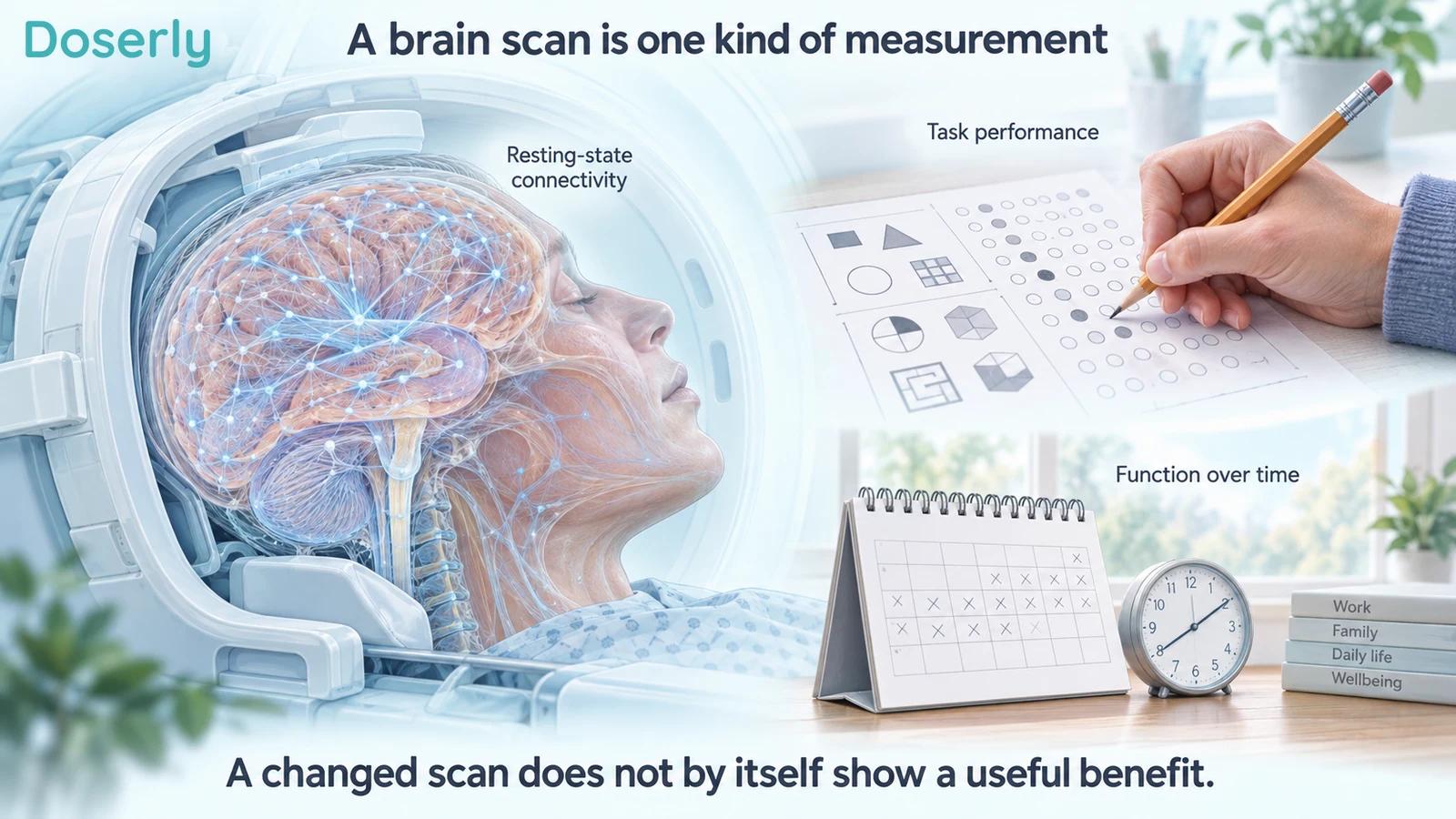
“Statistically significant” is only part of the answer
A statistically significant result addresses a particular analysis under particular assumptions. It does not tell you, by itself, whether the improvement is large enough to matter or likely to persist.
For a practical focus benefit, a study would need to show what changed in understandable terms. Did people make fewer errors? Complete a task more accurately? Sustain performance longer? A small change in a laboratory score might be valuable, trivial or offset by another effect; the number alone needs context.
Precision matters too. With a small sample, the estimated benefit may be uncertain even when a reported comparison crosses a significance threshold. Repeating the study in a larger, independently recruited population helps distinguish a durable finding from one that depends on a particular sample or analysis.
The number of outcomes also matters. If researchers explore many tasks, time points and brain regions, the interpretation of an isolated positive finding differs from a clearly specified primary result. A persuasive summary should show the full pattern, including neutral or unfavorable findings.
These principles do not invalidate an early study. They explain why early signals and established benefits are different stages of evidence.
Another useful check is whether two references describe independent participants. A translated paper, a later analysis and a database abstract can all refer to one experiment. Repeated appearances of a finding are not the same as replication in a new sample. This matters especially when the available human literature is small.
What a convincing focus trial would look like
The claim should first be made concrete. “Better brain function” is too broad to test usefully. A trial might instead examine sustained attention in healthy adults during a defined task, with accuracy and errors measured together.
A strong design would specify the main outcome before looking at the results, randomly assign participants to a matched comparison and keep participants and assessors unaware of assignment where feasible. It would report who entered, who withdrew and how missing measurements were handled.
The follow-up would need to match the promise. An acute experiment can address an acute effect; claims about a productive month require longer observation. Repeated testing also needs attention to practice effects, because familiarity with the task can improve scores without a treatment effect.
Safety belongs in the same experiment. Feeling more alert is not enough if sleep, anxiety or another important function worsens. A useful trial examines the overall tradeoff and reports unwanted events, rather than assuming that a peptide is gentle because its name sounds biological.
Independent replication would then test whether the result survives a new setting and research team. That is particularly important before generalizing from a specialized worker sample to everyday use.
Product and route are part of the claim
Even a well-conducted trial would support the preparation and exposure actually studied. It would not automatically validate a differently manufactured vial, another route or a chemically modified derivative sold under a related name.
The distinction is easy to lose when an online discussion links to a human paper and then recommends a different product. The citation may be real while the connection to the product remains untested. Identifying the molecule, formulation and route is therefore part of reading the evidence, not a technical distraction.
A 2026 FDA advisory briefing stated that the evaluated Semax substances were not components of FDA-approved drugs. It also explained that incomplete verified English translations limited consideration of several Russian-language reports. The document was staff material for an advisory process, not itself a final regulatory determination. FDA briefing.
That regulatory context cannot replace a scientific appraisal. It does, however, make it inappropriate to imply that US approval has established safety and effectiveness for everyday concentration.
A more useful way to assess a focus claim
When someone says Semax “works,” identify the result behind the statement. A stroke recovery score, a short number-recognition task and an MRI connectivity finding may each be interesting, but they should not be merged into one outcome.
Then ask whether the proposed use matches the studied person, product and time frame. An honest answer may be that there is a preliminary signal, with important questions still open. That is more informative than either dismissing every study or treating all positive results as interchangeable.
For a personal concern about concentration, describe the actual problem: when it occurs, how long it has lasted and what it interferes with. A clear account of the difficulty is more useful for assessment than assuming that a research mechanism identifies the right treatment.
The Semax literature contains reasons for further investigation. It does not currently provide a dependable basis for promising a healthy adult a sustained focus boost from stroke findings, a small early performance study or an acute brain scan.
Sources
- 1997 acute-stroke primary report
- 2018 stroke rehabilitation study
- 1996 healthy-volunteer performance paper
- 2018 default-mode-network study
- 2020 connectomic study
- 2026 FDA advisory briefing