
Peptides
October 16, 2026
Semax nasal products: why the formulation is part of the evidence
On this page
Semax is often discussed as though the name identifies a single, interchangeable treatment. In practice, a clinical report about nasal drops, an online spray and a vial intended for injection can refer to quite different products. Even when they contain the same peptide, the amount reaching a tissue and the risks accompanying it may differ.
That matters if you're trying to understand whether a study applies to a product you're considering. A result belongs to the treatment the researchers actually used: its ingredient, formulation, route, delivery device and schedule. Changing one of those features requires evidence that the comparison still holds.
The Doserly Semax guide introduces the compound and its clinical history. This article explains why nasal delivery deserves closer attention, what the absorption experiments measured and why a purity percentage cannot answer every product-quality question.
The nose is a biological surface
A nasal product first encounters the lining of the nose. That lining has mucus, cells and a blood supply. Much of the respiratory lining also has cilia, small moving structures that help clear material. A substance deposited there does not simply pass unchanged into the brain.
Researchers need to understand where the preparation lands, how long it remains, how much dissolves and how much intact substance is absorbed. Some material may be cleared or broken down before reaching the tissue being studied. These questions concern the entire formulation, not just the name of its main ingredient.
For nasal sprays generally, FDA's chemistry and manufacturing guidance treats the formulation, container and delivery system as important product characteristics. Testing a finished spray involves more than confirming that its ingredient can be detected in a bottle. FDA nasal-product guidance.
For Semax specifically, this means a drawing of the nose beside a brain is not proof of efficient brain delivery in humans. A proposed route is a biological possibility to investigate. The amount and timing of delivery require measurements.

What did the rat nasal experiment find?
A 2006 study administered radiolabeled Semax intranasally to rats. Radiolabeling attaches a detectable isotope so researchers can track material associated with the administered substance. Importantly, they also examined whether the detected material was intact Semax or breakdown products.
Two minutes after administration, the investigators found 0.093% of the introduced radioactivity per gram of brain tissue. About 80% of that radioactivity was attributed to Semax at that sampling point. They also described rapid enzymatic breakdown, with the fragment Pro-Gly-Pro prominent among the measured substances. Original rat kinetics study.
The denominator is essential: per gram of brain tissue is not the same as the fraction of the total dose found in the whole brain. Nor is radioactivity automatically equivalent to intact, pharmacologically active peptide. A label can remain detectable after a molecule has changed.
These findings establish that researchers detected the peptide and its products in an animal experiment. They do not establish human nasal bioavailability, a universal time to onset, or a percentage of an online spray that reaches the brain. Rat nasal anatomy, experimental administration and sampling are not a direct substitute for human product testing.
The study's short sampling intervals also answer a distribution question, not a duration-of-benefit question. Detecting material quickly does not demonstrate improved concentration quickly, and rapid degradation does not by itself establish how long any biological effect persists.
Why intravenous findings do not solve the comparison
An earlier study examined radiolabeled Semax after intravenous injection in rats. Using chromatography to separate substances in blood and brain extracts, the investigators detected peptide in brain tissue and estimated that the amount did not exceed 0.01% of the injected dose. 1991 rat intravenous study.
That result is sometimes placed beside the nasal finding to imply one route is dramatically more efficient. The two numbers cannot support that calculation. The studies used different administration routes, sampling conditions and denominators. One reported radioactivity per gram at a specified time; the other described an amount relative to the injected dose.
They also did not compare the same finished nasal and injectable products head to head in people. A direct route comparison would ideally use a common analytical method, comparable exposure definitions and a design that separates intact peptide from metabolites.
The broader point is practical: an injection bypassing the nasal surface does not automatically mean it has a better benefit–risk balance. It creates a different treatment exposure. Evidence for one route cannot be converted into instructions for another by adjusting a number.
What do human studies add?
Human Semax reports provide evidence of administration and measured outcomes in particular settings. They do not fill every pharmacokinetic gap. Pharmacokinetics describes what the body does to a substance: absorption, distribution, metabolism and elimination.
For example, a small 2018 study compared intranasal Semax with placebo in 24 healthy volunteers using resting-state brain scans. A difference in a brain-network measurement suggests a reason for further investigation. It does not reveal a blood concentration curve, the fraction absorbed or an equivalent injected amount. Human imaging study.
In its 2026 review, FDA reported that it could not identify human pharmacokinetic studies for the evaluated Semax free-base or acetate substances by any route, and did not identify clinical safety literature for the proposed subcutaneous route. FDA Semax briefing, pages 37–40.
An observed human effect and a complete account of delivery are therefore separate pieces of evidence. A compound can warrant clinical research while important questions about exposure remain unanswered. Those gaps become especially consequential when a new product changes the formulation or route.
Drops and sprays are not measured in the same way
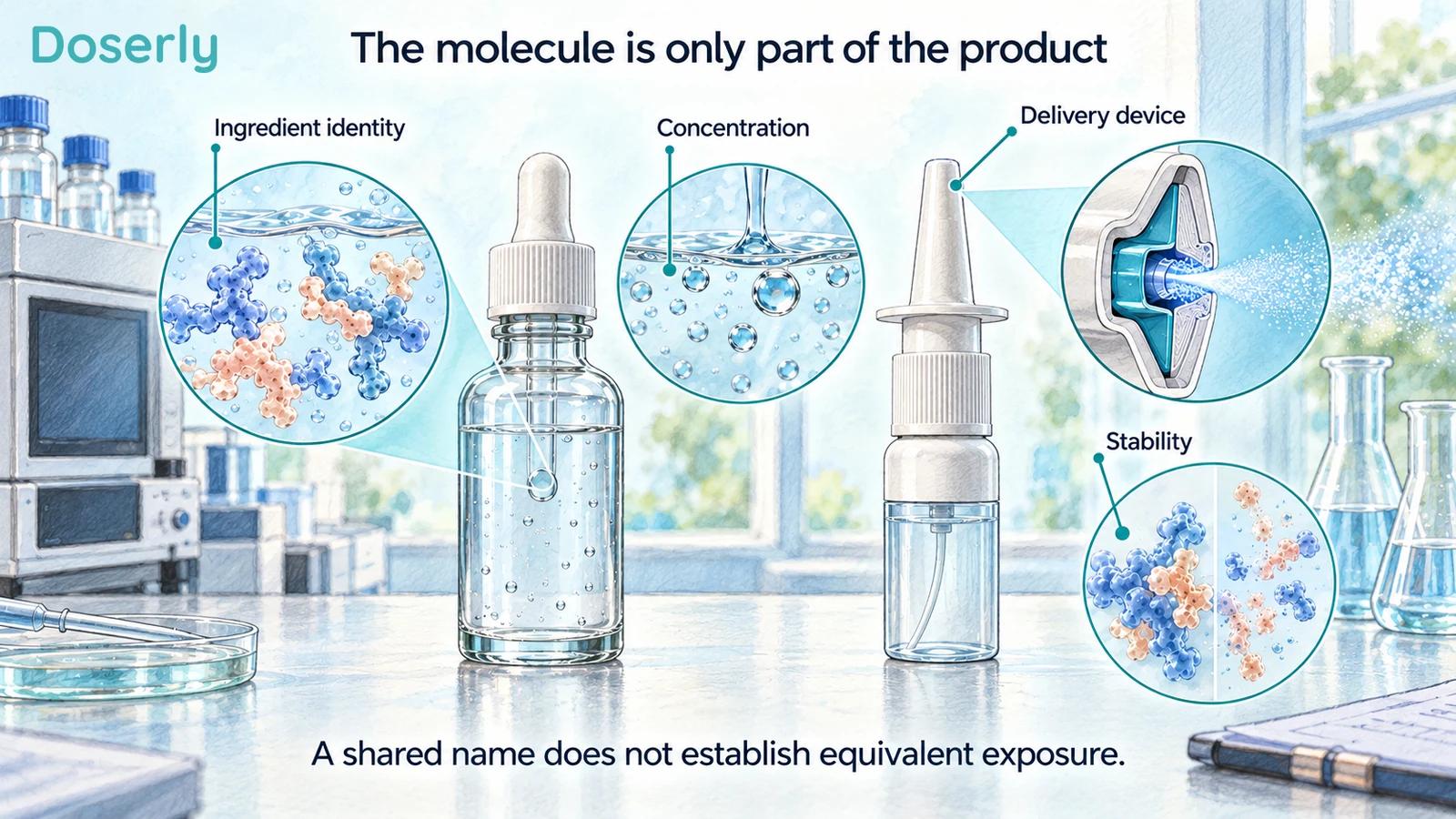
A dropper and a metered spray deliver liquid differently. Concentration tells you how much ingredient is present in a volume. It does not, by itself, tell you how much liquid the device releases during use, where that liquid deposits, or how much is absorbed.
A spray's performance can depend on the pump and nozzle as well as the liquid. A drop size is also a property of the actual delivery system, not a universal unit that can be transferred from every bottle to every other bottle.
Consider a hypothetical comparison between two products with the same stated concentration. If their devices deliver different volumes, the nominal amount delivered will differ. Even if the delivered amounts match, that still doesn't demonstrate matching absorption. This example explains the quantities involved; it is not a calculation for using Semax.
The general FDA nasal-product guidance is relevant because it addresses the need to characterize the finished delivery system. It does not endorse Semax or establish that a particular untested spray is equivalent to the drops used in a publication. Nasal-product manufacturing guidance.
What does “Semax” identify on a label?
Product identity starts with the actual substance. A peptide sequence, a salt form and a chemically modified derivative are related concepts, but they should not be casually collapsed into one name.
The 2026 FDA review evaluated Semax free base and Semax acetate separately and noted inconsistent naming among commercially described substances. It also discussed incomplete information about impurities, aggregation and stability in proposed products. FDA Semax briefing, chemistry assessment.
An acetate salt is not the same concept as adding an acetyl group to the peptide. A salt description concerns the chemical form of the preparation; a covalent modification changes the molecule itself. Similar-sounding labels can therefore hide a meaningful distinction.
For the reader, the useful question is whether the exact identity in a product record matches the identity in the supporting research. If that cannot be established, a claim of equivalence is premature. Adding a familiar peptide name to the front of a longer product name does not supply the missing comparison.
What can a laboratory analysis establish?
Analytical scientists have identified Semax and Selank in suspicious pharmaceutical preparations. A 2020 paper described two encountered preparations and developed a liquid chromatography–tandem mass spectrometry method for screening a wider group of putative cognitive-enhancing peptides. Original analytical study.
That kind of work is valuable because it helps establish what a sample contains. It should not be retold as a clinical trial, a survey of every supplier, or evidence that all products are contaminated. The study addressed identification and analytical methodology.
Identity, amount, purity and microbiological quality are different questions. A method that detects the intended peptide may not determine every impurity or prove that a finished preparation remains suitable throughout storage. A purity percentage also needs context: what method produced it, what substances could the method detect, and what sample was tested?
There is a further distinction between testing a raw ingredient and testing a finished bottle. The latter includes the liquid formulation, container, device and time since manufacture. A certificate for an earlier material cannot automatically answer questions about a later product.
This is why a photograph of a certificate is a starting point for product review, not a complete safety conclusion. A pharmacist or clinician needs the underlying product information and relevant testing, rather than a headline number alone.
Why storage claims need product-specific support
Peptides can change during handling and storage. Whether that matters for a given preparation depends on the molecule, liquid environment, packaging and conditions. An assay performed immediately after manufacture does not establish stability months later.
A defensible shelf-life statement requires data on the particular product under the conditions being recommended. General statements about dry powder or another formulation are not enough to establish the behavior of a liquid spray after opening.
The same principle applies to apparent normality. A clear solution may look unchanged even when an analytical property has changed. Conversely, appearance alone cannot identify the substance responsible for a visible change. Product-quality decisions require appropriate testing and professional guidance.
The FDA briefing raises stability and aggregation questions for Semax-related products; it does not provide a universal home-storage protocol. Readers should not infer one from a research chemical supplier's conditions or from an animal paper. Semax product-quality assessment.
How to discuss the actual product
If a clinician proposes Semax, ask for the formulation used in the evidence being cited and how it relates to the proposed preparation. Useful details include the exact chemical identity, route, concentration, delivery device and finished-product quality information.
Ask what is known about human exposure and what remains an assumption. If a nasal study is being used to support an injection, or a drop study to support a spray, ask for the comparison that connects them. The absence of that comparison does not prove the products behave differently; it means equivalence has not been established.
Keep the clinical goal in view as well. Even a well-characterized product needs evidence that it helps with the problem being treated. Chemical identity cannot establish improved cognition, and a clinical report cannot by itself certify a different product's quality.
The Semax guide offers the broader clinical context. The formulation lesson is straightforward: the product is part of the treatment, so the product must also be part of the evidence.
Sources
- FDA Semax-related bulk substance briefing, 2026.
- FDA nasal spray and inhalation product chemistry and manufacturing guidance, 2002.
- Semax penetration into rat brain and blood after intranasal administration, 2006.
- Entry into rat brain following intravenous injection, 1991.
- Semax and the default mode network, 2018.
- Identification of cognitive-enhancing research peptides in seized preparations, 2020.