
Peptides
October 16, 2026
Semax derivatives: why “stronger” needs its own evidence
On this page
A product described as “enhanced Semax” may sound like a newer version of an established treatment. The name suggests continuity, while words such as acetylated, amidated or longer-lasting suggest an improvement. But a chemical modification is a new question to investigate, not a clinical upgrade already demonstrated.
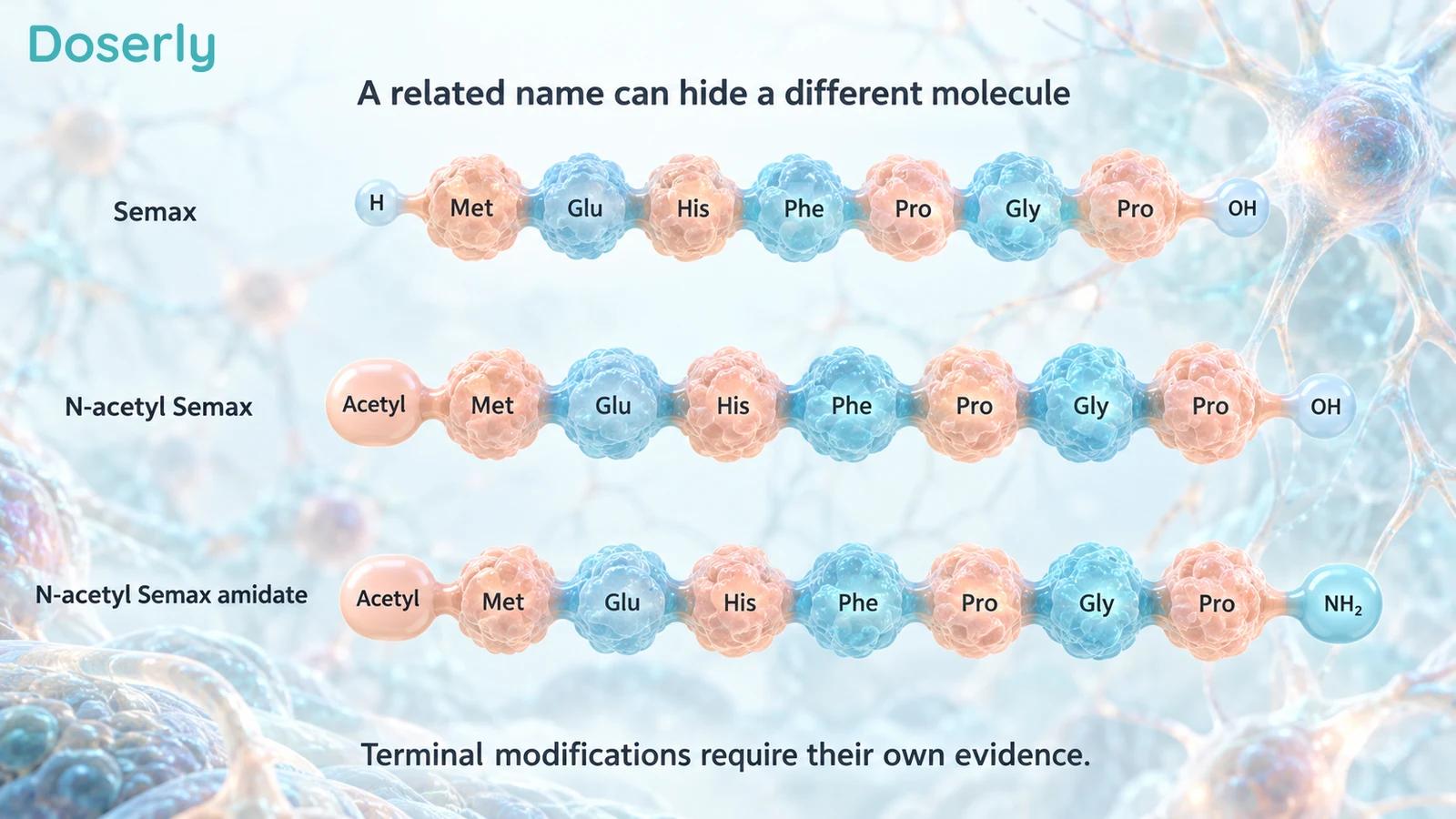
The first task is to identify the actual compound. Semax, an acetate salt, an N-acetyl derivative and an N-acetyl amidated derivative are not interchangeable descriptions. A paper about one cannot automatically establish the benefits, exposure or safety of another.
This matters because the parent Semax evidence is already specific to particular experiments and populations. Adding another layer of chemical difference makes accurate attribution more important. Our Semax guide introduces the parent compound; this article explains how to evaluate claims about related products without treating a family resemblance as proof.
Start with identity, not the product's ranking
A product name can be a shorthand. It may omit whether the peptide has a free acid or amide at one end, which salt is present, or whether a marketed label refers to a consistently specified structure.
For evidence appraisal, the useful description is the actual sequence and chemical modifications, together with the formulation and route. That allows a reader to ask whether the substance in a cited experiment is the substance being discussed.
A ranking such as “basic,” “advanced” and “maximum strength” does not provide this information. It may describe a seller's product range while implying a scientific comparison that has never been performed.
Before asking which version works best, establish whether the versions have even been compared. If the answer is unknown, the ranking belongs to marketing rather than to a demonstrated clinical hierarchy.
Acetate is not the same word as acetyl
An acetate salt and an N-acetyl modification refer to different kinds of chemistry. A salt involves the charged form and its associated counterion. N-acetylation changes the peptide covalently at its amino terminus.
The similar spelling can obscure that distinction. “Semax acetate” should not be casually shortened into “acetyl Semax,” nor should evidence about a salt be described as if it tested an acetylated analogue.
FDA's 2026 Semax advisory briefing explicitly discusses the evaluated free-base and salt forms, while distinguishing chemical entities with different active moieties. It does not establish that all substances carrying the Semax name are therapeutically interchangeable. FDA briefing.
Even salt and formulation differences can require attention to product characterization. The point is not that every naming difference has the same biological consequence. It is that the difference must be identified before anyone can assess what evidence bridges the products.
Acetylation and amidation are separate modifications
N-acetylation concerns one end of the peptide. C-terminal amidation concerns the other. A compound can therefore be acetylated without being the same structure as an acetylated-and-amidated compound.
PubChem contains a record for N-acetyl Semax amidate and a separate record with an N-acetyl Semax free-acid structure. Their recorded structures and formulas differ. These entries help identify what is being named; they do not show that either compound improves cognition. Amidated record, free-acid record.
A database identifier is useful when it resolves ambiguity. It is not a clinical credential. Nor does a matching identifier on a sales page independently verify the contents of a particular batch.
The distinction is especially important when one source abbreviates a name and another spells out both terminal changes. Without checking the structure, an apparent comparison between two products might be comparing different compounds—or using different names for the same claimed compound.
What “more stable” would need to mean
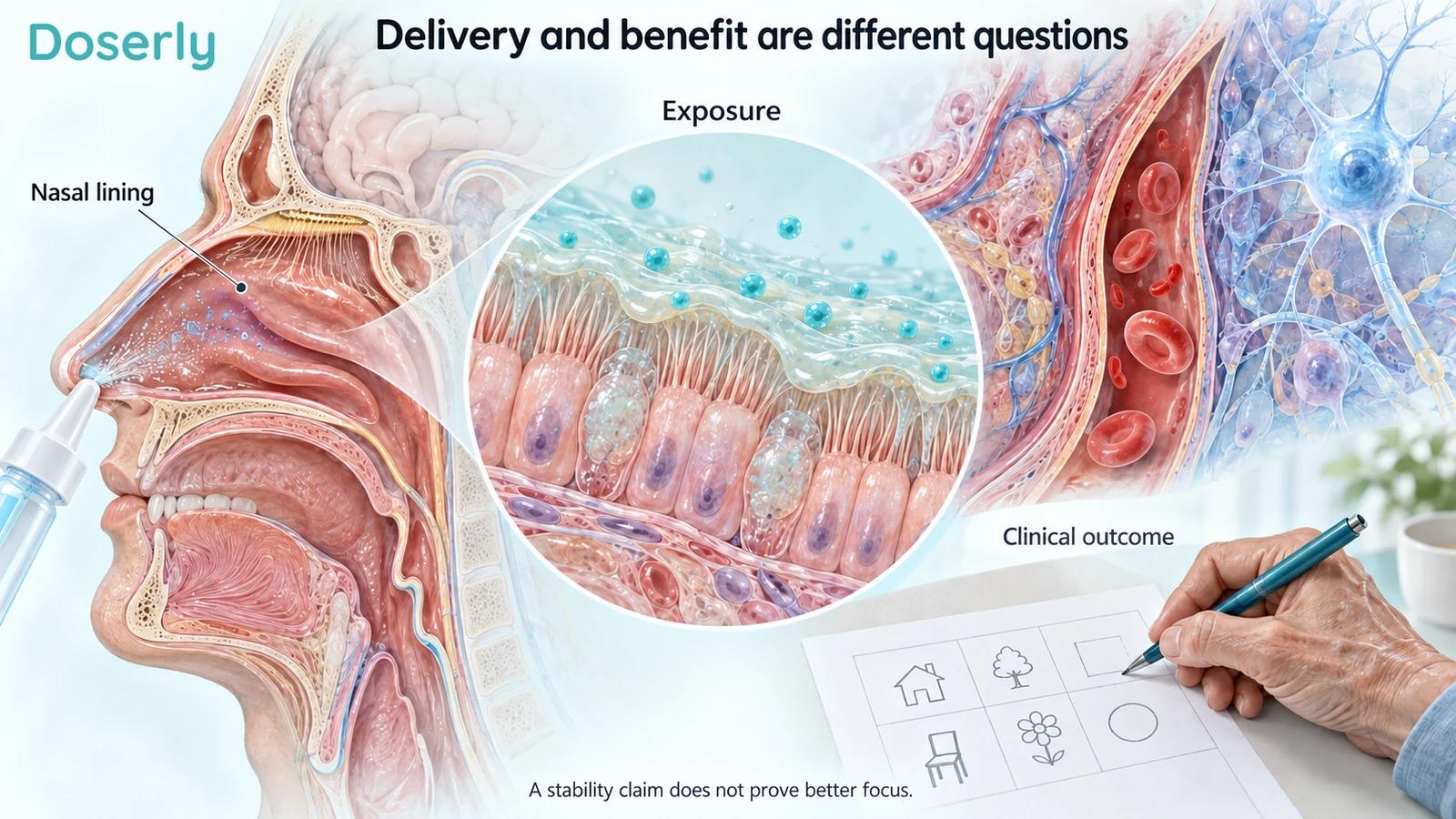
Stability is not one universal property. A claim might refer to a stored powder, a solution under particular conditions, resistance to an enzyme in a laboratory assay or persistence after administration.
Those are different experiments. A compound that lasts longer in one setting has not thereby demonstrated better delivery to the relevant tissue, a stronger desired effect or an acceptable safety profile.
A useful stability report identifies the test conditions, the comparator, what was measured and how much intact material remained over time. It also distinguishes intact compound from fragments or other products that an assay might detect.
Without those details, “more stable” is difficult to interpret. And even with them, the next question remains: does the measured difference matter to a person?
Imagine two preparations that differ in a laboratory degradation test. That would justify investigating their exposure and activity. It would not establish that the more persistent preparation produces better memory, or that a user should change an amount or schedule.
Longer exposure is not automatically a larger benefit
A longer duration of exposure could be relevant to drug development, but duration and benefit are not interchangeable. A desired effect might plateau, fail to appear or be accompanied by unwanted effects.
That is why claims about half-life, absorption or tissue penetration need their own measurements. They should not be inferred solely from the presence of a chemical group, a mechanism proposed for another peptide or an online experience report.
Even a measured pharmacokinetic difference would leave an efficacy question. Pharmacokinetics describes what happens to the substance in the body; it does not, by itself, show whether the person functions better.
A claim that one derivative is “several times stronger” therefore needs an identified endpoint. Stronger binding in a laboratory assay, a higher blood concentration and a larger improvement on a clinical scale are different quantities. A numerical multiplier without its measurement is not a usable comparison.
Parent-compound findings do not transfer automatically
A frequently cited Semax experiment measured BDNF-related changes in rat hippocampus. It studied the parent peptide, not a marketed panel of terminally modified derivatives. Those findings cannot establish that a derivative produces the same molecular pattern, much less a superior human benefit. Rat Semax study.
A healthy-volunteer study of Semax examined resting-state brain connectivity in a small sample. It was not a head-to-head trial of acetylated, amidated and parent versions, and an imaging change is not itself proof of better everyday attention. Human imaging study.
Related-compound evidence can help generate a hypothesis. It cannot silently fill every missing step between chemical identity, exposure, biological activity and clinical outcome.
This is sometimes obscured by a long reference list. Several genuine Semax papers may all be cited under a derivative's name, creating the appearance of a derivative-specific evidence base. The papers remain genuine; the attribution is what needs correction.
What about Adamax?
Adamax appears in discussions of Semax-related products, often accompanied by claims of a more advanced design. A 2025 Medsafe classification submission named Adamax and Semax among products marketed as cognitive enhancers. That was a regulatory classification proposal, not a trial demonstrating Adamax efficacy or a certification of a particular product's structure. Medsafe submission.
For this article, exact-name searches of ClinicalTrials.gov and searches of indexed biomedical literature did not locate a human efficacy trial for Adamax, N-acetyl Semax or Semax amidate. The search was performed on October 15, 2026. A name-based search cannot rule out unpublished work or research under another identifier.
The appropriate conclusion is therefore bounded: no derivative-specific human efficacy trial was identified in those searches. That is not a basis for declaring the products effective, nor for asserting that their risks have been fully characterized.
For an unfamiliar name, chemical identity should remain an open question until supported by reliable documentation. Repeating a vendor's proposed structure as established fact would add certainty that the evidence has not earned.
Purity reports answer a different question
A laboratory certificate may contain useful information about a submitted sample. Its meaning depends on the methods, reference standards, sample provenance and results actually provided.
A high reported purity percentage is not a measurement of cognitive benefit. It also does not automatically answer every question about identity, concentration, sterility, contaminants or changes during storage. Those are separate analytical questions, and a document should be read for what it tested.
The reverse distinction matters too: uncertainty about clinical benefit does not prove a particular sample is chemically impure. Product quality and treatment effectiveness are different dimensions.
For a consumer, the practical error is to let one reassuring number stand in for the entire assessment. A product can be accurately described chemically and still lack evidence that its intended use helps people.
Safety cannot simply be inherited either
If a derivative changes the molecule or its exposure, safety claims need to account for that change. It is not enough to borrow a short parent-compound study and assume the same findings apply to another structure, route or duration.
The FDA briefing discussed limitations in the available human safety information and potential peptide-related concerns. Such concerns should not be converted into a proven adverse-event rate for every derivative; equally, a sparse record does not demonstrate absence of risk. FDA briefing.
A stronger evidence package would characterize the exact product and collect adverse events systematically in the population receiving it. It would also examine duration and relevant interactions instead of treating “research peptide” as a safety category.
This uncertainty is particularly consequential when the expected benefit is also uncertain. An unproven improvement cannot provide a reliable counterweight to an incompletely described risk.
What would establish that a derivative is better?
The comparison needs to begin with well-characterized substances and a clearly defined use. For example, a claim about sustained attention would require an attention outcome, not simply a chemical stability assay.
A credible human comparison would use appropriate allocation and blinding, matched conditions and a prespecified primary outcome. It would need to report the magnitude and uncertainty of the difference, not just whether one analysis reached statistical significance.
The investigators would also have to justify how the exposures were compared. Equal mass is not automatically an equivalent biological comparison when compounds differ. That is a research-design issue, not a reason for readers to improvise conversions.
A finding of superiority would then need to survive examination of unwanted effects, persistence and replication. “Better” should mean a better overall result for the stated goal, rather than a favorable number selected from several measurements.
Until those data exist, the most accurate description is that a derivative is chemically different and its claimed advantage remains to be demonstrated.
Keeping the evidence attached to the product
When evaluating a claim, ask for the exact compound in the cited experiment, the measured outcome and the comparator. If the answer shifts from a derivative to parent Semax, or from human focus to rat BDNF, the evidence has changed underneath the claim.
A personal log should also preserve the exact product name and formulation. Grouping every related substance under “Semax” can make a later discussion of exposure or symptoms harder to interpret.
The useful distinction is straightforward: chemistry can explain why a new molecule is worth studying. Only suitable evidence can establish whether it is more effective, safer or more useful than the alternatives. A stronger-sounding name cannot do that work.
Sources
- PubChem N-acetyl Semax amidate record
- PubChem N-acetyl Semax free-acid structure
- FDA Semax advisory briefing
- Medsafe 2025 classification submission
- Parent Semax rat BDNF experiment
- Parent Semax human imaging experiment