
Peptides
October 16, 2026
Semax and BDNF: what a biomarker change can actually tell us
On this page
“Semax increases BDNF” is a compact claim that hides several questions. Was BDNF measured in a rat's brain or a person's blood? Did the experiment measure a gene transcript, the protein itself or activation of a related receptor? And did anyone actually function better?
Those distinctions determine what the result means. Semax has produced interesting findings involving brain-derived neurotrophic factor, or BDNF, in animal experiments. A human stroke study also examined plasma BDNF alongside recovery measures. Neither type of observation automatically proves better memory, focus or learning in a healthy adult.
The goal is not to dismiss biomarkers. They help researchers investigate biological activity and develop better questions. The problem begins when a laboratory finding is presented as if it were already a reliable treatment benefit. Our Semax guide provides the broader context; here, we'll follow the BDNF claim from measurement to interpretation.
What BDNF means in this story
BDNF is a signaling protein associated with the survival and function of neurons. Its name makes it sound like a simple quantity of “brain growth,” but that is not what a BDNF measurement directly tells you.
A study can examine BDNF in a particular tissue, at a particular time, after a particular intervention. That result is not a universal score for brain health. It also does not establish that increasing the measured value further would produce a larger benefit.
The relevant scientific question is more specific: what process changed, where did it change, and how does that change relate to the outcome of interest? A plausible answer can justify another experiment. It cannot replace that experiment.
For example, someone seeking better recall wants to know whether they remember useful information more accurately and for longer. A protein assay may help investigate a mechanism, but it does not directly measure that experience.
Gene expression, protein and receptor activity differ
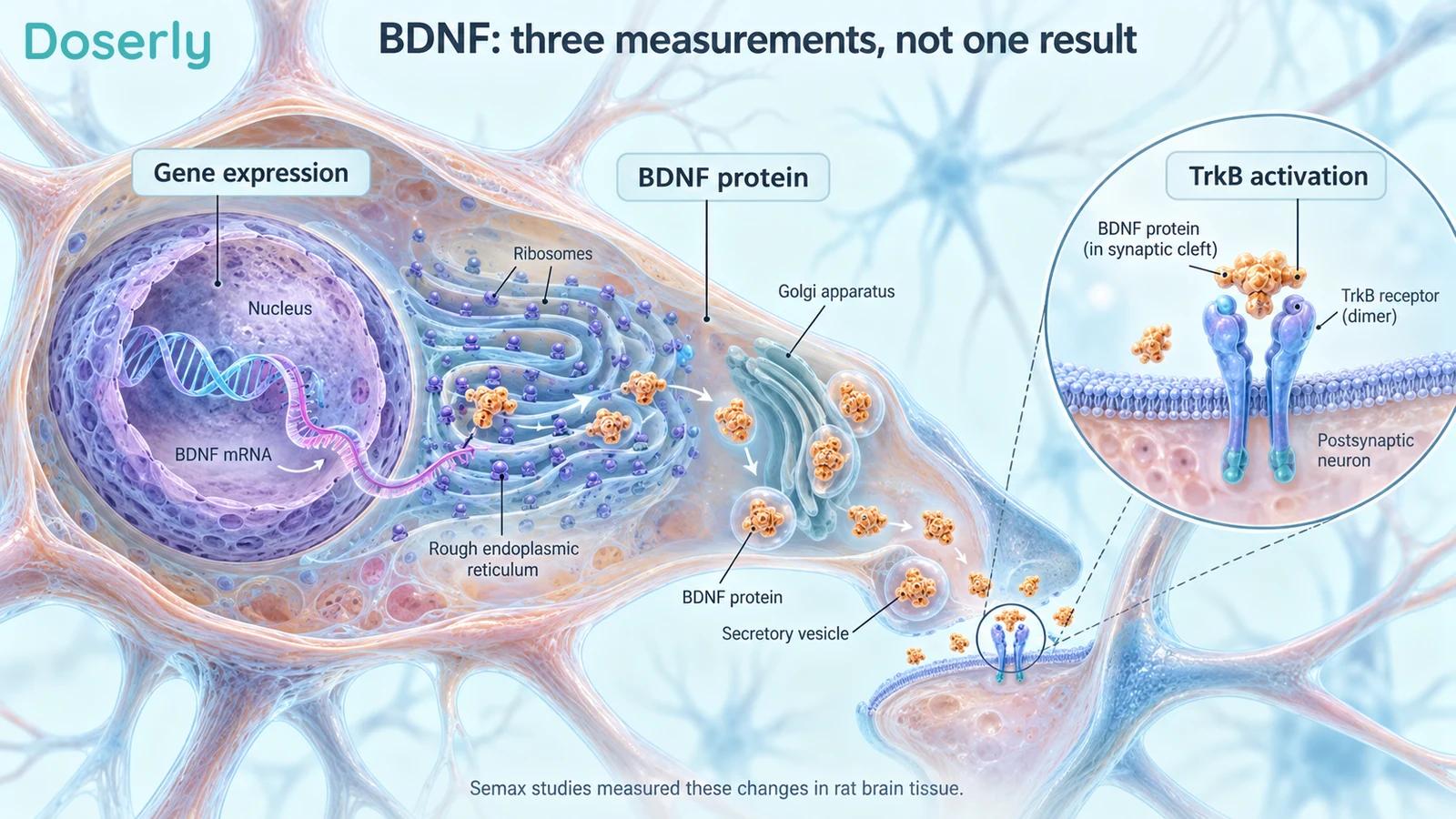
A gene-expression measurement examines RNA associated with producing a protein. It is evidence about a stage in the biological process, not a direct count of the final protein or proof of its effects.
A protein measurement asks how much of the protein an assay detects in the sampled material. That is a different question, with its own timing, location and laboratory method.
A receptor-activation measurement examines a change associated with signaling through a receptor. In this literature, TrkB is a receptor involved in BDNF signaling, and phosphorylation is one way its activation has been assessed.
The three can be related without moving in identical proportions. A claim that folds them into a single percentage loses information. “BDNF tripled” is particularly misleading if the original result concerned a specific RNA transcript while the protein changed by a smaller amount.
What the rat hippocampus experiment found
A 2006 experiment examined Semax in the rat hippocampus. After a single intranasal administration, the authors reported a maximum 1.4-fold BDNF protein level, 1.6-fold TrkB phosphorylation, threefold BDNF exon III messenger RNA and twofold TrkB messenger RNA, relative to comparison levels. The animals also showed changes in a conditioned-avoidance task. Rat hippocampus study.
These are different measurements in a defined animal experiment. The threefold value is not a demonstration that human brain BDNF triples. Nor does a conditioned-avoidance result establish improved human studying, creativity or work performance.
The finding supports a mechanistic hypothesis involving the BDNF–TrkB system. It does not settle how much of the behavioral effect was caused by that pathway, what happens during prolonged exposure, or whether an equivalent clinical benefit occurs in people.
A careful summary keeps the species and measurement beside the number. Removing those qualifiers makes the result appear much broader than it is.
Fold changes also need careful arithmetic. A value of 1.4 times the comparison level represents a 40% increase, not a 140% increase. A threefold value represents a 200% increase, not a 300% increase. Those conversions still describe only the original assay result; they do not convert a rat measurement into a human prediction. Keeping both the denominator and the measurement visible prevents two different exaggerations at once.
Region and timing change the interpretation
Another 2006 experiment found increased BDNF protein in rat basal forebrain three hours after intranasal Semax, but not in the cerebellum at that measurement point. It also investigated specific Semax binding in membranes from the basal forebrain. Basal-forebrain study.
That binding result should not be rewritten as proof that Semax directly activates TrkB in humans. Showing binding sites in a tissue preparation and identifying a particular receptor-mediated clinical mechanism are different claims.
A 2007 rat study measured gene expression after one hour. It found increases in Bdnf expression in several regions, including the cerebellum, and different effects for another neurotrophin gene, Ngf. Gene-expression study.
The cerebellar findings need not be contradictory: one experiment examined protein at three hours, while the other examined a transcript at one hour. Treating both as the same measurement creates an apparent conflict that the methods do not support.
The broader lesson is practical. A headline about “brain BDNF” may conceal differences among regions, time points and biological stages. Those details are central to interpretation, not footnotes that can safely be removed.
Human blood is a different sample
The 2018 stroke rehabilitation study examined plasma BDNF in 110 patients, alongside motor and daily-function measures. The authors reported favorable changes and relationships among these outcomes. The participants were recovering from ischemic stroke; they were not a healthy-adult cognitive-enhancement sample. Human rehabilitation study.
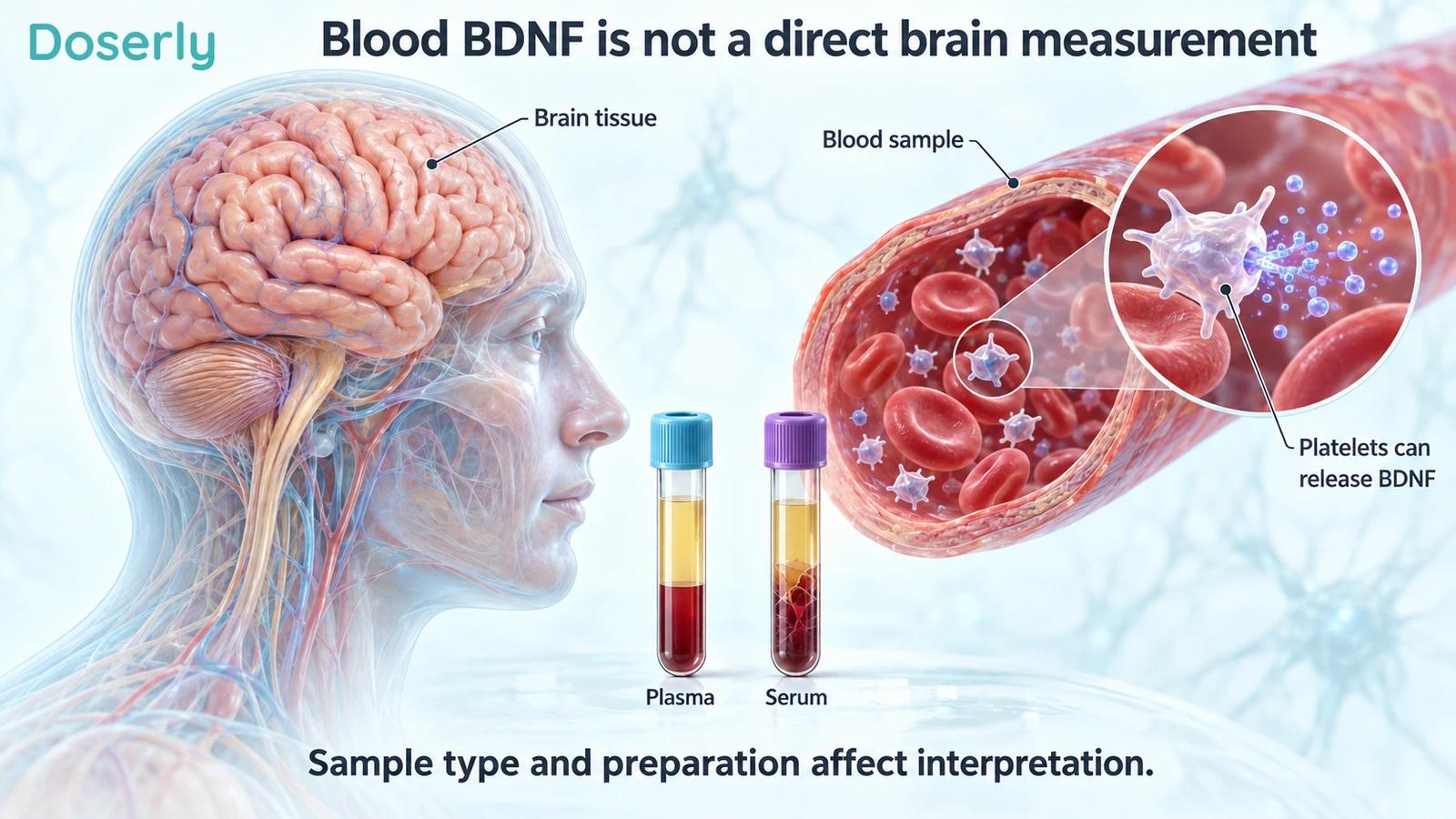
Plasma is a blood component. A plasma measurement is not a direct sample of the hippocampus or another brain region. It cannot simply be substituted for the rat tissue measurements described above.
The study's abstract also does not establish that a BDNF change caused the observed recovery difference. Both could relate to treatment, recovery stage or other factors. Determining the causal pathway requires more than observing that two measures vary together.
This human study is relevant to the research question, but the correct statement is narrow: investigators measured circulating BDNF and recovery-related outcomes in a stroke population. It does not establish a validated blood target for optimizing a healthy person's memory.
Why platelets and sample handling matter
Human laboratory research has shown that platelets can store and release BDNF when stimulated. This means circulating BDNF cannot automatically be interpreted as a direct reading of neuronal production. It also means the cellular contents of a blood sample matter. Human platelet experiment.
Serum and plasma are not interchangeable samples. Serum is obtained after blood clots; plasma is obtained from blood collected with an anticoagulant. An experiment on human serum preparation found that clotting duration and temperature influenced the BDNF measurement. Serum-preparation study.
A difference between two laboratory results may therefore involve more than a change in the person's biology. Sample type, preparation and assay conditions need to be considered before comparing values.
This does not make blood biomarkers useless. It makes standardized collection and processing important. A carefully controlled research assay can answer a defined question even when an isolated commercial test cannot support the much broader interpretation someone attaches to it.
A biomarker becomes a surrogate only with evidence
A biomarker is a measured characteristic that indicates a biological process or response. A clinical outcome directly addresses how a person feels or functions, or whether they live longer. A surrogate endpoint is used in place of that outcome and needs evidence that it reliably predicts the relevant benefit. FDA biomarker explanation.
The word “biomarker” does not itself confer that predictive status. A measurement can be scientifically interesting without being a validated substitute for memory, attention or independence.
For Semax, the studies discussed here do not establish that a particular BDNF increase reliably predicts a useful cognitive improvement in healthy adults. There is no justified conversion such as a specified percentage rise in BDNF equaling a specified improvement in learning.
This distinction also helps interpret a negative clinical result. If a biomarker changes but the person does not improve, the biomarker has not rescued the treatment claim. The biological activity may be real while the hoped-for benefit remains unshown.
Correlation does not establish the treatment pathway
Imagine a rehabilitation study in which people with better motor recovery also have higher BDNF measurements. That association could help generate hypotheses. It would not, on its own, show that raising BDNF caused the recovery.
Perhaps both reflect another process. Perhaps the relationship differs by recovery stage. Perhaps treatment affects several pathways, only some of which matter to function. These are possibilities to investigate, not conclusions about what happened in any particular Semax study.
A convincing causal account needs a design and analysis capable of distinguishing those explanations. A convincing treatment claim also needs a reliable benefit compared with the appropriate control.
That second requirement is easy to overlook when a mechanism sounds appealing. People do not generally seek treatment for the satisfaction of changing a laboratory value; they want a problem to improve. The value of a biomarker lies partly in helping answer that practical question.
What would strengthen the human case?
The clearest next step would connect a defined preparation to both a well-measured biological response and a meaningful human outcome in the relevant population.
For a memory claim, that could involve a prespecified memory measure with an appropriate placebo comparison and enough follow-up to assess persistence. The study would need to distinguish a treatment effect from practice, expectation and normal variation.
If BDNF were included, investigators would need to specify the sample and assay, control processing conditions and explain what relationship they expected between the biomarker and the main outcome. Reporting only the favorable laboratory finding would leave the central clinical question unanswered.
Researchers would also need to report unwanted effects. A beneficial-looking biomarker cannot establish that the overall tradeoff is favorable. Replication would then show whether the relationship holds beyond one sample or laboratory.
These requirements are not peculiar to Semax. They are what allow an appealing molecular explanation to become dependable evidence for a specific use.
Reading a BDNF claim without losing the detail
A useful source should let you answer five concrete questions: which species, which tissue or sample, which measurement, which time point and which functional outcome? If any of those are missing, the headline is probably doing more work than the evidence.
Be particularly cautious with multipliers detached from their assay. The threefold transcript finding and the smaller protein finding in the rat hippocampus are not competing estimates of one human effect. They are different observations.
For your own records, a perceived change in focus is also not a BDNF test. It may be worth describing the experience, its timing and its effect on daily life, but it cannot confirm a molecular mechanism.
Semax's BDNF findings provide a research rationale. They do not establish that increasing a blood value—or reproducing a rat molecular result—will deliver better cognition in a person. The human outcome still needs to be measured.
Sources
- Rat hippocampal BDNF and TrkB study
- Rat basal-forebrain BDNF study
- Rat neurotrophin gene-expression study
- Human stroke rehabilitation study
- Human platelet BDNF experiment
- Human serum-preparation experiment
- FDA biomarker and surrogate-endpoint explanation