
Peptides
October 16, 2026
Semax and ADHD: a plausible mechanism is not a tested treatment
On this page
If you are struggling to concentrate, a peptide described as improving attention can sound relevant. Semax is sometimes discussed in exactly that way, with references to brain signaling, BDNF and small human studies. But a result involving attention is not automatically evidence for treating attention-deficit/hyperactivity disorder.
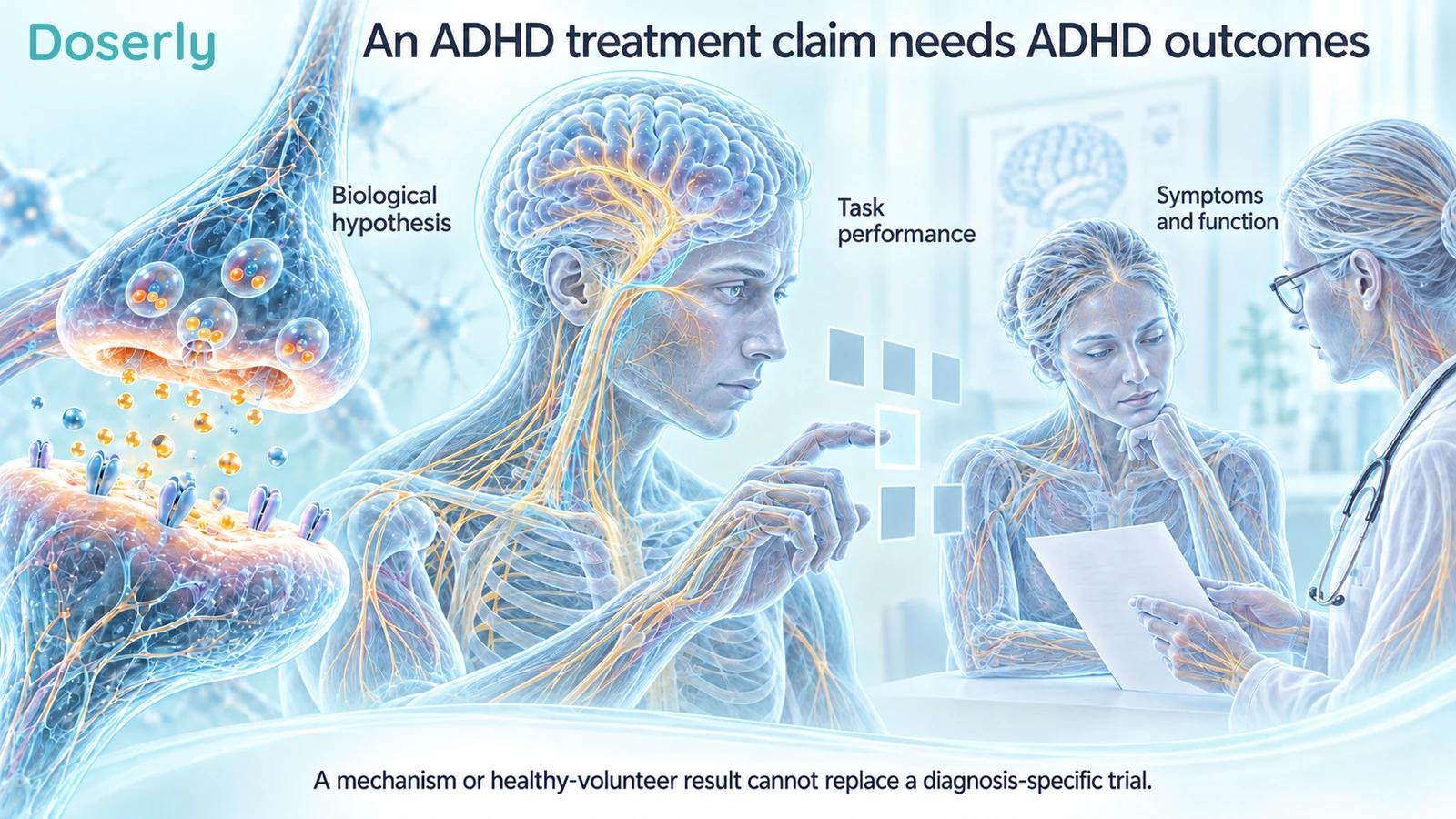
ADHD is a clinical diagnosis with persistent symptoms and effects on daily functioning. A treatment claim needs evidence in people with that diagnosis, using outcomes that reflect the problem being treated. A mechanism, a healthy-volunteer task or an acute brain scan cannot answer the whole question.
The Semax literature deserves a careful description. There is a published ADHD hypothesis, there are healthy-volunteer experiments, and Russian commercial material cites older pediatric reports. These are different kinds of evidence, with different limits. Our Semax guide covers the broader research; here, we'll examine what supports the ADHD claim and what remains unresolved.
A concentration complaint is real, even before a diagnosis
Difficulty paying attention can interfere with work, learning, relationships and ordinary tasks. It deserves to be taken seriously whether or not the eventual explanation is ADHD.
NIMH describes ADHD as an ongoing pattern of inattention and/or hyperactivity-impulsivity that interferes with functioning or development. Assessment also considers other possible explanations and coexisting conditions. Trouble sleeping, stress and other mental or physical health problems can produce overlapping difficulties. NIMH explanation.
This means a single symptom does not identify the right intervention. “I cannot focus” describes an experience; it does not by itself establish the diagnosis, mechanism or treatment.
For a useful conversation, describe when the problem occurs, how long it has been present and what it prevents you from doing. Those details help distinguish a persistent pattern from a recent change or a difficulty limited to one situation.
Diagnosis looks across history and settings
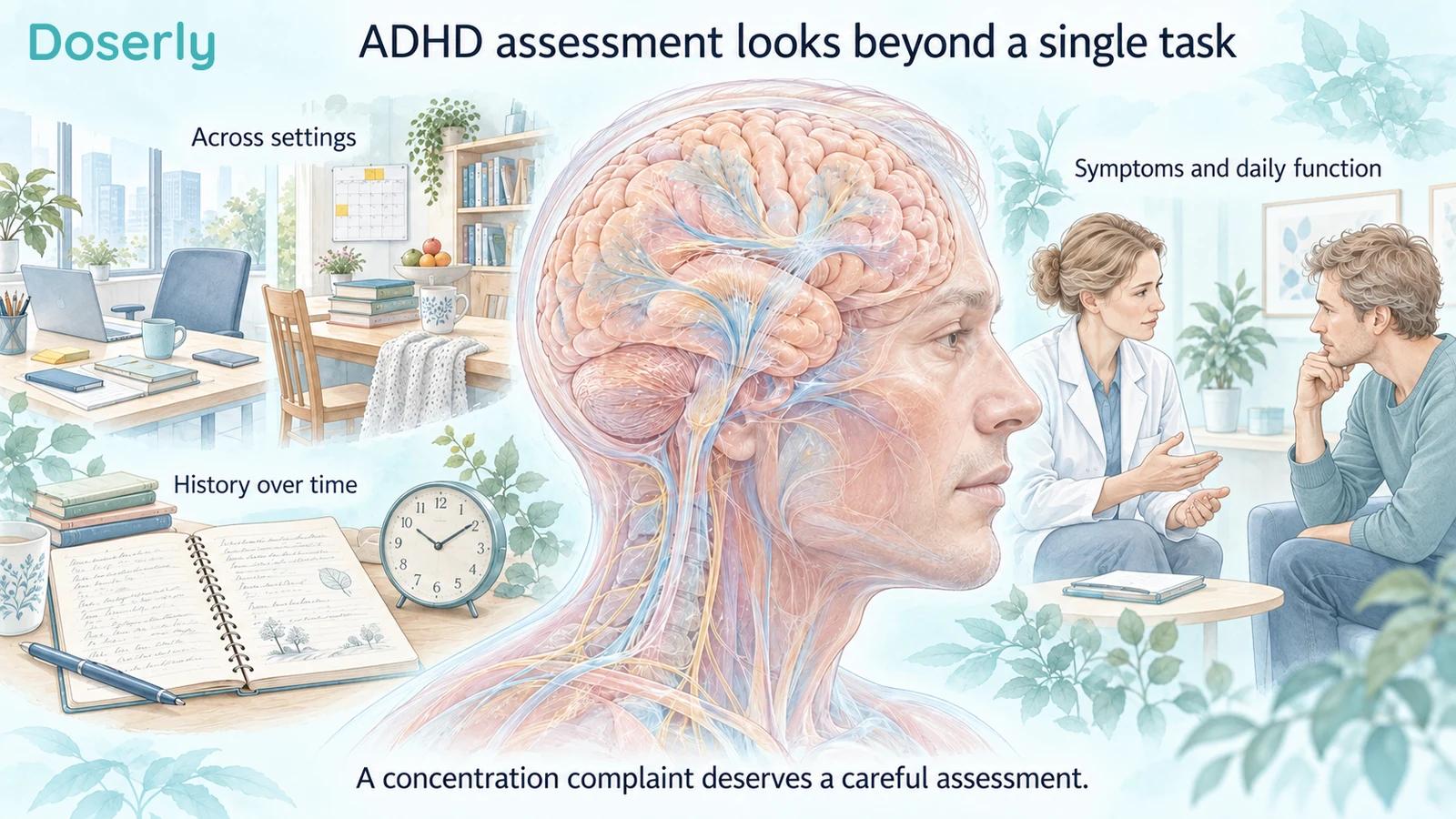
NICE recommends a full clinical and psychosocial assessment, developmental and psychiatric history, and relevant observer reports. Symptoms and impairment across important settings matter. A rating scale alone should not determine the diagnosis. NICE recommendations.
A person may perform adequately on a brief task and still have substantial everyday difficulties. Conversely, a poor test session may reflect factors that do not establish ADHD. The clinical assessment brings the history and context together.
This is also why a brain image should not be treated as a personal diagnosis. The Semax imaging studies discussed below were research experiments, not demonstrations that an individual has ADHD or needs a particular peptide.
Adults who were not diagnosed in childhood can still seek assessment; the clinician considers earlier symptoms rather than treating the absence of an old diagnosis as proof that ADHD is impossible.
The distinction protects both sides of the question. It avoids dismissing a person's difficulty because one test looks normal, while also avoiding a diagnosis or treatment choice based on one appealing measurement.
The often-cited Semax ADHD paper proposes a hypothesis
A paper published in 2007, with an earlier online record, proposed Semax as a potential treatment for ADHD and Rett syndrome. Its rationale drew on findings involving dopamine, BDNF and attention-related processes. It did not report a completed human ADHD efficacy trial. Original hypothesis paper.
That is an important difference in study type. A hypothesis paper can offer a coherent reason to test an intervention. It does not establish that the intervention reduces symptoms, improves daily function or has a favorable safety profile in the target population.
The title's language of “potential” matters. Removing that qualifier turns a proposed research direction into a conclusion the paper did not test.
The mechanism also should not be simplified into a claim that ADHD is merely a BDNF deficiency. A molecular rationale is not a diagnostic test, and a proposed pathway does not tell an individual which treatment will work for them.
Healthy-volunteer performance is not an ADHD trial
An older Semax paper included a small placebo-controlled experiment in male power-plant operators. It examined computerized performance over a short working period. This is relevant to the history of attention research, but the participants were not presented as an ADHD treatment population. Healthy-volunteer paper.
The distinction remains even if a task result is favorable. A treatment for ADHD needs to address symptoms and impairment in people who meet the relevant diagnostic criteria. A healthy-worker experiment cannot establish that benefit by analogy.
It also cannot tell us whether a peptide is equivalent or superior to an established ADHD treatment. That would require an appropriate direct comparison or another sound evidence base addressing the same clinical question.
Acknowledging the experiment prevents an inaccurate claim that Semax has never been tested in healthy people. Keeping its population attached to the result prevents the opposite error: describing a small performance experiment as an ADHD therapy trial.
A changed network is not the same as reduced symptoms
A 2018 Semax study examined resting-state functional MRI in healthy volunteers. Its reported finding concerned a component of the default mode network, not a diagnosis-specific improvement in ADHD symptoms or daily functioning. Primary imaging report.
A network may be scientifically relevant to attention without every measured change in it being beneficial. The meaning of a change depends on the task, population, analysis and relationship to actual outcomes.
For treatment assessment, the missing connection is concrete: did the person manage the difficulties that matter to them more successfully, and was the difference attributable to treatment?
An imaging result can guide research into that connection. It cannot supply the answer on its own, and it cannot establish that a different product or route will have the same effect.
What about the older Russian pediatric reports?
The Semax manufacturer's pediatric page cites reports from 2000 and 2001 concerning children and older diagnostic terminology such as “minimal brain dysfunction.” This is a reason to avoid saying that no pediatric research has ever been conducted. Manufacturer bibliography.
However, the complete original reports were not available for appraisal in this review. The commercial page is not a substitute for checking how participants were diagnosed, how groups were assigned, what outcomes were measured and how safety was assessed.
For that reason, this article does not repeat numerical success rates or characterize those reports as rigorous blinded ADHD trials. It also does not assume that an older, broader diagnostic label maps exactly onto today's ADHD criteria.
The limitation is access to interpretable original evidence, not proof that the reports are false. A stronger assessment would require the complete documents and a careful review of their methods.
FDA's review has a defined scope
In its 2026 Semax advisory briefing, FDA stated that ADHD was not evaluated because supporting literature had not been found for that indication in its assessment. The briefing also stated that the evaluated Semax substances were not components of FDA-approved drugs. FDA briefing.
That statement should not be expanded into a claim that no historical pediatric report exists anywhere. Nor should the existence of an older citation be treated as if it resolves the evidence gap identified by the review.
The briefing was staff material for an advisory process, not itself a final regulatory determination. It provides useful context, but it does not replace direct examination of diagnosis-specific trial evidence.
For a reader evaluating treatment claims, the practical implication is that Semax should not be presented as an FDA-established ADHD therapy.
What an informative ADHD trial would need to show
The study population would need a clear diagnosis and a defined age range. Evidence from adults cannot automatically settle pediatric use, and a mixed group with different attention complaints may not answer a specific ADHD question.
The trial would need an appropriate comparison, reliable allocation and blinding where feasible. Its main outcome should be specified in advance, with symptom measures and functional outcomes that match the treatment claim.
Function matters because a score change may not tell the whole story. Depending on age and circumstances, useful outcomes might include completing necessary tasks, managing routines or reducing interference with work and relationships. These examples describe research goals, not benefits already demonstrated for Semax.
The follow-up should also match the intended use. A brief change during a task does not establish sustained benefit over a school term or working month. Repeated assessments should account for practice and other changes in care.
Finally, a trial needs to report withdrawals, missing data and adverse events. Improvement and tolerability belong in the same assessment.
An add-on claim is a separate research question
Some discussions propose Semax alongside an existing ADHD medicine rather than as a replacement. That does not remove the need for evidence; it changes the question.
An add-on trial would ask whether Semax provides an additional benefit over stable background treatment, and whether the combination changes unwanted effects. A parent-compound mechanism or an anecdote about feeling more alert cannot establish that comparison.
If several treatments change at once, it becomes difficult to attribute a later improvement or symptom to one component. This is a reason to involve the prescriber in any proposed change, not a reason to conduct uncontrolled combinations to see what happens.
A mechanism suggesting interaction is also not evidence that the interaction is helpful or safe. The actual combination, population and exposure need to be evaluated.
Established care includes more than one option
NIMH describes ADHD treatment approaches that include medication and behavioral or psychosocial interventions. Support can also address practical difficulties in daily environments. Care should reflect the person's age, needs and coexisting conditions. NIMH treatment overview.
NICE likewise includes medication and nonpharmacological approaches in its management recommendations, with choices guided by clinical circumstances. Semax is not among its recommended ADHD medication options. NICE guidance.
A poor experience with one treatment does not establish that an untested alternative is effective. It is useful information for reassessing the plan: what improved, what did not, what unwanted effects occurred and which goals remain unmet.
That discussion can be specific without requiring you to settle a complex research debate alone. The aim is a workable plan for the actual impairment, with benefits and burdens reviewed over time.
What to record before a clinical discussion
A brief record can make the problem easier to explain. Note the task that was difficult, the setting, the approximate duration and the practical consequence. “Lost track of three steps while preparing a work handover” is more informative than a global score of “bad focus.”
It can also help to record sleep, major schedule changes and current medicines or supplements. These details provide context; they are not a self-diagnostic checklist or proof of a particular mechanism.
If treatment is already prescribed, record both useful changes and unwanted effects. Do not stop or replace it on the basis of a peptide claim without discussing the change with the clinician managing it.
The evidence question remains clear: a plausible Semax mechanism is a reason for research, while an ADHD treatment claim requires interpretable evidence in ADHD. The sources reviewed here do not establish Semax as a dependable substitute for diagnosis-specific, evidence-based care.
Sources
- NIMH ADHD overview
- NICE ADHD recommendations
- Semax ADHD hypothesis paper
- Healthy-volunteer performance paper
- Healthy-volunteer imaging report
- Manufacturer's pediatric report bibliography
- FDA Semax advisory briefing