
Supplements
October 16, 2026
Selenium and thyroid health: when essential does not mean more
On this page
Selenium is a trace mineral used to build proteins involved in thyroid hormone metabolism and antioxidant defense. That biology helps explain why it appears in thyroid supplements. It also makes the central question easy to oversimplify: if the thyroid needs selenium, wouldn't more selenium help a thyroid problem?
The clinical answer depends on the problem. Correcting inadequate intake, lowering a thyroid antibody measurement, improving fatigue and treating mild Graves' eye disease are different goals. They should not be treated as interchangeable evidence for a general “thyroid support” product.
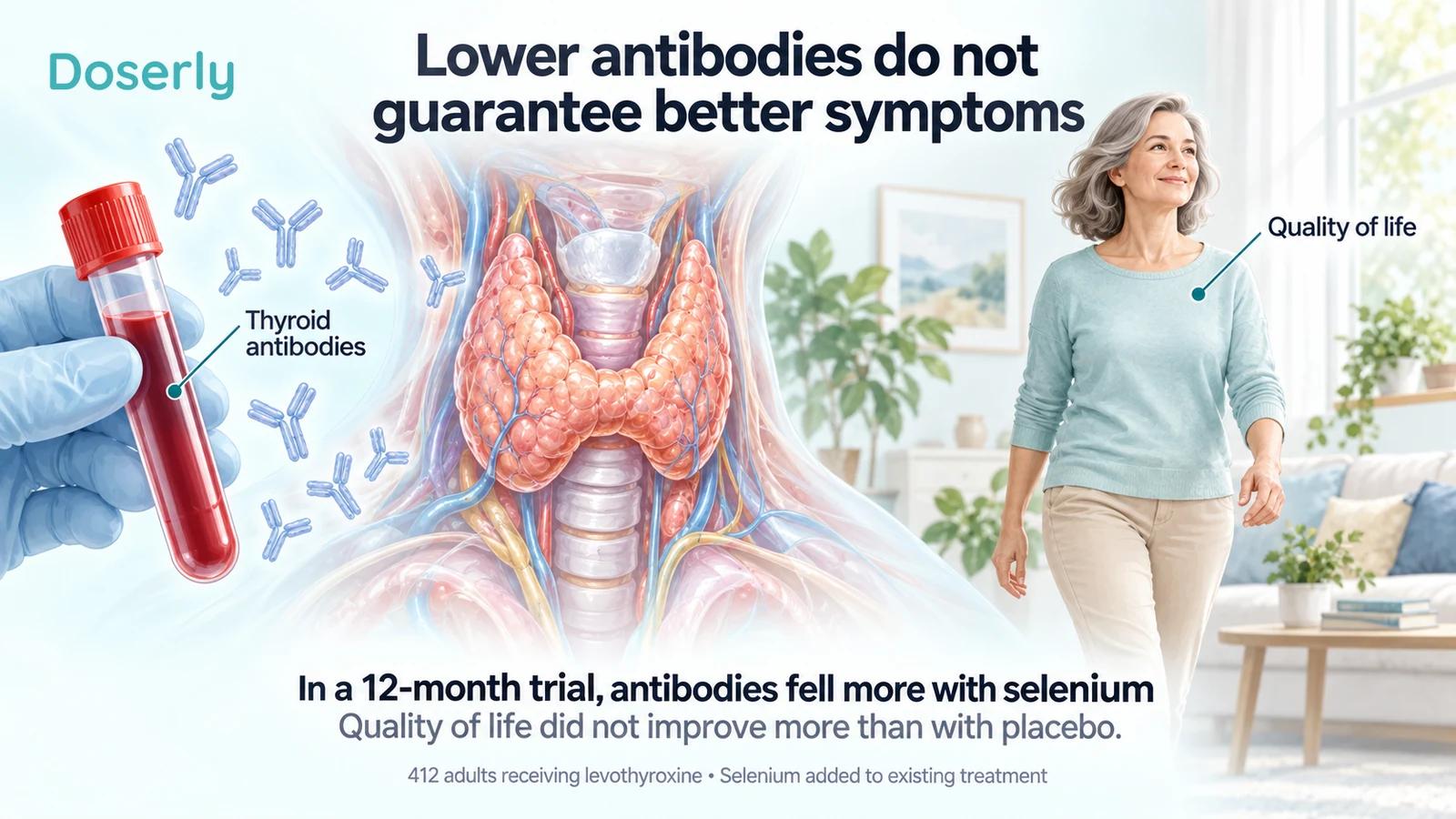
For people with Hashimoto's thyroiditis, the most useful distinction is between a changed blood marker and a change in how they feel or in the treatment they require. A substantial trial found exactly that separation: selenium lowered antibody levels more than placebo, but did not provide an additional quality-of-life benefit. Randomized hypothyroidism trial
What selenium does in thyroid-related biology
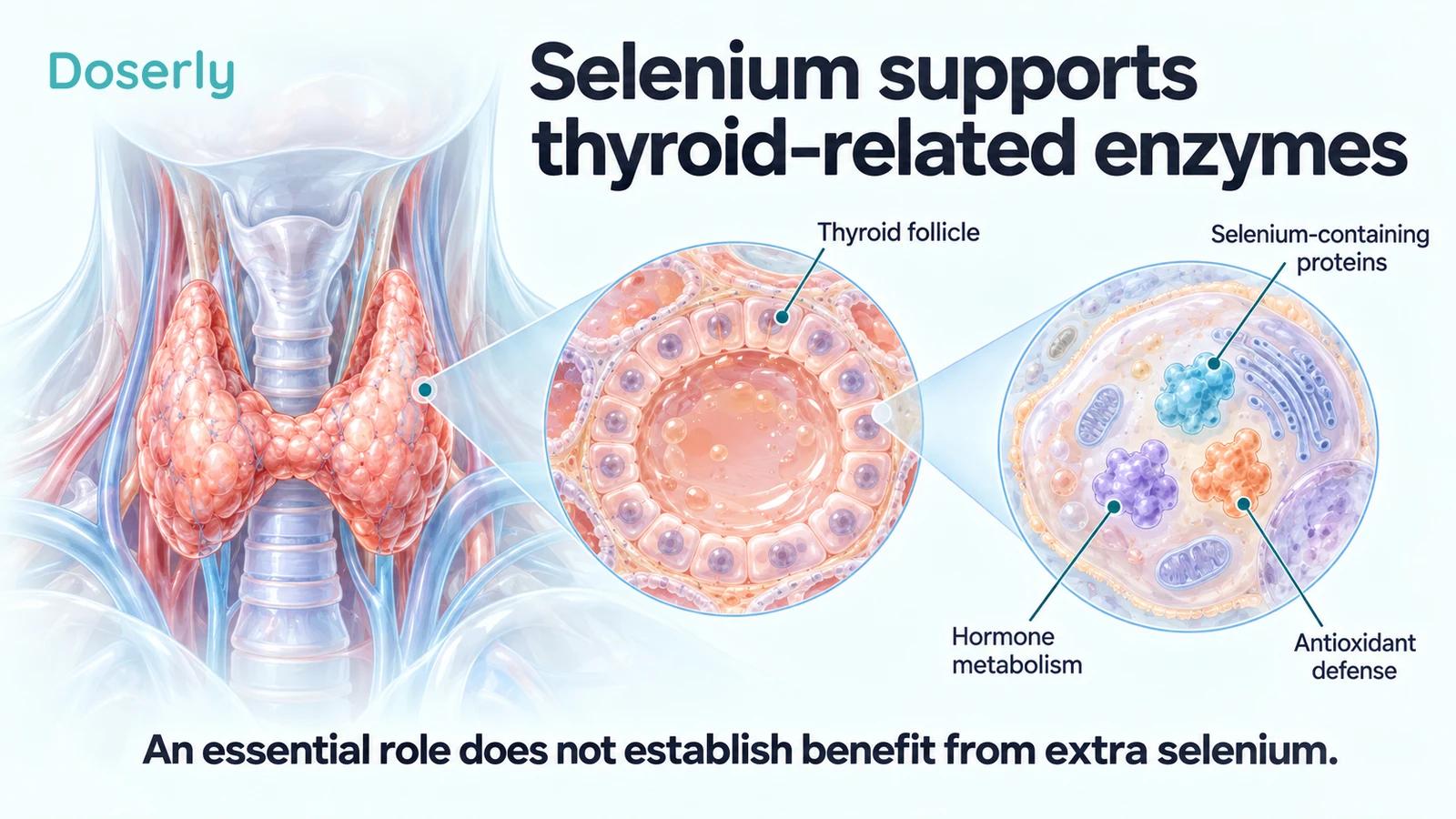
Selenium is incorporated into selenoproteins, proteins that contain the selenium-bearing amino acid selenocysteine. Some help regulate thyroid hormone metabolism, including conversion between hormone forms. Others participate in controlling oxidative reactions. These functions occur in a wider physiological system; they are not a switch that a supplement simply turns up. NIH selenium fact sheet
An enzyme needing selenium does not establish that the enzyme lacks it in a particular person. Nor does it establish that giving extra selenium will increase useful activity indefinitely. To move from the biological role to a treatment claim, researchers need to identify the population and measure a meaningful result.
That is why a low intake, an autoimmune diagnosis and an abnormal thyroid-function test deserve separate attention. They may coexist, but none automatically establishes the other. Our selenium guide offers more nutritional background; here the focus is what supplementation has achieved in thyroid studies.
Understanding the tests before judging a supplement
In Hashimoto's thyroiditis, the immune system targets thyroid tissue. Thyroid peroxidase antibodies, often abbreviated TPOAb, help identify thyroid autoimmunity. They are different from TSH, the pituitary signal regulating the thyroid, and free T4, a measurement of circulating thyroid hormone.
The American Thyroid Association explains that people with high thyroid antibodies but normal thyroid-function tests do not necessarily need thyroid hormone treatment. When Hashimoto's causes hypothyroidism, treatment decisions focus on the thyroid hormone problem; levothyroxine replaces hormone the body is not making adequately. Repeated antibody measurements are generally not needed to monitor routine treatment. ATA Hashimoto's information
For a reader, this changes how to interpret a supplement advertisement built around “lower antibodies.” That may describe a real laboratory finding, but the next question is whether it leads to less fatigue, improved function, lower medication requirements or less progression of disease.
Those outcomes need not move together. A marker can respond without the hoped-for benefit, and someone can need treatment even if an antibody number declines. The useful goal is better care, not necessarily making every laboratory number smaller.
What the pooled Hashimoto's studies suggest
A 2024 systematic review included 35 unique randomized studies of selenium in Hashimoto's thyroiditis. Its primary question concerned TSH in people not receiving thyroid hormone replacement. The analysis found a small reduction in TSH in that group and reductions in TPO antibodies in the broader evidence. Huwiler and colleagues
The studies differed in participants, selenium status, formulations and follow-up. A pooled marker change therefore does not identify a universally effective product or prove that selenium prevents the future need for thyroid medication. It also cannot answer a quality-of-life question simply by showing a statistically detectable antibody difference.
For someone already taking levothyroxine, research in people without hormone replacement may be less directly relevant. The treatment situation changes the question from supporting an untreated thyroid to testing whether adding selenium improves outcomes beyond existing care.
The 412-person trial asked about everyday benefit
The multicenter CATALYST trial enrolled 412 adults with autoimmune hypothyroidism receiving levothyroxine. Participants were randomized to 200 micrograms of selenium daily as selenium-enriched yeast or matching placebo for 12 months. The main clinical interest was thyroid-related quality of life, assessed with a structured questionnaire.
Of those enrolled, 332 completed the intervention period. Quality of life improved in both groups, but there was no significant additional benefit from selenium. Antibody levels were lower in the selenium group at 12 months, while levothyroxine dose and the free T3/free T4 ratio were not improved. CATALYST results
The key finding is not that participants failed to improve. They did improve overall; the randomized comparison did not attribute extra improvement to selenium. This is exactly why a before-and-after account can sound more favorable than a placebo-controlled result.
For a person hoping to feel less tired while already receiving thyroid replacement, that comparison is directly relevant. It does not rule out every nutritional circumstance, but it provides less support for routine addition than an antibody-only headline would suggest.
Why mild Graves' eye disease is a separate case
Graves' orbitopathy is an autoimmune condition affecting tissues around the eyes. It is not the same clinical problem as fatigue in treated Hashimoto's hypothyroidism. A positive selenium trial in one should not be presented as proof for the other.
In a 2011 randomized, double-blind trial, 159 people with mild Graves' orbitopathy received selenium, pentoxifylline or placebo for six months, followed by another six months of observation after treatment stopped. Selenium improved disease-specific quality of life, reduced eye involvement and slowed progression compared with placebo. The trial used 100 micrograms twice daily; that describes the research intervention, not a general self-treatment recommendation. Marcocci and colleagues
This is a clinically relevant positive finding in a defined population. It does not establish that selenium treats every form or severity of thyroid eye disease, replaces specialist care or benefits everyone with a thyroid antibody. If eye symptoms are the concern, the diagnosis and severity need to be assessed directly.
Keeping the two trials side by side is useful: the same nutrient can have evidence of benefit in one setting and no additional symptom benefit in another. The disease, background treatment and outcome all contribute to the answer.
Selenium status matters, but testing needs a purpose
Dietary selenium varies with food choices and the selenium content of the environment in which foods are produced. Brazil nuts are especially concentrated sources, with substantial variability. A supplement may also overlap with a multivitamin or a mixed thyroid product. NIH selenium fact sheet
A dietary history is therefore part of the decision. Someone who already has substantial exposure is in a different situation from someone with a documented nutritional problem. But a symptom such as tiredness cannot identify selenium deficiency by itself.
If testing is proposed, ask how the result would change the plan. A laboratory number is useful when it helps establish a deficiency, interpret exposure or monitor a specific intervention. It is less useful when any result leads to the same recommendation to take more.
The same applies to “optimal” ranges promoted outside a clear clinical context. A target should have a reason connected to the patient's health, not simply sit higher than a standard reference range. Increasing a selenium measurement is easier to demonstrate than improving a clinical outcome.
Why the safety margin deserves attention
Excess selenium can cause selenosis, with problems such as hair loss, brittle nails, gastrointestinal symptoms and neurological effects. Ironically, some of these overlap with symptoms that motivate people to buy supplements. More selenium is therefore not a harmless way to keep testing the theory that a thyroid needs support. NIH selenium fact sheet
In 2023, EFSA established an adult upper intake level of 255 micrograms per day, including for pregnancy and lactation. The assessment used evidence about adverse effects of excess intake, including hair loss. An upper limit is a risk-management reference for total intake, not a suggested daily dose. EFSA selenium assessment
This puts supplement arithmetic in context. A hypothetical 200-microgram tablet plus 100 micrograms from another supplement totals 300 micrograms before food is counted. That example illustrates overlap; it isn't a diagnosis of toxicity or a recommendation to approach the upper limit.
Don't try to make selenium intake precise by counting Brazil nuts as though each nut were an identical tablet. Variability makes that unreliable. The practical task is to identify concentrated sources and bring the overall pattern to a clinician or dietitian.
Longer-term evidence argues against assuming benefit is unlimited
A secondary analysis of a randomized trial followed 1,202 people without diabetes at baseline, comparing 200 micrograms of selenium daily with placebo. Over an average 7.7 years, diabetes developed in 58 selenium recipients and 39 placebo recipients. The hazard ratio was 1.55, with a confidence interval of 1.03–2.33. Stranges and colleagues, 2007
Diabetes was a secondary outcome, participants were mostly older and white, and the study was not a thyroid-treatment trial. It does not give an exact diabetes risk for a person considering short-term selenium for a thyroid indication. It does undermine the assumption that years of additional selenium must be beneficial because the nutrient has antioxidant functions.
Duration matters as much as the amount. A defined intervention with a clinical reason and review date is different from continuing a high-dose product indefinitely because it once seemed helpful.
Turn “thyroid support” into a specific clinical question
Before adding selenium, identify the actual problem: inadequate intake, abnormal thyroid function, persistent symptoms despite treatment or diagnosed thyroid eye disease. Those are different decisions, and their evidence comes from different sources.
If the goal is symptom improvement, name the symptoms and agree on how to assess them. If the goal is to lower antibodies, ask why that change would improve care. If selenium is proposed because of a low nutritional measurement, ask how the deficiency was established and how correction will be monitored.
Keep a record of the formulation, amount, start date, other supplements and thyroid medication changes. It can help explain what happened over time, while avoiding the assumption that a better week or a lower antibody result proves the supplement caused a meaningful benefit.
The selenium guide can help you review forms and intake. For treatment decisions, the strongest starting point is the specific diagnosis and outcome—not the general fact that selenium is essential.
Sources
- NIH: Selenium: biology, intake and excess.
- ATA: Hashimoto's thyroiditis: antibodies and thyroid-function care.
- Huwiler et al., 2024: randomized-study synthesis.
- CATALYST trial, 2024: quality of life during levothyroxine treatment.
- Marcocci et al., 2011: mild Graves' orbitopathy.
- EFSA, 2023: upper intake assessment.
- Stranges et al., 2007: secondary diabetes outcome in a long-term trial.