
Longevity
October 17, 2026
Sauna and heat therapy: promising biology, practical limits
On this page
A sauna can feel like a very simple intervention: sit somewhere warm, sweat, cool down and leave feeling relaxed. The longevity conversation gives that experience a much bigger job. It asks whether repeated heat exposure can protect the heart, improve the circulation and help people live longer.
There are good reasons to study those questions. Heat changes blood flow, challenges temperature regulation and can influence the lining of blood vessels. Researchers have measured some favorable changes after repeated heating. Finnish studies also find that people who use saunas more often have lower rates of several serious outcomes.
The evidence supports interest in heat as a possible addition to healthy routines. It does not establish a sauna prescription that extends life, or show that heating replaces exercise or hypertension treatment. The most useful distinction is between what happens during one hot session, what changes after weeks of repeated exposure, and what happens to health over years. Those are connected questions, but they have different answers.
What the famous Finnish study actually followed
The best-known longevity finding comes from the Kuopio Ischemic Heart Disease Risk Factor Study. Researchers followed 2,315 men from eastern Finland, aged 42 to 60 at enrollment, for a median of about 21 years. Sauna habits were recorded, and subsequent deaths were tracked. More frequent sauna use was associated with lower risks of sudden cardiac death, fatal cardiovascular disease and death from any cause. This was a prospective cohort, not a trial assigning people to different sauna routines. Laukkanen and colleagues, 2015
That design is valuable. It observes real habits over a period too long for most experiments. It is also vulnerable to differences between the people who choose those habits. Someone well enough to use a sauna frequently may differ from someone who rarely goes in ways a questionnaire cannot fully capture.
The comparison was largely between different frequencies of sauna use in a culture where sauna was already common. It was not a clean comparison of beginning sauna against never using one. The participants were middle-aged Finnish men, which also limits direct translation to women, frail older adults or people encountering heat for the first time.
This changes how a reader should understand a headline about a large percentage reduction in mortality. It describes an association within that population. It does not mean that buying a sauna reduces an individual's chance of death by that percentage. Statistical adjustment can make an association more persuasive without turning an observed habit into a randomly assigned treatment.
There is room for a real benefit and for confounding at the same time. Enjoyment, social contact, recovery time, activity patterns and underlying health could accompany sauna use. The reasonable next step is to test whether deliberately adding heat produces useful changes, then determine whether those changes translate into outcomes that matter.
Why heat affects the circulation
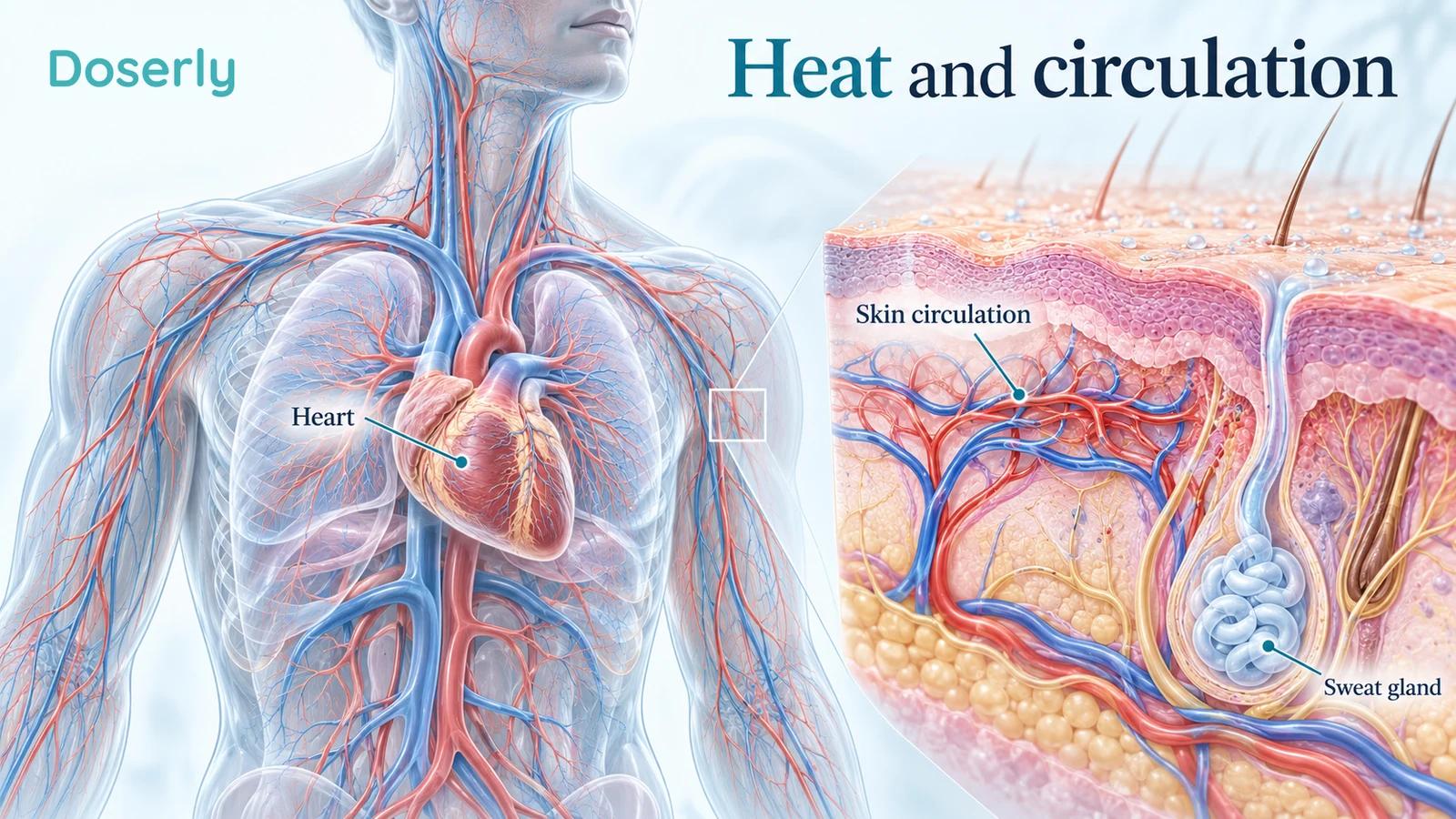
The body needs to move excess heat away from its core. One response is to send more blood through vessels near the skin. Sweating adds another route for cooling when evaporation is possible. The heart and circulation therefore do more work even while someone is sitting still.
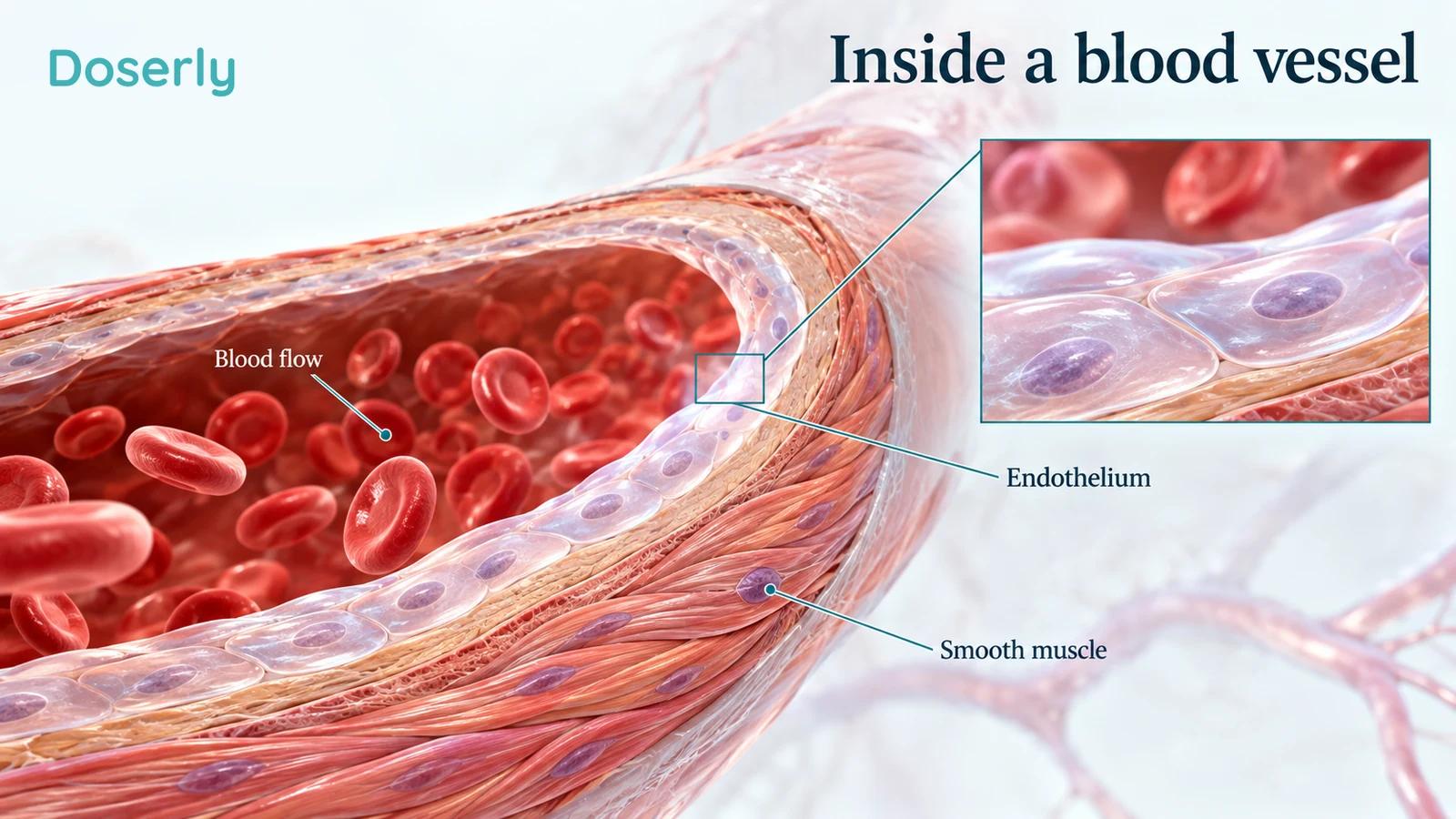
The inner lining of a blood vessel is called the endothelium. It helps regulate vessel widening, clotting and interactions with immune cells. Researchers can assess one aspect of its function by briefly changing blood flow through an arm and measuring how much an artery widens afterward. This is flow-mediated dilation. It is a useful physiological test, but it is not an image of plaque disappearing.
A small 2016 controlled study compared repeated hot-water immersion with a thermoneutral immersion condition in young sedentary adults. After eight weeks, the heat group showed improvements in several vascular measurements, including flow-mediated dilation and arterial stiffness. The work helped establish that passive heating could produce more than a temporary feeling of warmth. It did not measure heart attacks or survival. Brunt and colleagues, 2016
A related experiment examined tiny skin vessels and the role of nitric oxide, a signaling molecule that helps vessels relax. It found improved nitric oxide-dependent dilation after repeated heat exposure. The participants and experimental methods were highly specific; this was mechanistic human research, not evidence that every sauna user experiences a clinically important vascular improvement. Skin microvascular study, 2016
The appeal of these experiments is that they connect a whole-body experience with measurable physiology. Their limitation is scale. An artery responding differently during a laboratory test is an intermediate result. To call heat a cardiovascular treatment, we also need to know how reliably the response occurs, how long it lasts and whether the balance of benefit and harm remains favorable outside the laboratory.
What newer controlled studies add
The evidence becomes more interesting when studies disagree. That disagreement can show which assumptions need testing rather than simply identifying a winning or losing intervention.
In a 2022 randomized study, 47 adults with low activity levels and at least one cardiovascular risk factor were assigned to exercise, exercise followed by sauna, or a control condition. Over eight weeks, adding sauna produced favorable differences in some cardiovascular measures compared with exercise alone. Because sauna was added to an exercise program, the study addressed an adjunct, not a replacement. Its size and duration were insufficient to establish prevention of heart attacks. Exercise-plus-sauna trial, 2022
A 2025 randomized, sham-controlled study involved 19 older adults over eight weeks. It used tube-lined trousers that circulated warm water around the lower body, rather than a sauna. Daytime systolic blood pressure fell by an average of 5 mmHg in the heat group, compared with a 1 mmHg rise in the sham group; nighttime pressure did not show a corresponding difference. Endothelial function also improved. The result is encouraging, but it is a small physiological study of a particular device, not a demonstration of longer independent life. Home-based heat study, 2025
A separate 2025 randomized trial provides an important counterweight. Forty-one adults with untreated hypertension completed either aerobic exercise training or hot-water immersion over eight to ten weeks. Neither intervention significantly reduced the primary ambulatory blood pressure measurements. Arterial stiffness and kidney-function markers also showed limited changes. There was no untreated third group, and the trial was small, but its primary result was clearly not a demonstration that heat treated hypertension. Kaiser and colleagues, 2025
That finding does not overturn the broader evidence for exercise. Nor does it prove every form of heating is ineffective. It does mean the most relevant comparison cannot be resolved by collecting only favorable small studies. Populations, starting blood pressure, thermal exposure, medication use and outcome measurement can all influence results.
Another 2025 pilot randomized 24 sedentary older adults to home leg heating or sham treatment for twelve weeks. Adherence was high among completers, but there were no significant between-group differences in the secondary outcomes, which included walking distance, chair-rise performance, strength and blood pressure. Four heat-group participants reported minor thermal injuries at the knees. Ro and colleagues, 2025
The distinction between feasibility and efficacy is especially useful here. A device can be practical enough for people to use regularly while still needing a larger trial to determine whether it improves function. A numerical improvement within the heat group is not sufficient if the randomized comparison remains inconclusive. The reported skin injuries also show why home delivery needs its own safety assessment rather than inheriting reassurance from a supervised laboratory experiment.
For a person with high blood pressure, the practical interpretation is straightforward: a post-sauna reading is not enough to decide whether the condition is controlled. The question is what blood pressure does across normal days and nights, measured consistently, and whether the care plan has evidence for preventing complications.
An immediate response is not a lasting adaptation
Imagine two people taking their blood pressure after leaving a sauna. Both see a lower number than usual. One has a sustained improvement over subsequent weeks; the other's usual blood pressure is unchanged. The immediate reading alone cannot distinguish them.
The timing of a measurement changes its meaning. A result obtained while blood vessels are still responding to heat answers a question about the session. Measurements made under standardized resting conditions, away from the last exposure, are more useful for assessing a persistent change. Ambulatory monitoring adds information about the rest of the day and sleep.
This is why a convincing personal story can still leave the main medical question open. The story may accurately describe what the person experienced, while the explanation offered for it goes further than the observations allow. Feeling relaxed, sleeping comfortably that evening and lowering long-term cardiovascular risk are all worthwhile possibilities. They are not the same outcome.
A useful diary separates these categories. Record how the session felt, any symptoms and how it fit into daily life. If blood pressure is being followed for a clinical reason, keep the measurement approach agreed with the clinician. Avoid mixing a collection of unusually low post-heat readings with ordinary baseline readings and calling the difference a treatment effect.
Heat-shock proteins and immune signals need careful translation
Heat is often described as activating cellular repair. Cells do have stress-response systems, including proteins that help other proteins maintain or regain useful shapes. That biological idea makes heat research plausible. It does not supply a validated temperature target for rejuvenation.
A 2026 human study examined the immediate immune response to a Finnish sauna session in 51 adults. White blood cell counts increased, while changes across a large cytokine panel were much more limited. The investigation followed acute blood responses; it did not test infection resistance, cancer prevention or reversal of immune aging. Heinonen and colleagues, 2026
An increase in circulating immune cells is not automatically an improvement in immunity. Cells can move between tissues and blood during a physiological challenge. A transient change may show redistribution, not an increase in the body's ability to fight a future infection. Likewise, a signaling protein changing in blood does not establish what happened in every organ.
This matters when an online protocol turns a molecular hypothesis into a target to chase. Feeling hotter is not a measurement of beneficial protein repair. Consumer temperature estimates are not interchangeable with controlled research measurements, and discomfort is not proof that a useful threshold has been crossed.
The clinical question remains whether a tolerable intervention improves meaningful function or reduces disease. Mechanistic results help researchers design that test. They cannot replace the result.
Dry sauna, steam and hot water are different exposures
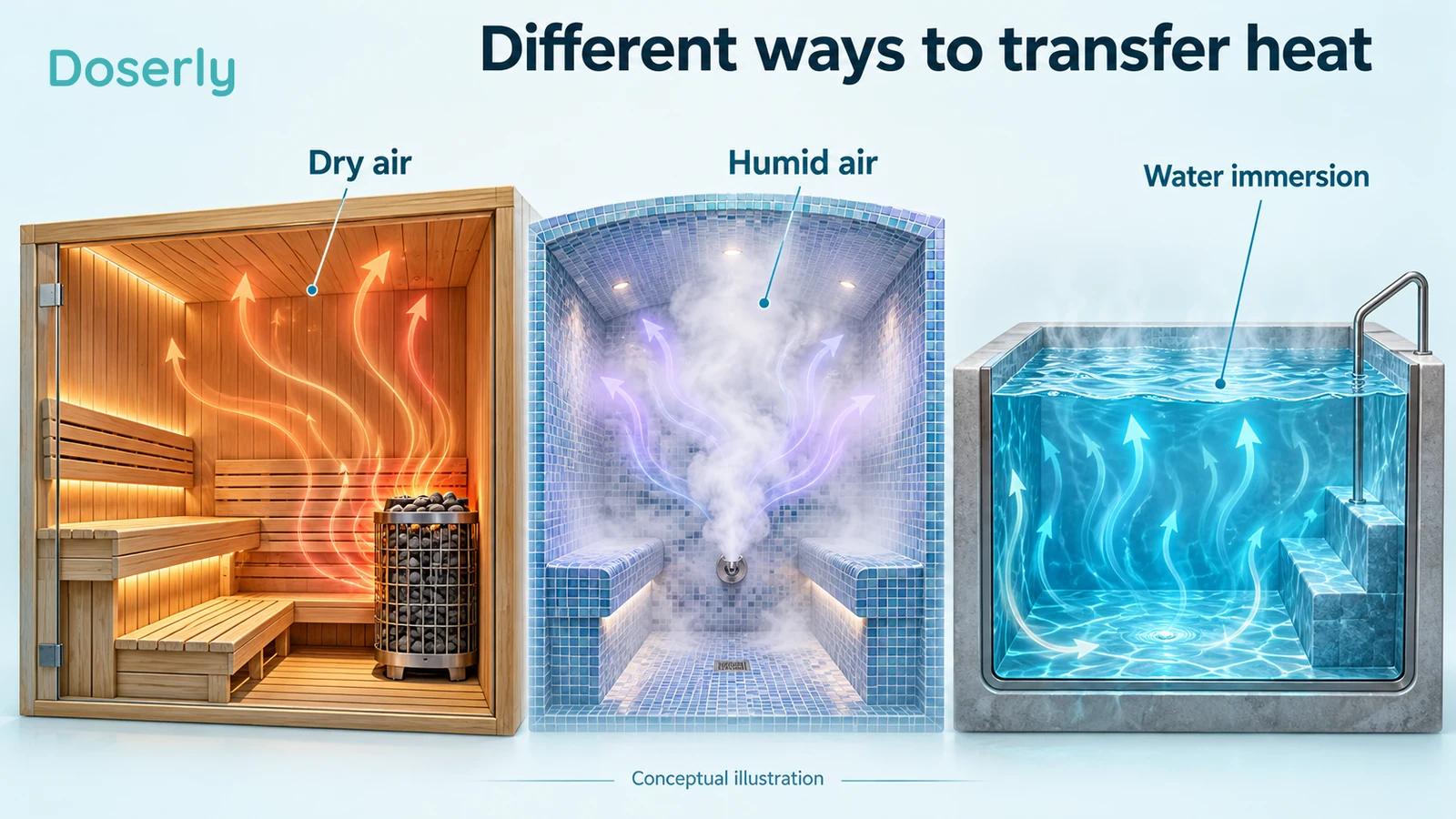
The word heat can hide substantial differences. Air temperature, humidity, immersion depth, session length, clothing and airflow all influence how much heat reaches the body and how effectively it can leave.
Hot water transfers heat differently from air. Immersion also changes the physical pressure around the body. A dry sauna, a humid steam room and an infrared cabin therefore cannot be treated as interchangeable devices merely because each makes someone sweat. Even two sessions in the same room may feel different after exercise, illness or inadequate fluid intake.
A randomized crossover comparison published online in 2025 examined Japanese steam sand bathing, hot-water immersion and sauna. It reported differences in discomfort and respiratory strain alongside acute blood pressure responses. This was a comparison of immediate responses to different heating methods, not a demonstration that one method extends life. Comparative heat study
For consumers, the useful question is whether the actual product and exposure resemble the research being cited. A company may accurately cite a Finnish cohort while selling a device that produces a different physiological stimulus. That mismatch does not prove the device has no value. It means the cited study does not establish its claimed health effect.
A purchase also has practical consequences. Cost, access, cleaning, ventilation, ease of leaving and whether someone enjoys using it matter more to a sustainable routine than a dramatic laboratory pathway diagram. There is no evidence-based reason to feel that healthy aging requires owning expensive heat equipment.
Why a raised heart rate does not make sauna exercise
A watch can display a substantial heart-rate rise during passive heating. That number describes a cardiovascular response; it does not identify the work performed by skeletal muscle.
Walking uphill requires repeated muscle contraction, coordination, balance and force against gravity. Resistance exercise asks muscles to produce force against a load. Passive heating does not reproduce those tasks. For healthy aging, the ability to rise from a chair, carry groceries and recover balance deserves attention alongside cardiovascular measurements.
A small trial can find similar changes in one marker after heat and exercise without establishing equivalent effects across the body. The same principle applies in reverse: an exercise trial with no blood pressure improvement does not imply that participants gained no useful adaptation elsewhere.
This creates a sensible place for heat in the conversation. Someone who enjoys sauna after activity may regard it as an additional experience. Someone whose illness limits movement may ask a rehabilitation team whether supervised heating has a role. The evidence does not justify replacing a feasible movement program simply because sitting in heat raises the pulse.
An adjunct also has to earn its place in a person's week. If heat sessions make exercise less likely because of fatigue, travel or cost, the tradeoff may be different from the one imagined when reading a study. The best routine is not necessarily the one containing the greatest number of interventions.
Where the practical risks come from
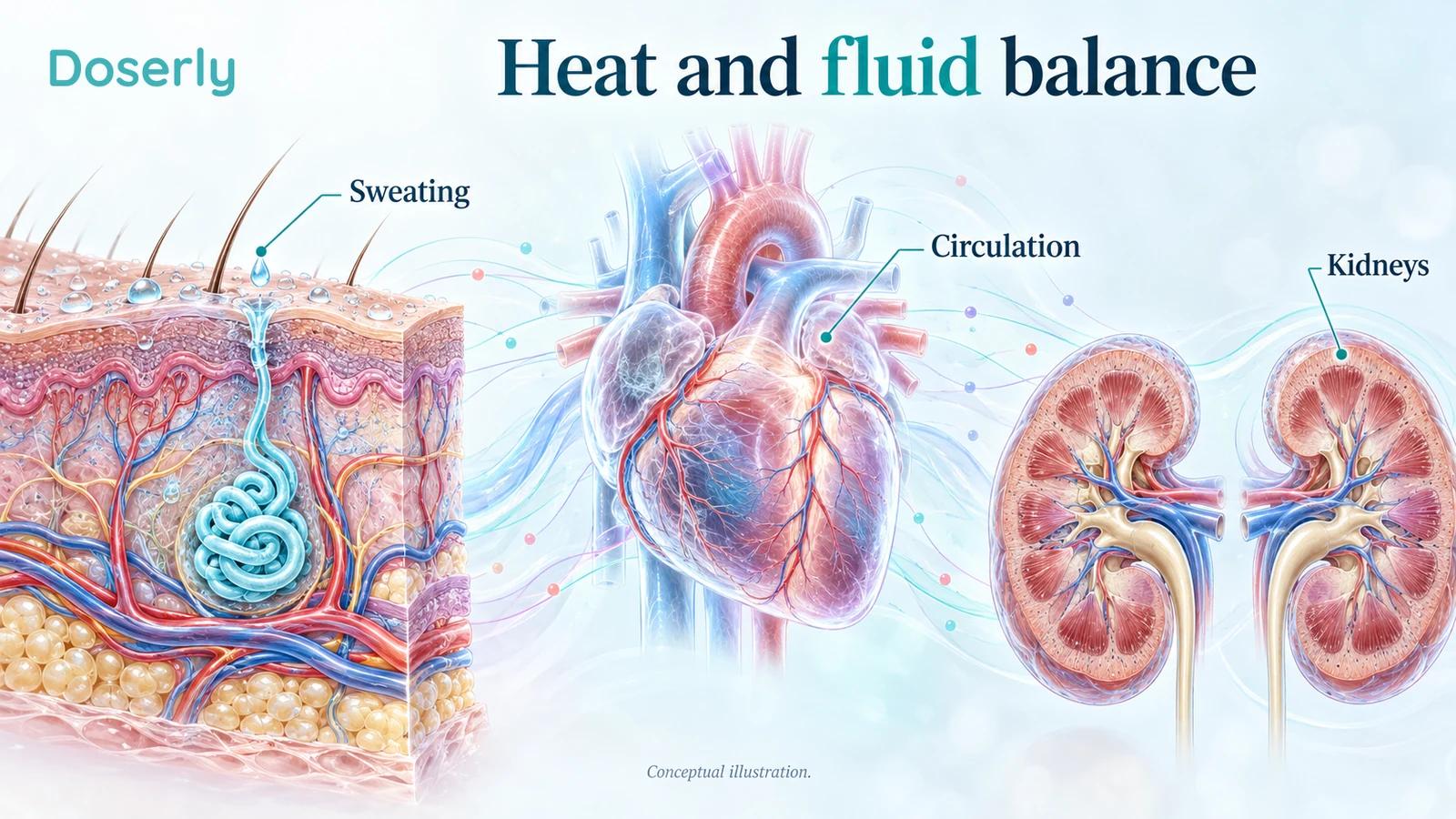
The same physiology that makes heat interesting can create problems. Moving blood toward the skin and losing fluid through sweating can challenge blood pressure and circulation. Heat illness, fainting and falls are especially relevant when someone cannot leave easily or does not recognize that they are becoming unwell.
CDC guidance identifies cardiovascular disease, older age and several other health circumstances as reasons for particular care during heat exposure. This guidance concerns heat risk broadly, not a trial proving that every sauna session is dangerous. It helps explain why safety findings from screened research volunteers may not apply to everyone. CDC cardiovascular heat guidance
Medicines can change the response. Diuretics may contribute to volume depletion; some drugs interfere with sweating, circulation, alertness or thirst. Combinations matter as well. The appropriate response is to review the medication list with a clinician or pharmacist, not to skip prescribed treatment to accommodate sauna use. CDC medication guidance, 2025
A universal instruction to drink a large amount of water is also unsuitable for people with prescribed fluid restrictions. Their plan needs to account for the underlying heart or kidney condition. Research participants often receive supervision, hydration checks and predefined stopping rules that are invisible in a promotional summary.
Symptoms are a reason to stop the exposure, not evidence of successful adaptation. Faintness, marked weakness, nausea or a racing heart that feels abnormal warrant attention. Confusion, collapse or chest pain require urgent medical assessment. Alcohol or sedating substances can make it harder to recognize trouble and leave safely; a heat session is not a setting for testing tolerance.
A useful conversation before making heat a health project
The decision becomes easier when the goal is specific. Relaxation, enjoyment and a shared social ritual do not require a claim of life extension. Treating hypertension or improving exercise capacity requires a more demanding standard of evidence.
A clinician conversation might focus on a few questions:
- Does my medical history or medication list make heat exposure harder to tolerate?
- What outcome are we trying to improve, and how would we measure a sustained change?
- Would heat interfere with a more established part of my care or rehabilitation?
- What symptoms should make me stop, and what circumstances require avoiding exposure?
These questions are more useful than asking for a universal longevity dose. They make room for preference while keeping the health claim proportional to the evidence.
For someone already using sauna comfortably, the research does not require turning every visit into a test. Enjoyment can remain enjoyment. There is no need to maximize sweating, chase a high body temperature or interpret every wearable fluctuation as a sign of cellular renewal.
For someone deciding whether to begin, the missing evidence matters just as much as the promising findings. We still need larger, well-controlled studies with relevant populations, consistent measurement and outcomes beyond short-term vascular tests. Long-term studies should also account for adherence, adverse events and the competing demands of ordinary life.
Sauna is an interesting example of a familiar practice with real physiology behind it. Its strongest case today is as a potentially useful, individually tolerable addition to life. The claim that it reliably extends human lifespan remains ahead of the evidence.