
Supplements
October 16, 2026
Rhodiola for burnout: fatigue is an outcome, not a diagnosis
On this page
Rhodiola rosea is a plant whose root extracts are marketed for stress, fatigue and mental performance. It is often called an “adaptogen,” a term used to describe a proposed ability to help the body cope with stress. For someone feeling depleted, that sounds like a close match to the problem.
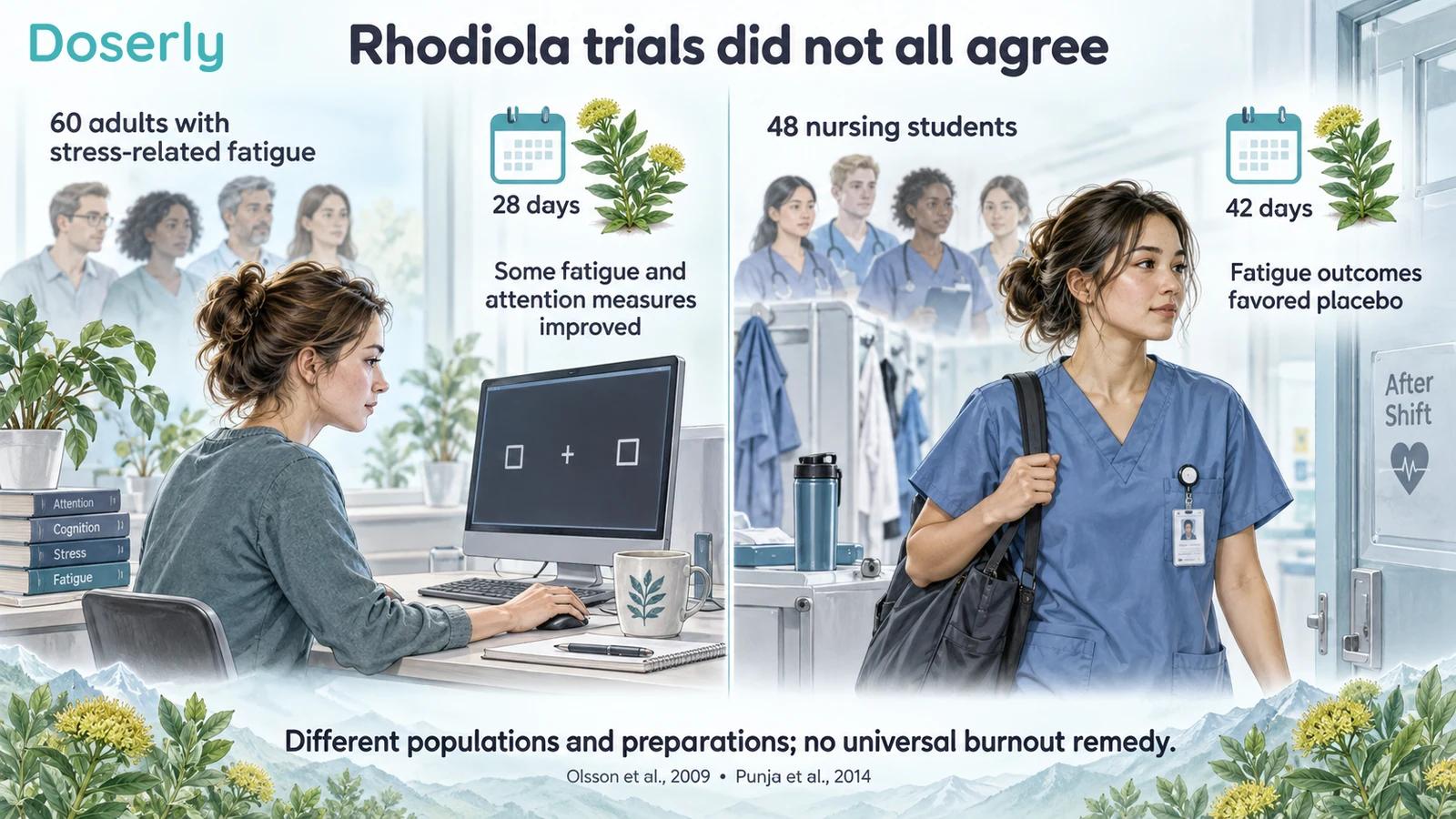
The human research is less uniform. One controlled trial found improvements in selected fatigue and attention measures, another found fatigue outcomes favoring placebo, and a larger burnout study had no comparison group. These results support a specific discussion about the preparation and population studied, not a universal promise of resilience.
Before asking whether rhodiola can help, it is useful to understand what “burnout” and “fatigue” mean in the studies. Our rhodiola guide covers the plant and its preparations. This article focuses on exhaustion, the clinical experiments and the questions a supplement cannot answer by itself.
Burnout has a workplace context
The World Health Organization classifies burnout in ICD-11 as an occupational phenomenon, rather than a medical condition. It describes a pattern associated with chronic workplace stress that has not been successfully managed: exhaustion, mental distance or cynicism about work, and reduced professional effectiveness. WHO explanation
That definition is narrower than everyday use of the word. People may say they are burned out by caregiving, illness, training or a difficult period of life. Their distress is real, but those situations aren't automatically the same population as a workplace-burnout study.
Fatigue is broader still. It describes reduced energy or capacity without identifying the cause. Someone with sleep loss, depression, a medical condition or an unsustainable workload may use the same word while needing a different kind of help.
A supplement trial can measure a fatigue score. It cannot establish that every reader with a similar score has the same underlying problem. That distinction matters because feeling temporarily more capable is not necessarily the same as resolving what is causing exhaustion.
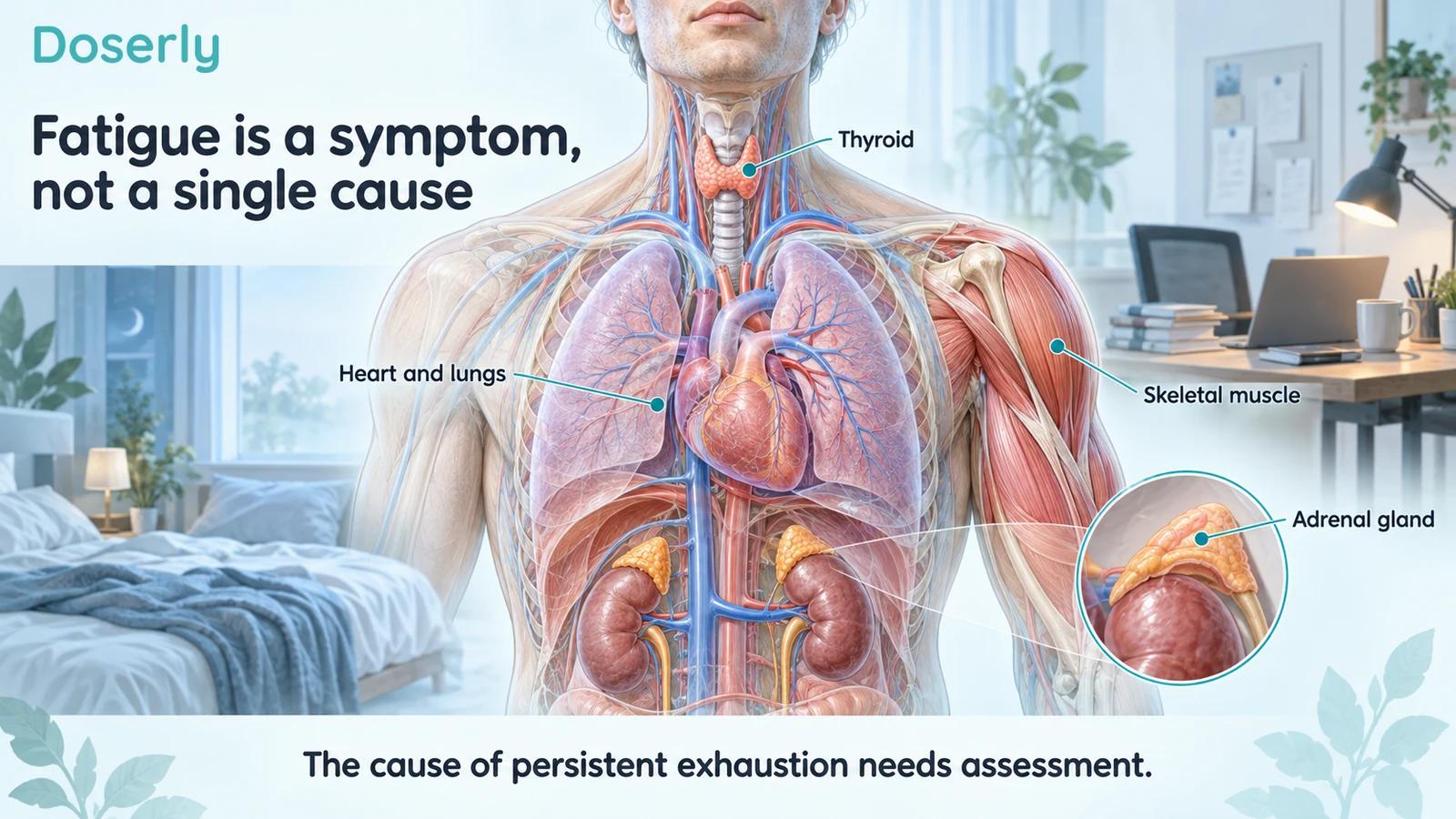
Persistent exhaustion deserves a broader look
The Endocrine Society emphasizes that symptoms often attributed to “adrenal fatigue” can have other explanations, including sleep problems, depression and medical illness. It also states that adrenal fatigue is not a scientifically established diagnosis and that there is no validated test for it. Endocrine Society patient information
This doesn't mean fatigue is imaginary. It means the symptoms deserve an explanation that can guide effective care. Genuine adrenal insufficiency is a different medical condition; a vague sense of being depleted does not diagnose it.
A useful description includes when the fatigue started, whether it is constant or tied to shifts, how much sleep is available, and whether it comes with other changes. Medication use, illness, mood and workload all belong in that conversation. A clinician can decide which examination or tests fit the history.
The positive controlled trial: 60 adults over 28 days
A 2009 randomized, double-blind trial enrolled 60 adults aged 20–55 selected using Swedish diagnostic criteria for fatigue syndrome. Thirty received 576 mg daily of the standardized root extract SHR-5, and thirty received placebo for 28 days.
Researchers assessed fatigue with the Pines burnout scale, attention with a computerized continuous-performance test, mood, quality of life and the saliva cortisol response after waking. Both groups improved on several measures. When the groups were compared, rhodiola had favorable results on the burnout score and selected attention indices. Olsson and colleagues
The result is relevant to people with a similar stress-related fatigue presentation. It does not establish that rhodiola improves all kinds of tiredness or every domain of functioning. Some outcomes improved in both groups without establishing an added treatment effect.
The particular extract also matters. The trial tested SHR-5 at a defined daily amount. A product with a different extract or additional ingredients is not automatically interchangeable. The study dose describes the research, not a recommendation for someone who hasn't been assessed.
What did the cortisol measurement mean?
Cortisol is a hormone involved in normal metabolism and stress responses. Its concentration varies over the day, so the timing of a sample matters. The 2009 trial measured the response around awakening rather than using one unspecified “stress level.”
The researchers found a difference in the change in this waking response between treatment groups. That offers a clue about physiology under the study conditions. It doesn't show that participants had exhausted adrenal glands, and it does not establish a cortisol target for treating burnout.
A lower hormonal response is not automatically better in every circumstance. The practical outcomes remain whether fatigue, attention and daily functioning improve sufficiently, without unwanted effects. Those outcomes have to be measured rather than inferred from a saliva result.
This is why a home hormone panel and a supplement label should not replace assessment of persistent symptoms. The study did not validate a diagnostic test that tells a consumer when to start rhodiola or how much to take.
A nursing-student trial found the opposite direction
A 2014 randomized, double-blind trial studied 48 nursing students undergoing clinical rotations, with 24 assigned to rhodiola and 24 to placebo for 42 days. The study used a different preparation and dosing schedule from the SHR-5 trial.
The main fatigue measures favored placebo. On the RAND-36 vitality subscale, the between-group change was 17.3 points in the direction favoring placebo, with a 95% confidence interval corresponding to 3.9–30.6 points. A separate visual fatigue scale also favored placebo. The investigators concluded that fatigue worsened relative to placebo, while urging caution in interpretation. Punja and colleagues
This is an important counterweight to a simple adaptogen narrative. It doesn't prove rhodiola always worsens fatigue. It shows that a positive result in one selected population did not reproduce as a general benefit in this shift-work setting.
The difference could involve population, preparation, schedule, baseline characteristics or chance. The trials were not designed to determine which explanation is correct. Picking only the favorable study would hide uncertainty directly relevant to someone working long or irregular hours.
Why the larger burnout study cannot settle effectiveness
A 2017 study enrolled 118 outpatients with burnout symptoms and gave them 400 mg daily of the extract WS 1375 for 12 weeks. Many symptom and functioning measures improved, with some changes reported after the first week.
However, this was an open-label, single-arm exploratory study. Everyone knew treatment was being given, and there was no concurrent placebo group. The authors described it as a basis for planning later randomized trials. Burnout study
Without a comparison, the study cannot separate the extract's effect from expectations, attention received during visits, changes in circumstances or symptoms moving back toward their usual level after a particularly difficult period.
The observations are still useful. They show what researchers measured, how symptoms developed during treatment and which questions deserve controlled testing. But an improvement over time is not the same as an improvement caused by rhodiola.
The study also assessed many different scales. That broad exploratory approach can help identify promising outcomes, yet it makes a single triumphant headline less informative. The most useful next trial would choose a main outcome in advance and compare the same preparation with an appropriate control.
Does “adaptogen” explain who will benefit?
The label describes a proposed broad pattern of effects. It doesn't identify a diagnosis, a validated deficiency or a predictable response in an individual. Someone can feel exhausted for reasons that an herb's proposed stress pathways do not address.
It also doesn't tell us whether the desired benefit is less fatigue, improved concentration, better mood or increased physical performance. Those may overlap, but they require different measurements. A result on a computer attention test should not be presented as proof that a person can tolerate a heavier workload.
NCCIH's current rhodiola overview concludes that there is not enough reliable evidence to determine usefulness for a health-related purpose and describes much human research as low to moderate quality. That broad assessment is consistent with the mixed trials above. NCCIH rhodiola information
The most defensible interpretation is that certain preparations have preliminary signals worth studying. A reliable general treatment for burnout has not been established.
What tolerability issues matter for someone already exhausted?
NCCIH describes rhodiola as possibly safe for up to 12 weeks, while noting potential dizziness, headache, insomnia, dry mouth or excessive saliva. It also reports an interaction with losartan and limited information during pregnancy or breastfeeding. NCCIH safety information
Insomnia is particularly relevant if inadequate sleep is already contributing to fatigue. A product that makes someone feel more activated during the day could still be unhelpful if it disrupts the next night. The trials don't justify treating every unpleasant effect as a temporary adjustment that should be pushed through.
A pharmacist or clinician can review the exact label and medication list. “Rhodiola” is not enough information when a product includes caffeine, other herbs or a proprietary blend. The combination may have a different tolerability profile from the studied extract.
The short research periods also leave long-term use uncertain. No serious event signal in a small trial is not proof that uncommon harms cannot occur.
What would a useful personal outcome look like?
Start with an activity that fatigue is preventing or making unusually difficult. Examples include getting through a normal shift without prolonged exhaustion, concentrating on a routine task, or having enough energy for basic responsibilities afterward. These are clearer goals than “supporting resilience.”
Keep sleep and workload in the same record. If the schedule changes, the change may explain part of any improvement. If several supplements are started at once, it becomes difficult to know which affected symptoms.
A simple diary can record shifts, sleep opportunity, fatigue at a consistent time, medicines or supplements, and adverse effects. It should be brief and useful to a clinician. It is not a substitute for diagnosis, and it cannot establish that a supplement corrected a hormone problem.
An early rise in perceived energy should not automatically become a reason to increase demands. The relevant question is whether functioning improves sustainably. A supplement cannot demonstrate that an unhealthy work pattern has become safe or that a person no longer needs recovery time.
Put the work situation and health assessment together
If the problem is tied to work, the workplace context belongs in the plan. Work hours, recovery opportunities, support and the nature of the demands may matter more than the choice of extract. A product trial does not test whether those conditions have improved.
If fatigue persists away from work, is worsening, or is accompanied by other symptoms, describe that to a clinician. The aim is to avoid treating a broad symptom as though its explanation were already known.
Rhodiola's research contains both favorable and unfavorable controlled findings. The open-label burnout study adds observations but cannot resolve the disagreement. A reasonable discussion therefore starts with the cause of exhaustion and the intended functional outcome, then asks whether a specific preparation has evidence relevant to that situation.
Sources
- WHO: burnout as an occupational phenomenon.
- Endocrine Society: adrenal fatigue and alternative explanations.
- Olsson et al., 2009: SHR-5 in stress-related fatigue.
- Punja et al., 2014: fatigue in nursing students.
- Kasper and Dienel, 2017: open-label burnout study.
- NCCIH: rhodiola evidence and safety.