
Supplements
October 16, 2026
Resistant starch and weight loss: what human trials actually show
On this page
Resistant starch has a more interesting weight-loss story than either the miracle claims or the dismissive summaries suggest. There is a small, carefully controlled human trial showing weight loss. There are also human studies that found little metabolic improvement, and many experiments that measured fermentation rather than weight. Those findings can coexist because they answer different questions.
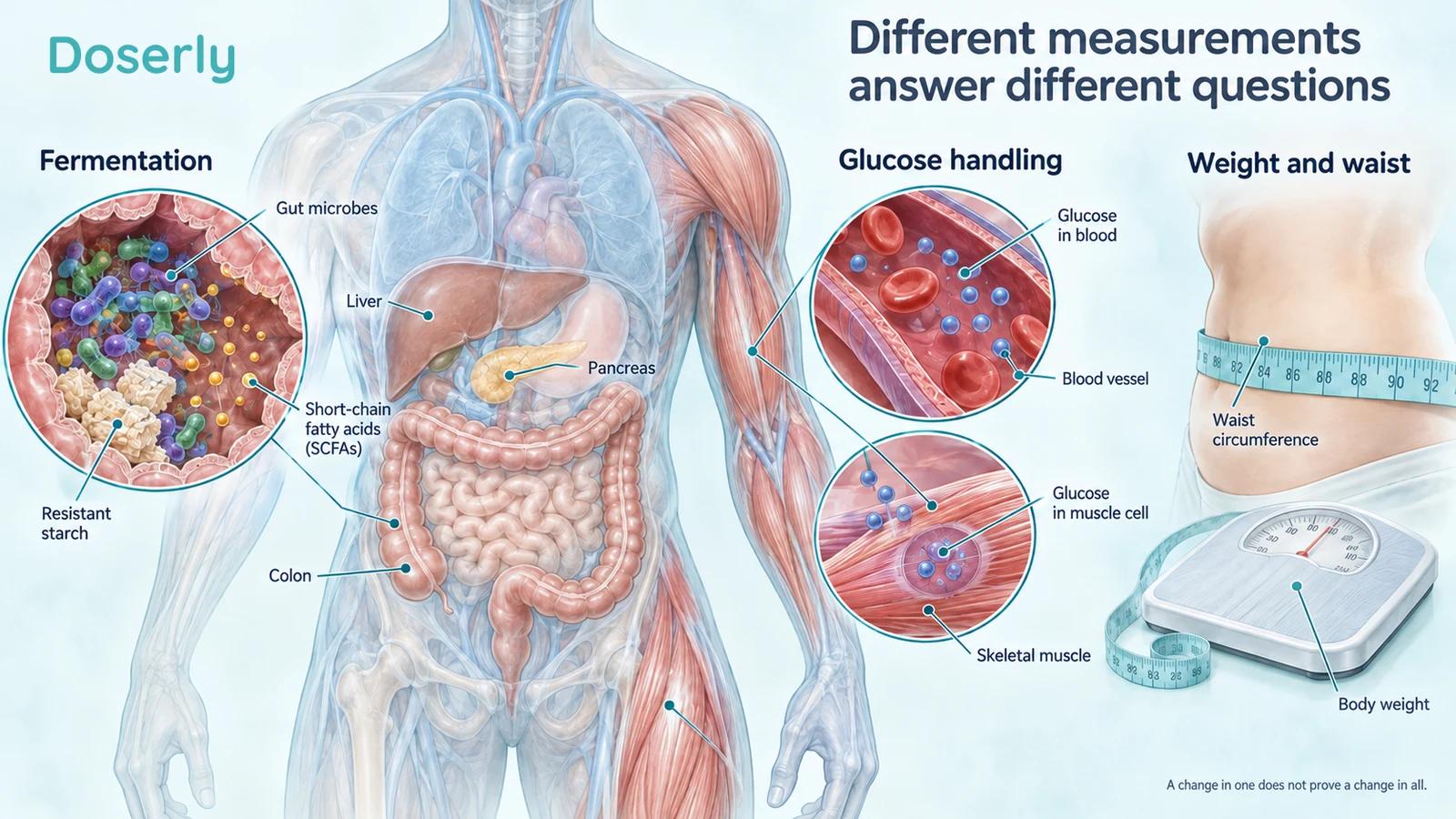
The useful question is whether a particular resistant-starch preparation, taken under particular conditions, produces an outcome that matters to you. A change in stool bacteria is evidence of biological activity. It is not a substitute for measuring weight, waist, glucose control, digestive comfort, or whatever goal prompted the purchase.
This distinction also protects a promising result from being stretched beyond recognition. A trial of a defined maize ingredient is not automatically a trial of raw potato starch, a cooled bowl of rice, or every product carrying a prebiotic claim. Our resistant starch guide provides broader ingredient context; here, the focus is what the human research can support about weight and metabolism.
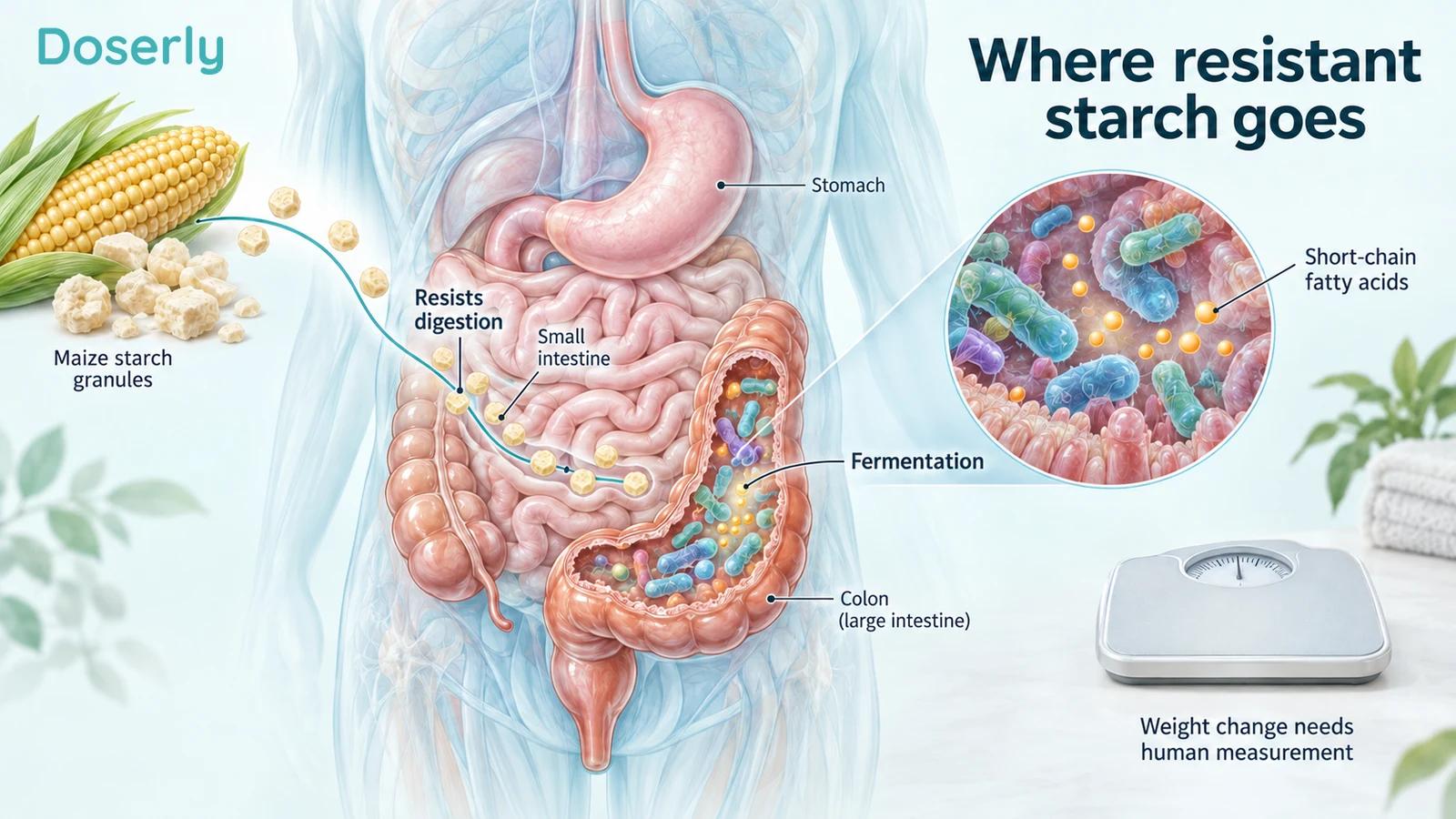
What makes this starch resistant?
The name refers to resistance to digestion in the small intestine. Some starch reaches the large intestine, where microbes can use it and produce metabolites, including short-chain fatty acids. Human feeding studies have measured changes in these metabolites after resistant-starch intake. They have also found considerable variation between participants. Human fermentation study
That definition describes a digestive property, not one standardized supplement. The source, structure, processing, and amount of the resistant fraction matter. The research discussed below includes high-amylose maize starch and unmodified potato starch. Their names should stay attached to their results rather than disappear into a generic statement that “starch burns fat.”
For a shopper, the distinction between total powder and resistant starch is particularly practical. A serving can contain both resistant and digestible material. A scoop size cannot be compared with a trial dose unless the quantities refer to the same thing. The same issue appears when a recipe is presented as an alternative to a research product: food weight and resistant-starch weight are different measurements.
A positive weight-loss trial deserves a fair reading
A 2024 randomized crossover trial analyzed 37 adults with overweight or obesity. Participants received high-amylose maize powder supplying 40 grams of resistant starch daily, or an energy-matched control, for eight weeks each, with a washout between periods. Researchers provided three balanced meals per day. The resistant-starch period produced an average weight difference of about 2.8 kilograms compared with control. This is a measured human result, not an inference from a bacterial change. Trial report
The study was small and short, with a closely managed food environment. It does not establish long-term maintenance, the effect of a smaller retail serving, or the response of people using weight-loss medicines. Its mechanistic work included mouse experiments; those experiments do not establish that taking a particular bacterium reproduces the human result. The right reading is promising evidence for a defined intervention, with replication and broader testing still needed. Trial report
When reading a headline about that finding, look for what has quietly been removed. Does the headline preserve the specific product? Does it mention the study duration and participants? Does it retain the supplied background diet? If those details disappear, the claim becomes much broader than the experiment.
None of those limitations erases the outcome. Small controlled trials can identify useful effects worth pursuing. But a successful experiment is the beginning of a practical question: can people obtain a comparable intervention, tolerate it, maintain it, and keep the benefit in ordinary life? Those questions require their own evidence.
Other metabolic trials did not show the same broad benefit
A 2018 randomized trial enrolled 68 adults with prediabetes and used 45 grams per day of high-amylose maize resistant starch for 12 weeks. It did not improve insulin sensitivity, insulin secretion, or glucose responses to a meal compared with control. The small HbA1c difference was described as clinically insignificant. Some other measurements changed, including tumor necrosis factor alpha and heart rate, but the main metabolic picture was not a sweeping improvement. Prediabetes trial
This does not directly cancel the later weight-loss result. The populations, design, dietary setting, and primary questions differed. It does show why “improves metabolism” is too vague to be useful. A supplement can affect one marker without producing a meaningful change in another. People with prediabetes should not assume that a positive weight headline establishes better glucose control for them. Prediabetes trial
An earlier crossover experiment in ten healthy participants found improved measures of insulin sensitivity after four weeks of 30 grams daily. Its small size and healthy population limit its reach, and it was not evidence of durable weight loss. Insulin-sensitivity experiment
Together, these studies illustrate a problem with shopping by a single favorable number. “Insulin sensitivity improved” sounds like a universal property of the ingredient. In practice, it is a result obtained with a particular method in particular people. A stronger interpretation keeps those details visible and asks whether the result has been reproduced in the population of interest.
Butyrate is a useful clue, not a personal success score
In a study of 46 healthy adults, adding resistant starch to a diet containing other fiber generally increased fecal short-chain fatty acids, but responses varied substantially. A separate study of 20 healthy young adults given unmodified potato starch also found heterogeneous butyrate responses. Some people increased production-related stool measurements more than others. Feeding study, microbiome study
A stool concentration is the amount measured in that sample. It is not a direct reading of every molecule produced, absorbed, or used throughout the colon. Nor is it a validated target that tells an individual how much weight they will lose. These studies help explain why a common ingredient can produce different biological responses; they do not supply a consumer threshold for a “good” microbiome.
That matters when a stool test or supplement advertisement presents a microbial change as a complete outcome. Even a technically accurate laboratory result needs a bridge to the health claim. If the goal is easier bowel movements, measure bowel function. If the goal is better glucose control, use an appropriate clinical measurement. If the goal is weight management, a bacterial percentage cannot answer the question alone.
Does cooling rice reproduce a supplement trial?
Food preparation can alter starch properties. A small crossover study in 15 healthy adults compared freshly cooked rice with rice cooled for 24 hours at 4°C and reheated. It measured resistant-starch content and the acute glucose response. That is useful food research, but it did not test sustained weight loss or establish equivalence with a concentrated maize supplement. Rice study
The practical lesson is about matching questions. An experiment measuring glucose after one meal cannot tell you what happens to body weight after months. A change in the resistant fraction also does not make the rest of a meal nutritionally irrelevant. Portion size, accompanying foods, and the overall eating pattern still belong in the discussion.
There is no reason to turn ordinary food into a laboratory protocol solely to imitate a supplement headline. If you enjoy rice, legumes, or other starch-containing foods, their place in your diet can be considered within a broader eating plan. This article is not a food-storage guide; cooling and reheating should follow reliable food-safety instructions, not improvised social-media methods designed to maximize a claimed metabolic effect.
Comparing a product with the evidence
A useful label review starts with the actual ingredient. “Prebiotic starch blend” may not tell you enough to compare it with a trial. Look for the starch source, the amount per serving, and whether the stated quantity refers to the whole ingredient or its resistant fraction. If a manufacturer cites a study, check whether it used that same preparation.
Next, separate the claimed purpose from the study endpoint. A study about stool metabolites can support a statement about those measured metabolites. It cannot silently become evidence for appetite suppression. A study about post-meal glucose does not establish diabetes prevention. A weight-loss study does not automatically show cardiovascular benefit.
Finally, consider the comparator. Replacing another ingredient is a different intervention from adding a powder to an unchanged diet. A controlled comparison is designed to isolate an effect, but the way the product enters everyday eating may differ. Writing down what you are replacing, adding, or changing makes the experiment more interpretable.
These questions are often more informative than comparing front-label adjectives such as “advanced,” “natural,” or “microbiome optimized.” None of those terms identifies the preparation, population, or outcome needed to judge the evidence.
A sensible way to judge whether it helps you
Start with one goal and an appropriate time frame. Someone interested in bowel regularity needs a different record from someone working on weight with a clinician. Avoid changing several fiber products, meal patterns, and supplements at once if your aim is to understand the contribution of one ingredient.
For a practical record, note the exact product, serving amount, start date, digestive symptoms, and major changes in food intake or medication. If weight is the goal, compare measurements taken under reasonably consistent conditions and look for a trend rather than interpreting a single reading. A diary is useful for discussion; it does not turn an uncontrolled personal experiment into proof of causation.
Digestive comfort belongs in that record. A product that makes the intended eating pattern difficult to sustain is not automatically a success because its mechanism sounds attractive. Persistent or severe symptoms deserve assessment rather than being relabeled as evidence that fermentation is “working.” People managing diabetes or using medicines that affect glucose should discuss a substantial dietary supplement change with their clinician instead of adjusting treatment based on a supplement claim.
Weight management also needs a plan beyond an ingredient. NIDDK emphasizes an eating and activity approach suited to the person, ongoing support, realistic goals, and maintenance. That is a more durable framework for judging a supplement than asking it to carry the whole effort. NIDDK guidance
Resistant starch merits interest because human research includes both a meaningful positive weight result and useful studies of fermentation and glucose handling. The most defensible next step is to keep those findings distinct, match the product to the evidence, and evaluate the outcome you actually care about.
Sources
- Li and colleagues: resistant starch and weight loss in humans, 2024
- Resistant starch in adults with prediabetes, 2018
- Robertson and colleagues: insulin sensitivity, 2005
- McOrist and colleagues: fecal butyrate variation, 2011
- Variable human microbiome responses to potato starch, 2016
- Cooling cooked rice and acute glycemic response, 2015
- NIDDK: choosing a safe and successful weight-loss program