
Supplements
October 16, 2026
Red yeast rice and cholesterol: a supplement with statin effects
On this page
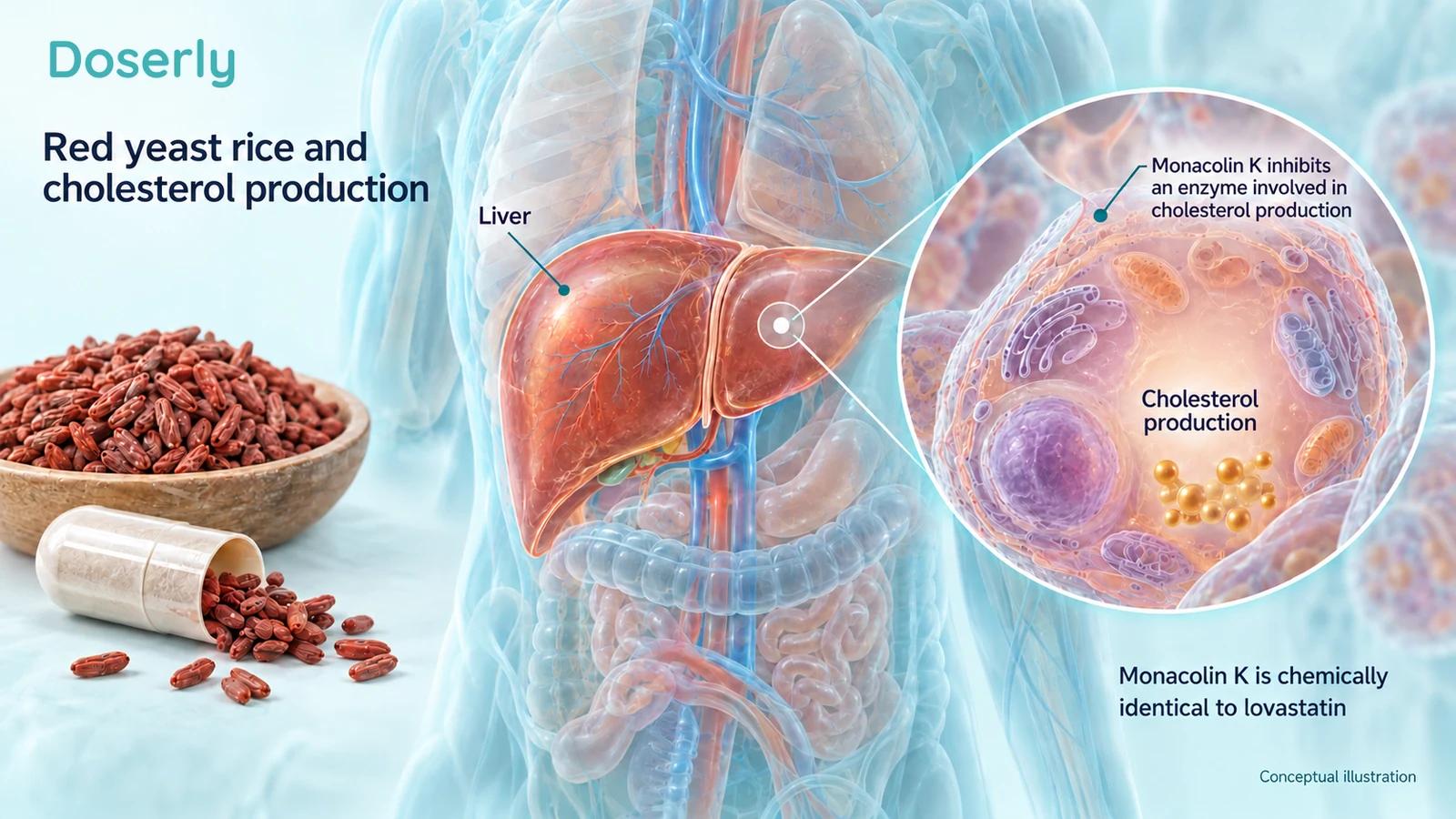
Red yeast rice is rice fermented with a fungus that can produce cholesterol-lowering substances. One of them, monacolin K, is chemically identical to the medicine lovastatin. That explains both its appeal and its complications: a product sold beside vitamins can contain an active ingredient with the effects and interactions of a prescription drug. NCCIH overview.
If you're considering it after a high cholesterol result, the useful question is whether the particular product offers a predictable, worthwhile way to manage your cardiovascular risk. The amount of fermented rice printed on a bottle doesn't answer that question. Neither does the word “natural.” We need to distinguish the ingredient, the preparation tested in research, and the product someone actually takes.
Why can fermented rice lower cholesterol?
Your liver makes cholesterol as well as handling cholesterol arriving from food. Monacolin K inhibits an enzyme involved in its production, the same pathway targeted by lovastatin. LDL cholesterol is the cholesterol carried in low-density lipoprotein particles in blood. A change in that blood measurement can tell a clinician whether a lipid-lowering intervention is having an effect; it does not directly show the condition of an artery. EFSA safety assessment.
The rice itself isn't a standardized dose of monacolin K. Fermentation and processing affect the mixture that ends up in a capsule. Products can contain other monacolins as well, so the name of the starting material describes less than a prescription label specifying a particular drug and strength.
This distinction helps explain a common misunderstanding. Someone may say they want to avoid statins and choose red yeast rice instead. They may be avoiding a prescription, but if the product supplies appreciable monacolin K, they haven't necessarily avoided exposure to a statin molecule. Their previous experience with cholesterol medicines is still relevant.
How much active ingredient is in a capsule?
In a 2017 laboratory analysis of 28 brands purchased from mainstream US retailers, researchers found no detectable monacolin K in two brands. Among the other 26, concentrations ranged from 0.09 to 5.48 mg per 1,200 mg of red yeast rice. Following manufacturers' suggested daily servings produced an even wider estimated exposure range, 0.09 to 10.94 mg daily. Cohen and colleagues.
Those are two different comparisons. The first holds the amount of red yeast rice constant. The second also incorporates the serving instructions. They should not be combined into a single “capsule strength” number. The findings mean that equal amounts of the named ingredient did not reliably deliver equal amounts of its drug-like constituent.
This was a historical sample, not an inspection of every product available today. It cannot identify the contents of a bottle you have at home, and it wasn't a trial measuring cholesterol or side effects. Its contribution is more basic: it demonstrates why a rice-weight label alone is inadequate for predicting exposure.
An earlier analysis reached a similar conclusion using a different set of products. Researchers tested 12 formulations labeled 600 mg per capsule and found monacolin K ranging from 0.10 to 10.09 mg per capsule. Total monacolins had a different range, 0.31 to 11.15 mg. These figures are sometimes confused, although total monacolins and monacolin K aren't the same measurement. Only one lot of each product was examined. Gordon and colleagues, 2010.
For a reader comparing bottles, the practical consequence is straightforward. Twice as many milligrams of red yeast rice does not necessarily mean twice the cholesterol-lowering activity. A lower price per gram of rice may therefore say little about either value or safety.
What did a trial in people with statin-associated muscle pain find?
A 2009 randomized trial enrolled 62 people who had stopped statins because of muscle pain. Thirty-one received a particular red yeast rice preparation and 31 received placebo for 24 weeks. Both groups also entered a 12-week lifestyle program. Researchers tested 1,800 mg twice daily; that describes the trial, not a recommendation to reproduce it with a retail product. Becker and colleagues.
At 12 weeks, LDL had fallen by 43 mg/dL from baseline in the red yeast rice group and 11 mg/dL in the placebo group. At 24 weeks, the reductions were 35 and 15 mg/dL, respectively. Pain scores and the measured muscle enzyme did not differ significantly between groups.
The result shows that a defined preparation can lower LDL in a selected group. It doesn't show that every person with statin symptoms will tolerate every red yeast rice product. With 62 participants at one practice and six months of follow-up, the trial was too small to settle uncommon harms or long-term cardiovascular protection.
It also illustrates why a before-and-after result needs context. LDL fell in the placebo group too, while participants received lifestyle support. Crediting the entire 43 mg/dL change to the supplement would ignore that comparison. The useful treatment question is what the preparation added under the study conditions.
Why did a later retail-supplement trial look different?
The SPORT trial, published online in 2022 and in a 2023 journal issue, compared low-dose rosuvastatin, placebo and six supplements over 28 days. The 190 people who completed the study had increased cardiovascular risk but no established atherosclerotic cardiovascular disease. The supplements included red yeast rice, garlic, cinnamon, fish oil, turmeric and plant sterols. SPORT primary report.
Rosuvastatin produced a significantly greater LDL reduction than placebo and every supplement. Its difference from placebo was 35.2 percentage points in percentage LDL reduction. None of the tested supplements significantly lowered LDL compared with placebo. The study was single-center, relatively short and funded by AstraZeneca.
This doesn't erase the earlier positive trial. The preparations, people and follow-up differed. It does challenge the assumption that buying a common retail supplement reliably reproduces a favorable trial result. SPORT tested specific products, so it also cannot establish that every possible formulation is ineffective.
These studies answer a more useful question together than either does alone. Red yeast rice can have cholesterol-lowering activity, but the category name doesn't guarantee the amount or consistency of that activity in ordinary purchasing decisions.
Has red yeast rice ever reduced heart attacks?
There is clinical-event evidence for Xuezhikang, a partially purified red yeast rice extract studied in China. In a randomized trial of nearly 5,000 people with a previous heart attack, average follow-up was 4.5 years. The main outcome combined nonfatal heart attack and death from coronary heart disease. It occurred in 5.7% with the extract and 10.4% with placebo. Lu and colleagues, 2008.
That is an observed difference of 4.7 percentage points. It is a meaningful finding for the studied preparation and population, and it goes beyond a blood-test change. It should not be rewritten as proof that an unspecified supplement prevents heart attacks in healthy adults.
Someone who has already had a heart attack has a different starting risk from someone with an isolated mildly elevated LDL result. The trial also took place in a particular historical treatment setting. A contemporary treatment decision needs to consider the care a person is already receiving, rather than treating this extract as interchangeable with every red yeast rice capsule.
What safety questions deserve attention?
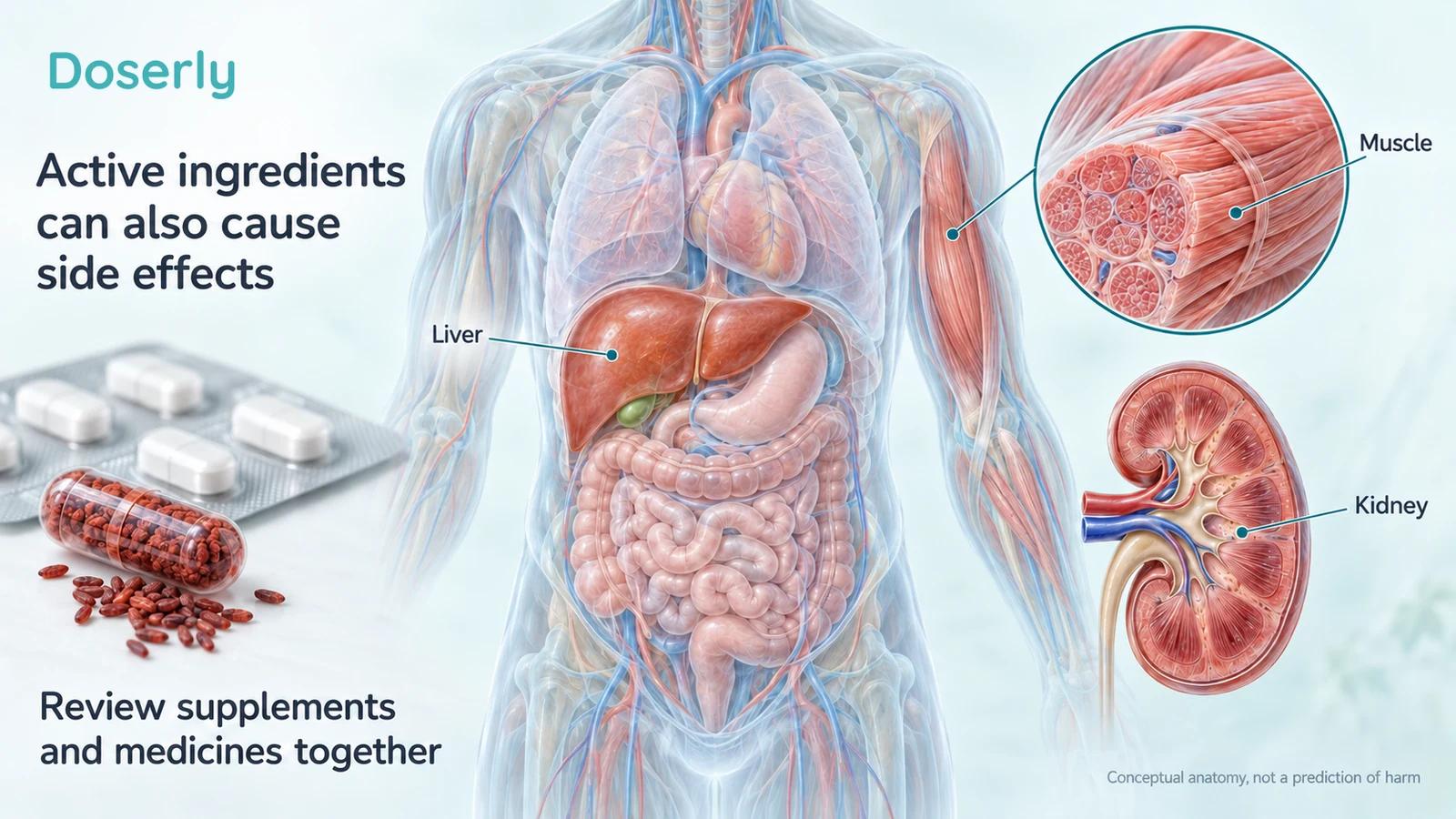
Products providing significant monacolin K can cause statin-like adverse effects, including muscle, liver and kidney problems. They can also share statin-type drug interactions. Red yeast rice is not recommended during pregnancy or breastfeeding. These concerns apply even when the product's front label emphasizes its food origin. NCCIH safety information.
A separate issue is citrinin, a contaminant that can be produced during fermentation. In the 2010 product analysis, four of 12 formulations had elevated citrinin. This is a quality problem, distinct from the pharmacological effects of monacolin K. A product could have a consistent active ingredient and still require contaminant testing. Original product analysis.
The European Food Safety Authority revisited monacolin safety in 2025. Its assessment remained unable to establish a daily intake without safety concerns for the general population or vulnerable groups. A regulatory limit should therefore not be interpreted as a personal guarantee that an amount below it is harmless. EFSA updated opinion.
The findings about benefit and safety belong in the same conversation. A product with enough monacolin K to change cholesterol is also a product whose active ingredient deserves medication-level attention. Conversely, a product containing little active ingredient may provide little expected benefit without resolving every quality concern.
Why does the US regulatory distinction matter?
NCCIH explains that products with enhanced or added lovastatin cannot legally be marketed as dietary supplements in the United States. This reflects the history of lovastatin's approval as a drug. The fact that a product is available online does not establish that it meets those rules. NCCIH explanation of FDA regulation.
For consumers, this creates an awkward situation: the constituent that helps explain stronger cholesterol effects is also central to the regulatory and safety questions. “Contains red yeast rice” and “provides a known amount of an active cholesterol medicine” are different claims. A label that supplies only the first leaves important questions unanswered.
A more productive discussion about your cholesterol
Bring the actual product label to a clinician or pharmacist, including the serving size, other ingredients and any available batch testing. Explain why red yeast rice appeals to you. Cost, concerns about side effects and a previous unpleasant experience are useful information; they can help shape a workable treatment plan.
If you previously stopped a medicine, record which medicine it was, when symptoms began, what happened after stopping, and whether other treatments changed. That history is more informative than simply describing yourself as “unable to take statins.” It doesn't establish the cause on its own, but it gives the clinician something specific to assess.
Agree on what outcome will guide the decision. A follow-up lipid result addresses cholesterol response. Symptoms address tolerability. Neither alone proves protection from a future heart attack. Ask how the proposed approach fits your overall risk and what would lead to changing the plan.
Our red yeast rice guide provides broader background on preparations and interactions. The essential lesson from this research is that red yeast rice can be pharmacologically active, while the amount of that activity may be difficult to predict from the bottle. A dependable plan needs to account for both facts.
Sources
- Cohen et al., 2017: variability in 28 retail brands.
- Gordon et al., 2010: monacolins and citrinin in 12 products.
- Becker et al., 2009: randomized trial after statin-associated muscle symptoms.
- Laffin et al., SPORT: retail supplements and rosuvastatin.
- Lu et al., 2008: Xuezhikang after myocardial infarction.
- EFSA, 2025: updated monacolin safety assessment.
- NCCIH: red yeast rice, safety and US regulation.