
Red Light Therapy
October 17, 2026
Red light therapy for wrinkles and collagen: what changes in real skin?
On this page
The appeal of red light therapy for skin is easy to understand. A treatment that might soften fine lines without needles, peeling or recovery time sounds useful, especially when the alternative is another product promising to rebuild collagen.
There is human research behind that interest. Some controlled trials report improvements in wrinkles or skin texture, and several experiments have examined collagen-related changes. The important question is what each finding actually means for the person looking in the mirror.
“More collagen” can describe several very different observations: a cell producing more of a precursor protein, a biopsy containing more visible fibers, or an ultrasound image changing in a way interpreted as greater dermal density. None automatically tells you how much younger a face will look. Conversely, someone can notice smoother skin without a study proving that new collagen caused the change.
A realistic reading of the evidence leaves room for modest benefit while setting aside the promise of reversing facial aging. This article considers original research available through October 17, 2026, including newer mask studies and an October 2026 report. It focuses on nonthermal photobiomodulation, usually called PBM, rather than resurfacing lasers or other procedures designed to heat or injure tissue.
A wrinkle is more than a shortage of collagen
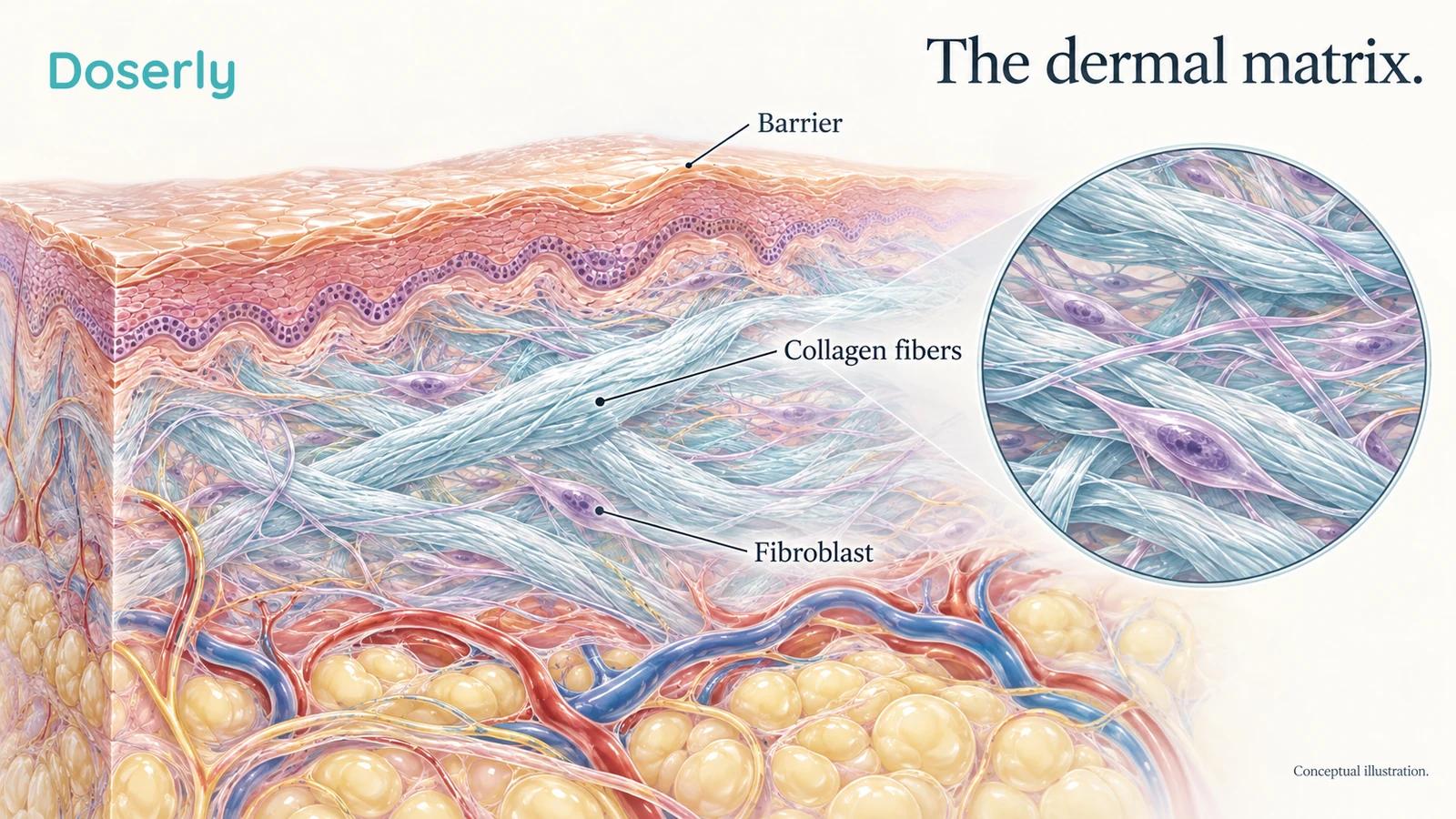
Skin has several layers, each contributing something different to its appearance. The outer barrier influences water retention and surface texture. Beneath it, the dermis contains collagen, elastic fibers, blood vessels and cells that maintain the surrounding matrix. Deeper tissues, including fat, also shape the face.
Collagen helps provide tensile strength. Elastic fibers contribute to recoil. Fibroblasts are among the cells responsible for producing and maintaining these structural materials. The matrix is continually remodeled, with synthesis and breakdown both contributing to its condition. A healthy result is not simply the largest possible amount of collagen.
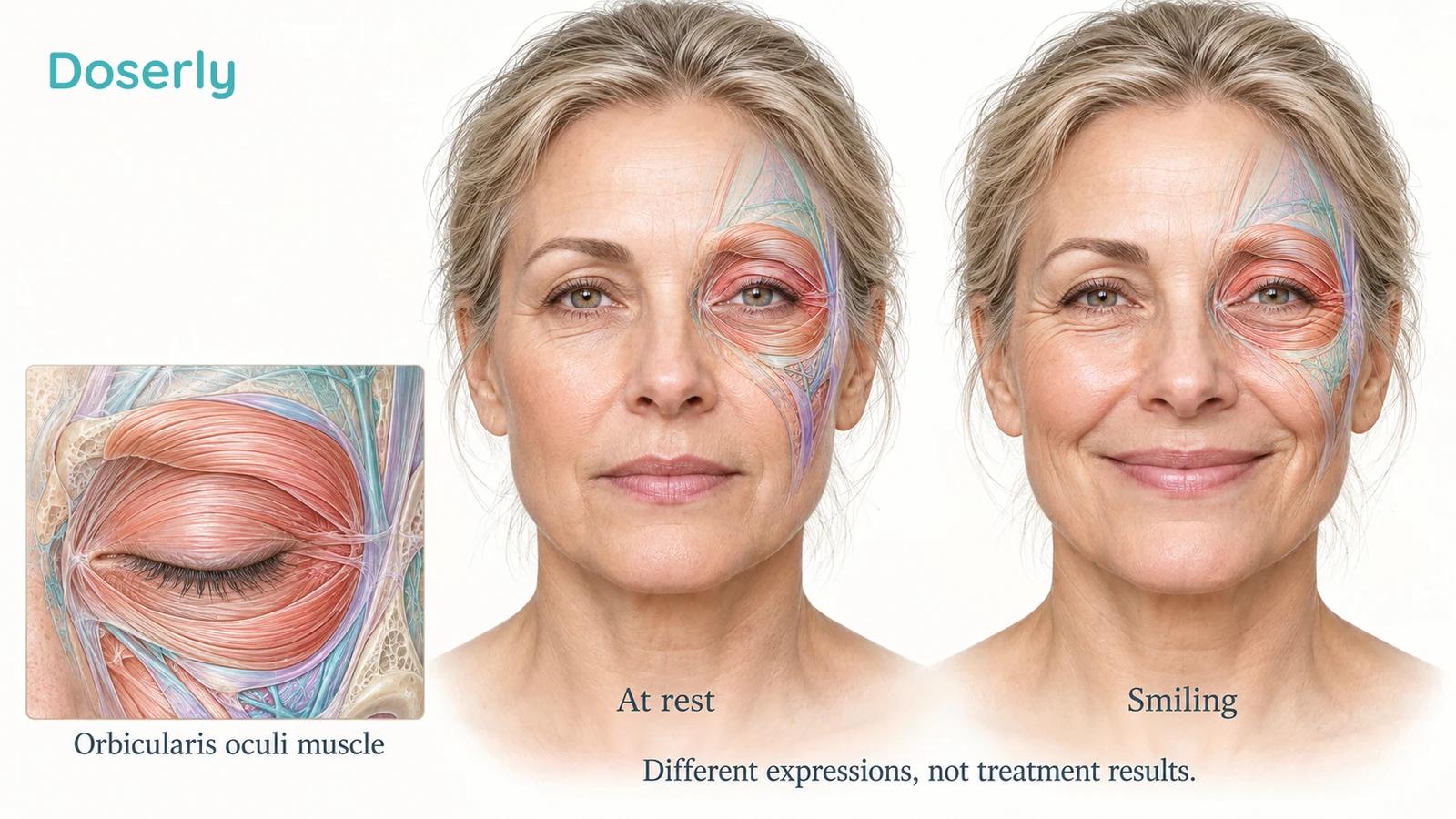
Facial movement adds another dimension. Lines visible mainly when smiling or frowning are not the same outcome as lines assessed with the face relaxed. A study of crow's feet at rest does not necessarily answer how much those lines will appear during a broad smile. Changes in facial volume or tissue position are different again.
That is why a useful expectation should name the feature you want to change. Fine surface lines, roughness and mild textural changes are plausible research targets. A deep fold, pronounced sagging or a major loss of facial volume requires a different conversation. Calling all of these concerns “collagen loss” makes it too easy to promise one treatment for several distinct problems.
There is also nothing medically wrong with having expression lines. Whether a small cosmetic improvement is worth repeated sessions depends on personal preference, cost and the burden of the routine. The purpose of understanding the evidence is to make that choice clearer, not to turn ordinary aging into a defect that requires correction.
What collagen experiments can establish
Laboratory work can test whether light changes a particular biological process under controlled conditions. It is especially useful for identifying which molecules or cell activities deserve investigation in people. The setting also removes many features of everyday skin, including its full circulation, immune environment, movement and exposure history.
In a 2021 experiment using human fibroblasts and skin explants, combined red and near-infrared light increased several collagen- and elastin-related gene and protein measurements. The researchers also reported changes in ATP production in cultured fibroblasts. These are observations in human-derived material, not a trial showing that volunteers developed fewer wrinkles.
The distinction matters because “human skin study” can sound like a clinical study even when the tissue is maintained outside the body. A skin explant preserves more architecture than isolated cells, but it still cannot report satisfaction, tolerate a daily routine or demonstrate a visible benefit over months.
A 2009 investigation of pulsed 660 nm light combined work in reconstructed human skin with a separate single-blinded split-face clinical study. The laboratory model showed changes in procollagen and a collagen-degrading enzyme, while the clinical component reported improvements in surface measurements and wrinkle ratings. The laboratory model did not show corresponding histological changes in that experiment.
That combination is useful precisely because the measurements do not collapse into one result. A biochemical signal, a tissue section and a photograph ask different questions. The clinical findings support further interest in the tested intervention; they do not justify converting a laboratory percentage into a predicted percentage reduction in your wrinkles.
Human biopsies provide a closer look
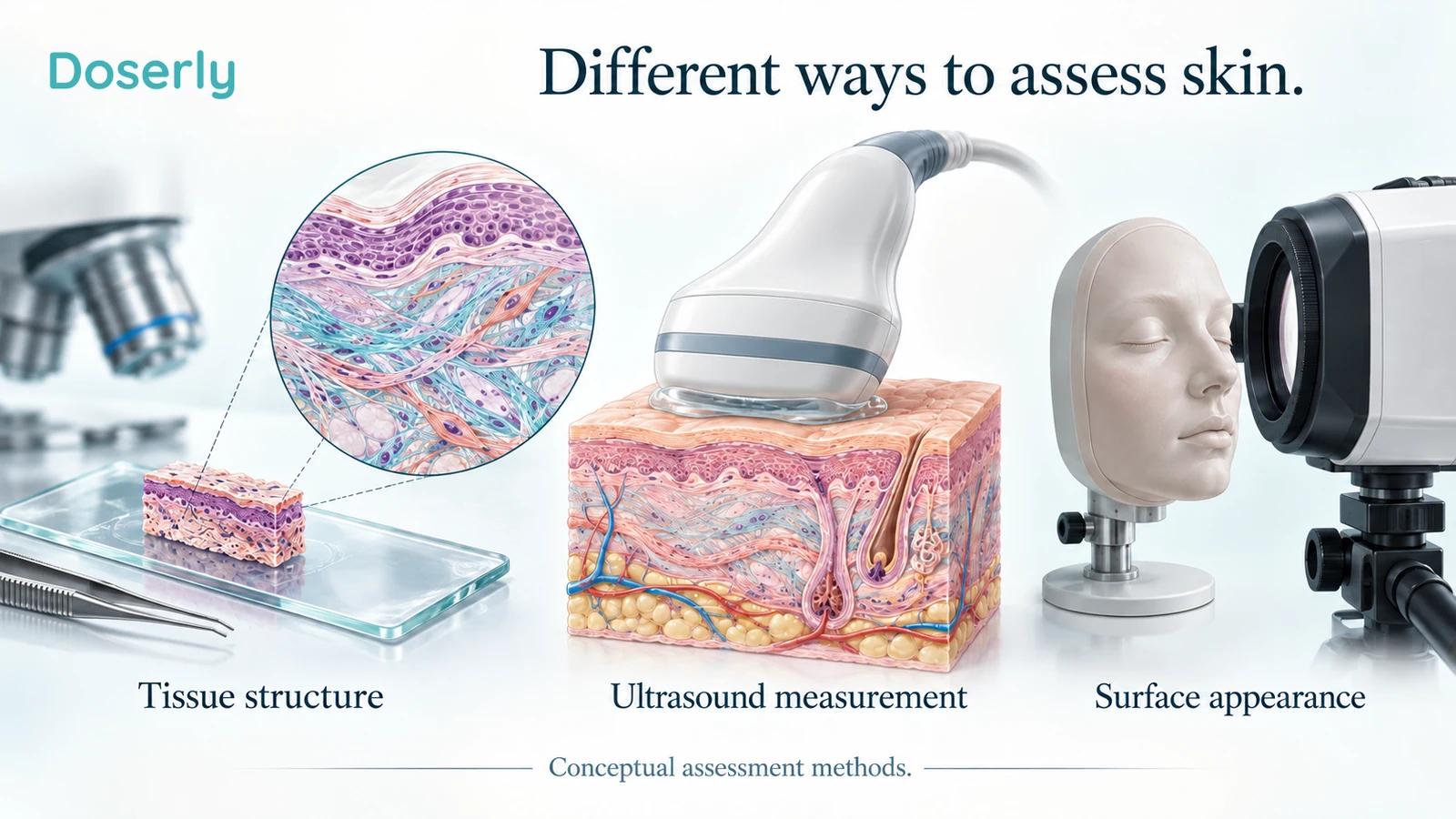
A biopsy samples living tissue after an intervention, bringing the evidence closer to actual skin. It can reveal fiber organization or cellular features that a photograph cannot. It also examines a very small area and may not represent the entire face.
An influential 2007 randomized, sham-controlled split-face study enrolled 76 people with facial wrinkles. It examined red light, near-infrared light, their combination and sham. Alongside clinical and surface measurements, the investigators assessed tissue using histology, electron microscopy and biochemical methods. They reported increased collagen and elastic fibers in treated groups, with fibroblast changes consistent with increased activity.
This is more substantial evidence than a claim based only on cultured cells. It connects an intervention in people with both tissue findings and skin measurements. However, the study used particular equipment and treatment settings, and the reported maximum improvements from baseline are not a universal effect size for consumer masks. Follow-up was measured in months, not years.
Biopsy evidence also does not establish that every visible improvement came from collagen. Skin appearance depends on several interacting features. Demonstrating a plausible biological change helps explain a result, but proving that it is the sole cause would require a more specific design.
For a reader, the practical conclusion is encouraging but limited: some human tissue research supports biological remodeling after particular light treatments. It does not establish a permanent reserve of collagen, a guaranteed facial lift or a way to stop the normal passage of time.
Ultrasound density is not a direct collagen count
Another frequently cited controlled study published in 2014 involved 136 volunteers. Investigators compared treated groups using red or a broader spectrum with 23 controls. They assessed photographs, surface roughness, satisfaction and an ultrasound-derived measure described as intradermal collagen density. Several outcomes improved in treated participants, while the broader spectrum did not show an advantage over red-only treatment.
The study adds useful human data, but ultrasound and biopsy are different tools. An ultrasound-derived density measure is not a chemical count of collagen molecules, and a change in that measure should not be translated into a claim that the entire face contains a specified amount of new collagen. The controls also should not be described as a convincing identical sham-mask group.
Surface profilometry has a different role again. It measures the shape or roughness of the skin surface. A camera-based wrinkle-volume measure describes a selected region. These tools can detect changes that are difficult to judge by eye, but the scale of a numerical change is specific to the measurement method.
Imagine two people whose baseline lines differ substantially. The same relative change could leave one with a barely perceptible difference and the other with a more noticeable improvement. Without the baseline, the actual units and a suitable comparison group, a percentage alone is an incomplete description of a cosmetic result.
What the newer mask trials found
Home-mask studies are especially relevant to a person deciding whether a repeated routine is worthwhile. They examine a format closer to what many consumers actually use, although the evidence still belongs to the tested product and population.
A 2025 multicenter sham-controlled trial studied a mask combining 630 nm red and 850 nm near-infrared light. Sixty Asian adults were enrolled, mostly women. At 12 weeks, independent raters found at least a one-point improvement on the crow's-feet scale in 25 of 29 active participants in the full-analysis group, compared with 5 of 30 controls.
The treatment period was 12 weeks, followed by four weeks of observation. The control mask emitted a reduced amount of red light and no infrared light, so it was not simply an unlit device. Participant-rated aesthetic improvement did not clearly separate between groups in the reported analyses. That difference between expert ratings and personal perception deserves as much attention as the positive wrinkle score.
A separate 2025 randomized trial in 95 women tested a 660 nm mask at two application frequencies against sham. Blinded specialists did not find significant group differences on the Wrinkle Assessment Scale. Image analysis found improvements in some regions, and satisfaction measures favored active treatment. The more frequent schedule was not clearly better.
These trials are not mutually exclusive. They used different devices, populations, durations and outcome measures. Together, they suggest a possible benefit for selected features while showing why “clinically proven wrinkle reduction” needs more detail. The most useful description names the measure that improved and the measures that did not.
Why a thirty-percent headline needs its denominator
A 2023 randomized split-face study enrolled 137 women and compared red light on one side of the face with amber light on the other. It reported reductions in periocular wrinkle volume of about 32% and 30%, respectively. Hydration and viscoelasticity did not improve.
That is an interesting result, but both sides received active light. The percentage describes change after treatment, not a thirty-percent advantage over an untreated side. A split-face design can be an excellent way to compare two interventions within the same person. It does not automatically provide a no-treatment control.
The trial therefore helps answer a comparison between the tested red and amber approaches. It is less able to separate effects shared by both sides from other changes occurring over the same period. It also does not show that every aspect of skin quality improved simply because one surface measurement did.
When a device page repeats a large percentage, look for the noun immediately after it. Was it wrinkle volume, wrinkle length, a severity score, the proportion of participants who improved, or a collagen-related laboratory marker? These quantities are not substitutes for one another. A study in which many people improve slightly can produce an impressive responder percentage without showing a dramatic change in each face.
The same caution applies to the word significant. Statistical significance concerns how a result relates to variability and the study's analysis. It does not tell you whether a friend would notice the difference across a dinner table. Both questions can matter, but they need separate evidence.
An October 2026 update broadens the areas studied
A very recent University of Manchester record for an accepted study describes treatment of the face, neck and décolleté with combined 633, 830 and 1072 nm light. Thirty-three women with dry, photoaged skin enrolled, and 31 completed 56 days. Several biophysical measures and dermatologist wrinkle assessments improved.
The record was marked accepted/in press on October 12, 2026. Its central limitation is explicit: there was no control group. The findings are useful as an early report about these regions and this device combination, but they do not establish that the light caused every observed change or that adding the third wavelength improved results.
This is a good example of how newer evidence can expand a question without settling it. It raises interest in neck and chest outcomes while leaving a need for controlled comparisons. An accepted study is also not interchangeable with a large replicated evidence base simply because its publication date is recent.
For someone whose main concern is the neck, a facial trial should not be the only supporting evidence. Skin thickness, movement, exposure patterns and device fit differ by region. The fact that all three areas contain collagen does not erase those practical differences.
What a reasonable change might look like
The studies most directly relevant to cosmetic use generally assess changes over weeks or months. They do not support judging structural remodeling from the glow immediately after one session. Temporary warmth, hydration, lighting and facial expression can all influence how skin appears in a photograph.
A modest result might be a small improvement in fine lines, surface texture or the way skin feels. It need not be a dramatic transformation to be worthwhile. The difficulty is deciding whether that result exceeds ordinary variation and whether it persists long enough to justify the routine.
The trials also do not establish one maintenance schedule for all devices. Continued treatment, stopping treatment and switching equipment are different questions. A study that observes participants for a short period after treatment provides limited information about appearance a year later.
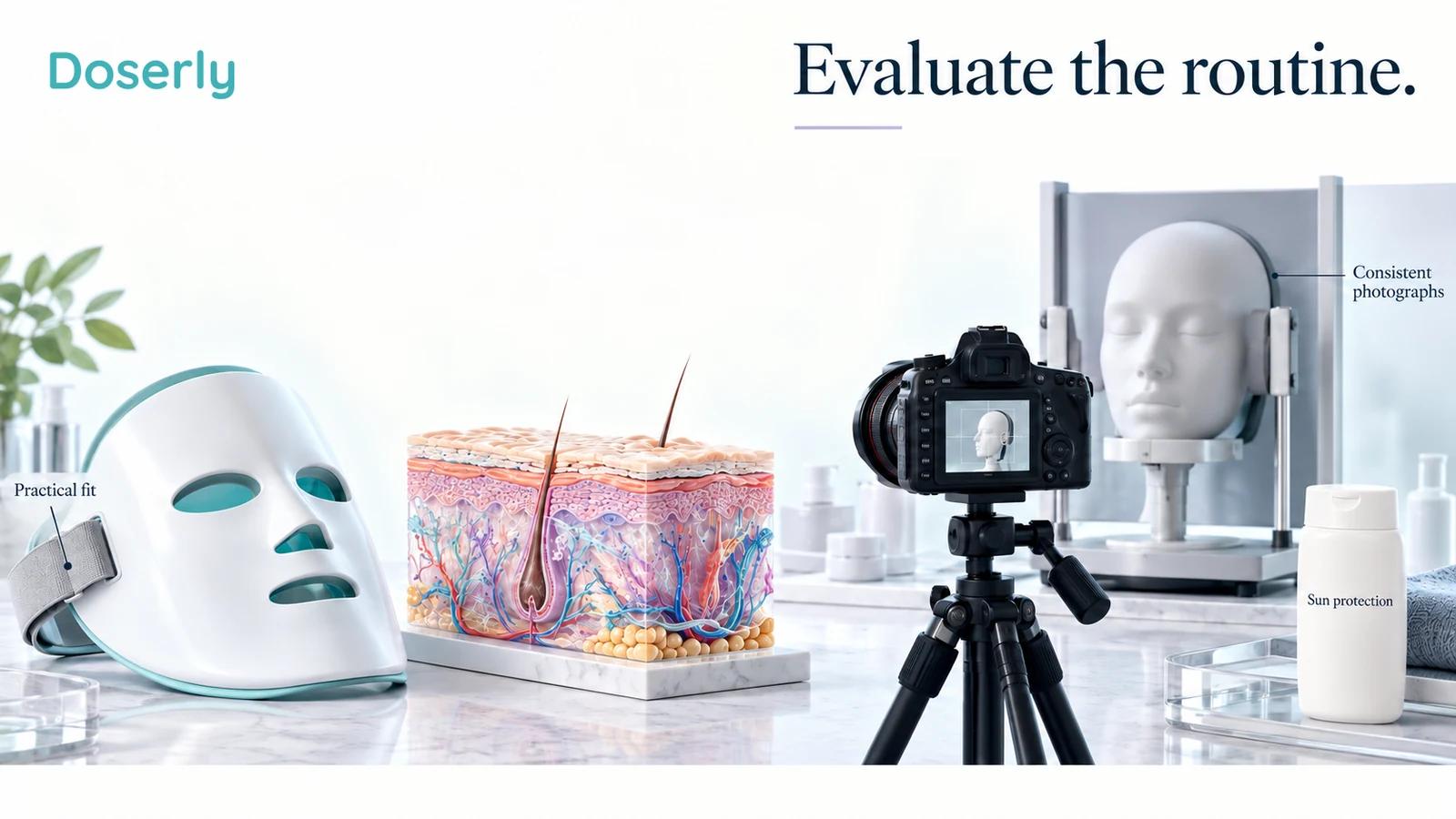
A useful personal evaluation starts with a defined feature and a stable way to observe it. Choose photographs with the same lighting, distance, camera settings and facial expression. Compare relaxed expressions with relaxed expressions. If the concern is lines during movement, record that consistently as a separate outcome.
Do not inspect a new photograph every day for a tiny change. That invites differences in sleep, skin hydration and camera processing to become apparent treatment effects. A less frequent, planned comparison is easier to interpret and usually less frustrating.
Keep the rest of skin care in view
The strongest reason to preserve sun protection is that a light treatment does not remove the ongoing source of photoaging. Red-light research should not become a reason to seek additional ultraviolet exposure or to stop protecting skin outdoors.
In a randomized community trial involving 903 adults, daily sunscreen use was associated with less progression of skin aging over 4.5 years than discretionary use. The trial measured skin microtopography, with blinded assessment. It addresses prevention over a much longer period than most cosmetic PBM studies, rather than proving that sunscreen and red light have the same effects.
Topical treatments also have their own evidence. A 1993 human study of tretinoin found that collagen formation in photodamaged skin was partly restored after treatment compared with vehicle. It provides a separate line of biological and clinical research, not a direct head-to-head comparison with a modern LED mask.
These findings do not create a shopping list that everyone should combine. A treatment suitable for one person's skin may irritate another's, and prescription decisions belong within an appropriate clinical assessment. The more useful point is that a new light device enters an existing routine with its own benefits, burdens and evidence.
If you introduce a mask, a retinoid and several new products together, you may like the overall result while remaining unable to identify the contribution of the mask. That is not a failure of skin care. It simply makes a personal claim about one device less certain.
Does more light mean more collagen?
The available clinical evidence does not support treating session frequency or advertised power as a collagen-building score. In the 2025 frequency study discussed above, the more frequent schedule did not clearly improve outcomes. That result does not define the best schedule for every device, but it challenges the assumption that extra sessions must help.
Exposure depends on more than the wavelength printed on a box. Output at the skin, the area illuminated, fit and time all influence the delivered light. A mask held differently on the face may create a different exposure pattern. A panel with the same nominal wavelengths is not automatically equivalent to a studied mask.
Heat is another source of confusion. PBM is intended to be distinguished from treatments that deliberately use a thermal effect. An increasingly hot face is not evidence that collagen is being rebuilt faster. A sensation cannot substitute for a measured clinical outcome.
There is no reason to reproduce a research dose from a paper on an unrelated device. The article's study descriptions explain the evidence; they are not instructions for constructing a home regimen. Product-specific directions and an appropriate assessment of the intended use provide a more defensible starting point than combining numbers from different trials.
Tolerability and representation matter
Many cosmetic light studies report good tolerability within the participants they enrolled. Small, selected trials cannot establish that every device is suitable for every skin condition or that uncommon problems never occur.
The American Academy of Dermatology's guidance on red light therapy emphasizes discussing suitability, especially when skin conditions or medications could change the risk. Device instructions concerning eye protection also matter. Closed eyes and ordinary sunglasses should not be assumed to replace specified protection.
People with different skin tones should be able to find evidence relevant to them, rather than being asked to infer identical outcomes from a narrow study population. Some wrinkle studies include several Fitzpatrick categories, but their size is generally too small to settle every difference in response or tolerability. Enrollment across categories is a starting point, not proof of identical effects.
Persistent irritation, discomfort or an unexpected pigment change should not be reframed as proof that the treatment is working. Similarly, a changing lesion deserves its own assessment rather than being treated as another sign of aging. The aim of cosmetic care is an acceptable improvement with an acceptable burden, not endurance of a troublesome routine.
Choosing an expectation you can evaluate
Red light therapy has a more credible place in the conversation about fine lines than a blanket claim of age reversal. Original human studies provide signals of benefit, and tissue research offers plausible explanations. The evidence is also uneven, with differences between outcomes, limited long-term follow-up and findings that do not generalize to every home device.
Before committing to a routine, define the feature you care about and ask whether the supporting trial actually measured it. A claim about collagen should identify how collagen was assessed. A claim about wrinkles should identify the region, expression and comparison group. A result that appears only on an instrument should be described that way.
It is reasonable to value a small cosmetic improvement. It is equally reasonable to decide that the cost and repetition are not worthwhile. The most useful expectation is a possible, gradual change in selected skin features. Assess it alongside the rest of your care, with a clear idea of what would make the routine worthwhile for you.