
Red Light Therapy
October 17, 2026
Is red light therapy working? How to judge results and read a device study
On this page
You have used a red light device for a while, followed its instructions and tried to be consistent. Some days your skin looks better. Your knee may feel a little more comfortable. Or perhaps you are sleeping better, but you also changed your evening routine. How do you tell whether the light is making a useful difference?
There are two questions here. One is whether a treatment has helped people in a well-designed study. The other is whether the routine is worthwhile for you. Research can guide the second decision, but neither a promising paper nor a good week at home answers both questions completely.
You do not need to become a statistician to make progress. Start by deciding what you want to improve, use a reasonably consistent way to observe it, and check what the relevant studies actually compared. Those steps are more useful than counting how many papers a product page links to.
The examples below come from human photobiomodulation and related light-treatment research available through October 17, 2026. Some are positive, some are mixed and some are negative. They show how to evaluate a claim without assuming that every encouraging result is hype or that every scientific-looking advertisement is dependable.

Begin with the change you would actually value
“Better mitochondrial function” sounds impressive, but it is usually not the reason someone buys a device. They want to walk comfortably, see less noticeable fine lines, or feel more rested. Naming that goal makes it possible to ask whether the evidence is relevant.
For a cosmetic goal, describe the feature and setting: fine lines around the eyes when the face is relaxed, for example. For knee symptoms, choose an ordinary activity such as a familiar walk or getting up from a chair. For sleep, distinguish difficulty falling asleep from repeated awakenings or daytime sleepiness. A broad promise of improved wellness can otherwise move from one outcome to another whenever the original goal fails to change.
It also helps to decide what would make a difference worth the time and cost. A slight cosmetic improvement may be valuable to you. Someone else may be unwilling to repeat a lengthy routine for the same change. Neither preference is wrong. The goal is to make the decision visible before you become attached to the purchase.
Write down one main outcome and perhaps one supporting observation. A long list can make it easy to find something that looks positive by chance. “My usual walk is more comfortable, without cutting it short” is a clearer goal than a collection of vague impressions about circulation, inflammation and recovery.
Match the outcome to the measurement
A photograph, a questionnaire and a tissue sample can all provide useful information. They do not provide the same information.
A 2025 randomized study of a red-light mask enrolled 95 women. Specialists did not find a significant difference between groups on the wrinkle assessment scale. Image analysis found changes in certain regions, while participant satisfaction favored active treatment. The original report presents these different findings together. Describing the study simply as positive or negative would lose something important.
If you care about a visible difference, a measurement that detects a tiny surface change is relevant but incomplete. If you care about how you feel about your appearance, satisfaction matters, although expectations may influence it. A stronger explanation tells you which outcome changed and how it was measured.
The same principle applies to pain. In a 2025 elbow trial, light combined with a static magnetic field improved pain outcomes, but disability, grip strength and treatment satisfaction did not significantly differ between groups. The original trial therefore supports a narrower claim than restoring normal arm function. The combined intervention also prevents us from assigning the result to light alone.
A useful question is: if this number improved, would it answer the problem that brought me here? Sometimes the answer is yes. Sometimes it describes an interesting part of the problem while leaving the practical outcome unresolved.
Ask what happened in the comparison group
A treatment group improving from its own starting point is not enough to establish that the treatment caused the change. Symptoms vary, people enter studies when a problem is troublesome, and participation may change routines or expectations. The comparison group helps estimate what might have happened without the specific treatment being tested.
Consider a 2026 plantar-fasciitis trial in which both groups performed stretching. One group received high-intensity laser and the other received sham treatment. Pain, function and fascia thickness improved in both groups, with no significant additional benefit from active laser. The original report contains some inconsistencies in its numerical presentation, so its precise estimates deserve caution. Its central result was that adding this laser did not clearly improve the outcomes beyond the comparison treatment.
High-intensity laser is a different device class from a home red light panel. This study illustrates how to interpret a comparison, rather than establishing what a panel would do.
A clinic could truthfully say that people receiving the package improved. That would still leave unanswered whether the laser contributed anything detectable. This distinction matters when the addition requires extra appointments or substantial expense.
The control also has to fit the question. Light plus exercise versus exercise alone asks about adding light. One wavelength versus another asks which of two exposures performs better. A study with no comparison group mainly describes what happened after treatment. These designs can all contribute information, but they cannot support identical conclusions.

A sham device should be more than an empty label
Blinding means keeping relevant people unaware of which treatment a participant receives. With light devices, that can be difficult. Brightness, warmth, sound and the way a device feels may provide clues. The person applying treatment may also know more than the participant or the assessor who later evaluates photographs.
A 2025 facial-mask study illustrates why the details matter. Its control mask emitted a reduced amount of red light and no near-infrared light, while the active mask used both. Independent wrinkle ratings favored active treatment, but participant-rated aesthetic improvement did not clearly separate between groups. The paper describes the control and the different assessments.
That comparison was not simply light versus complete darkness. A weak light exposure might help preserve the experience of treatment, but it also raises a question about whether the control itself could have biological effects. The right response is to describe the comparison accurately, rather than assuming that the word sham guarantees a perfect inactive control.
Look for who was blinded: participants, treating staff, outcome assessors or data analysts. A blinded assessor can make photograph ratings less vulnerable to expectations even when the participant knows which device was used. Conversely, a participant's report of comfort remains important, but may be more affected by knowing they received the expensive new treatment.
Read the main result before the most exciting result
Trials often measure several outcomes at several times. A primary outcome is the main question specified in advance. Other outcomes may add context, suggest mechanisms or generate ideas for another study. Finding a favorable result somewhere in a large collection of measurements is less persuasive than a clear benefit on the planned main question.
The CONSORT 2025 reporting guideline calls for clear reporting of trial registration, protocols, outcomes, participant flow, effect estimates and harms. It is a reporting framework, not a certificate that every trial following its checklist was well designed or that its treatment works. Its practical value is helping readers locate the information needed to judge those questions.
When reading a paper, first find what the authors said they intended to test. Then check the results for that outcome and time point. If the discussion emphasizes a favorable subgroup or a different measurement, keep that finding in proportion. A result discovered after looking at the data may be worth pursuing without being ready to guide routine treatment.
You do not have to dismiss exploratory research. Much useful work begins with an unexpected observation. The difference is whether the article presents it as a possibility to test or as an established benefit that everyone should expect.
Percentages need a clear denominator
“Seventy-two percent responded” and “pain fell by seventy-two percent” mean different things. The first describes how many participants crossed a chosen threshold. The second describes the size of a change in pain. A headline can sound dramatic when those meanings are blurred.
In the elbow trial discussed earlier, 72% of the combined-treatment group and 40% of the placebo group achieved the study's threshold of at least a 30% pain reduction. That is a 32 percentage-point difference in the proportion responding. It does not mean that every treated participant experienced a 72% pain reduction, and it does not establish a lasting improvement in grip strength.
For a personal decision, ask three questions: improvement in what, compared with whom, and over what period? Those questions work for skin, hair, exercise performance and pain. They also help distinguish a proportion of people improving from the amount of improvement in each person.
Absolute numbers are often easier to understand than a relative headline. A study reporting how many people improved in each group gives you a better starting point than a claim that one treatment was several times more effective. The definition of improvement still matters: a small change on a scale may be counted as a response without representing the result you hoped to achieve.
Uncertainty is part of the result
A trial estimates an effect using a finite sample. The estimate has uncertainty, commonly expressed with a confidence interval. A wide interval means the data allow a broad range of effects under the study's statistical assumptions. A narrow interval can be more informative, even when the average change is modest.
A nonsignificant result does not automatically prove that two treatments are equivalent. A small trial may be unable to distinguish a worthwhile benefit from no benefit. On the other hand, uncertainty is not evidence that a large benefit probably exists. The useful question is how much benefit the study can reasonably support, rather than whether a particular statistical cutoff was crossed.
For example, a 2024 randomized Achilles-tendinopathy trial gave both groups eccentric exercise and compared active with sham low-level laser. It found no additional advantage in pain or the tendon-specific outcome through 24 weeks. The original study is evidence against assuming that this particular addition improves rehabilitation. It does not test every wavelength or every tendon problem.
This is a good reason to read more than one relevant study. Several independent trials addressing a similar question can clarify whether a small positive result is reproducible. A large number of loosely related papers about cells, animals and different diagnoses cannot provide the same reassurance.
Count the people who are missing, too
The number enrolled at the beginning is not always the number measured at the end. Participants may leave because the treatment is inconvenient, they feel better, they feel worse or they have unrelated problems. If those reasons differ between groups, the people who remain may give an incomplete picture.
A 2023 knee-osteoarthritis study compared exercise with exercise plus active or placebo photobiomodulation. It did not find an additional benefit from the light intervention, and approximately 45% of participants were missing at the six-month assessment. The paper reports its follow-up and analysis methods. Statistical handling of missing data can be appropriate, but it cannot make the absent observations known with certainty.
Look for the number assessed at the time point you care about, not just the enrollment number in the title or abstract. Also ask whether the analysis retained people in their assigned groups or focused only on those who completed the course. A treatment that helps only the people able to tolerate a demanding routine may be less useful in ordinary life than the completer results suggest.
This does not mean every withdrawal invalidates a study. It means that persistence, convenience and tolerability belong in the evaluation alongside a favorable average score.
A biological change is not automatically a health benefit
Photobiomodulation research includes laboratory measurements of energy metabolism, inflammatory signals and tissue proteins. These findings can help explain how light might act. They are not substitutes for showing that people feel or function better.
A 2021 study reported collagen- and elastin-related changes in cultured human fibroblasts and human skin explants after red and near-infrared exposure. The original experiment used human-derived material, but it was not a trial of volunteers looking younger. The distinction is easy to miss when a product page shortens the description to “human research.”
Similarly, a 2023 sham-controlled study of a near-infrared neck device found some favorable subjective sleep and daytime outcomes without significant between-group differences in actigraphy, which estimates sleep from movement. The full report shows why different measurements need to remain separate. Feeling more relaxed can matter, but it is not the same finding as a demonstrated increase in objectively estimated sleep.
You can value a symptom improvement without inventing a mechanism for it. You can also find a mechanism interesting while waiting for convincing clinical results. Keeping those positions separate makes the evidence easier to use.
Check whether the device really matches the study
A wavelength alone does not describe a treatment. A small contact probe, a face mask and a large panel can illuminate different areas and deliver very different exposures. The amount of light reaching the skin also depends on distance, geometry, duration and the device's actual output.
A foundational photomedicine reporting paper by Jenkins and Carroll explains why studies need to report beam and treatment parameters accurately. Among the important details are wavelength, power, time, illuminated area, pulse characteristics, treatment location and the number and spacing of sessions. Electrical consumption at the wall is not the same quantity as optical power delivered by the device.
This is not an invitation to copy a research schedule onto equipment you own. It is a way to ask whether a manufacturer's claim of equivalence has a reasonable basis. A seller should be able to explain the connection between the tested device and the product being offered, rather than relying on the shared phrase red light.
A list containing dozens of studies may still include no direct trial of that product for your goal. That does not prove the product cannot help. It means the claim depends on extrapolation, and the uncertainty should remain visible in the buying decision.
Give photographs a fair chance to be useful
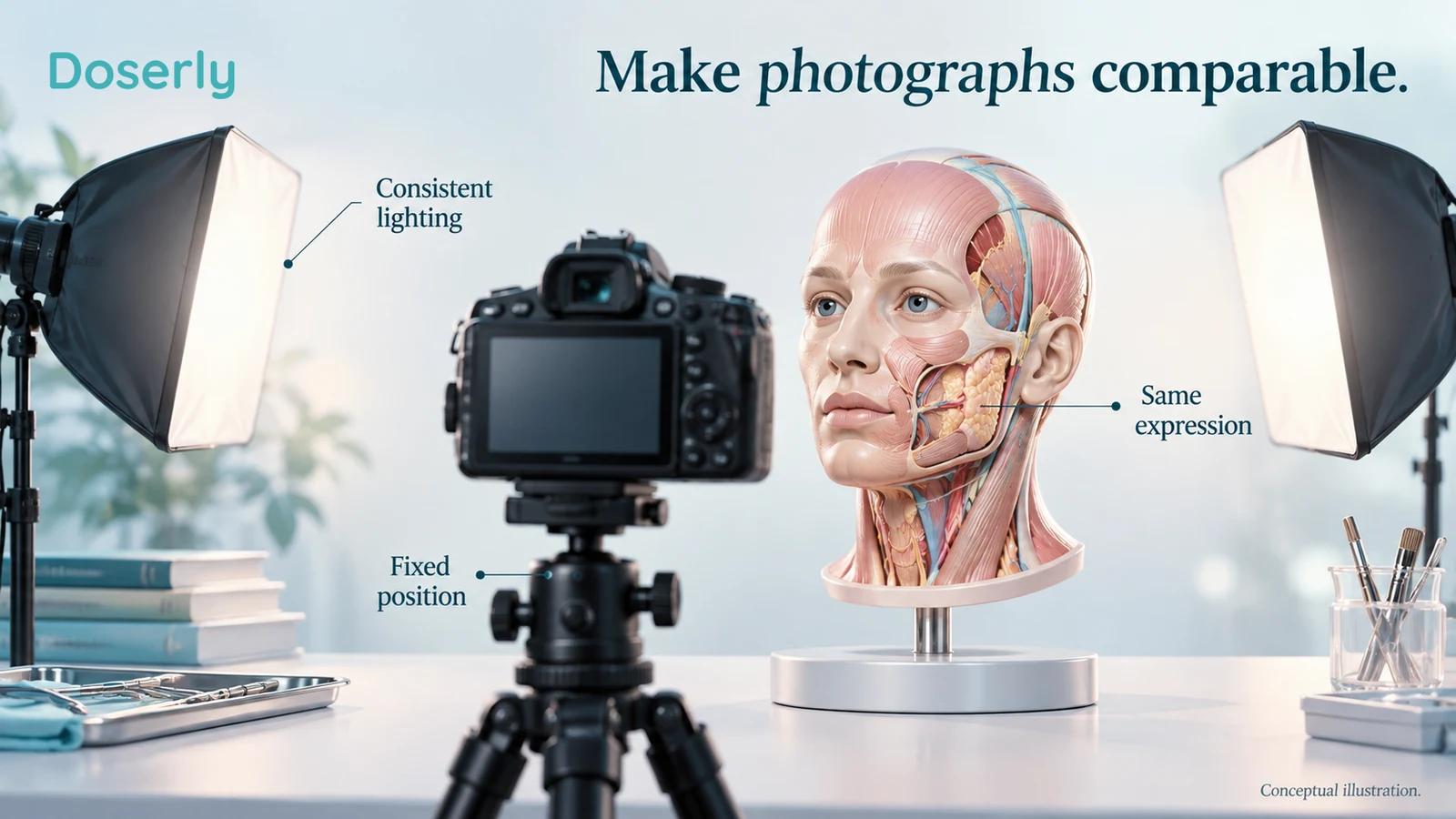
For appearance-related goals, photographs can be helpful if you make the conditions repeatable. Use the same camera, distance, angle, lighting and facial expression. Keep the framing consistent so that the area of interest occupies a similar part of the image. Avoid comparing a harsh overhead light with soft window light and calling the difference a treatment effect.
Skin preparation matters to the comparison too. Makeup, moisturizer and the time since washing can change what the camera captures. Record those conditions rather than assuming a phone image is an objective measurement simply because it is digital. Automatic processing can also change the appearance of detail between images.
This is a practical documentation method, not a validated home wrinkle assay. It can help you notice whether an apparent change survives a fair comparison. It cannot reproduce a clinical imaging system or establish that collagen caused the change.
If you review photographs, look at the full sequence rather than selecting the most flattering final image. A neutral observer can sometimes help, provided they are not told which photograph is supposed to look better. Even then, treat the result as a personal observation, not a blinded clinical trial.
Track daily experience without making it another burden
A short record is often more useful than a complicated dashboard. Note the outcome you chose, the activity or circumstances surrounding it, whether the routine was completed, and any discomfort or inconvenience. The aim is to make a later decision easier, not to assign a score to every sensation.
For a walking goal, record enough context to distinguish improvement from doing less. For sleep, note unusual travel, illness or a change in work hours. For skin, record other new products. These details help explain why a good week may not be attributable to the newest device.
Changing several treatments at once makes attribution difficult. Someone who adds a light device, changes bedtime and starts melatonin may experience a real improvement without knowing which change contributed. If melatonin is part of your routine, Doserly's melatonin guide explains that separate intervention. Do not stop prescribed treatment simply to make a personal experiment easier to interpret.
Choose a review point appropriate to the intended use with the relevant clinician or device guidance. Daily scrutiny can amplify normal variation. Equally, continuing indefinitely because a benefit might appear eventually leaves no clear way to recognize an ineffective or impractical routine.
Ask whether improvement lasts after treatment stops
Continued improvement during continued treatment is different from a benefit persisting after treatment has ended. Maintenance can be a reasonable part of care, but it carries ongoing cost and effort. Studies should make clear whether participants were still using the intervention during follow-up.
A 2025 Parkinson's trial illustrates another issue: its randomized comparison and optional continuation phase answer different questions. The controlled phase did not show a significant between-group benefit on the main motor outcome, while later observations suggested improvement among some people continuing treatment. The original report is interesting, but optional continuation introduces selection and cannot replace the randomized comparison.
At home, the same distinction matters. If a routine appears helpful, ask what is known about maintaining it, reassessing it and its long-term burden. An early signal of benefit is not a promise that a short course permanently changes the underlying condition.
Evaluate the claim, the source and the practical decision together
A clinician's explanation, a podcast interview and a detailed personal account can all help you discover useful questions. They are less able to tell you how often a treatment works across comparable people. People with disappointing or inconvenient experiences may be less visible than those posting enthusiastic results.
The NCCIH checklist for understanding health news encourages readers to consider the population, size, duration, meaningfulness and limitations of a study, along with financial interests. A commercial connection does not automatically invalidate a finding, but it increases the value of independent replication and clear disclosure.
Regulatory language deserves the same precision. The FDA explains that establishment registration and device listing are not approval, clearance or authorization. Check the actual device and intended use rather than treating a registration certificate as proof of clinical benefit.

The final decision can be simple even when the science is complicated. Has the outcome you cared about improved enough to matter? Is the routine comfortable and manageable? Does the best relevant evidence support continuing, and is there a more useful next step to discuss?
A good assessment leaves room for a worthwhile modest benefit, no noticeable benefit, or a result that remains uncertain. You do not need to defend a purchase or dismiss an entire field. You need enough reliable information to decide what deserves a place in your own care.