
Red Light Therapy
October 17, 2026
Red light therapy for Hashimoto’s and thyroid health: what small trials can and cannot show
On this page
Living with Hashimoto’s can mean taking a tablet every morning, watching blood-test results, and still wondering why your energy has not returned. In that setting, the suggestion that light might help the thyroid recover is understandably appealing. It speaks to something hormone replacement does not promise: changing the disease process itself.
There is human research behind the idea. Small studies have reported lower thyroid-medication requirements, changes in antibodies and ultrasound findings, and, more recently, improvements in fatigue and related symptoms. Those findings deserve a careful reading. They do not establish that shining a home red-light panel at the neck reverses Hashimoto’s or makes it safe to reduce levothyroxine independently.
The most useful way to understand this evidence is to separate three questions: does treatment change a laboratory or imaging measurement, does it help people feel and function better, and does it safely preserve thyroid function over time? A study can provide an encouraging answer to one while leaving the others open.
Hashimoto’s and hypothyroidism are related, but different
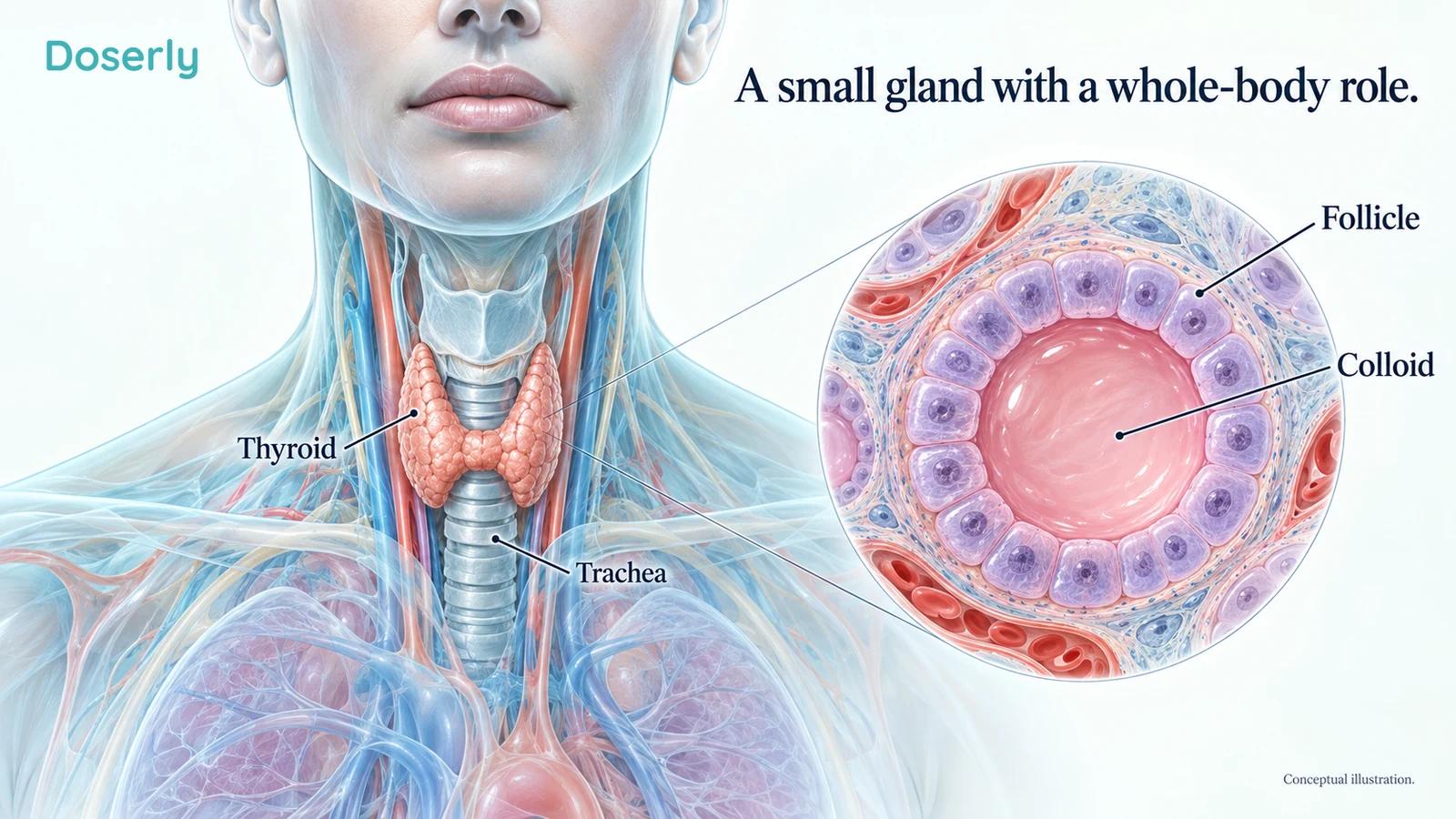
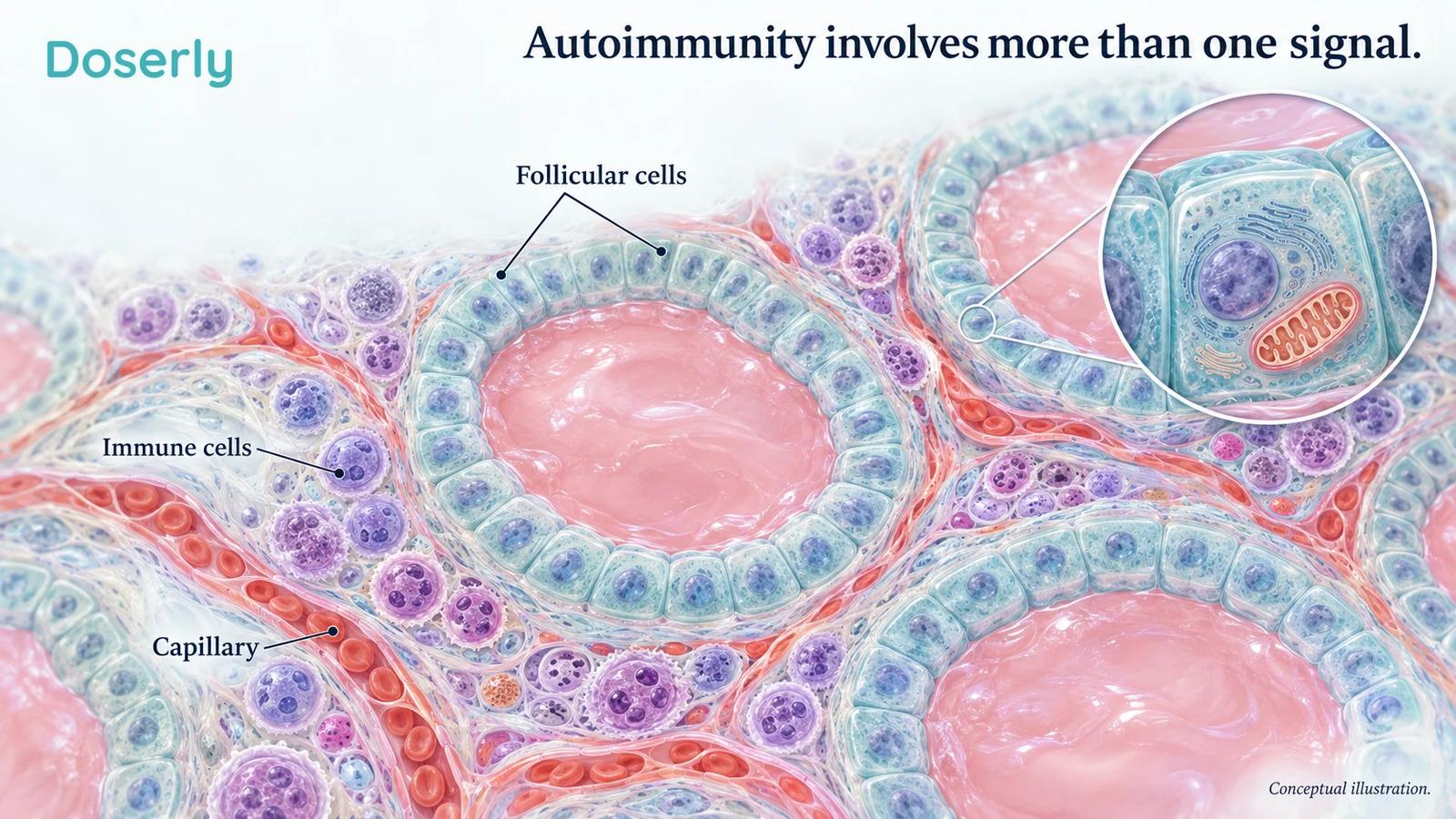
Hashimoto’s is an autoimmune condition in which immune activity damages the thyroid. Hypothyroidism means that thyroid-hormone production is insufficient. A person can have evidence of Hashimoto’s while their thyroid function remains normal, and hypothyroidism can also arise for reasons other than Hashimoto’s. The National Institute of Diabetes and Digestive and Kidney Diseases explains this distinction.
That matters when comparing studies. Someone with antibodies and normal hormone production is not in the same starting position as someone who has needed replacement for years. Neither represents a person whose thyroid has been removed. Evidence from one group cannot be assumed to apply to all three.
Levothyroxine replaces T4, a hormone the thyroid normally produces. Taking it is not a sign that someone has failed to improve their health. It is a way to supply a hormone their body needs. A proposed additional treatment has to show what it adds while keeping hormone levels appropriate; simply reducing the number on a prescription is not enough.
What a thyroid result actually tells you
The pituitary gland produces thyroid-stimulating hormone, or TSH, to regulate thyroid activity. TSH is interpreted with measures such as free T4, the portion of circulating T4 not bound to transport proteins. In primary hypothyroidism, a high TSH with low free T4 generally indicates inadequate thyroid-hormone availability. The American Thyroid Association describes how these tests fit together.
Thyroid antibodies answer a different question. They can help identify autoimmune thyroid disease, but their concentration is not a direct measure of how much hormone the thyroid makes or how tired a person feels. A declining antibody result therefore cannot, on its own, demonstrate that replacement is no longer needed.
The ATA notes that routinely repeating thyroid-antibody measurements is generally unnecessary once Hashimoto’s has been established; monitoring thyroid function is more useful for treatment decisions. It also explains that people with antibodies but normal thyroid function do not necessarily need thyroid-hormone treatment. Its Hashimoto’s guidance makes those distinctions explicit.
For the red-light question, this gives us a practical reading rule: ask which outcome changed. “Thyroid health improved” is too broad if the result was only a change in one antibody, one ultrasound feature, or a questionnaire score.
Where the early enthusiasm came from
An early pilot study treated fifteen people with autoimmune hypothyroidism who were already taking levothyroxine. Medication was subsequently withdrawn under the study's clinical monitoring and restarted when needed. Seven participants did not require replacement during the nine-month follow-up, and average dose requirements fell. Some antibody and ultrasound measures also changed. The original 2010 pilot reports these observations.
This was an intriguing starting point, especially because medication requirement is more directly relevant than a cellular marker. But there was no untreated or sham comparison. A small before-and-after study cannot determine how much of the observed change was caused by the intervention or how reproducible it would be.
The supervised withdrawal is also essential context. This was a research procedure with repeated biochemical assessment and criteria for restarting treatment. Copying only the light exposure and medication withdrawal would remove the safeguards that made the observation interpretable.
A later randomized, placebo-controlled trial included 43 people with established autoimmune hypothyroidism. After the intervention and supervised medication reassessment, the average levothyroxine requirement at nine months was approximately 39 micrograms per day in the active group and 107 in the placebo group. TPO antibodies and ultrasound echogenicity favored treatment, while thyroglobulin antibodies did not differ. The original randomized report provides the results.
This is the most important early evidence for a possible effect on thyroid function. The result is promising, but the sample was small and carefully selected. It tested a particular clinical laser procedure and monitoring process. It did not establish that ordinary red-light devices are equivalent, or that the treatment cures the autoimmune condition.
A red-looking device is not the same intervention
Although this subject is usually called red-light therapy, the early thyroid studies used near-infrared laser light. The original Doppler study describes an 830-nanometer source, which is different from simply illuminating the skin with a visible red lamp. The distinction matters because the device, delivery method, and tissue exposure are part of the treatment being tested.
Matching a wavelength on a product listing does not establish that the gland receives the same exposure. Nor does a warmer neck demonstrate an appropriate biological effect. The published studies cannot be converted into a universal home-panel routine by copying one number from a methods table. Their results belong to the tested clinical procedures, including the accompanying selection and monitoring.
What six-year follow-up adds
The investigators later reassessed the original cohort. Two participants initially assigned to placebo had subsequently received active treatment, so the long-term groups no longer preserved the original randomized comparison exactly. Thyroid-medication requirements remained lower in the treated group, but the antibody differences were no longer significant. The full six-year follow-up describes the crossover and findings.
The study also looked for thyroid nodules, finding three affected participants in each group. Those observations provide some reassurance within this small cohort, which had no nodules at the original baseline. They cannot exclude uncommon cancer risks or establish safety in people who already have nodules, previous thyroid cancer, or different neck conditions.
The long-term result is therefore more nuanced than “one course permanently repairs the thyroid.” The comparison suggested a persistent difference in replacement needs, but it did not establish universal medication independence or disappearance of autoimmunity. Longer follow-up is valuable; the size and changing composition of the cohort still matter.
Several papers came from the same people
Two mechanistic reports from the Brazilian research program are often listed alongside the medication study. One examined thyroid blood flow using Doppler ultrasound. Certain vascular measurements changed after treatment, while others did not. The original Doppler report describes the 43-person randomized cohort.
Another measured circulating transforming growth factor beta 1, a signaling protein involved in immune regulation and tissue processes. The change favored the active group while levothyroxine was maintained. The cytokine report also involved 43 participants.
These publications deepen the description of what happened in a small research population. They do not multiply that population into several independent replications. A list of papers can look much larger than the underlying evidence if every laboratory analysis and follow-up is counted as a new trial.
The biological findings are useful for designing the next experiment. They are not enough to identify a single established mechanism or to prove that altered blood flow or immune signaling explains a durable clinical benefit. More activity in one pathway does not automatically mean less autoimmune disease.
The larger observational reports need careful interpretation
A 2020 report included 350 people: 210 received photobiomodulation plus supplements, while 140 received supplements alone. It reported favorable differences in thyroid-related measures and replacement requirements. The supplements included vitamin D, iron, and selenium. The original report describes the grouped comparison.
A larger participant count is useful, but it does not automatically provide the protection of random assignment and a credible sham. The accessible abstract does not establish a randomized, blinded comparison, and its striking relative-effect language is not a reliable way to predict how much medication an individual will need. The combination of interventions also matters when translating the result into a claim about light alone.
A 2023 feasibility study makes the limitations especially visible. Seventy-four women entered a comparison of light plus supplements against supplements alone, but group assignment followed patient preferences rather than randomization. Both groups received selenium, vitamin D when indicated by the study, and dietary advice. Only 38 participants remained at the six-month assessment. The full methods and results disclose the design and attrition.
Several measurements favored the combined intervention, including medication-related and antibody outcomes. Those signals justify better trials, but losing nearly half the starting cohort makes the remaining results harder to generalize. Preferences, associated behavior changes, and differences between those who stayed and those who left could contribute. This is not a clean demonstration that a home light treatment independently restores thyroid function.
The 2026 symptom trial asks a more patient-centered question
A new sham-controlled trial examined fatigue, sleep, anxiety, depression, and related symptoms while participants remained on levothyroxine. The full methods report 66 randomized participants, with sixty included in the analysis. At three months, questionnaire changes favored active treatment. For example, the mean Fatigue Impact Scale score fell from about 70 to 30 in the active group and from about 64 to 59 with sham. The 2026 full report gives the participant flow and symptom results.
That is a clinically relevant direction of research: people want to function better, not merely change a laboratory value. The study was single-blind, small, and short, with multiple symptom comparisons. It did not establish that thyroid tissue regenerated or that replacement could be stopped. Participants with thyroid nodules, pregnancy, lactation, and several major conditions were excluded.
The result is a reason to investigate symptom benefit further. It should not be turned into a claim that all persistent fatigue in Hashimoto’s arises from one light-responsive thyroid mechanism.
Another 2026 study examined an antioxidant marker
A separate study enrolled fifty women with autoimmune thyroiditis who initially had normal thyroid function and had not started treatment. Twenty-five received photobiomodulation and twenty-five received selenium plus vitamin D. Assignment was nonrandomized and open-label. The primary outcome was serum glutathione, an antioxidant-related measurement, which changed more favorably in the light group. The original 2026 report describes the population and outcomes.
The authors also reported thyroid-related differences, including that some comparison-group participants started levothyroxine during follow-up. Because treatment selection was not randomized and follow-up was short, that observation cannot establish that light prevents future hypothyroidism. It also concerns initially euthyroid women, not patients with longstanding replacement needs.
Glutathione is a useful research measurement, but a higher blood concentration does not demonstrate repair of damaged thyroid follicles. The proposed connection between oxidative stress and thyroid recovery remains a hypothesis to test with controlled clinical outcomes.
Feeling better and changing hormone needs are separate goals
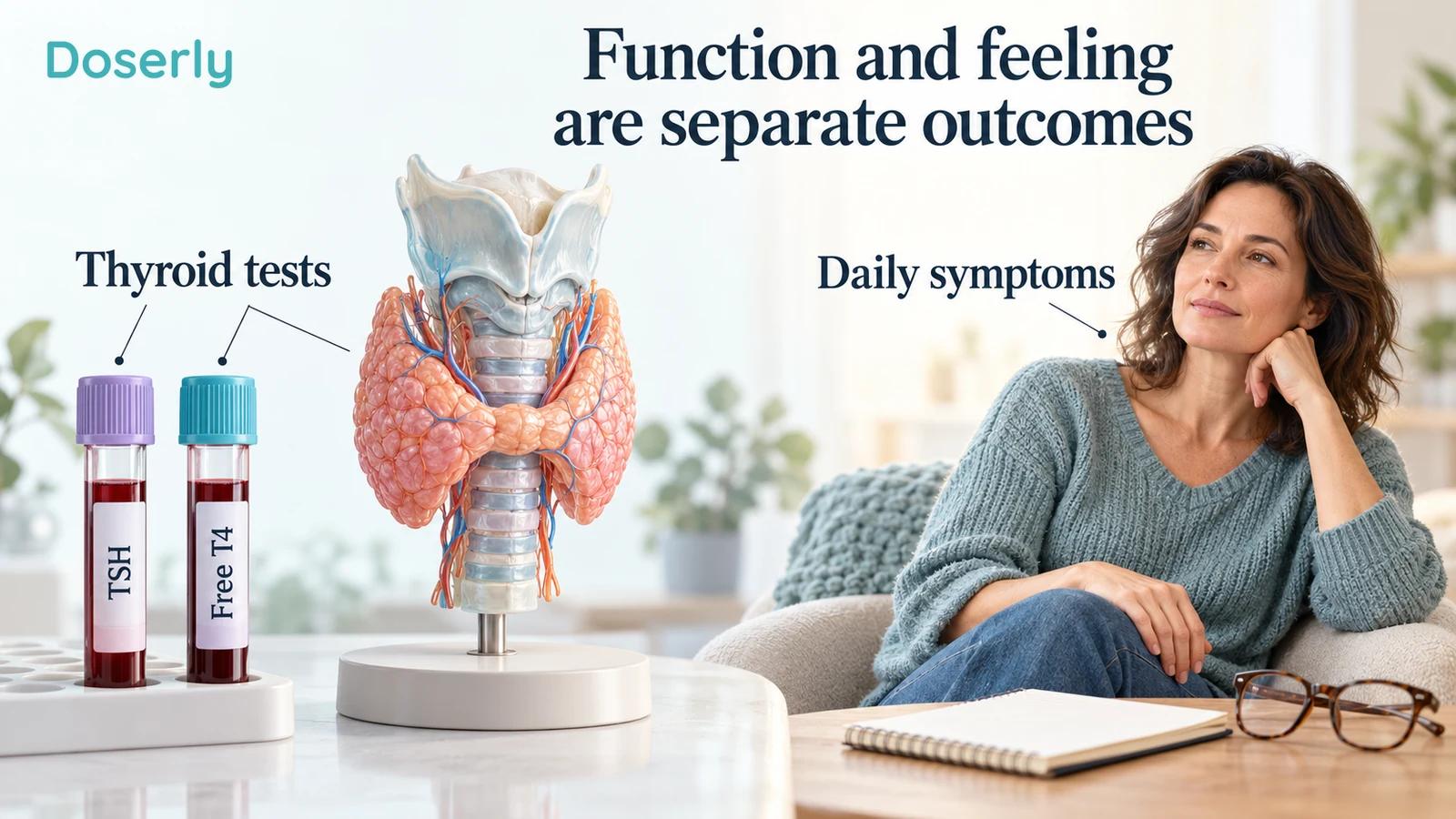
A person may place greater value on getting through a workday than on reducing a prescription. That is reasonable. A study that improves fatigue deserves attention even if it leaves the thyroid's hormone output unchanged. Conversely, a lower replacement dose is not automatically a meaningful improvement if hormone control or daily functioning worsens.
Persistent symptoms also deserve to be taken seriously when standard thyroid tests are normal. A human study of physical fatigability found differences in people with treated, euthyroid Hashimoto’s despite the absence of obvious deficits on routine neuromuscular testing. It did not test light treatment or establish a single explanation for the symptoms. The original study examines that mismatch.
That study compared 24 patients with 25 healthy controls. Performance during a six-minute walk changed differently between groups, whereas an arm-movement measure did not. Reported fatigue and the measured walking fatigability were not closely correlated. This illustrates why asking how someone feels and measuring what they can sustain are both useful: neither fully describes the other. It also cautions against treating an antibody level as a complete explanation for physical symptoms.
This is a reason for careful assessment, not a reason to assume that every symptom is thyroid-driven. Fatigue, weight changes, and difficulty concentrating can have overlapping causes. The NIDDK's hypothyroidism information notes that common symptoms are not specific to thyroid disease.
For an individual appointment, it helps to describe what fatigue prevents: walking a usual distance, concentrating through a meeting, preparing dinner, or staying awake during the day. Those concrete changes give a clinician more to work with than a general wish to “optimize” thyroid function. They also provide a clearer outcome for any treatment discussion.
Medication routines can change the interpretation
A thyroid result is not produced by the gland in isolation. In someone taking replacement, it reflects the medication they receive, how it is taken and absorbed, and the laboratory method used. Changes in those factors can complicate a before-and-after story about light.
In a randomized crossover study of levothyroxine timing, ninety participants completed comparisons of morning and bedtime administration. Thyroid blood-test values changed with timing, while quality-of-life measures did not significantly improve. The original trial demonstrates that distinction.
The lesson is not that everyone should switch schedules. It is that medication habits belong in the record when interpreting a new result. If someone changes their light exposure, supplement routine, meal timing, and medication schedule together, the next blood test cannot identify which change mattered.
Laboratory interference is another possibility. A prospective study in thirteen adults showed that biotin supplementation altered results on some thyroid-assay platforms, with the pattern depending on the test method. The original investigation documents the interference.
This can make an apparent hormonal change partly a measurement problem. Tell the clinician and laboratory about supplements, including hair-and-nail products, and follow their instructions about testing. An unexpected result deserves interpretation before medication is changed or an experimental treatment is credited.
Why a supplement combination is not proof of synergy
Selenium appears in several photobiomodulation studies because it has roles in thyroid biology. That does not establish that combining it with light produces a clinically useful synergistic effect. Demonstrating synergy would require a design that can separate the individual interventions and their interaction.
The CATALYST trial is informative here. It randomized 412 people with autoimmune hypothyroidism to selenium or placebo alongside levothyroxine. Although an antibody measure favored selenium, thyroid-related quality of life did not improve more than with placebo, and replacement requirements were not reduced. The 2024 primary report separates the biochemical and patient-reported outcomes.
This does not answer whether light works. It shows why an antibody change cannot be assumed to explain symptom relief, and why a supplement component needs its own evidence. Doserly's selenium guide provides background on the nutrient without making it a substitute for thyroid treatment.
It is also useful to keep correction of a documented deficiency separate from an attempt to suppress autoimmune disease. A combined research regimen should not become a shopping list of supplements, particularly when the study was not designed to tell which component helped.
Screening is part of the intervention
The clinical thyroid-light studies did more than place a device near the neck. They selected participants, reviewed medications and medical history, and in several studies used ultrasound to characterize the gland and exclude nodules. Those choices define the population in which the findings were obtained.
A neck lump, pressure symptom, or change in swallowing should therefore prompt evaluation rather than an assumption that Hashimoto’s explains it. Thyroid nodules are common and often benign, but deciding whether one needs observation, imaging, or biopsy depends on its clinical and ultrasound features. The American Thyroid Association explains nodule evaluation.
This is not a reason to order ultrasound for every person with fatigue. It is a reason not to treat an unexplained neck finding as an opportunity for home irradiation. A study that excluded nodules provides no evidence that light can shrink them safely or replace the assessment of a suspicious lesion.
Pregnancy needs separate consideration. Thyroid-hormone availability matters for pregnancy and fetal development, and replacement requirements may change. The NIDDK's pregnancy guidance emphasizes clinical treatment and monitoring. The small photobiomodulation studies do not establish a pregnancy treatment, and pregnancy is not an appropriate setting for unsupervised medication withdrawal based on an experimental approach.

What a useful next conversation looks like
Start with the problem you want solved. Is the concern persistent fatigue, unstable blood tests, a rising replacement requirement, a neck symptom, or fear about future thyroid damage? Each leads to different questions. A treatment that might affect a symptom score is not necessarily the right response to an unexplained TSH change or a new nodule.
If a clinician offers photobiomodulation, ask which human study best matches your situation. The answer should include the population, the device, the comparison treatment, and the outcome being pursued. A citation to a laboratory marker does not answer a question about medication independence. A favorable study in people with normal thyroid function does not answer one about longstanding hypothyroidism.
It can help to bring a simple record of medication changes, relevant test dates, supplements, and the activities that have become difficult. The aim is a coherent clinical history, not constant self-testing. If several treatments are being changed together, make that visible rather than attributing every better or worse day to the newest intervention.
Ask how your existing treatment will be managed, who interprets follow-up tests, and what would count as an adverse change. The clinical aim is appropriate hormone replacement and better health, not the lowest possible tablet dose. A clinician should also be able to explain the uncertainty and cost without promising that the gland will regenerate.
The research is promising enough to merit larger, independent trials, particularly trials that measure everyday function as well as hormone control and follow patients long enough to assess durability. For now, the evidence supports an investigational conversation with an informed thyroid clinician. It does not support a universal neck-exposure protocol or stopping a medication that is supplying a hormone the body still needs.