
Red Light Therapy
October 17, 2026
Red light therapy for tendon injuries: Achilles, elbow and rehabilitation
On this page
A tendon problem has a way of turning ordinary movements into negotiations. The first steps downstairs feel stiff. Picking up a kettle catches the outside of your elbow. A run that used to clear your head now comes with a calculation about tomorrow morning. It is understandable to want something that helps the tissue recover without another injection, another tablet or another long interruption to your life.
Red light therapy is often presented as that missing ingredient. There is human research behind the idea, including blinded trials. But its results are mixed, and the strongest practical message is less exciting than the advertising: light has not reliably added to a good Achilles rehabilitation program. For tennis elbow, some studies report pain relief, but improvement in grip, disability and lasting recovery is less consistent. A tendon rupture is a separate injury with a separate care pathway.
As of October 2026, this is a treatment to evaluate by diagnosis, device and outcome. A comfortable session, a change in an inflammatory marker and a stronger tendon are three different things. Understanding those differences can help you avoid paying for a promise that the trial never tested.
Start with the tendon problem you actually have
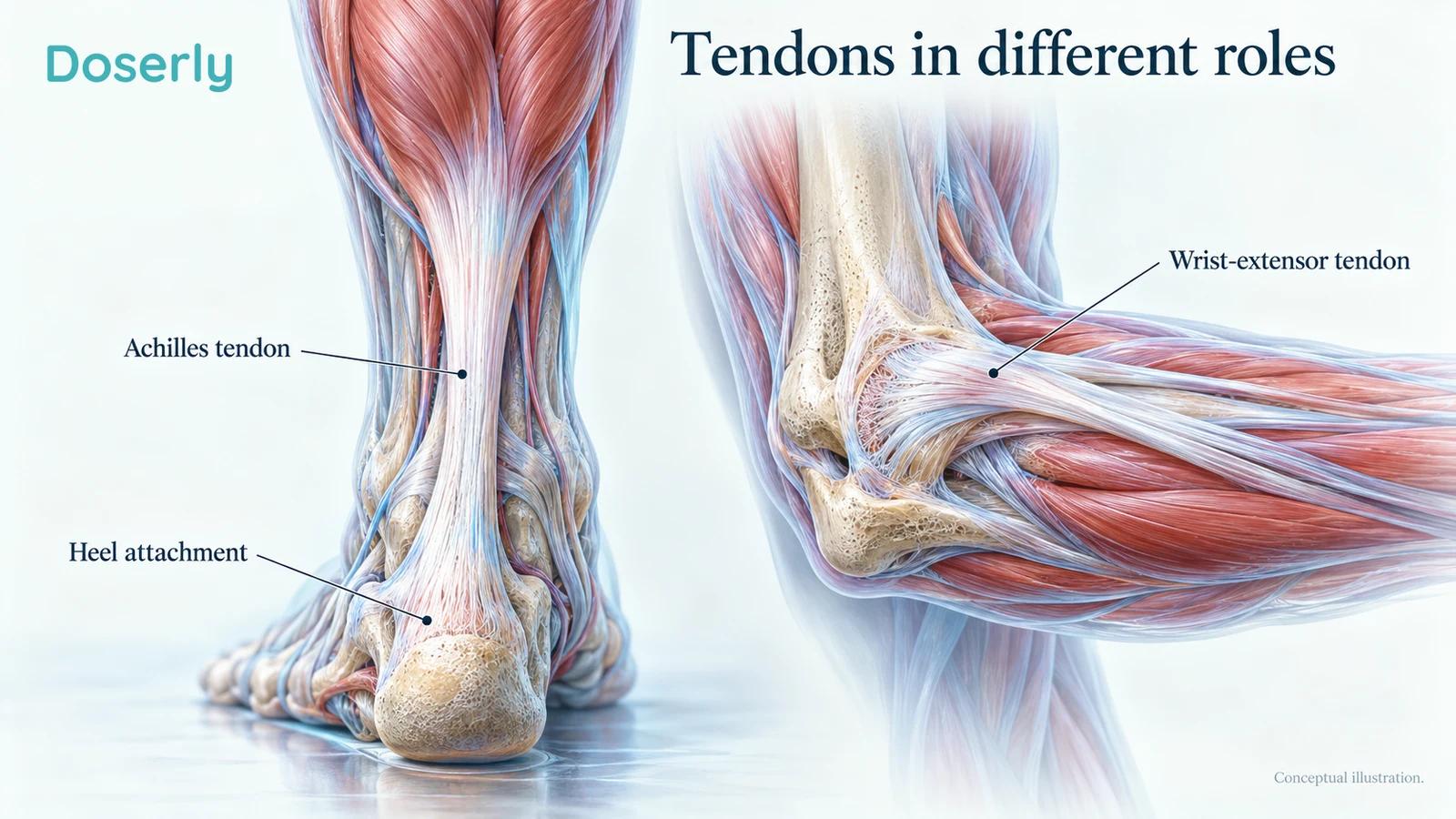
The Achilles tendon connects the calf muscles to the heel bone and helps transfer force during walking, running and jumping. Midportion Achilles tendinopathy usually refers to symptoms in the tendon above its attachment to the heel. Insertional tendinopathy concerns the attachment itself. A study of one location does not establish treatment for the other, even when both are described online as “Achilles pain.”
Tennis elbow usually involves pain around the common wrist-extensor tendon attachment on the outside of the elbow. You do not need to play tennis to develop it. Gripping, lifting and repeated wrist movements can make it noticeable at work or at home. The NHS description of tennis elbow includes everyday tasks such as computer work and using a screwdriver, which is a useful reminder that rehabilitation should fit the person's actual activities.
These conditions are often grouped under “tendonitis.” That familiar word can make the problem sound like a simple patch of inflammation that needs switching off. Persistent tendon symptoms are more complicated: pain, changes in tissue, muscle performance and tolerance of repeated loading can all matter. A treatment that influences one part of that picture may leave the others largely unchanged.
An acute rupture is different again. A sudden pop or feeling of being kicked in the calf, followed by difficulty pushing off, needs prompt assessment. Pain can settle even when the tendon is ruptured. Cambridge University Hospitals' rupture guidance describes this pattern and the importance of protected recovery. It is not a situation to test with repeated heel raises or a home light device while waiting to see whether it improves.
What the light treatment in a paper actually means
Much of the tendon literature uses low-level laser therapy, or LLLT, now often grouped under photobiomodulation, or PBM. These treatments deliver selected wavelengths of red or near-infrared light to tissue with the aim of producing biological effects without deliberately damaging it. Near-infrared light is not visible red light, even though both can appear in a treatment marketed as “red light therapy.”
A small contact laser directed at several tender points is not the same exposure as standing near a broad home panel. The wavelength, energy, illuminated area, treatment placement and delivery method all matter. Even two studies using the same wavelength can deliver different exposures. A model name or a number of minutes alone does not describe what the tendon received.
The literature also includes high-intensity laser systems and devices that combine light with a static magnetic field. Those comparisons can be relevant to a clinic's service, but they cannot identify the effect of ordinary nonthermal PBM by themselves. A positive result from a combined device belongs to the combination until a study separates its components.
This becomes especially important when an advertisement lists several successful “laser studies” together. Before treating that list as cumulative proof, check whether they involved the same tendon, similar patients and comparable equipment. The words laser and light are broad enough to conceal clinically important differences.
Achilles tendinopathy: encouraging early results, followed by important null trials
One frequently cited 2008 randomized trial enrolled 52 recreational athletes with chronic Achilles symptoms. Both groups performed eccentric exercises, which load the calf while the muscle lengthens. Participants received either an 820-nm laser treatment or placebo laser. At 12 weeks, average activity-related pain was 33 versus 53 on a 100-mm scale, favoring active laser. Earlier assessments also favored it.
That is a meaningful positive signal. It is also a result from one relatively small study of a particular exercise-and-laser package. The main finding concerned pain during activity. It did not demonstrate that the tendon had become mechanically stronger, that rupture risk had fallen or that all participants returned to their previous sport sooner.
A 2012 placebo-controlled trial reached a different conclusion. Forty people with midportion Achilles tendinopathy received the same eccentric exercise program with either active or placebo laser. The primary outcome was the VISA-A score at 12 weeks, a questionnaire covering Achilles symptoms and activity limitations. There was no significant added benefit from laser. The four-week result favored placebo; the other measured comparisons, including later follow-up, did not establish an advantage for active treatment. Thirty-three participants completed the one-year assessment.
A larger 2016 trial, published online in 2015, tested 80 participants across four groups combining active or placebo light with two different exercise schedules. The group receiving active light with the less frequent exercise schedule had better VISA-A results at 12 weeks than the other groups. However, 16 participants were lost to follow-up, including four described as leaving because of adverse reactions, and missing outcomes were imputed. This supports further study of the specific combination, rather than a general instruction to reduce rehabilitation or add light to every program.
The more recent 2024 trial from New Delhi randomized 60 adults to eccentric exercise with active or placebo laser. Both groups improved, with no significant between-group differences in pain or VISA-A at any assessment through 24 weeks. At that final visit, mean VISA-A scores were approximately 85 in both groups. The study reported no dropouts, but excluded several conditions that could complicate recovery, including diabetes and systemic inflammatory disease.
Taken together, these trials do not tell a simple story of steadily increasing success. Some treatment combinations looked helpful, while other reasonably direct comparisons did not. The shared exercise program often produced substantial improvement in both arms. That is precisely why “patients improved after laser” is not enough to show that laser caused the improvement.
The current Achilles guideline is more cautious than older summaries
The final 2024 clinical practice guideline for midportion Achilles tendinopathy recommends tendon-loading exercise as first-line treatment for appropriate patients. Its updated recommendation says clinicians should not use low-level laser therapy for this condition, with a grade C recommendation reflecting the limitations of the evidence.
This is easy to miss because the document also reproduces the older 2018 wording, which said contradictory evidence prevented a recommendation. Search snippets and clinic pages may display that historical section. The final 2024 recommendation is the relevant one when asking what the updated guideline advises.
The recommendation does not prove that every possible future light treatment will fail. It means the available clinical evidence has not justified routine use for midportion Achilles tendinopathy. For someone deciding where to spend limited time and money, that is a useful distinction: an unconfirmed additional benefit should not displace access to a tailored rehabilitation program.
A 2025 runner trial did not rescue the case for adding light
In a 2025 three-arm trial, 46 runners with persistent non-insertional Achilles symptoms received exercise alone, exercise plus radial pressure waves, or those two treatments plus photobiomodulation. At three months, the exercise-plus-pressure-wave group improved more on VISA-A than exercise alone. The group also receiving light did not demonstrate a significant advantage over exercise alone, and light did not add greater gains to pressure-wave treatment.
There are important qualifications. The trial was not blinded, it was smaller than the planned sample, and its later crossover phase allowed people to choose treatment. It also used a LightForce XPi 25W platform with 810- and 980-nm light. This was a higher-power clinical system with individualized delivery, not a small low-power probe or a consumer LED panel. Its result should be described on those terms rather than folded indiscriminately into low-level laser evidence.
Less pain is valuable, but it is not proof of repair
If a treatment makes walking less painful, that can matter a great deal. It may make a shopping trip manageable or reduce the strain of getting through a shift. There is no need to dismiss symptom relief because it is not a cure. The difficulty comes when that result is relabeled as tissue regeneration.
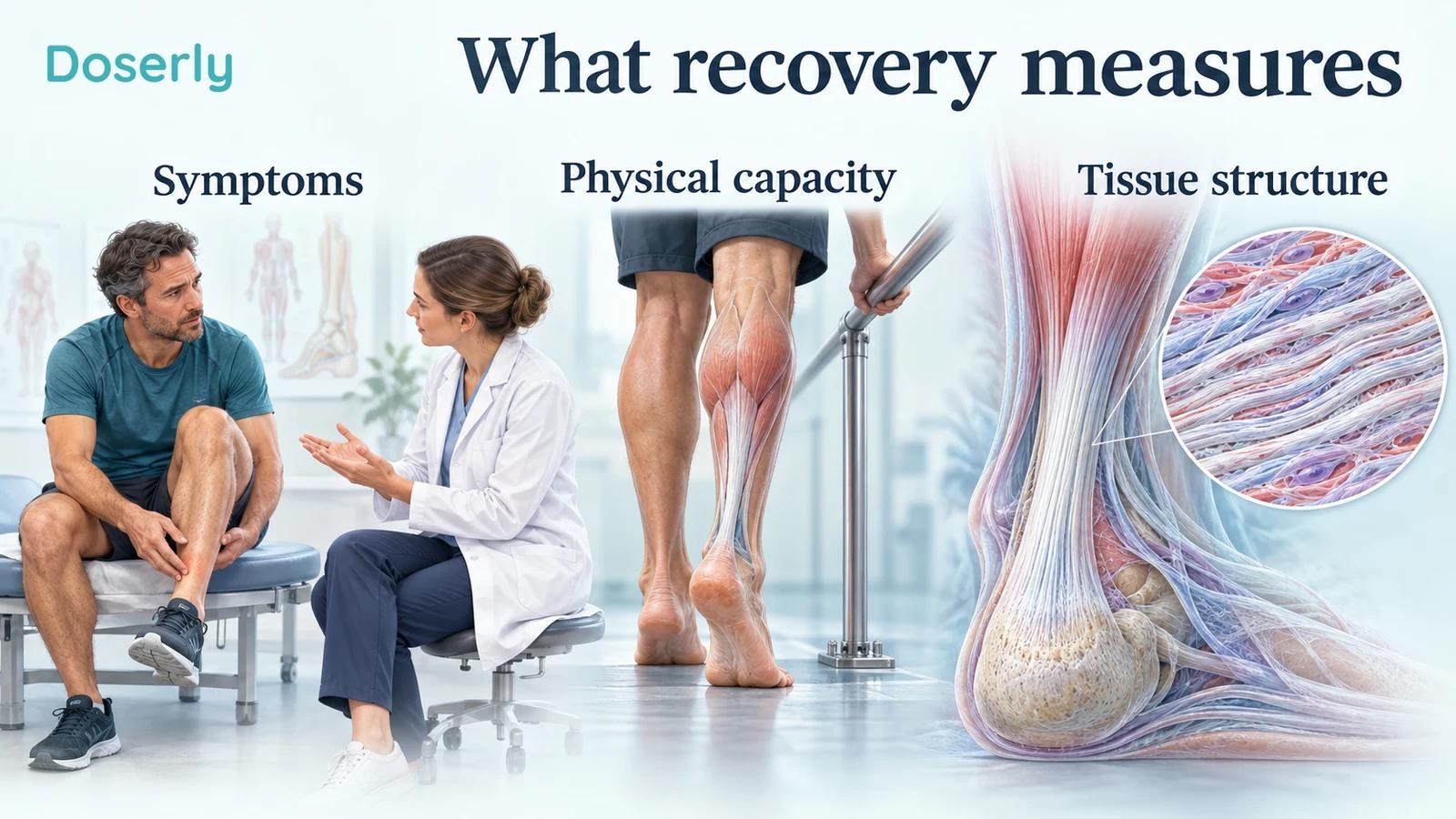
A pain score records an experience. A heel-rise test examines a functional task. Ultrasound describes aspects of tissue appearance. Return to sport asks whether someone has resumed a particular level of activity, ideally for long enough to know that the return is sustainable. These measures may move together, but one cannot stand in for all the others.
Imagine that your pain falls while your running volume also falls by half. That may be a welcome period of symptom control, but it does not show that you can tolerate your previous workload. Conversely, being able to walk farther with similar discomfort may represent useful progress even before pain disappears. The context gives the number its meaning.
This is why a rehabilitation conversation should include both comfort and capacity. Which everyday task has become easier? Has the amount of activity changed? Can you repeat the task on another day without an escalating response? Those observations are more informative than asking only whether the tendon feels warm or relaxed immediately after a session.
Human biology studies are interesting, but answer a smaller question
A 2006 experimental study examined seven people with symptoms in both Achilles tendons. After activity aggravated their symptoms, one tendon received active low-level laser and the other placebo. Researchers used microdialysis to sample fluid around the tendon. Active treatment reduced prostaglandin E2, an inflammatory signaling substance, over the short observation period, and improved pressure-pain threshold compared with placebo.
This is direct human evidence that a particular exposure can affect a local biological measurement. It is stronger support for that narrow claim than a cell-culture story alone. However, seven people observed over hours cannot tell us whether a tendon becomes stronger over months, whether a runner returns to competition or whether rupture becomes less likely. The study did not establish those outcomes.
The distinction is especially useful when comparing light with other treatments advertised for “healing.” Our BPC-157 evidence guide addresses another intervention often discussed in that language. It is a separate evidence question, not a recommendation to combine treatments. A plausible pathway should lead to a well-designed clinical comparison, rather than substitute for one.
An Achilles rupture trial found a pain signal without better function
The most direct human test of a repair-related claim comes from a 2022 randomized trial of conservative Achilles rupture care. Thirty-four men received active or sham photobiomodulation during immobilization, followed by rehabilitation. The primary outcome was the Achilles Tendon Rupture Score.
Both groups improved, but active treatment did not produce superior function on that primary measure. Strength and ankle range of motion also did not differ significantly. Pain while walking was lower in the active group at weeks 12 and 16, a secondary finding that may be relevant to comfort but does not establish better structural repair.
The trial was small and included only men. It does not settle every possible application, yet it directly challenges the leap from “light may affect tendon cells” to “light reliably accelerates recovery after rupture.” Protection, clinical follow-up and the prescribed progression of rehabilitation remain central. Reduced pain is not permission to advance loading ahead of the treating team's plan.
Tennis elbow has some positive findings, with a narrower payoff than the headlines
The elbow literature is similarly mixed. A 1994 double-blind trial randomized 36 people to an 830-nm low-power laser or placebo and found no advantage for lateral elbow pain. Older negative studies do not invalidate every newer device, but they belong in the history alongside positive reports.
A 2008 randomized comparison studied 58 people receiving a brace, ultrasound or low-level laser, each alongside exercise; the ultrasound and laser groups also received heat. Several measures improved within groups. Despite the abstract's favorable conclusion about laser, it reported no significant between-group differences in pain or grip strength at follow-up. That comparison cannot cleanly establish laser's superiority, and it did not include a sham-laser arm.
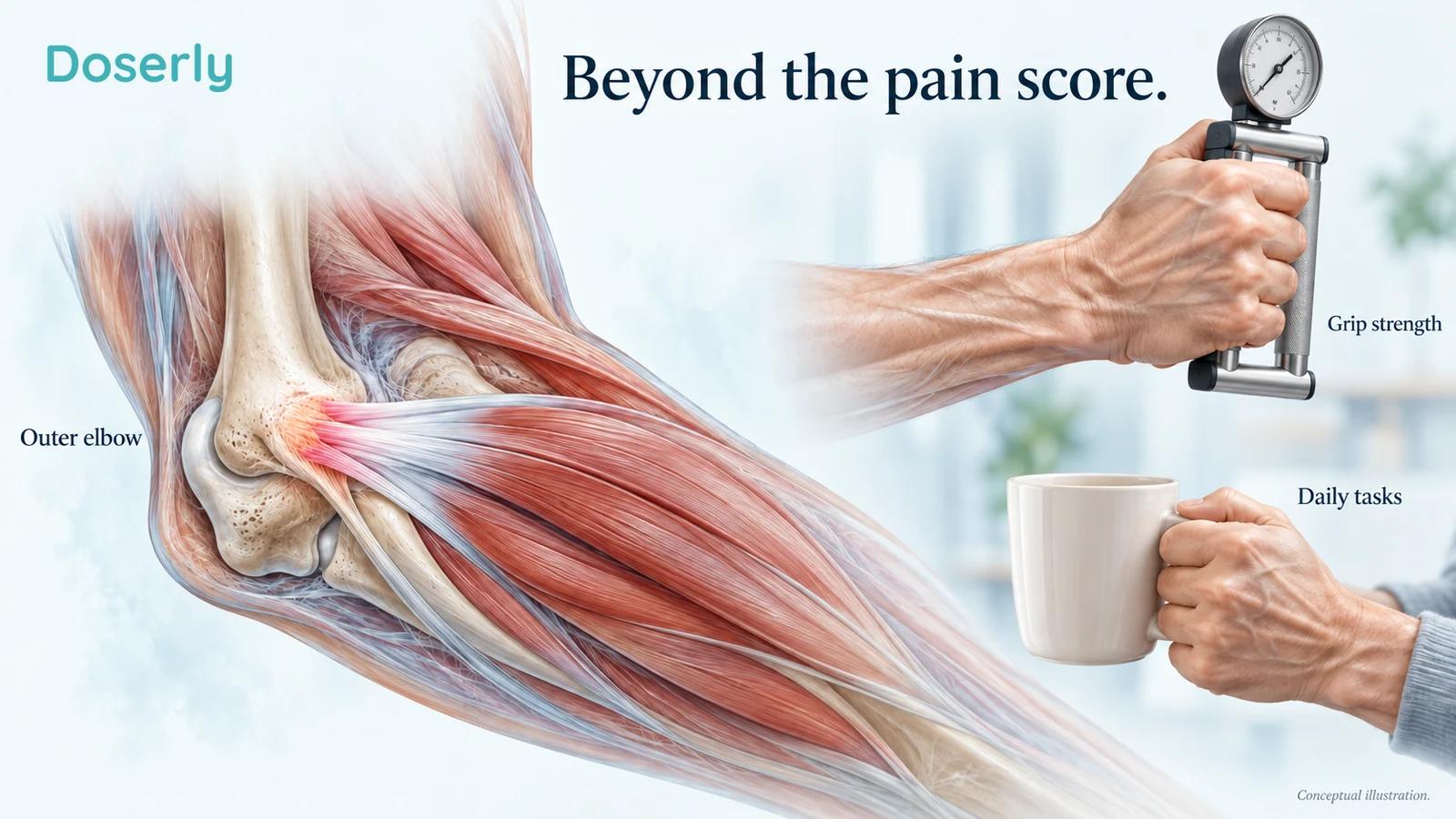
More recently, a 2025 multicenter, placebo-controlled trial enrolled 50 people with lateral epicondylitis. The intervention combined multiple light wavelengths with a static magnetic field. A response defined as at least a 30% reduction in pain occurred in 72% of the active group versus 40% of the placebo group, a 32-percentage-point difference. Pain reduction and a blood inflammatory marker favored active treatment, but disability, grip strength and satisfaction did not show significant between-group differences.
That is a promising pain result with a short follow-up, not proof of restored tendon capacity. The combination also prevents attribution to light alone. Disclosures included manufacturer research support and an author who was a manufacturer employee and shareholder. Those relationships do not erase the result, but independent replication would make the finding more persuasive.
For someone whose main goal is sleeping without elbow discomfort, pain relief may be the outcome they value most. For a mechanic who needs sustained grip, or a parent lifting a child many times a day, the unanswered functional question is particularly important. A treatment discussion should start with that distinction instead of assuming that every positive pain trial solves the same problem.
New high-intensity laser studies need their own category
A 2026 randomized study, published online in April and in an August issue, compared physical therapy alone with physical therapy plus either high-intensity laser or Kinesio tape. It included 53 people with chronic lateral epicondylitis. The investigators reported better pain and functional outcomes with high-intensity laser, while grip strength and pain sensitivity did not show significant group-by-time interactions.
This is relevant if the actual service being offered is high-intensity laser delivered in a clinic. It is not a direct validation of a home red-light panel. The study had no sham-laser group, used a two-week treatment period and followed outcomes through six weeks. It therefore leaves uncertainty about the specific light effect and longer-term recovery.
Powerful systems also raise different delivery and eye-protection considerations. “Laser” should never be treated as a single interchangeable product category. Ask which study supports the equipment and application being proposed, and whether that study's comparator resembles the care you would otherwise receive.
Rehabilitation remains an active treatment
Tendon-loading rehabilitation is sometimes described as the boring option you try before the interesting treatment. That misses its purpose. The work is to rebuild tolerance for the forces your life requires. A calf exercise, wrist-strengthening task or adjusted work activity can be progressed and assessed in a way that connects directly to that goal.
There is also more than one exercise approach. A 2015 randomized trial compared eccentric training with heavy slow resistance in 58 people with chronic midportion Achilles tendinopathy. Both groups improved in symptoms and function, with improvements maintained at one year and no significant difference between programs. Adherence was higher in the heavy slow resistance group. The useful lesson is that a sustainable program matters; it is not that one schedule should be copied by everyone.
For the elbow, the University Hospitals of Derby and Burton rehabilitation guidance emphasizes adapting daily activities and gradually building strength for tasks that matter to the person. A workday full of gripping is part of the total load, not separate from rehabilitation. An exercise plan that ignores it may be much harder to tolerate.
Ask your clinician to help distinguish a temporary modification from indefinite avoidance. What can you keep doing? What should change for now? Which response would lead to adjusting the plan? These questions leave room for individual differences without turning every twinge into evidence of damage or every comfortable day into a signal to accelerate.
What to ask before paying for a course of treatment
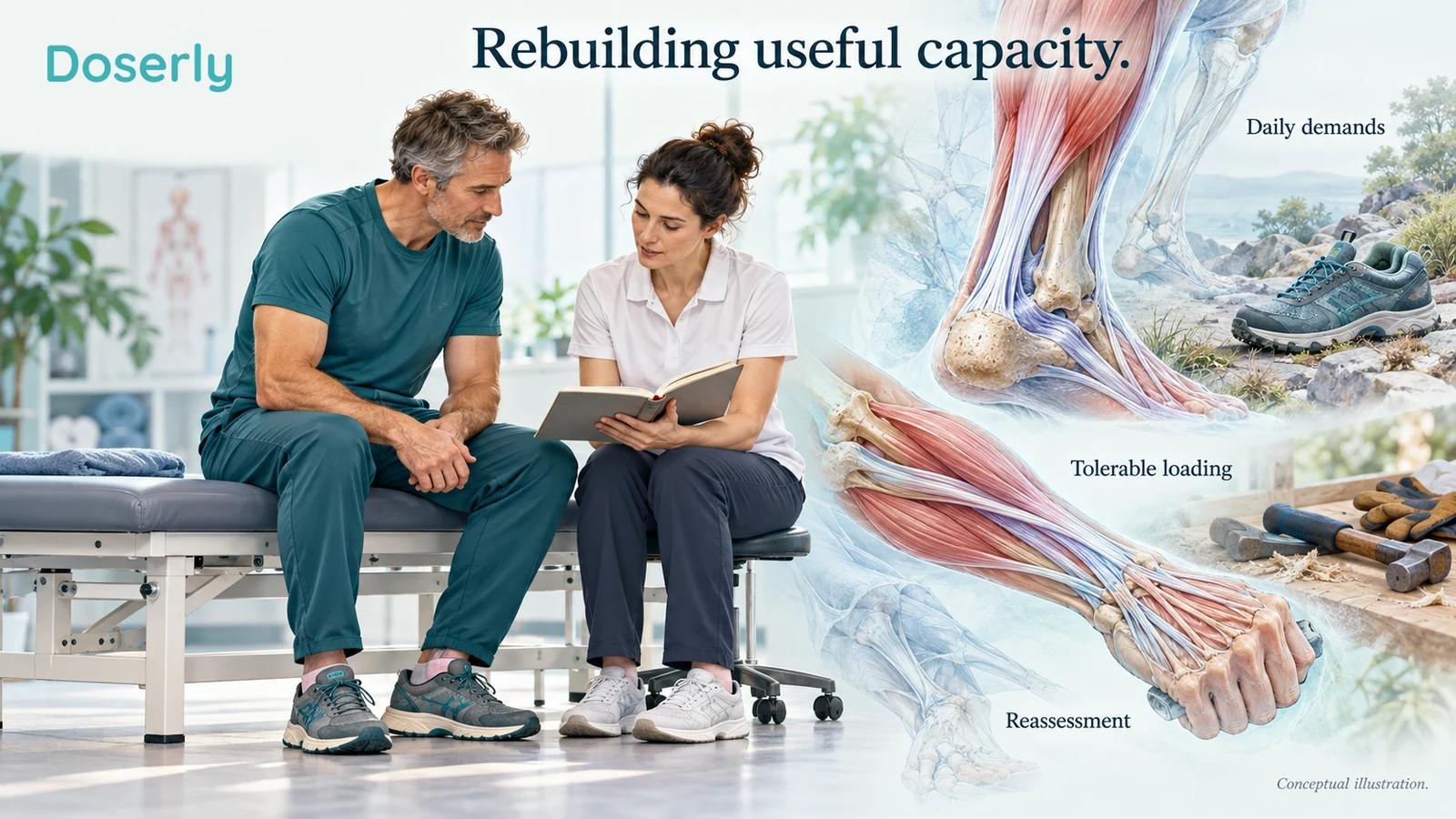
Begin with the diagnosis and the goal. “Tendon healing” is too broad to evaluate. “Walking to work with less pain” or “using my tools for a full shift” gives you and the clinician something concrete to revisit. It also makes it easier to recognize whether a proposed benefit matches the evidence.
Useful questions include:
- Does the supporting study involve my tendon location and a similar duration of symptoms?
- Was this exact type of device tested against a credible placebo, and what else did both groups receive?
- Did the trial improve pain only, or also function and return to activity?
- How will my exercise and everyday workload be accounted for when judging progress?
- What improvement would justify continuing, and when will we reassess if that improvement is absent?
Record a few relevant observations consistently rather than checking the tendon constantly. A brief note about the same everyday task, the amount of activity and the following day's response can support a more useful review. If medication, workload and several treatments all change at once, acknowledge that you may not be able to identify which change helped.
For midportion Achilles tendinopathy, current guidance and several null trials give a strong reason to prioritize rehabilitation over adding low-level laser. For tennis elbow, a short-term pain benefit remains possible with some studied devices, while durable functional benefit is less secure. After rupture, the evidence does not justify promises of faster repair. The aim is to recover a life that asks less of your attention every time you move, using progress you can actually recognize.