
Red Light Therapy
October 17, 2026
Red light therapy for stretch marks and cellulite: what is realistic?
On this page
Stretch marks and cellulite often appear in the same advertisements, usually beside promises about collagen, smoother skin and body confidence. They may even share space on the same thigh or abdomen. But they are different structural changes, and a treatment that helps one cannot be assumed to help the other.
The human light-treatment research is interesting, but narrower than many product claims suggest. A small clinical trial has tested near-infrared photobiomodulation for mature stretch marks. Other studies have combined red LEDs with lasers or topical gels, making the light's individual contribution difficult to identify. Cellulite studies sometimes measure tenderness, temperature or body circumference rather than the dimpling someone wants to change.
The most realistic expectation is a possible improvement in a particular feature with a particular treatment, not reliable removal of either condition. Both are common body changes, and neither requires treatment simply because it is visible. If you want to explore treatment, understanding the actual evidence can help you decide what would be worth the time, cost and uncertainty.
A stretch mark is a scar; cellulite is a different arrangement of tissue
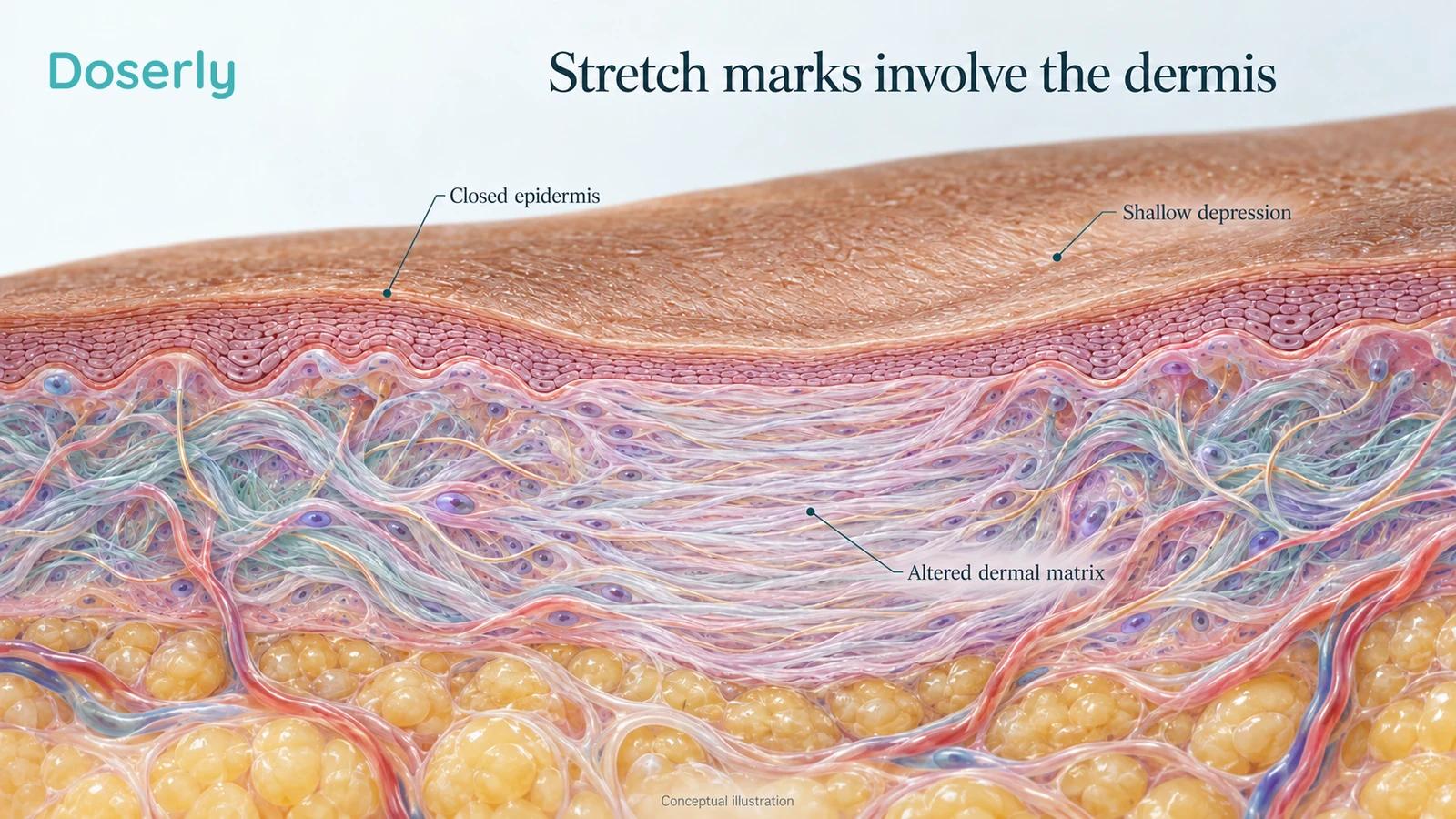
The American Academy of Dermatology describes stretch marks as scars that can develop when skin changes size quickly. Early marks may be reddish, purple, pink or brown, depending on skin tone. Over time they often become paler and slightly depressed. This natural evolution matters when judging any before-and-after picture.
Clinicians call the earlier colored stage striae rubrae and the mature pale stage striae albae. A study of one stage does not automatically apply to the other. Making a fresh mark less conspicuous in color is also a different goal from improving the shallow depression of an older mark.
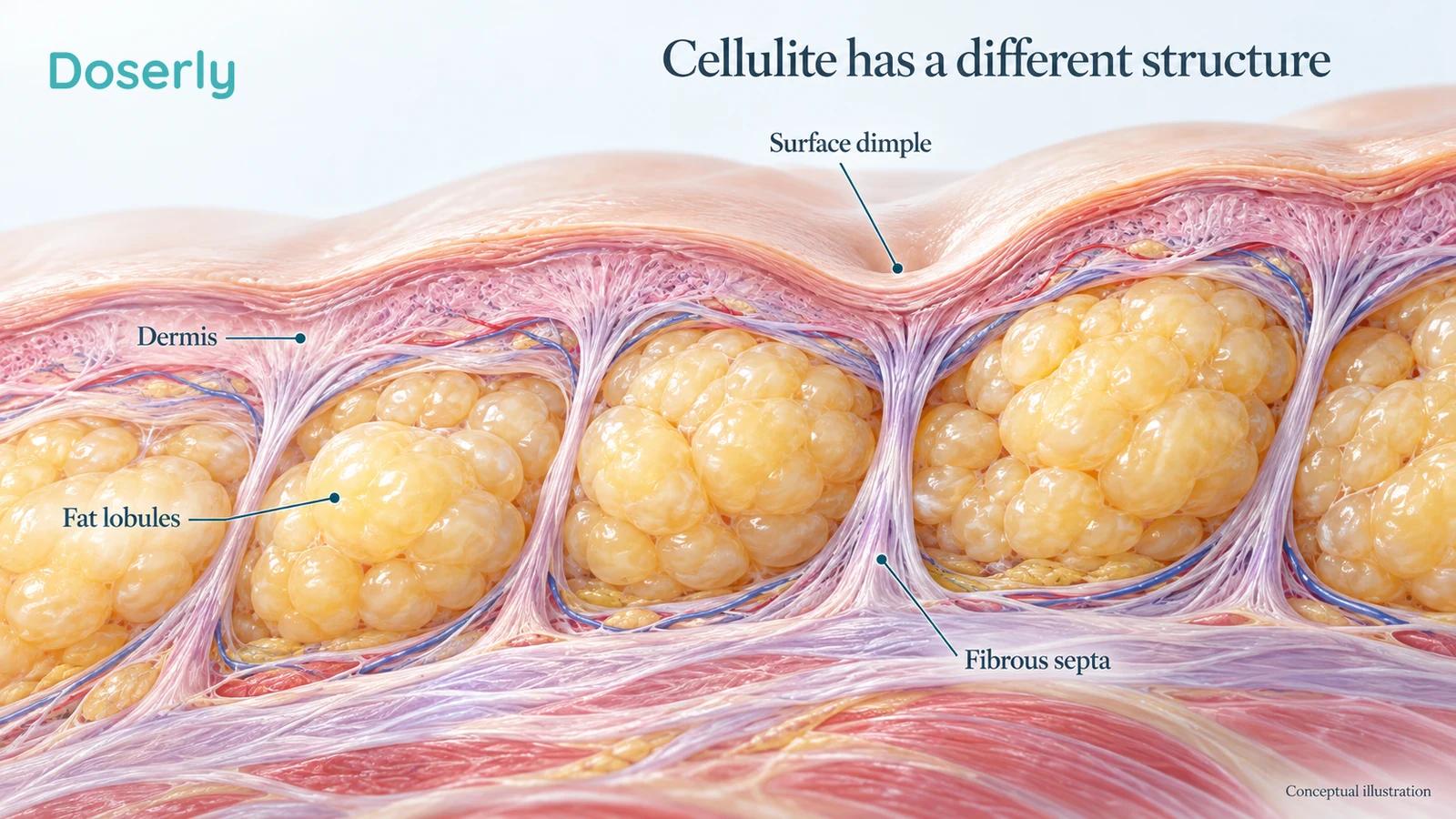
Cellulite concerns the relationship between the skin, underlying fat and fibrous connections. In a human MRI study of thirty women, areas with cellulite depressions were strongly associated with underlying fibrous septa compared with nearby areas without depressions. This is anatomical evidence, not proof that a particular treatment changes those connections.
An earlier MRI and spectroscopy study also showed that the connective-tissue network is more complex than a simple diagram of straight bands. It did not confirm a general increase in water within the fat lobules of women with cellulite. Claims that cellulite is merely trapped fluid waiting to be “drained” therefore oversimplify the tissue involved.
This difference in anatomy is the starting point for realistic treatment. A collagen-related effect in skin does not automatically release a tethered dimple, and a smaller thigh measurement does not show that a stretch mark has changed.
The most direct stretch-mark photobiomodulation trial
A 2024 randomized study assigned thirty people with mature stretch marks and skin phototypes III or IV to an 808 nm near-infrared diode laser, fractional carbon dioxide laser or the combination. Twenty-six completed the study, with follow-up to three months after treatment.
Ratings improved, and the investigators did not find a significant efficacy difference between photobiomodulation alone and fractional laser alone. That does not establish equivalence: the groups were small, and there was no sham or untreated group. The combination performed least well on the efficacy comparisons, despite the expectation that adding treatments would help.
The photobiomodulation group reported no downtime or treatment side effects during the assessed treatment period. One participant in the combined group developed persistent darkening after fractional laser and declined another session. Pregnancy and breastfeeding were excluded.
This is a useful clinical signal for mature marks, but it concerns a specific supervised near-infrared laser, not a household red LED belt. It does not establish complete removal, durable benefit over years or a universal protocol. The absence of downtime also needs to be weighed against the repeated visits required.
A red-LED combination study cannot identify the LED effect
A pilot study first published online in 2017 enrolled thirty people with mature stretch marks in a combined treatment program. It included an ablative fractional erbium laser, a topical recombinant growth factor and red LED sessions. All participants were reported to improve, and biopsies in two participants showed changes in skin thickness and connective tissue.
The central limitation is the combination itself. There was no separate arm showing what happened with the laser and topical treatment without LEDs. There was also no red-LED-only arm. The study can describe the outcome of the package, but it cannot assign that outcome to one component.
This distinction matters whenever a product page cites a paper with “red light” in its title. The important part may be in the methods: what else did people receive? A home panel does not reproduce an ablative procedure and a topical growth-factor regimen simply because LEDs were included somewhere in the clinical program.
Biopsy changes require the same care. Seeing more collagen in a small tissue sample does not tell us how much visible improvement a typical person will notice, whether it lasts, or which part of a combined treatment caused it.
Fractional lasers use a different approach to the skin
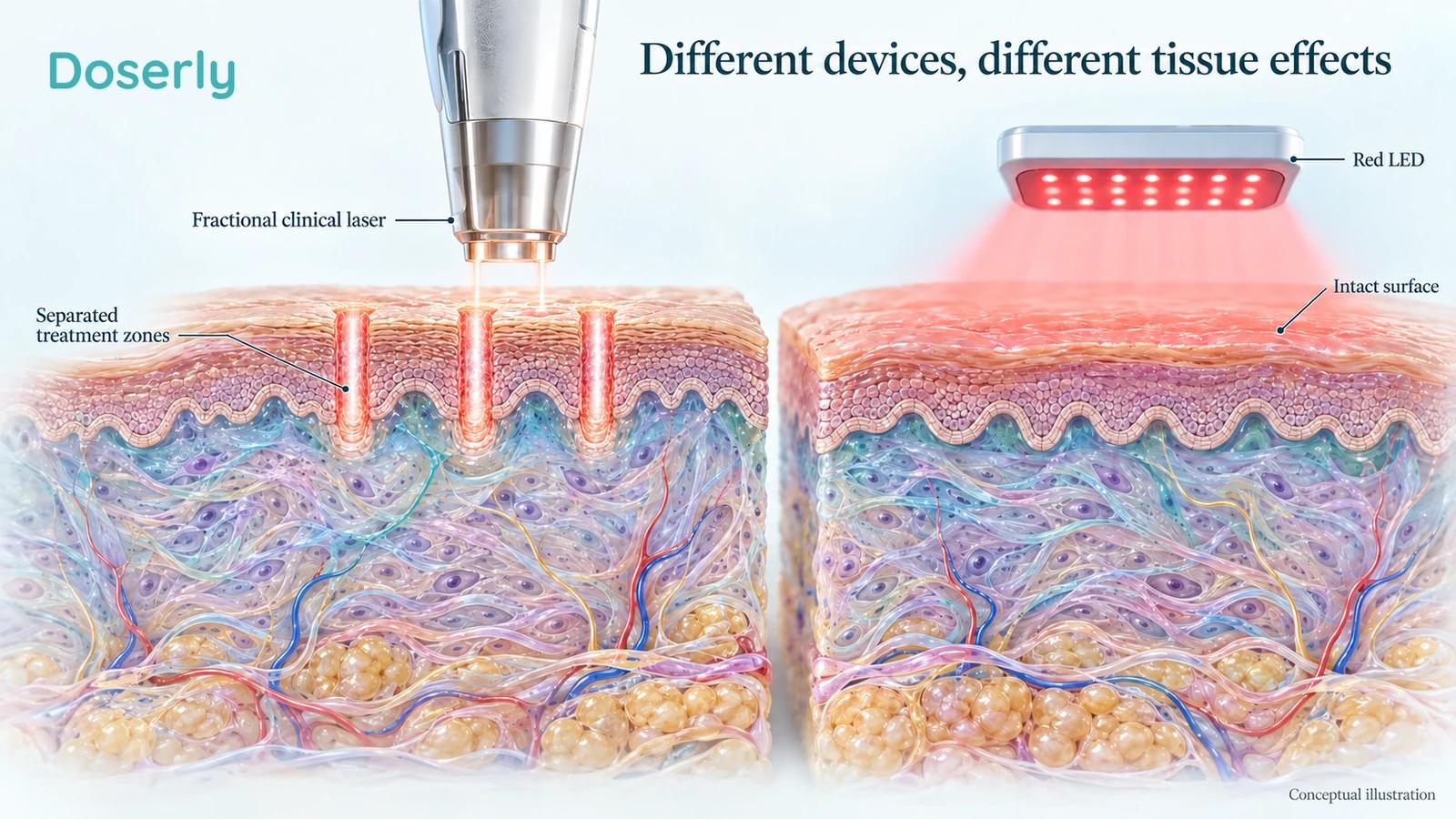
Fractional clinical lasers create controlled treatment zones in the skin. Depending on the device, they may remove tiny columns of tissue or heat selected zones while leaving surrounding areas to support recovery. Red LED photobiomodulation is not designed to reproduce that controlled injury.
A 2019 randomized study compared a nonablative fractional laser with microneedling on different halves of the abdomen in twenty women with mature stretch marks and phototypes III or IV. Both approaches improved patient ratings, with no significant difference between them. Tissue samples showed increased collagen and elastic fibers with both.
The tradeoffs differed. Microneedling was more painful during treatment, while adverse effects lasted longer with the laser. The trial compared two procedures; it did not include a red LED treatment. It also does not turn either intervention into a guaranteed way to eliminate marks.
When a clinic describes a procedure as collagen stimulating, ask what it actually does to the tissue. A shared description of the hoped-for response does not mean that two devices have the same mechanism, evidence or recovery requirements. That question is more useful than comparing the number of lights, the warmth of a session or the intensity of a marketing image.
A 2026 trial shows how modest improvement can look
A July 2026 randomized study compared fractional radiofrequency, topical tretinoin, their combination and untreated areas within twenty people with mature stretch marks. Nineteen completed the study. This was not red-light treatment, but its controlled design offers a useful reality check for the broader cosmetic-treatment conversation.
At twenty weeks, only the combination significantly outperformed untreated areas on the patient-reported scar score. The blinded dermatologist's ratings did not show a significant advantage for any treatment over control, and three-dimensional imaging changes were subtle.
Tolerability also mattered. Dermatitis was common with tretinoin, and some combined-treatment areas developed post-inflammatory darkening. No serious adverse events were reported. The participants had skin phototypes I to III, so the results do not fully describe outcomes in darker phototypes.
This does not mean the patient-reported benefit was imaginary. It means the improvement was easier for participants to perceive than for a blinded observer to confirm. Even carefully studied procedures may produce modest, uneven changes. Expectations for a less-studied home red-light device should not be more certain than those for the treatments actually tested.
What the red and near-infrared cellulite gel study tested
In a 2007 randomized study, nine women applied an active phosphatidylcholine-based gel to one thigh and placebo gel to the other. Both thighs received red and near-infrared LED treatment. After three months, eight active-gel thighs improved to a lower cellulite grade, while the placebo-gel thighs showed minimal change.
The comparison therefore tested the added gel within a light-treatment program. It did not compare LEDs with sham light, and it cannot establish that LEDs alone were effective. Without a gel-only arm, it also cannot show that light was necessary for the combination's benefit.
Longer follow-up was revealing. At eighteen months, five of the eight initially responsive thighs had returned to their original grade; three retained improvement. Mild transient itching, redness and swelling were reported during treatment.
The study supports further investigation of that particular combination. It does not establish a red-light-only cellulite cure or a proven maintenance schedule. The return of dimpling also reminds us that an early response and a lasting result are separate outcomes.
A later LED-bed study had the same attribution problem
A study published in 2023 enrolled eight women in a similar comparison. Both sides received LED-bed treatment, while one randomly selected thigh and buttock area also received an anti-cellulite gel.
After three months, the combined-treatment side improved in cellulite grade, while the light-only side did not change from its baseline grade. Skin-elasticity findings also favored the combined approach. Changes in thigh circumference did not correlate with the treatment regimens. No adverse reactions were reported in this small sample.
Again, there was no no-light group and no gel-only group. The result does not tell us that the light independently improved cellulite or that the two treatments had a special interaction. It tells us that the side receiving the added gel did better under the conditions studied.
For someone considering a package of LED sessions, cream and massage, this is a practical question to ask: is the evidence for the entire package, or for the specific part being sold? A positive combination study should not be used to make an unsupported claim about each ingredient separately.
A red-light trial measured tenderness and temperature
A November 2024 randomized study investigated 650 nm LEDs in twenty-five women with cellulite. The researchers assessed pressure-pain thresholds and skin temperature, including local treatment with or without an additional approach described as systemic irradiation.
The report described increased pain thresholds and lower skin temperatures, with larger changes in the combined-treatment group. Those findings concern sensitivity and thermal measurements. They do not establish that dimples were eliminated, that fibrous connections were released or that fat was lost.
The accessible abstract does not provide enough detail to turn the reported changes into a dependable estimate of cosmetic improvement versus placebo. It also does not provide evidence for long-term home use. The authors disclosed nonfinancial interests related to the work.
This is worth distinguishing from a negative study: it may be investigating a useful symptom effect. But someone seeking smoother-looking skin should not be shown a temperature result as if it were a validated measurement of that goal. Tenderness and appearance need their own evidence.
The positive green-laser cellulite trial is not red-light evidence
A 2013 double-blind randomized trial compared a low intensity green laser with sham treatment in sixty-eight participants. Nineteen of thirty-four people in the active group improved by at least one cellulite grade, compared with three of thirty-four in the sham group.
That is a meaningful controlled signal for the particular 532 nm device studied. The follow-up was short, extending to six weeks, and the paper disclosed manufacturer-related financial and patent interests. It does not establish lasting benefit over years.
Most importantly for this article, green light is not red light. Calling both treatments low-level laser therapy does not make them interchangeable. A red device cannot inherit the outcome of a green-device trial because both appear under the same broad technology label.
The same reasoning applies to a result achieved with heat, suction, radiofrequency or a procedure beneath the skin. Those may be legitimate treatment approaches to investigate, but their results belong to the interventions actually used.
Body circumference is another separate outcome
A 2009 sham-controlled body-contouring trial tested a 635 nm laser in sixty-seven volunteers. It reported a greater reduction in the sum of waist, hip and thigh circumference measurements in the treatment group than in the control group after the short treatment course. Eight participants lacked measurements at the later follow-up point, and some of the reduction had already returned in the treated group.
The trial's endpoint was combined circumference. That is not a cellulite-severity score or a stretch-mark assessment. Adding several measurements together also produces a number that should not be presented as the reduction at a single body site.
The FDA distinguishes noninvasive body contouring from weight-loss treatment. Such procedures are not intended to treat obesity or deliver the health benefits of weight loss. Their effects can be temporary, and the relevant outcome depends on the technology.
For a reader, the key is to keep the measurement attached to the claim. A smaller tape measurement cannot tell you whether dimples are shallower. A smoother photograph cannot tell you whether body fat decreased. Neither result demonstrates that a mature stretch mark has been erased.
What combination devices make difficult to interpret
A clinic may offer several treatments in the same visit, while a home routine might combine light, exercise, a cream and massage. If appearance changes afterward, it can be difficult to determine what contributed. That uncertainty is especially large when the starting photographs were taken during a period of rapid body change.
Combination treatment is not inherently unreasonable. The problem is assigning all improvement to the newest component. To learn what light adds, a study needs a comparison in which the other parts of care are similar and the light exposure differs. To learn whether two treatments reinforce each other, the design needs to separate their individual contributions as well.
For example, light plus active gel versus light plus placebo gel can test the gel's added effect in that setting. It cannot show the benefit of light versus no light. That is a different question requiring a different comparison.
When reviewing a clinic's evidence, ask to see the methods as well as the headline. The study may be accurately described as randomized while still answering a narrower question than the treatment package's advertising suggests. Randomization improves a comparison; it does not change which comparison was actually made.
Choose the feature you would like to change
Before considering a device, name the feature that bothers you. It may be the color of newer stretch marks, the depression of mature marks, dimpling while standing, skin laxity or discomfort. Those are different targets and may not respond to the same treatment.
The AAD's cellulite treatment overview describes approaches directed at different tissue features, including procedures that release fibrous connections. It also emphasizes that cellulite differs from fat and that removing fat does not necessarily improve it. These are reasons to seek an assessment of the actual concern rather than purchasing a general “body smoothing” solution.
An assessment can also clarify whether the feature you see is cellulite, loose skin, a scar or something else. There is no obligation to treat any of them. If your goal is a small appearance improvement, the expected benefit should be proportionate to the expense, discomfort and recovery involved.
A useful consultation ends with a specific expectation: what may change, how much uncertainty remains and when the result can reasonably be assessed. It should also leave room for the possibility that doing nothing is the best fit for you at present.
Photographs need consistent conditions
Skin texture changes its appearance with posture, muscle tension, camera angle and lighting. Directional light can emphasize every shallow depression, while broad frontal light can hide the same contours. A before photograph with contracted muscles and an after photograph with relaxed muscles is not a fair comparison.
If you track an area, use comparable posture, distance and illumination. Photograph the same location without stretching or pinching the skin differently. Keep the original images rather than using filters or automatic smoothing. Avoid interpreting one favorable picture as proof of structural change.
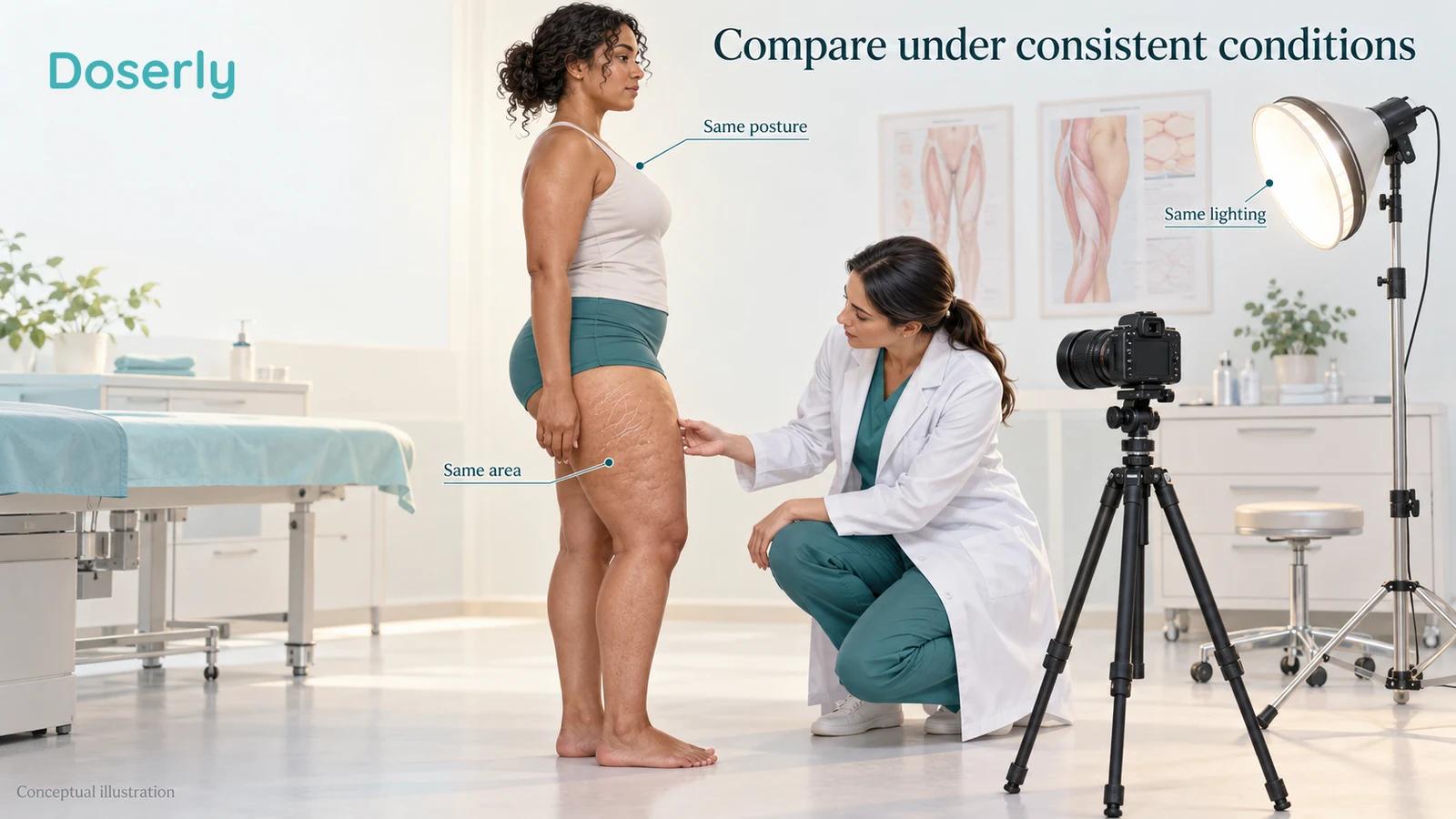
Record other relevant changes too, including a new exercise program, weight changes, recent pregnancy, creams or procedures. This is not an instruction to keep your life unchanged for a cosmetic experiment. It is a way to preserve context when reviewing what happened.
It also helps to separate photographs taken immediately after a session from those taken later under ordinary conditions. Temporary warmth, redness or swelling can alter appearance without demonstrating lasting benefit. Ask a clinician when assessment makes sense for the procedure involved rather than assuming the most flattering moment is the most informative one.
Safety and expectations belong in the same conversation
The main safety question is about the actual treatment, not whether its advertisement uses words such as gentle or natural. A household LED device, an ablative laser and a radiofrequency procedure have different precautions. A positive result from one does not tell you that another is appropriate for your skin or medical history.
Discuss pregnancy or breastfeeding, medicines, light sensitivity and a tendency to develop dark marks after irritation before elective treatment. Do not copy a research exposure schedule or add a topical product simply because it appeared in a combination study. Ingredient suitability and device suitability both need consideration.
For clinical procedures, ask about expected recovery, pigmentation changes and what to do if symptoms exceed the expected course. Persistent pain, blistering or an unexpected skin reaction should be assessed rather than treated as a necessary stage of collagen production. More irritation is not a useful target.
For a home purchase, consider the total commitment rather than only the device price. An uncertain modest benefit may not justify months of sessions, additional products or repeated concern about whether you are doing enough. Lack of visible improvement is not a personal failure and does not prove that you need stronger exposure.
Red and near-infrared treatments remain reasonable subjects for research, with a few human signals that deserve better controlled follow-up. For stretch marks and cellulite today, a careful interpretation supports possible, limited appearance or symptom changes in selected settings. It does not support dependable removal, permanent smoothing or claims that one panel can solve several distinct tissue problems at once.