
Red Light Therapy
October 17, 2026
Red light therapy with retinoids and skin care: what combinations have evidence?
On this page
A red light mask can make an already complicated skin-care routine feel even more complicated. Should it go before retinol? After moisturizer? Does vitamin C help the light work, or get in its way? And if a copper-peptide serum and a light device each have research behind them, is using both an obvious upgrade?
The useful answer starts with three separate questions: whether the combination is tolerable, whether it changes how light reaches the skin, and whether it produces better results. Those questions need different evidence. A routine can be comfortable without being more effective, and a promising laboratory interaction can exist without a proven improvement in anyone’s wrinkles.
There are encouraging studies of light-based skin treatments, established reasons to use selected retinoids, and some early research on combinations. There is much less direct evidence for the exact sequence of products that fills social-media routines. Understanding that gap helps you keep the useful parts of skin care without buying a new step for every proposed mechanism.
Start with the problem you actually want to improve
Skin care is easier to evaluate when the goal is specific. Fewer inflammatory acne lesions, less uneven pigmentation, softer fine lines and less irritation are different outcomes. An intervention can help one without helping the others. Even “better texture” can mean several things: temporary hydration, fewer clogged pores, smoother surface roughness or a change in deeper tissue.
That matters when combining treatments. If your prescription already controls acne but leaves your skin uncomfortable, the next useful step may be improving tolerability rather than adding another active treatment. If your main concern is a changing dark spot, a device experiment is not a substitute for having the spot assessed. If your goal is a modest cosmetic improvement, the amount of effort and cost you consider worthwhile may be quite different.
Write down what success would look like before changing the routine. “My face looks healthier” is understandable, but hard to compare from one week to another. “Fewer new inflamed spots,” “less stinging during cleansing” or “a visible change in the same photographed fine lines” gives you and your clinician something more concrete to discuss. You do not need to turn your bathroom into a laboratory. You do need a consistent question.
Retinoids and light do different jobs
Retinoid is the family name for vitamin A-related compounds. Retinol is one member of that family; tretinoin is another. Their names are often used as if they describe the same product, but formulations, strengths and tolerability differ. The American Academy of Dermatology explains that topical retinoids can be useful for selected acne and cosmetic concerns, while also causing irritation. Oral isotretinoin is a separate prescription treatment and should not be treated as simply a stronger skin-care cream. AAD retinoid explainer.
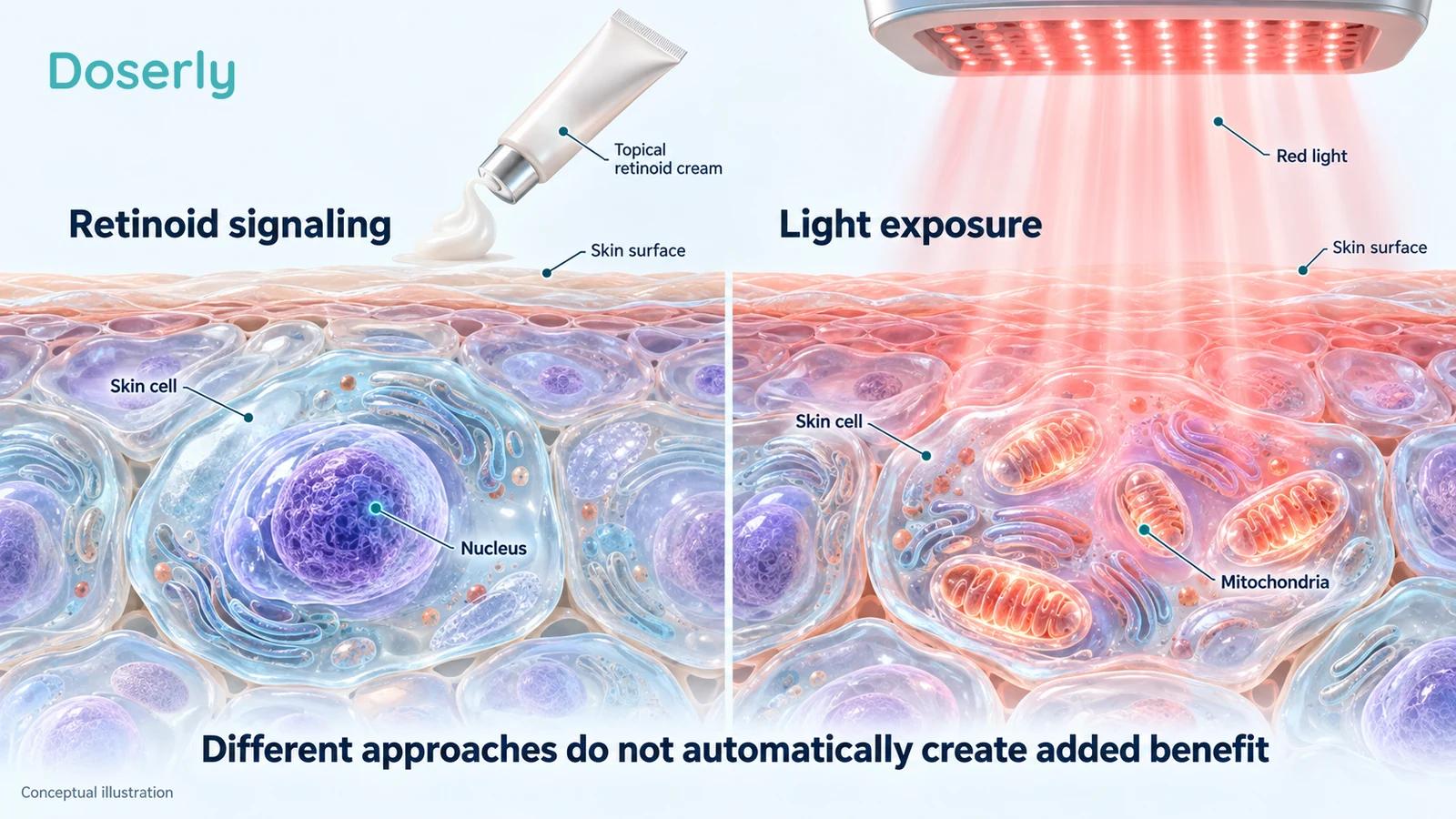
Retinoids affect cellular signaling, including pathways that influence skin-cell behavior. Photobiomodulation, often shortened to PBM, exposes tissue to particular light wavelengths under particular conditions. Researchers investigate how absorbed light can influence cellular processes. Neither description tells us that combining the two will produce a larger visible benefit.
A useful human example comes from a small randomized study published in 2022. Twenty-four participants were assigned to a particular tretinoin-precursor formulation or 0.02% tretinoin for 24 weeks; 20 completed the analysis. The study did not find a significant difference between the groups on its main photoaging score, and redness was less frequent with the precursor formulation. Skin-biopsy findings did not neatly support every commonly repeated collagen mechanism. This was a retinoid comparison, not a red-light combination trial. It also cannot establish that every over-the-counter retinol is equivalent to prescription tretinoin. Original JAMA Dermatology trial.
The practical lesson is to evaluate the actual formulation and the actual outcome. A mechanism is a reason to investigate a treatment, not a shortcut around testing it.
What light-alone studies tell us about adding a device
Before asking whether a serum boosts red light, it helps to ask what the light itself has demonstrated. A 2025 sham-controlled trial enrolled 95 women aged 45–60 and compared two schedules of a specific red LED mask with sham treatment. The clinical Wrinkle Assessment Scale did not show significant differences between groups. Computerized analysis found improvements in selected wrinkle measurements, and participant satisfaction favored the active groups. The higher session frequency did not clearly improve those findings. 2025 facial-rejuvenation trial.
That is a mixed but potentially useful result. It supports discussing selected cosmetic benefits under the studied conditions. It does not support promising a dramatic change, assuming every mask will perform similarly, or adding more sessions whenever progress seems slow.
Now imagine someone uses a mask, starts tretinoin and changes moisturizer in the same month. Their skin improves. The improvement may be real, but that experience cannot tell us which change contributed most or whether the combination outperformed the simpler routine. This is why a product’s before-and-after photograph, however appealing, often answers less than the caption suggests.
For an individual, satisfaction still matters. A modest improvement can be worthwhile. The point of separating the outcomes is to help you decide what you are paying for, rather than asking you to ignore your own experience.
Can you use red light while using tretinoin?
There is no single answer that covers every device, every retinoid formulation and every skin condition. A statement that red light is different from ultraviolet light is scientifically relevant, but it is not a complete compatibility assessment.
The prescribing information for tretinoin describes local irritation and cautions about sunlight exposure and other irritating products. These warnings should not be rewritten as proof that all visible red-light devices are dangerous. Equally, the absence of ultraviolet output does not establish that a particular mask is suitable for already irritated skin or for every person taking medication. Tretinoin prescribing information.
The most useful compatibility check includes the exact prescription, the device instructions and the condition being treated. Bring the device name and its instructions to the clinician who manages your skin treatment. “Can I combine these two specific products?” is a more answerable question than “Are retinoids photosensitive?”
If the device instructions exclude a medication or require a waiting period, do not replace that instruction with a schedule from an online comment. A dermatologist may be able to explain whether the restriction reflects evidence, precaution or the population studied, and suggest an appropriate alternative. Persistent burning, significant swelling, blistering or worsening discoloration should prompt stopping the new exposure and obtaining medical advice.
Before or after: what does the evidence actually establish?
The question sounds simple because it asks for an order. The research question is more demanding: does applying a defined product before light, compared with applying it afterward, change a meaningful outcome while keeping everything else the same?
The studies discussed here do not establish a universal best sequence for tretinoin and a home red-light mask. Nor do they establish a universal waiting time that makes all combinations safer or more effective. A ten-minute gap, a morning-versus-evening split or an alternating-day routine can be convenient arrangements, but convenience should not be presented as a clinically validated optimum.
If a device specifies clean, dry skin, that is the condition to follow unless the treating clinician and manufacturer’s instructions support something different. If a prescription has its own application instructions, those matter too. The aim is not to invent a compromise schedule that quietly ignores both sets of directions.
There is also an attribution issue. Suppose a routine becomes more comfortable after you separate products. That is useful information about tolerability. It does not prove that the light is now stimulating more collagen. Naming the outcome accurately lets you preserve a helpful change without attaching an unsupported explanation to it.
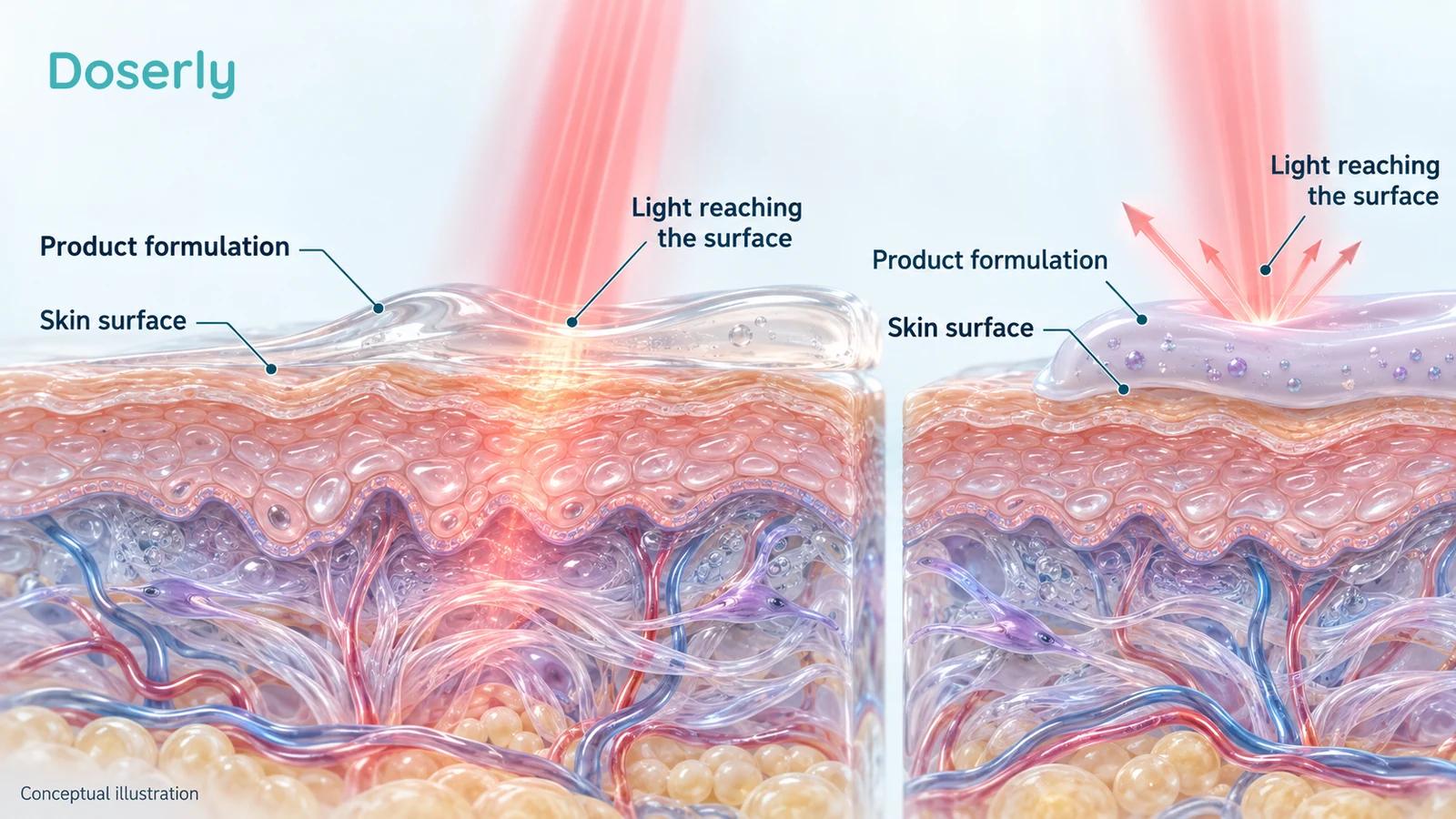
Products can change the optical surface
A cream or serum is more than the ingredient advertised on its label. It is a complete formulation with a vehicle, pigments, solvents and other components. Those features can affect what happens to light at the skin surface.
A 2019 laboratory study measured visible-light and infrared-A transmission through cosmetic and sunscreen products. Optical behavior varied with the products and wavelength ranges; tinted formulations provided their greatest protection in the blue-light range. This was a transmission study, not a trial showing that applying or removing a particular serum improves PBM treatment outcomes. Original cosmetic-transmission study.
This is why “all serums block the light” and “clear serums always improve penetration” are both overly confident rules. Visual transparency to your eyes is not a complete measurement of a product’s behavior across a device’s wavelengths. A marketing ingredient list also cannot tell you the dose reaching cells beneath the surface.
None of this is a reason to give up daytime sun protection. Sunscreen serves a different purpose. The practical task is to fit any optional device session around a sensible skin-care plan while following its instructions, not to sacrifice protection from sunlight for an unproven increase in treatment delivery.
The 2026 serum study: a promising comparison with important limits
In June 2026, Mito Red Light described a manufacturer-commissioned, 12-week split-face evaluation involving ten women aged 42–61. One side received its serum before light exposure; the other received the same light without serum. The company reported greater improvements on the serum side across several instrument-based measurements, including wrinkle width. Manufacturer’s study summary.
The comparison is relevant because it actually asks about adding a product. However, it remains a small commercial report. The public summary does not provide the level of methods, statistical detail and independent assessment expected from a complete peer-reviewed clinical paper. It also lacks a serum-only comparison, so it cannot establish that light and serum interact synergistically rather than each contributing separately. Its findings concern that formulation and device, not all vitamin C, antioxidant or “light-activated” serums.
This deserves attention as an early signal. It does not yet justify treating a matching serum as necessary equipment for everyone who owns a light device.
Green tea: an interesting idea that became a broad claim
An often-cited 2009 paper described green-tea-assisted red-light treatment and reported faster improvement than an earlier period of light treatment alone. Its abstract gives an appealing time comparison, but does not describe a randomized concurrent control group or provide the detail needed to estimate a reliable average benefit for consumers. Original green-tea and red-light report.
This distinction matters when an old exploratory report becomes the scientific foundation for a modern bottle containing many ingredients. Even if the original observation is reproducible, changing the formulation, concentration, light source and population creates a new question. A botanical ingredient’s antioxidant properties do not answer that question by themselves.
A fair response is curiosity with a specific request: show a controlled human comparison of the finished product with the device being recommended. That standard leaves room for a useful combination to emerge. It simply prevents a striking early observation from becoming a guaranteed result.
Copper peptides: the cells were human, but the experiment was not a human trial
GHK-Cu is particularly relevant because it appears in both peptide discussions and skin-care marketing. A 2007 experiment studied human fibroblasts, cells involved in connective tissue, exposed to red LED light and copper-peptide conditions. The combined exposure increased selected measures related to collagen production and growth-factor secretion compared with light alone. Original laboratory study.
“Human fibroblasts” means cells of human origin studied in a laboratory. It does not mean volunteers applied a serum and had their wrinkles measured. The experiment also involved light followed by copper-peptide-containing incubation, which does not establish that putting a commercial serum on first is the best sequence.
This is a worthwhile biological lead, not a reason to dismiss the subject. It is also not evidence for a particular percentage improvement in facial collagen, an injectable GHK-Cu regimen, or the claim that a retail serum is clinically proven to multiply red-light results. The Doserly GHK-Cu guide explains the broader evidence and why route and formulation matter.
Why some “light plus retinoid” trials do not answer the mask question
Search results can make the evidence look more extensive than it is because several very different treatments share the word light.
A randomized 2009 study assigned 36 people to a hydroquinone/tretinoin skin-care system or placebo products, with both groups receiving intense pulsed light, or IPL. The combination group had better selected cosmetic outcomes. That is evidence about a prescription combination used with IPL. It does not isolate tretinoin’s contribution from hydroquinone, and IPL is not interchangeable with a home red LED mask. Original IPL combination trial.
A 2016 study of 32 participants compared several gel-and-light arrangements with a retinol cream. The light system used blue light to interact with a chromophore-containing gel, producing a different optical treatment. Selected outcomes favored the active light groups, but the retinol arm was a comparison group, not proof that adding retinol to red light improves the result. The small groups and multiple subjective scales also limit confidence. Original KLOX trial.
A 2022 split-face acne trial provides another example. Thirty-six people receiving oral isotretinoin were enrolled, and one side also received a narrow-spectrum pulsed-light treatment; 33 completed the study. Acne outcomes favored the combination. But the reported light range was 500–600 nm, not a conventional red-light mask treatment, and this was clinician-managed acne care. It should not become a do-it-yourself instruction for someone taking isotretinoin. Original pulsed-light combination trial.
There are less positive findings too. A 2021 study combining a 1927 nm fractional laser with topical tretinoin did not find a consistent additional benefit on the investigator-rated outcomes, and early satisfaction was lower in the tretinoin group. Again, this is a different procedure, but it illustrates why plausible combinations still require testing. Original fractional-laser study.
The question to ask whenever a study is shared is straightforward: was this the same kind of light, the same medicine and the same use case? If not, the paper may be informative background rather than direct evidence for your routine.
Photodynamic therapy is a separate treatment
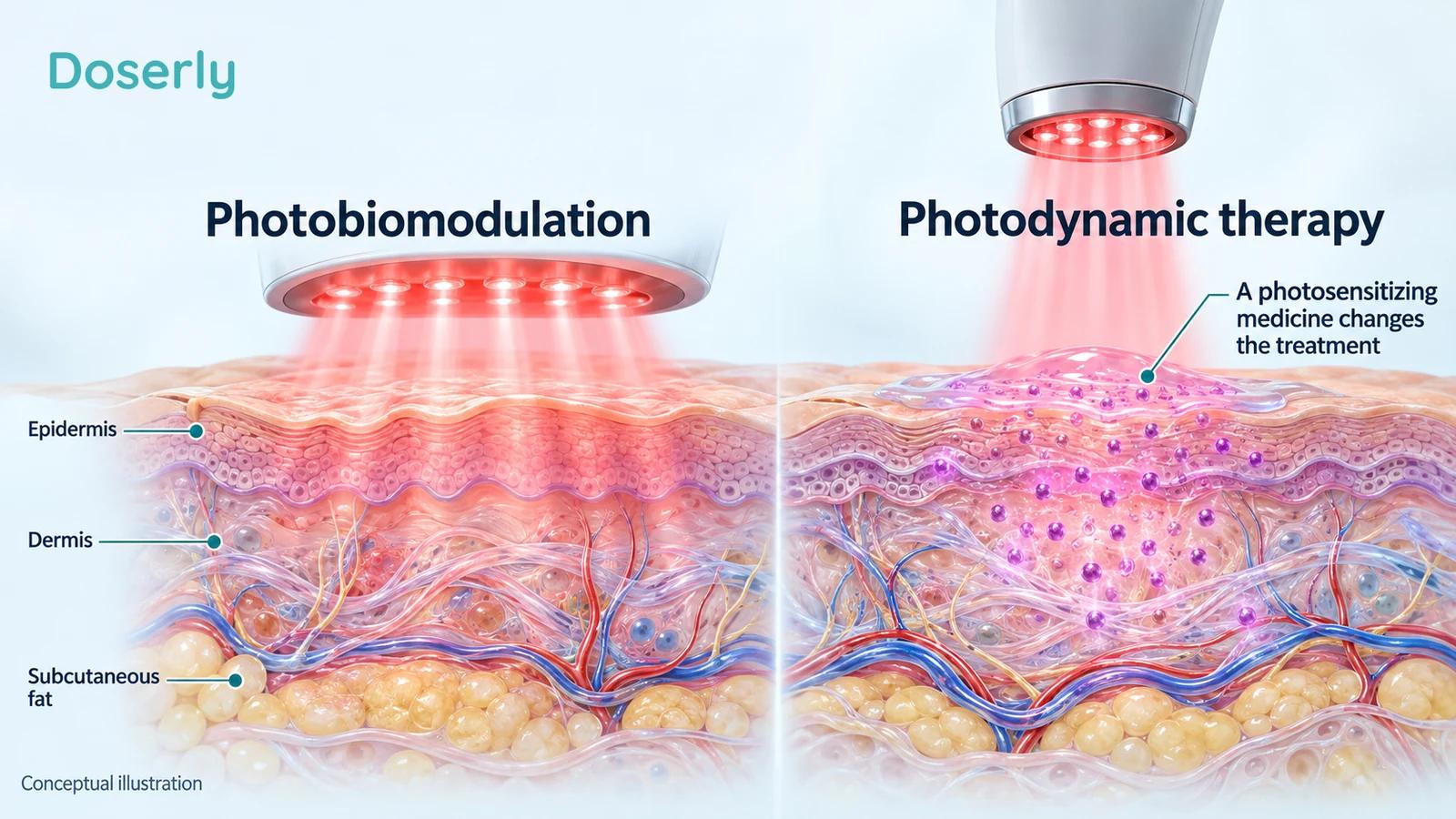
Photodynamic therapy, or PDT, deliberately combines a photosensitizing medicine with light. The medicine changes how the tissue responds to illumination. This is different from ordinary PBM, and the presence of a red light source in both settings does not make them equivalent.
The AAD describes PDT among clinician-directed options for selected acne cases, with a medication applied before light treatment. That is not an invitation to create a photosensitizing mixture at home. A substance that interacts strongly with light can change both effects and risks. “Light activated” is a description that requires explanation, not an automatic sign of a better cosmetic product. AAD explanation of light treatments for acne.
How to interpret other people’s routines
A friend’s experience can help identify practical questions: whether a mask fits comfortably, whether a routine is too time-consuming, or whether irritation appeared after a new step. It cannot establish the average added benefit of combining two treatments.
When looking at a testimonial, ask what else changed. Was the person already several weeks into a retinoid course? Did they change moisturizer, sunscreen, acne medication or cosmetic procedures? Were the photographs taken under the same lighting? Is the comparison with an unusually bad flare rather than the person’s typical baseline?
These are not accusations that the person is mistaken. Skin changes over time, and people reasonably remember the intervention that feels most distinctive. A glowing device can become the explanation for a result even when several quieter changes happened alongside it.
A useful personal record separates what you observed from what you infer. “My skin stung after these two products” is an observation worth taking seriously. “The light destroyed my collagen” is a much larger causal claim. “My fine lines look softer in consistent photographs” is useful; “the serum doubled mitochondrial function” would require a different kind of measurement.
Build a routine you can evaluate
A simple routine is easier to understand than one in which five things change at once. Before adding an optional device or product, record what you already use, why you use it and whether it causes problems. Include prescription medicines rather than listing only cosmetics.
Then identify the decision you actually need to make. It might be whether a device adds enough cosmetic value to justify its cost, whether a particular product is tolerable, or whether an existing prescription needs adjustment. Those are different decisions and may call for different professional input.
For a clinician-approved trial of a new step, keep the rest of the routine reasonably stable and use comparable photographs if appearance is the goal. Record discomfort and missed sessions as well as favorable changes. An approach that looks good on paper but repeatedly irritates your skin or is too burdensome to maintain may have little practical value.
Agree on a review point suited to the problem and the evidence for the actual treatment. Do not borrow a hair-growth timeline for acne or a short-term redness result for wrinkle remodeling. Equally, a lack of improvement is not a reason to keep increasing light exposure beyond the instructions.
The most useful combination is one with a clear purpose, credible evidence for the relevant outcome and tolerability that lets you maintain appropriate care. Red light can be considered within that discussion. It does not make every additional serum necessary, and a longer routine is not automatically a better one.