
Red Light Therapy
October 17, 2026
Red light therapy safety: eyes, skin, medications and special situations
On this page
A red light device does not have to feel powerful to affect tissue. That is part of its appeal, but it also makes safety harder to judge by instinct. A comfortable session, a reassuring product description and an absence of ultraviolet light each tell you something. None answers every question about your eyes, skin, medication or medical history.
The evidence is neither a reason to fear every red light device nor a guarantee that every exposure is harmless. Many studies report good short-term tolerability under specific conditions. Human safety studies also document pigmentation, persistent redness, burns and, with particular direct-eye treatments, retinal changes. The useful approach is to connect the risk to the actual device, tissue and person.
This guide explains how to do that using research and clinical guidance available through October 2026. The goal is a clearer conversation before using a device, and a sensible response if something changes during use. It is not a universal list of conditions that automatically permit or prohibit every form of light treatment.
First identify what the device actually does
Red light therapy is a broad consumer term. Photobiomodulation, or PBM, generally describes an attempt to influence tissue biology with light without relying on destructive heating. A skincare LED mask, a handheld clinical laser and an ophthalmic system can all appear in that conversation. Their delivery, intended uses and safety requirements can be very different.
A familiar color does not establish equivalence. A device may combine visible red with invisible near-infrared light, or add blue light for a different purpose. Its beam can be concentrated or spread over a large area. Some products sit against the skin; others are designed for a specified distance. Those details affect the exposure and the instructions that apply.
Begin with the model name and the actual manual. Find the intended use, body area, exposure directions, eye-protection requirements and warnings. If a seller supplies only a wavelength and a glowing list of benefits, you do not yet have enough information to assess the product. An instruction for another device is not an adequate substitute.
The FDA also distinguishes device registration from authorization. A business being listed with the agency does not mean that its product has been approved, cleared or authorized. The FDA explains this distinction directly. When a device does have an authorization, check what it covers. A skincare indication cannot be expanded into permission to treat an eye disorder simply because a wavelength overlaps.
What “well tolerated” means in a study
A safety statement belongs to a particular group of people, treatment and observation period. It may mean that no serious events occurred during a short trial, while mild irritation was still possible. It may also reflect exclusions: people most likely to react might not have been enrolled.
Consider the STARS studies, two early-phase randomized trials of relatively high-exposure red LEDs on healthy forearm skin. The trials included 60 and 55 participants and deliberately increased exposure to examine tolerability. Some participants developed blistering or prolonged redness at higher exposure levels, and temporary pigmentation also occurred. People with several relevant conditions, including light-sensitive disorders and use of photosensitizing medication, were excluded. The original safety report describes the findings and exclusions.
These were not trials showing that every home mask is dangerous. They were also not a license to copy the largest tolerated exposure. The findings depend on the device, body site, participant selection and monitoring. A study-defined tolerated level is not a personal target, particularly for a different product or tissue.
This is why a good answer to “is it safe?” usually needs another sentence: safe for whom, for what purpose, under which conditions, and for how long? That is useful detail rather than an attempt to avoid answering. It tells you whether the reassurance actually applies to your situation.
Warmth, redness and pigmentation are different observations
A device may feel warm without causing injury, but warmth is not evidence that the treatment is effective. Likewise, a temporary color change after a session is not proof of increased collagen, improved circulation or a useful cellular response. Sensation and appearance cannot identify the mechanism on their own.
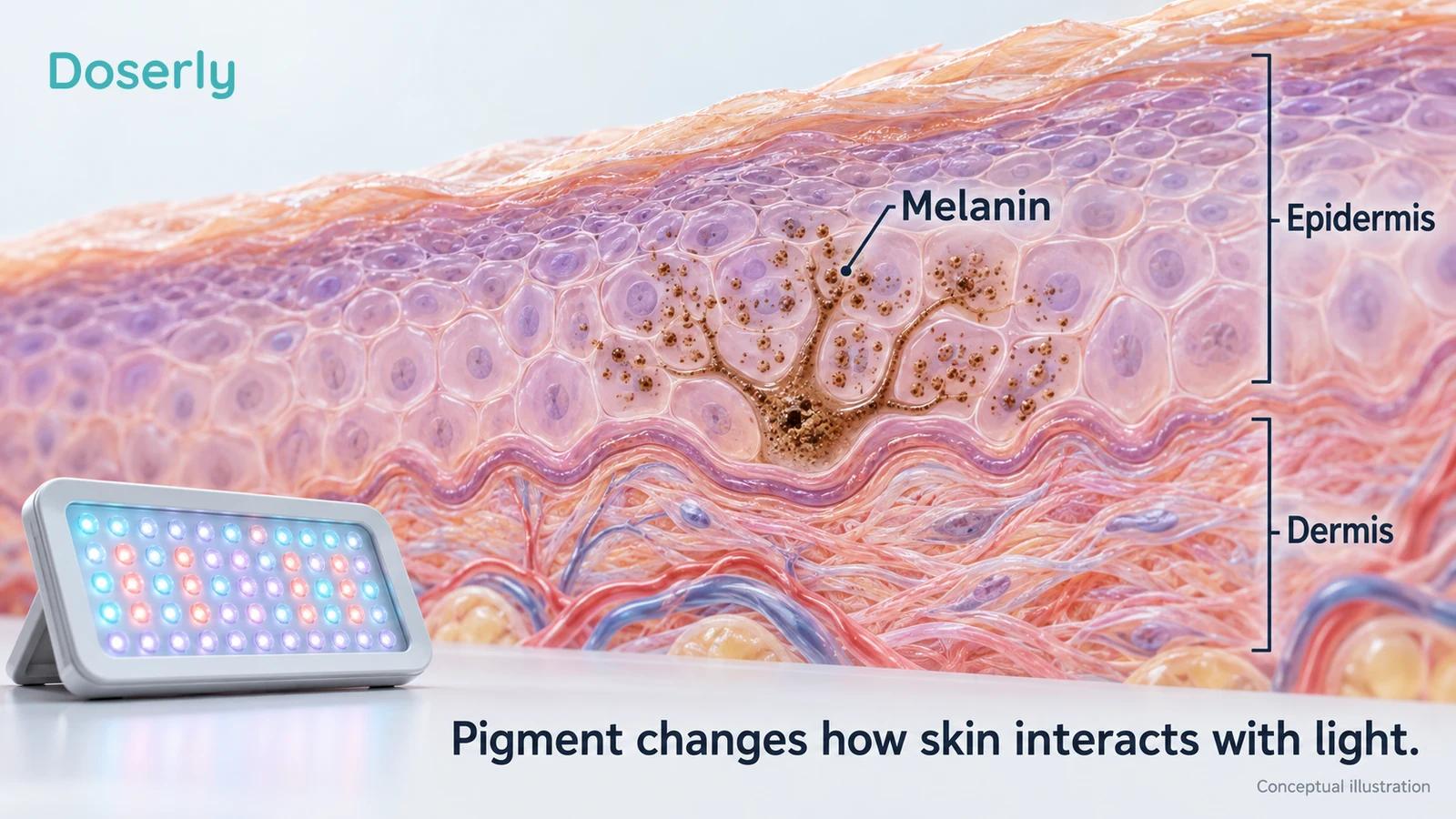
Skin pigmentation deserves particular attention because it may persist after other sensations settle. In a controlled human experiment, 415-nanometer blue-violet light produced pigmentation in skin types III and IV, whereas the tested 630-nanometer red exposure did not. Some pigmentation persisted for months. The original 2014 clinical study used experimental exposures rather than testing every commercial mask.
That result is compatible with the red-LED safety studies reporting pigmentation under different exposure conditions. It would be a mistake to combine the papers into the slogan that red never pigments skin or that every blue-light product causes dark marks. Wavelength matters, but so do exposure, skin characteristics and how the outcome is assessed.
For someone already managing melasma or persistent post-inflammatory marks, a small increase in pigmentation may be a meaningful adverse effect even if a trial labels it mild. Tell the clinician what you are trying to avoid as well as what you hope to improve. A safety assessment should reflect the outcome that matters to you.
A 2025 study adds a useful warning about generalizing
A retrospective dental-clinic study examined records of 173 people treated with simultaneous red and near-infrared laser exposure. Twenty-five people had recorded heating or thermal-injury reactions, including five people with burns. The events were more frequent in the group categorized as having darker skin. This was a particular dual-wavelength clinical laser arrangement, not a study of ordinary skincare masks. The original 2025 report provides the context.
Its limitations matter. The skin categories were based on self-report, the study was observational, and there were few burns. Some numerical reporting is inconsistent, so the exact risk ratios should not become a universal rule. The authors also lacked enough observations of individual medicines to establish drug-specific associations.
The useful lesson is more modest: a treatment described as low power can still produce unwanted heating in a particular delivery setup. Skin characteristics belong in the assessment, and the label alone does not supply the risk estimate. The study cannot tell a person their probability of a burn from a different device.
It also shows why a symptom described as photosensitivity does not always mean the same process. Here, the recorded categories included heat sensation and burns. Elsewhere, photosensitivity may refer to a light-triggered chemical or immune reaction. A clinician needs the actual history rather than just the word.
Medicines require a specific review, not an internet blacklist
A long list of supposedly incompatible medicines can look helpful while concealing important differences. A drug associated with a reaction to sunlight has not necessarily been tested with the red and near-infrared output of your device. The opposite shortcut is also unreliable: absence of ultraviolet light does not prove that a medicine-light combination is safe.
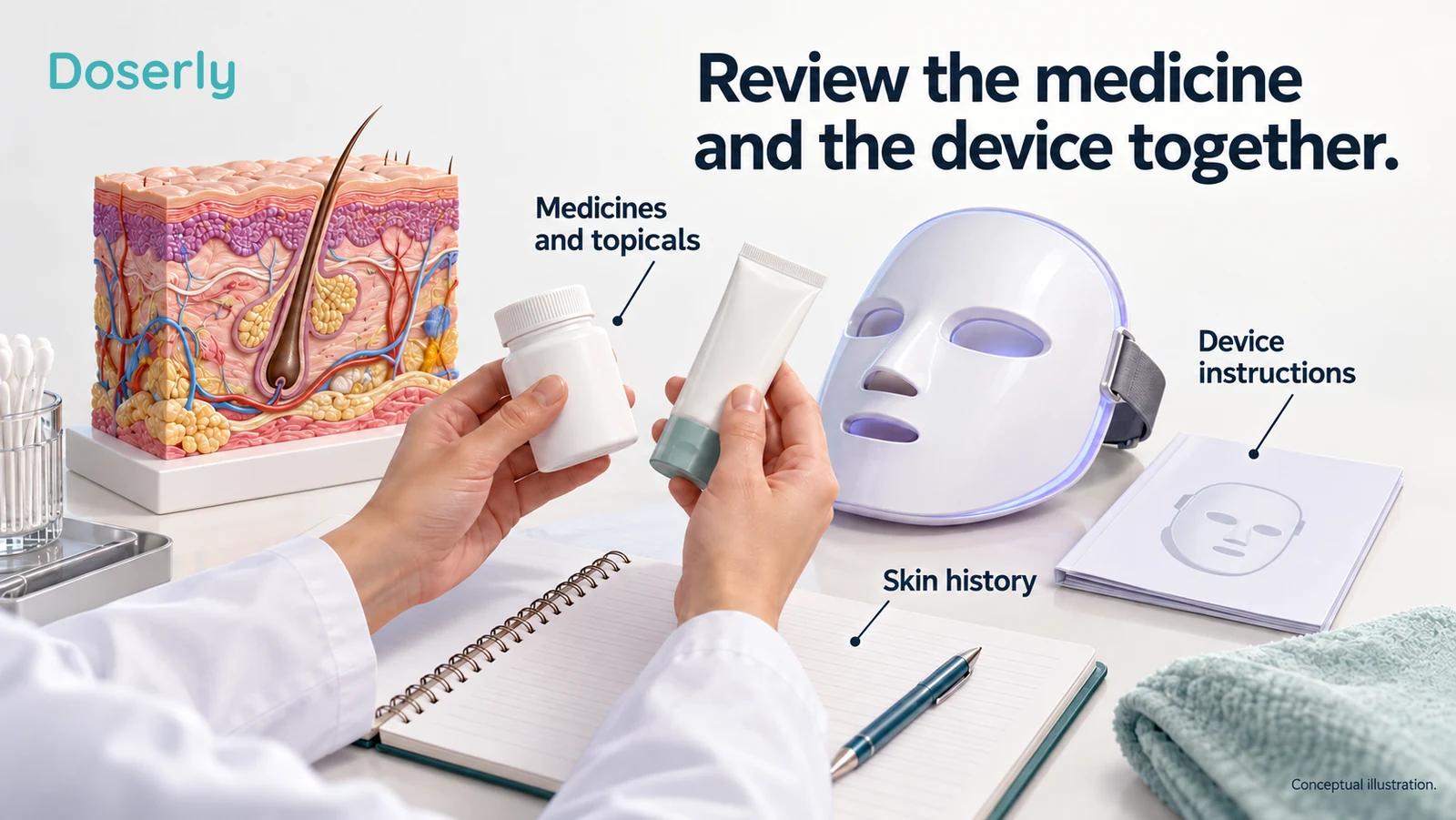
The practical information to bring is straightforward: the exact medicine, dose and formulation; when it was started or changed; any previous light reaction; and the device's manual. Include creams, recent procedures, nonprescription products and supplements. A pharmacist or treating clinician can then assess a specific combination instead of guessing from a category such as antibiotics or skincare.
Do not stop a prescribed medicine to make room for a cosmetic light routine. If an interaction is uncertain, the optional exposure can wait while the question is resolved. Likewise, a previous uneventful session is not a substitute for reviewing a newly introduced product or a changed treatment.
The FDA's review of the professional Valeda eye device illustrates how specific precautions can be. It identifies relevant sensitivity to the device's wavelengths, light-activated neurological disorders and photosensitizing agents affected by its output. Those precautions belong to that particular device. They should not be copied into a universal waiting period or clearance rule for every home panel.
Photodynamic therapy explains why a cream can change the question
Photodynamic therapy, or PDT, uses a photosensitizing agent together with light. The agent changes the tissue's response. It is a distinct medical procedure, even when the illumination looks similar to an ordinary red-light treatment.
In a small controlled experiment involving 16 healthy volunteers, researchers applied methyl aminolaevulinate or placebo to skin before red-light exposure. The active product led to phototoxic reactions including pain, redness, swelling and temporary pigmentation. Sensitivity changed over time as the relevant porphyrins declined. The original study demonstrates a genuine interaction between a topical agent and red light.
It does not mean that every moisturizer is a photosensitizer. It means that product identity matters. Do not assume that a serum, procedure aftercare product or medicine improves PBM simply because someone describes it as light-activated. A desirable effect and an unwanted reaction may both depend on a combination that needs its own evidence.
If you have recently had a skin procedure, use the treating clinician's aftercare instructions. Combining treatments at home to accelerate recovery can change the exposure in ways the original procedure or device study did not test. Bring the actual product names rather than relying on broad terms such as natural, soothing or medical grade.
Eye safety is a separate question from skin safety
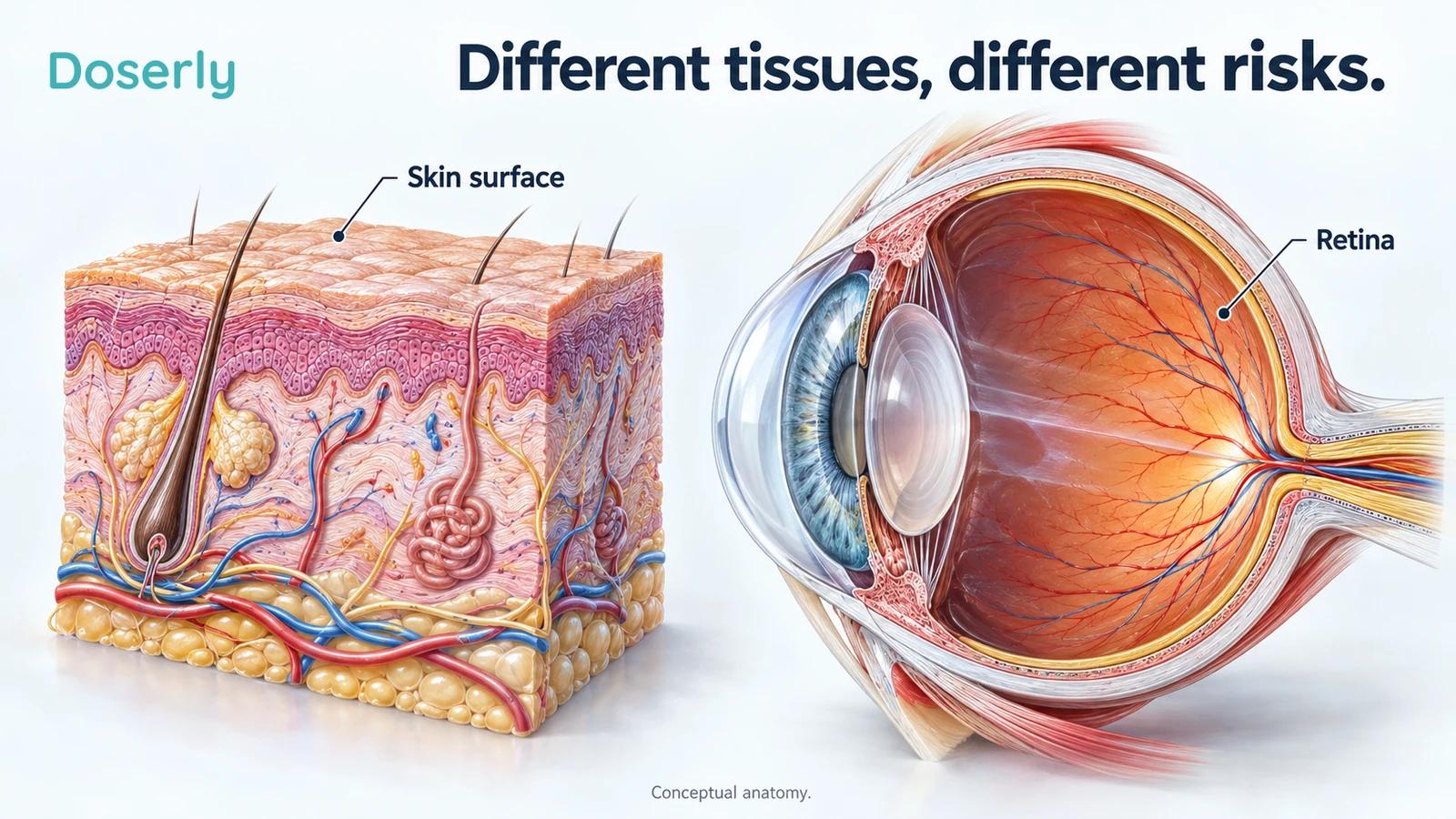
The retina is the light-sensitive tissue at the back of the eye. A skin study does not establish what happens when a device is viewed directly, and a device that feels comfortable on the face does not provide a reliable test of retinal exposure. Follow the eye-protection requirements for the actual product. Closing the eyes is not a substitute for protection that the instructions specify. The American Academy of Dermatology includes eye protection in its home-use advice.
Direct-eye treatment research provides a reason to take that distinction seriously. A 2023 case report described bilateral vision loss and retinal damage in a 12-year-old after several months of repeated red-light laser treatment for myopia. The original report cannot establish how often this happens, or the risk from an unrelated facial LED device. It does document a clinical concern that a blanket harmless-light claim would miss.
A 2025 randomized myopia study adds a different observation. Among 43 children allocated to red-light treatment, three developed transient changes detected by optical coherence tomography, an imaging method used to examine retinal layers. They had no visual symptoms or decline in measured acuity, and the changes resolved after treatment stopped. The original report shows why monitoring can find changes that a person does not feel.
These findings should not be collapsed into a claim that every red light damages eyes. They support device-specific assessment and professional monitoring where the eyes are the treatment target. They also argue against trying to recreate an ophthalmic protocol with a general-purpose panel.
The latest optical measurements do not replace clinical outcomes
In 2026, researchers tested the optical output of four devices marketed for myopia treatment. Their calculations found substantial differences among the devices, including much shorter times to specified safety limits for some laser systems than for the diffuse LED system. The original laboratory evaluation was a device study, not a trial in which those exposure times were shown to injure children.
That distinction works in both directions. Crossing a calculated classification limit is not the same as observing a retinal injury. A lack of immediately reported injuries also does not invalidate a concern raised by measured output. Optical testing and clinical monitoring answer complementary questions.
For a parent, the practical conclusion is to ask the eye-care professional about the exact system, independent safety assessment and monitoring plan. Product classification and a study of another device are not enough to establish that a proposed treatment is appropriate for a particular child. General adult skincare experience cannot fill that gap.
The same reasoning applies to adults seeking better vision. A device studied for a diagnosed retinal condition does not establish a benefit for healthy eyes. The desired outcome, diagnosis and authorized use all need to match before the discussion moves to treatment.
Pregnancy and breastfeeding should not be treated as one evidence category
Pregnancy creates questions that ordinary adult skin studies may not answer. A trial excluding pregnant participants cannot establish pregnancy safety, but exclusion alone is not proof of fetal harm. Those are different statements, and a responsible explanation should preserve the difference.
Postpartum research cannot automatically settle the pregnancy question either. A trial published online in February 2026 randomized 60 women with nipple pain after childbirth to a specific local light treatment or sham. It reported less pain at several follow-ups and no identified adverse effects. The original trial concerned early postpartum treatment under study conditions, not whole-body exposure during pregnancy.
This is useful evidence for a narrow clinical question. It does not establish every exposure as safe while breastfeeding, and it does not justify applying a home device to an infant. A short trial in a selected group cannot answer rare-event or long-term developmental questions that it was not designed to study.
If you are pregnant or breastfeeding, discuss the actual reason for treatment and the actual device with the clinician responsible for your care. For an optional cosmetic routine, postponement while uncertainty is clarified may be a reasonable choice. For a clinical problem, ask what options have evidence in the relevant population rather than assuming all light-based care is interchangeable.
Cancer history requires context, not a blanket slogan
PBM is used in some oncology supportive-care settings, including management of treatment-related mouth problems. That does not make it a cancer treatment, and it does not mean that any exposure over a suspected or known tumor is appropriate.
A follow-up of a randomized head-and-neck cancer trial evaluated 94 people receiving chemoradiation with or without a specific laser intervention intended to prevent oral mucositis. It did not show worse cancer outcomes in the treated group; some outcomes favored treatment. The original survival report called for larger confirmatory studies. It cannot establish safety across every tumor type, device, body site and exposure.
The relevant distinction is between a coordinated supportive-care intervention and a separate home protocol applied without the oncology team's knowledge. A clinician can evaluate the treatment field, purpose, timing and evidence in the context of the cancer plan. A laboratory mechanism or an encouraging result in one setting cannot replace that assessment.
A changing skin lesion also deserves diagnosis before it becomes the target of a cosmetic routine. Improvement in nearby redness or discomfort would not establish what the lesion is. Let the diagnosis guide the next step rather than using a response to light as a home diagnostic test.
Reduced sensation makes comfort a poor safety signal
If neuropathy reduces sensation, excessive warmth or an early skin injury may not be felt normally. NIDDK advises people with diabetic nerve damage to protect their feet from heat and avoid heating pads and hot-water bottles. Its foot-care guidance explains the underlying concern.
A PBM device is not automatically a heating pad, but the principle remains relevant: lack of pain cannot be used to certify the exposure as safe. Do not move a device closer or extend a session because a numb area feels nothing. The device instructions and clinical assessment matter more than trying to create a sensation.
Tell the clinician about reduced sensation, circulation problems, wounds and previous skin injury. If an area is already damaged, the question is not simply whether red light might support healing. It is what the damage requires and whether the proposed intervention has an appropriate role in that care.
Continue protective skin checks even if burning pain improves. A change in symptoms does not demonstrate that protective sensation has returned. Relief and safety can improve differently, so each needs its own assessment.
What to do with a new reaction
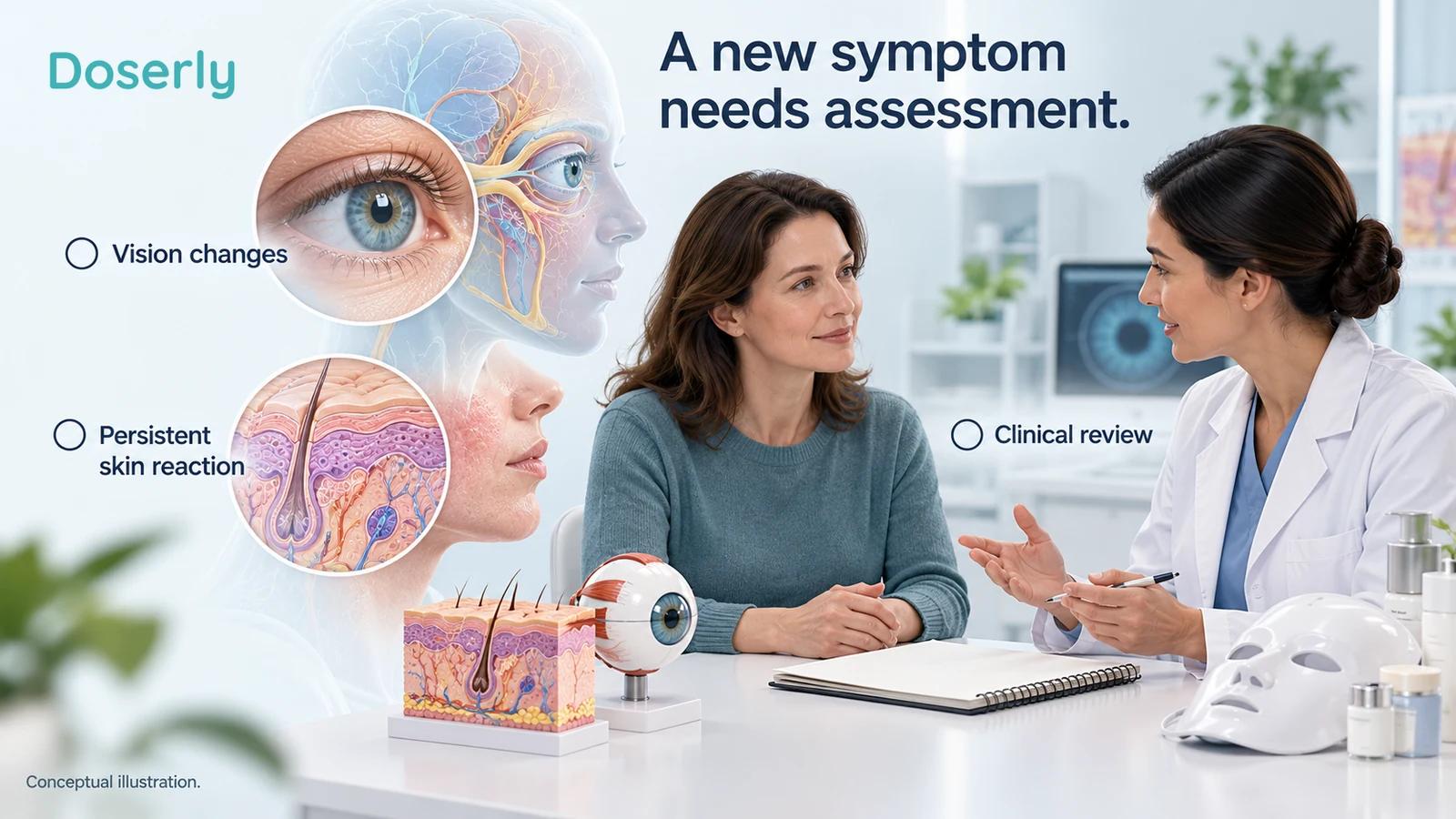
A new symptom is information to investigate, not a sign that a device must be working. Do not continue an exposure through burning, worsening pain or a developing skin reaction in the hope of building tolerance. Set the device aside and record what happened, including when the symptom began and whether it persisted.
For a skin reaction, photographs taken under ordinary consistent lighting may help a clinician understand the change. Keep the device details and a list of products used before the session. Note any recent medication changes or procedures. This is more useful than labeling the reaction a detox, purge or healing response without an assessment.
New vision changes, persistent visual disturbance or eye pain warrant prompt professional assessment. Sudden vision loss needs urgent care. Do not test the symptom by repeating the exposure or switching to a more powerful setting. The question is what caused the change and what care it needs.
For less urgent concerns, the review should still be specific. Was there irritation from a product or device contact? Was pigment changing over repeated sessions? Did discomfort persist after the device was removed? The answers may lead to different decisions, and an online reassurance cannot distinguish them reliably.
A practical way to make the decision
Before starting, be able to explain three things in plain language: what you want to improve, why this device is relevant, and what would make you stop and seek advice. If the proposed benefit is vague, even a low-risk routine can become an expensive commitment without a useful endpoint.
Use the instructions for the model you have, including its eye protection, spacing, cleaning and exposure directions. Ask about your own conditions and products before experimenting with combinations. Keep necessary medical care in place while judging whether the optional device adds enough benefit to justify its burden.
Red light therapy safety is most understandable when the broad label is replaced with the details. A particular treatment may be well tolerated in a relevant study while another setup carries different risks. Knowing those limits helps you take promising research seriously without treating comfort, popularity or the absence of ultraviolet light as a guarantee.