
Red Light Therapy
October 17, 2026
Red light therapy for rosacea and sensitive skin: promise and practical limits
On this page
When your face burns after washing, flushes in a warm room or reacts to products everyone else seems to tolerate, a gentle light treatment sounds appealing. The attraction is understandable: something that might calm the skin without another cream, peel or prescription to negotiate.
There is human research worth discussing, including new studies published in 2025 and 2026. But the evidence for red LED treatment of rosacea remains limited. Small case reports, a retrospective comparison and trials involving other treatments do not yet establish a dependable home-mask benefit. A recent randomized sensitive-skin study is encouraging, although sensitive skin and rosacea are different study populations.
The most useful starting point is the problem you want to improve. Persistent facial color, episodic flushing, visible vessels, inflammatory bumps and stinging are related experiences, but they are not interchangeable outcomes. A treatment can help one while leaving another largely unchanged.
First, separate sensitive skin from rosacea
Sensitive skin describes symptoms such as burning, stinging or discomfort in response to exposures that ordinarily would not cause much trouble. It does not, by itself, tell you why those symptoms are happening. Rosacea is a clinical diagnosis with a particular pattern of facial findings and symptoms.
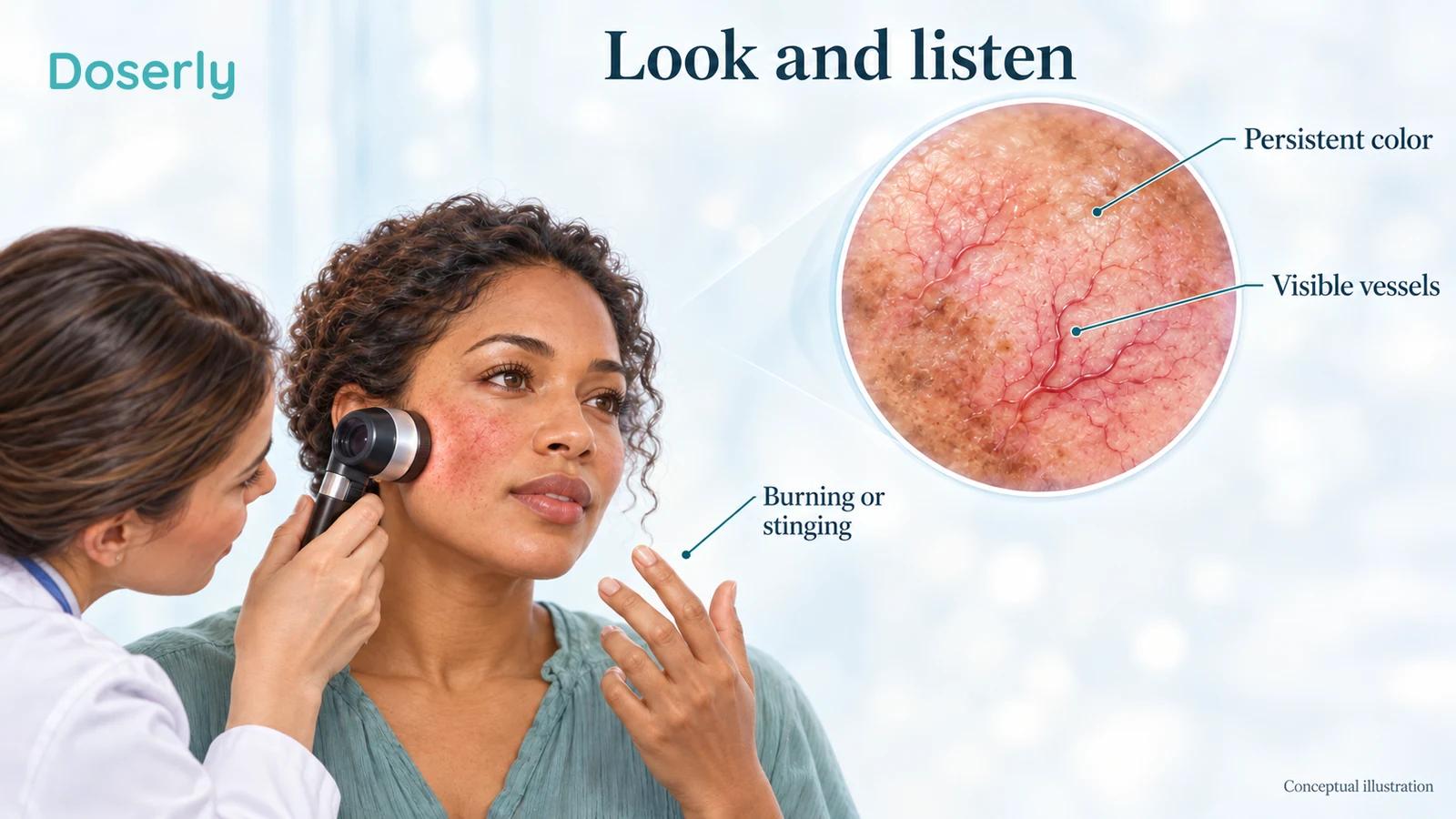
The American Academy of Dermatology describes rosacea as involving combinations of prolonged facial color, flushing, visible vessels, acne-like bumps and discomfort. Eye symptoms can occur too. Someone may have several features, while another person has mostly one. In darker skin, the color change may be less obviously pink or red, making the history of warmth and sensitivity especially useful.
That variety matters when reading a device claim. An advertisement showing fewer bumps does not necessarily demonstrate less heat-triggered flushing. A study measuring redness does not establish that participants could comfortably use moisturizer again. “Calmer skin” is a reasonable personal goal, but a clinical paper needs a more specific definition.
A new facial reaction also deserves a different conversation from longstanding diagnosed rosacea. Tell the clinician about a recently introduced cleanser, fragrance, exfoliant, medication or device that touches the affected area. Contact dermatitis, irritation and other facial conditions can overlap with a rosacea history. The AAD's diagnostic guidance emphasizes examination and history, with testing when needed to distinguish another condition.
This is especially relevant if you are considering LED treatment because everything else seems to sting. Before adding another exposure, it helps to identify whether a removable trigger is keeping the problem active.
Why researchers are interested in light
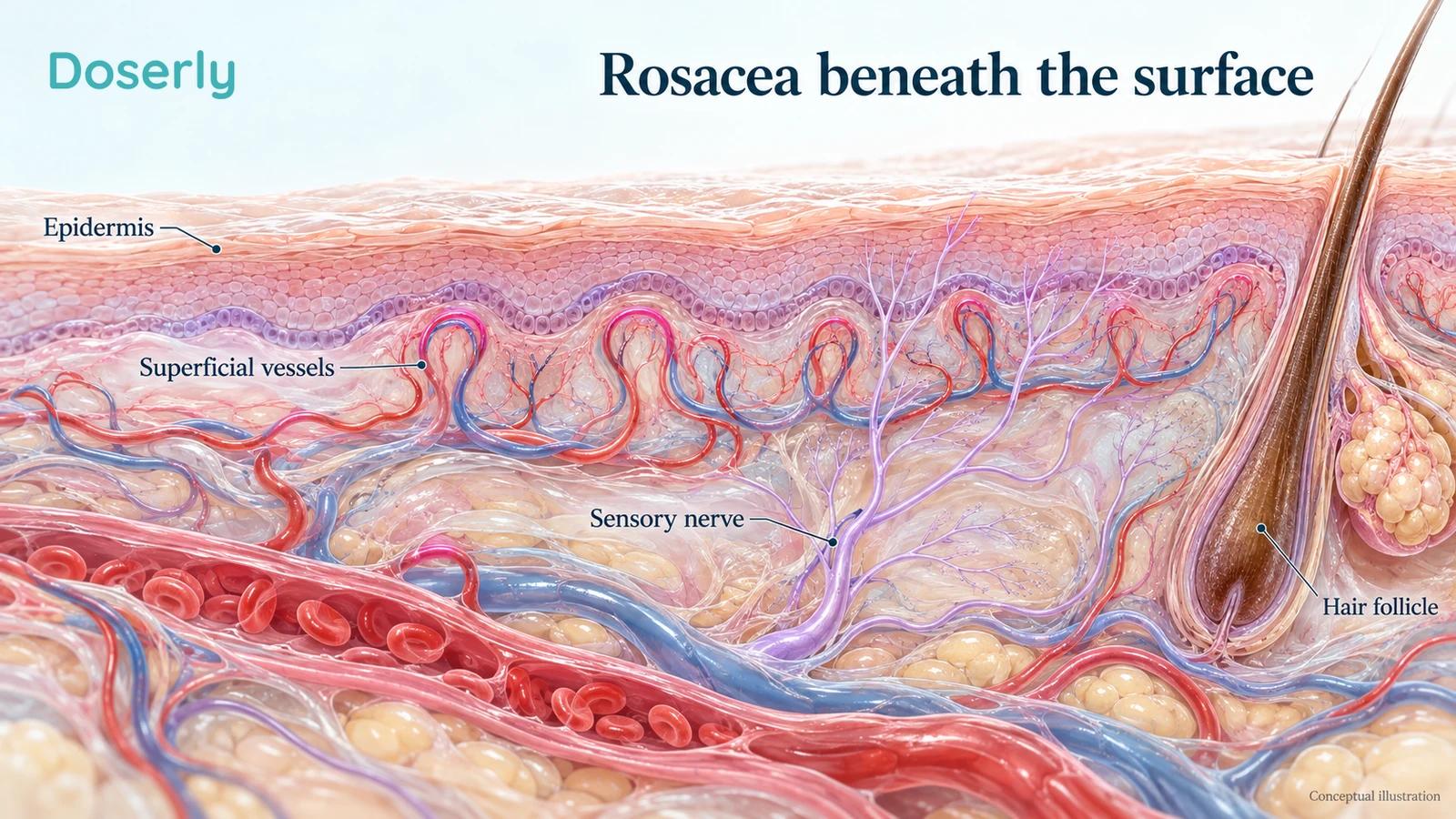
Rosacea involves more than blood vessels becoming visible. Sensory signaling, inflammatory responses and the skin's surface environment are part of the research picture. That creates several possible targets for treatment, but also several opportunities to overinterpret a plausible mechanism.
A human skin study of TRPV channels found differences in the expression and distribution of these stimulus-responsive channels across rosacea presentations. These channels can participate in responses to heat and other triggers. The work examined tissue and molecular markers, rather than testing an LED treatment. It supports investigating sensory biology; it does not show that red light resets it.
Photobiomodulation, often shortened to PBM, aims to influence biological activity using light without intentionally destroying tissue through heat. Researchers studying rosacea may therefore look for changes in inflammation, barrier measurements or discomfort. Those are sensible hypotheses. Demonstrating them in cultured cells, however, would still leave the practical question open: do people have fewer troublesome symptoms than they would with a credible comparison treatment?
You do not need to master every proposed signaling pathway to assess a device. Ask whether the claimed benefit was measured in people with your condition. A beautiful explanation of cellular energy cannot fill in a missing rosacea trial.
What the early LED case reports actually showed
A 2020 report described two people with papulopustular rosacea treated with sequential blue and red LEDs. Their facial findings and reported burning or itching improved over ten treatment sessions. The older participant also used topical azelaic acid, which matters when assigning credit.
This was an observation of two patients, without a sham device or untreated comparison. It also tested a combination of colors, rather than red light alone. The photographs and symptom changes offer a reason to investigate, but cannot tell us how often a similar person would improve without the treatment or how durable the benefit would be.
A 2023 Japanese report added five cases, again using blue and red LEDs together. Four patients had papulopustular rosacea and one had a predominantly vascular presentation. Improvement was reported over eight to twelve weeks. With five uncontrolled cases, the findings remain preliminary. The paper's broad statements about safety, including pregnancy and breastfeeding, go beyond what that small series can establish.
These reports should neither be dismissed as meaningless nor treated as a success rate. They tell us that improvement occurred in selected patients receiving a particular intervention. They do not provide a reliable estimate of what a new buyer should expect from a different mask.
The newer rosacea studies need careful translation
Research has moved beyond individual cases, but the treatment combinations remain important.
A 2025 retrospective study of 90 patients compared medication and topical treatment alone with the same background care plus either IPL or LEDs. The LED group used 590 nm yellow and 830 nm near-infrared light according to the methods, despite broader red-yellow terminology elsewhere in the paper. Its reported response rate was 66.7%, versus 40% with the background regimen alone.
That is an interesting association, not a randomized estimate of LED benefit. The background regimen included hydroxychloroquine and a topical growth-factor product, so this was not a home red-mask trial or a routine-care recipe to copy. Treatment selection, other differences between groups and subjective response categories complicate interpretation. The abstract also contains an internally inconsistent statistical statement about the IPL versus LED comparison. It should not be used to claim the two approaches are equivalent.
In a 2026 randomized trial of 60 people, everyone received doxycycline. One group also received 633 nm red light; the other received a Shumin device using a different physical treatment approach. The Shumin group had better results on several outcomes. Both groups improved during the twelve-week course.
Crucially, there was no doxycycline-only or doxycycline-plus-sham-light group. Improvement in the red-light group therefore cannot establish what the light added. Participants and operators could not be blinded, although outcome assessors were blinded. The trial included Fitzpatrick skin types III and IV, making it useful evidence beyond fair skin, but still not a general answer for every complexion or rosacea presentation.
Together, these studies show why “there are clinical trials” is only the beginning of the conversation. The question is what each trial can separate. A medication-plus-device result may be clinically interesting while leaving the device's independent contribution uncertain.
A 2026 sensitive-skin trial offers a more direct signal
The randomized study by He and colleagues enrolled 30 volunteers with sensitive skin. It compared emollient alone with 590 nm yellow LED treatment or combined 590/630 nm yellow-red treatment, assessing participants through eight weeks.
Both light groups improved on a sensitive-skin symptom questionnaire compared with control. Yellow light also showed advantages on several measurements, including erythema, water loss and a lactic-acid sting test. The combined-color group improved sting-test scores, but the abstract did not report the same breadth of instrumental advantages. No adverse events were reported.
This is a useful positive study, with important boundaries. Thirty participants divided among three groups leave little room to characterize uncommon reactions or diverse subgroups. The comparison was emollient alone, not a visually convincing sham device. The two light regimens also differed in more than their color combination, so the result cannot establish that adding red light is better. Most importantly, the participants had sensitive skin; it was not a rosacea-specific efficacy trial.
For someone whose main concern is stinging rather than visible vessels, this research is relevant to the discussion. It is still too small to turn into a universal treatment schedule or a claim that an arbitrary red-only mask will produce the same effect.
Why vascular lasers and IPL are a separate evidence base
The word “light” can hide a major difference in treatment. A vascular laser uses selected wavelengths and brief pulses to target blood-containing vessels through controlled heating. IPL uses filtered pulses spanning a range of wavelengths. These clinical treatments are different from low intensity LED photobiomodulation.
In a 2009 randomized split-face study enrolling 29 patients, pulsed-dye laser and IPL reduced facial erythema, visible vessels and associated symptoms. The study included an untreated comparison and did not find a significant difference between the two active approaches. It supports their use for the vascular presentation studied, while leaving room for individual differences and the limitations of a small trial.
A 2026 randomized split-face trial in 24 patients asked a different question: whether adding topical ivermectin to KTP vascular laser improved results. At sixteen weeks, the combination side had a larger change in the primary normalized erythema measure. Several other redness and clinical scores did not show significant between-side differences. Papule reduction across visits favored the combination.
This newer study illustrates two useful points. Different measurements can disagree, even in the same face. And a trial of medication added to a vascular laser does not test red LED treatment, whatever similarities a marketing summary might imply.
For persistent vessels, a consultation can establish which clinical options fit your skin and goals. Device choice, operator experience, skin pigmentation and the particular vascular target all matter. A home mask is not simply a gentler version of the same procedure with proportionally smaller effects. It may act differently and has to earn its own evidence.

Effective treatment can be specific to the symptom
The choice is not limited to a device or doing nothing. The AAD describes a treatment plan built around the features present: topical or oral treatments for inflammatory lesions, selected medications for persistent facial color, and procedures when appropriate. Gentle skin care and sun protection remain part of that plan.
For perspective, a randomized trial of 962 people with moderate to severe inflammatory rosacea compared topical ivermectin with topical metronidazole over sixteen weeks. Inflammatory lesion counts fell by 83.0% and 73.7%, respectively, with a statistically significant difference favoring ivermectin. These are changes within the treatment groups, not the proportion cured, and the study did not compare either cream with a red-light device.
Its relevance here is the scale and specificity of the evidence. A treatment for bumps can be evaluated using lesion counts in hundreds of patients. That still does not mean it solves all flushing, and it does not mean one particular medication is right for everyone. It gives a clinician a firmer starting point for that symptom than a handful of LED case reports.
It is also reasonable to care about tolerability as much as average efficacy. A treatment you cannot comfortably use may be a poor fit despite positive trial results. That is a reason to adjust the plan with your clinician, rather than assume the only remaining option is an untested device routine.
Heat deserves attention even when the light is called nonthermal
“Nonthermal” describes the intended biological approach; it is not a guarantee that every device will feel cool against your face. A mask, its electronics, close contact or the surrounding room can affect comfort. The relevant practical question is whether the actual exposure triggers your symptoms.
The AAD's guidance on identifying triggers includes tracking heat, cold, products, foods and other exposures alongside symptoms. You do not need to assume everyone shares the same triggers or eliminate a long list of ordinary activities. A short record of your own reactions is more useful than adopting someone else's restrictions.
If a session causes escalating warmth, burning or a prolonged flare, that is not evidence of productive inflammation or a necessary adjustment period. Stop the exposure and discuss the reaction. Increasing session time to chase a response makes the situation harder to interpret, especially when the original problem is sensitivity.
Likewise, feeling nothing does not prove the dose was ineffective. Comfort is a safety and tolerability observation, not an optical measurement. There is no justified universal “strong enough to feel it” rule for rosacea.
Ask about the precise device, its intended indication, eye protection and compatibility with your current treatments. A clearance or study for wrinkles or acne does not automatically answer the rosacea question. If a provider recommends a device, they should be able to explain which symptom they expect it to improve and why.
Keep the skin-care routine understandable
When skin is reactive, the temptation is to add several calming products at once. That can obscure the original trigger and make any apparent device effect impossible to interpret.
The AAD's skin-care recommendations emphasize gentle cleansing, moisturizing, sun protection and avoiding unnecessary rubbing or irritating products. Fragrance-free products are often a useful starting point. An expensive botanical formula is not automatically gentler, and a product's soothing label does not override a reproducible reaction.
Before introducing an optional device, write down the routine you already tolerate. Include prescription products, cosmetics and the timing of recent changes. This gives your clinician something concrete to review. It also prevents a common attribution problem: starting LED sessions, changing moisturizer and stopping an irritating exfoliant in the same week, then assigning the entire improvement to light.
Keeping the routine understandable is not a demand to endure an ineffective treatment unchanged. Necessary clinical changes take priority over a tidy personal experiment. It simply means recording those changes honestly, so a useful improvement is not turned into a misleading explanation.
Eye symptoms need their own assessment
Facial rosacea and ocular rosacea can overlap, but an LED mask is not a treatment plan for a painful or persistently irritated eye. Dryness, gritty sensation, recurrent eyelid inflammation or light sensitivity deserve attention. Eye pain or a change in vision should prompt urgent assessment rather than a device experiment. The AAD specifically highlights eye involvement among rosacea's possible manifestations.
A randomized ocular-rosacea study published online in late 2025 examined adding clinical IPL to meibomian-gland expression and topical medication. It involved 48 participants and reported advantages on tear-film stability and several eyelid or ocular-surface measures. The symptom questionnaire did not show a significant between-group difference. This was a supervised eye-care intervention with a sham IPL comparison, not direct illumination of the eyes by a consumer red-light panel.
The distinction is practical: an eye-care team evaluates the ocular surface, glands and treatment protections. Closing your eyes beneath an unrelated device does not recreate that clinical setting or establish appropriate protection. A reassuring facial skin study cannot substitute for ocular safety data.
Judge progress by the problem you started with
Researchers have developed tools specifically because sensitive skin is difficult to capture in a photograph. The original Sensitive Scale-10 validation study evaluated questionnaires in 2,966 participants across eleven countries. The shorter version retained good internal consistency and was easier to complete. This supports taking the patient's experience seriously as a measurable outcome, rather than treating it as less real than visible redness.
It does not make every change in a questionnaire a treatment effect. Participants who know they are receiving the active device can have different expectations from people assigned moisturizer alone. A well-designed study therefore benefits from both a patient-reported measure and a comparison that makes those expectations reasonably similar. Instrument readings add another perspective, but cannot replace the experience the treatment is meant to improve.
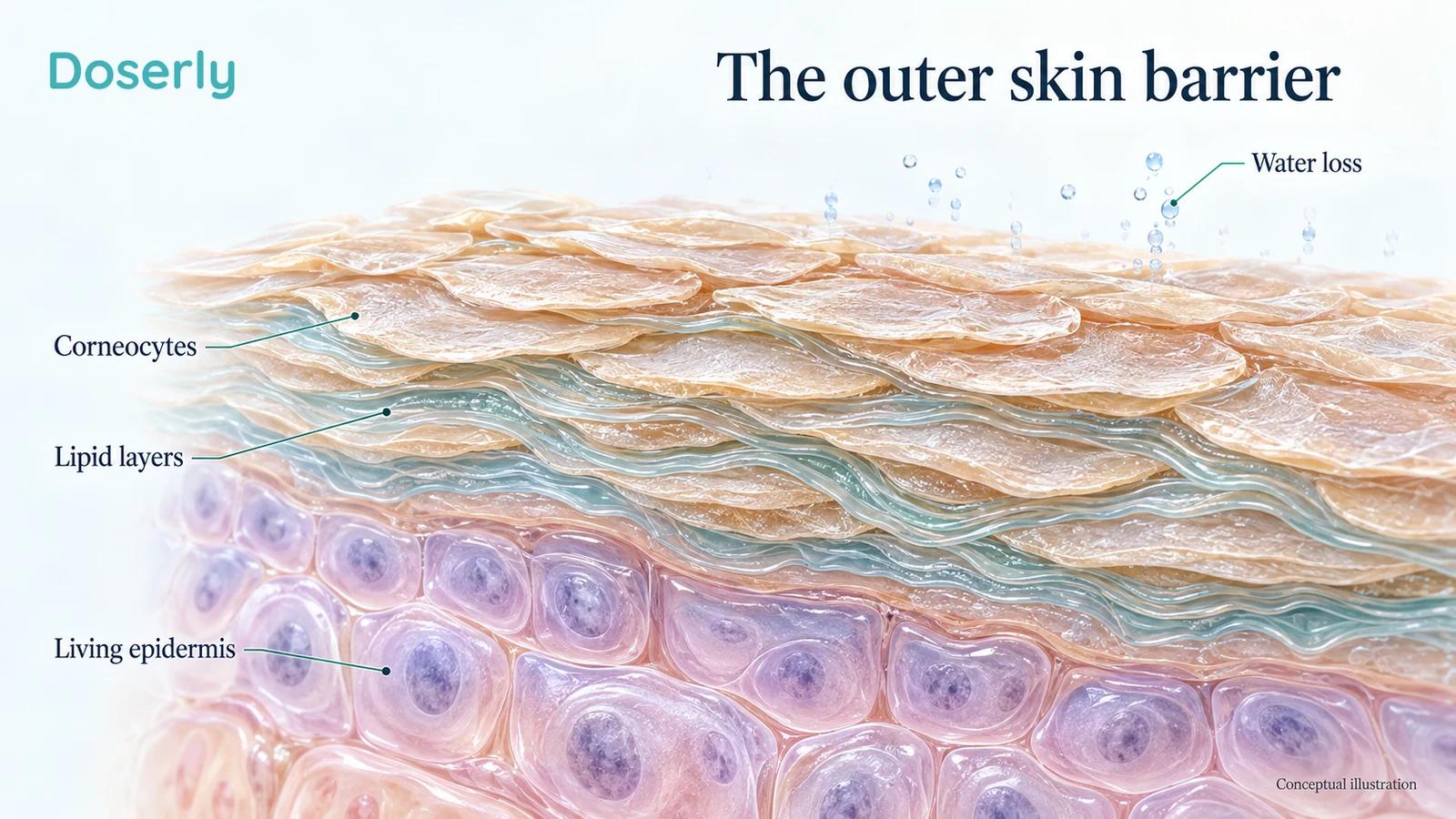
For example, water-loss testing concerns the skin barrier, an erythema index concerns a component of skin color, and a sting test concerns a response to a particular challenge. None is a complete substitute for the question, “Can I get through an ordinary day with less discomfort?” A device study is most helpful when several relevant outcomes tell a consistent story, with differences large enough to matter to participants.
The same principle applies to a consultation. If your priority is avoiding a painful flush during work, say that explicitly. If it is reducing visible vessels, say that instead. These goals can lead to different options and different definitions of success. They also make it easier to recognize a partial benefit without overstating it or dismissing it entirely.
For rosacea, a photograph can miss an important improvement or suggest one that is not real. Skin may look less red under different lighting while burning just as much. Conversely, discomfort may improve without a dramatic visible change.
Choose a few observations that match your goal: how often a troublesome flush occurs, how long it lasts, whether burning interferes with washing or sleep, and whether inflammatory bumps are changing. If you take photographs, use comparable lighting and avoid comparing a post-exercise image with one taken after resting in a cool room. These are practical tracking suggestions, not a validated home diagnostic test.
Durability also deserves a place in the discussion. In a follow-up of successfully treated participants from the ivermectin-versus-metronidazole trial, median time to first relapse after stopping was 115 versus 85 days. Relapse remained common in both groups. This was medication research, not an LED maintenance study, but it shows why initial clearance and lasting control are different questions.
For LED treatment specifically, the studies discussed here do not establish a reliable long-term maintenance schedule after stopping. A seller's recommendation to continue indefinitely may be a usage instruction, but it should not be confused with demonstrated prevention of rosacea relapse.
The most constructive conversation is therefore specific: Which feature are we treating? What evidence supports this device for that feature? What would count as enough improvement to continue? What reaction would lead us to stop or reconsider?
Red light remains an interesting possible adjunct for selected people with reactive skin, with early research that merits better trials. It is not yet a dependable substitute for diagnosing the cause of sensitivity or choosing established rosacea care. The goal is a face that feels and functions better in daily life, with a plan clear enough to tell whether each addition is helping.