
Red Light Therapy
October 17, 2026
Red light therapy for plantar fasciitis: can it help persistent heel pain?
On this page
The hardest part of plantar fasciitis can be how ordinary the triggers are. You get out of bed, stand up after lunch or walk across the kitchen, and your heel immediately reminds you it is there. Later, the foot may loosen up enough to make you wonder whether the problem is finally settling, only for a long afternoon on your feet to bring it back.
When that pattern persists, red light therapy can sound appealing: a treatment applied from outside the body, without an injection and without having to stop everything. There is a reasonable clinical question behind the interest. Several human trials have found less heel pain after particular low-level laser treatments. Others, including a small LED trial, have not found an advantage over sham treatment.
The balanced answer is that low-level laser may help short-term pain as part of rehabilitation, and a clinical guideline supports that use. It has not been shown to reliably rebuild the plantar fascia, remove heel spurs or make every home light device effective. Newer high-intensity laser studies also include important null findings. As of October 2026, the useful decision is whether a specific treatment adds enough to a practical heel-pain plan to be worthwhile for you.
What hurts in plantar fasciitis?
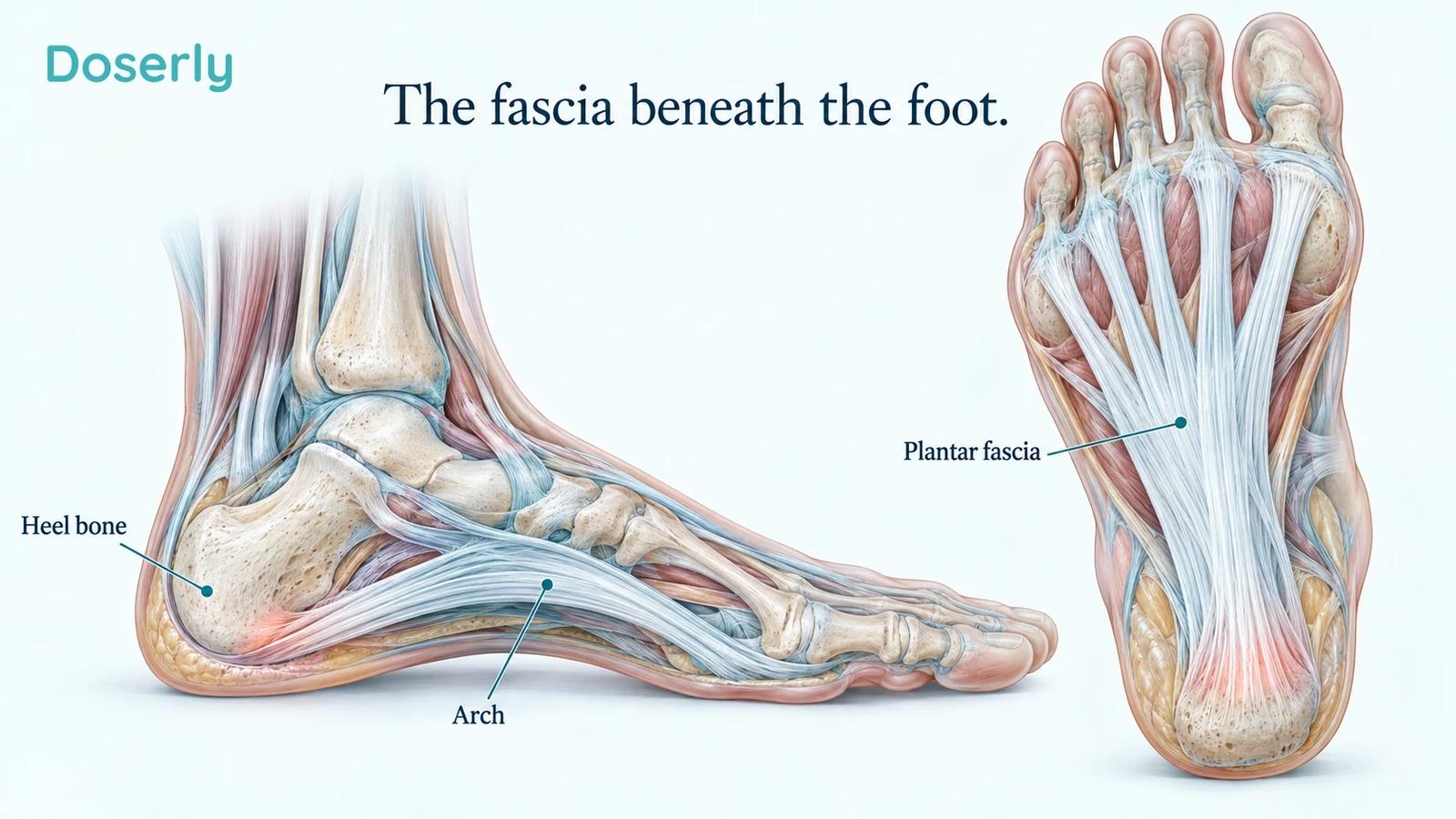
The plantar fascia is a strong band of connective tissue along the sole. It extends from the heel toward the toes and helps support the arch as the foot bears weight. Pain is often most noticeable near its attachment under the heel, although people may also describe discomfort into the arch. This is different from Achilles pain at the back of the heel.
The term plantar fasciitis is familiar, but persistent symptoms do not necessarily mean a simple pocket of inflammation. Clinicians also use plantar fasciopathy or plantar heel pain. East Lancashire Hospitals' explanation notes that inflammation is not always present and that diagnosis is usually based on the history and examination. That matters when a treatment is advertised entirely as an inflammation switch.
The classic pattern is pain with the first steps after rest, easing somewhat as you move, then becoming more troublesome with prolonged standing, walking or running. The NHS plantar-fasciitis guidance describes that pattern, while also advising assessment for severe or worsening pain, tingling, loss of sensation or foot pain in someone with diabetes. A familiar label should not become a reason to overlook a different problem.
A clinician can consider whether the symptoms fit the fascia or whether another structure needs attention. Stress injury, joint disease, nerve symptoms and pain around the Achilles require different thinking. The American Academy of Orthopaedic Surgeons' patient information describes ruling out other causes, including stress fracture. Choosing a device before clarifying the diagnosis reverses the useful order of decisions.
A heel spur is not a treatment target by itself
An X-ray report mentioning a heel spur can sound alarming. It is easy to picture a sharp spike digging into the foot and assume that it must be removed or dissolved. The anatomy is less dramatic than that picture suggests. Heel spurs can be present in people without heel pain, and finding one does not establish why a particular person hurts.
The Royal Orthopaedic Hospital explains that the spur is a shelf of extra bone associated with the same stresses around the heel, rather than necessarily being the cause of symptoms. Pain can improve without making that bone disappear. A light-treatment claim about “breaking down spurs” therefore needs its own direct evidence; improvement on a pain scale would not demonstrate it.
This is also why before-and-after images can be misleading when they are used to sell treatment. The clinically relevant question is not whether an illustration looks smoother after exposure. It is whether people with your diagnosis could stand, walk and live more comfortably, and how that compared with the care they would otherwise receive.
Low-level laser, LED and high-intensity laser are different exposures
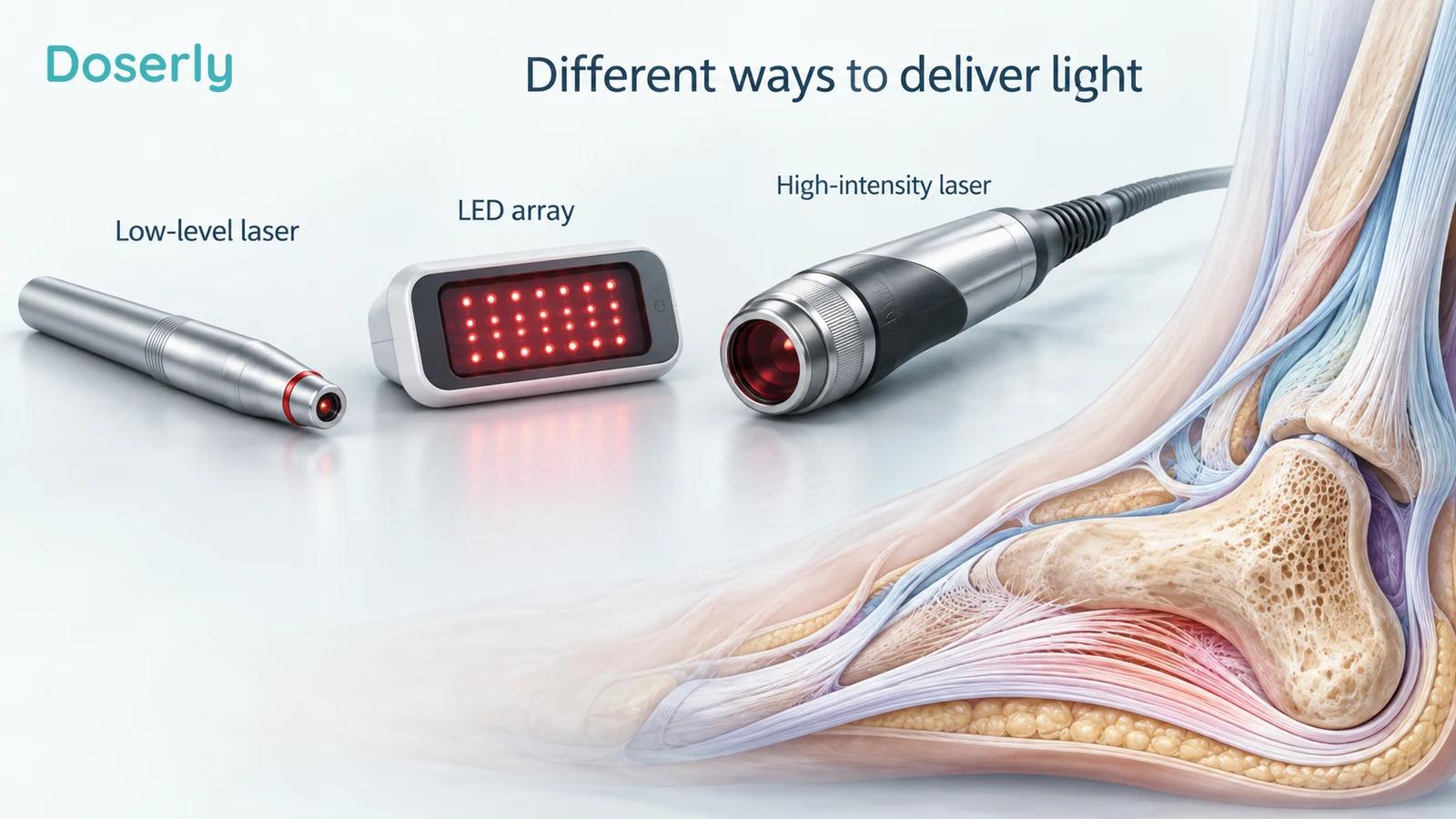
Photobiomodulation, often shortened to PBM, uses selected wavelengths of light with the aim of influencing tissue biology. Low-level laser therapy, or LLLT, is one way to deliver it. Some devices use visible red light; others use near-infrared wavelengths that you cannot see. An LED is another type of light source, not a guarantee of the same exposure as a laser.
In a clinical study, light may be directed at a few points on the heel or along the fascia. The result belongs to that treatment arrangement: wavelength, delivered energy, illuminated area, location and schedule. It does not automatically apply to a broad panel, a wrap or a light source used through a sock. Similar color is not a reliable indicator that two devices deliver similar treatment.
High-intensity laser therapy, or HILT, uses different power and delivery conditions. Some papers still describe its intended effects as photobiomodulation, but this does not make it interchangeable with a low-power probe. Potential thermal effects, application technique and protective measures also differ. Studies of high-intensity systems should be identified plainly rather than pooled into an advertisement for any product with red LEDs.
No universal home protocol follows from the evidence below. In particular, longer exposure or a more powerful device cannot be assumed to work better. The relevant test is a clinical comparison showing benefit for the actual application, not the size of a number on the specification sheet.
What the placebo-controlled studies found
One of the more encouraging studies is a 2015 multicenter trial of 635-nm low-level laser. It enrolled 69 people with chronic symptoms affecting one foot and compared active treatment with placebo. At the final eight-week assessment, mean improvement in heel pain was 29.6 points on a 100-point scale with active treatment versus 5.4 with placebo, a difference of about 24 points.
That is a useful positive result, not just a report that pain declined after treatment. However, the follow-up was short, and the result does not tell us whether the benefit persisted through a year or translated into sustained return to demanding work or sport. The abstract also says function and fascia thickness were measured, but its clearest numerical result is pain improvement. Those additional measurements should not be assumed to have proved regeneration.
An earlier 2010 sham-controlled study used a 904-nm infrared laser. Thirty people entered and 25 completed the protocol. Pain after overnight rest and during daily activities favored active treatment. The abstract's reporting of changes in fascia thickness is less clear, including a nonsignificant final comparison. The small sample and incomplete follow-up make the pain finding more defensible than a broad claim that the fascia healed.
There are also negative results. A 1998 randomized, double-blind trial studied 32 otherwise healthy people using a low-intensity 830-nm laser or a dummy treatment. It found no significant between-group differences in morning pain, tenderness or its other outcomes during treatment or at the one-month follow-up. That older protocol cannot settle every modern application, but it shows why the evidence should not be presented as uniformly positive.
A 2015 LED-versus-sham pilot is particularly relevant to the assumption that any light source will help. Eighteen participants received active or sham LED, with massage and stretching in both groups. Active LED did not produce greater improvement in pain or function. The sample was too small to rule out every useful effect, but this was not a positive demonstration of added benefit.
The overall picture is compatible with some helpful applications and some ineffective ones. It does not support treating all positive studies as proof for one product while dismissing every null trial as simply using the wrong settings. Dose and delivery are legitimate research questions, but they need to be tested rather than used as explanations after the fact.

Adding light to rehabilitation asks a more practical question
Many people considering light are already stretching, changing footwear or using an insert. For them, the useful comparison is the same care with and without the additional treatment. A study comparing light with nothing cannot answer that question as directly.
A trial published in 2018, online in December 2017, allocated 49 participants to usual care with or without an 850-nm laser. Both groups received a home exercise program and orthotic support. The laser group had lower activity-related pain at three months, with some favorable functional findings. Walking speed and cadence, however, were comparable between groups at all assessments.
This is encouraging for an additional symptom benefit, but the control group did not receive sham laser. Extra treatment contact and expectations therefore remain possible contributors. It also illustrates why the word function deserves a closer look: a questionnaire item about walking can improve without a measurable change in walking speed.
Another 2017 trial randomized 60 people with chronic plantar fasciitis to low-level laser, therapeutic ultrasound or shockwave treatment. Laser and shockwave performed better than ultrasound on the study's predefined pain-response criterion, with no significant difference between those two groups. Fascia thickness on MRI decreased in all three groups. There was no sham or untreated group, and the assessment was one month after treatment.
This comparison helps describe how specific clinic treatments performed against each other. It cannot prove that light caused every improvement seen within its group, or that a reduction in MRI thickness was unique to laser. The number of visits also differed among treatments, which matters when considering the practical burden of care.
What the clinical guideline actually recommends
The 2023 plantar-fasciitis clinical practice guideline gives a grade B recommendation to use low-level laser as part of a rehabilitation program to reduce short-term pain in acute or chronic plantar fasciitis. Its evidence discussion describes a small short-term pain improvement and less consistent evidence for disability. Optimal treatment parameters and effects on foot function remain uncertain.
That is a more specific endorsement than “red light heals plantar fasciitis.” The words short term and part of rehabilitation carry much of the meaning. They leave room for a useful adjunct while keeping the broader treatment plan in view.
Guidelines also summarize evidence available at a particular time. Their recommendations should be read alongside later trials rather than treated as a permanent verdict. The newer studies below concern high-intensity systems, so they do not directly reverse the low-level-laser recommendation, but they do challenge the idea that increasing laser intensity necessarily improves results.
Newer trials do not show that more power is better
A 2020 comparison of high-intensity and low-level laser analyzed 102 participants after seven of 109 randomized participants did not complete treatment. Pain, pressure-pain measurements and ultrasound thickness did not differ significantly between groups. More participants receiving high-intensity treatment rated its effect above a selected threshold, but that did not establish superiority on the principal pain measurements. There was no sham group and follow-up was brief.
In a sham-controlled trial published in February 2026, 36 participants entered and 34 completed treatment. Everyone received stretching; the active group also received a 1064-nm, 12-W high-intensity laser. Pain, ultrasound thickness and foot-and-ankle ability improved in both groups, without a significant added benefit from active laser. The reported pain contrast was about 5 mm on a 100-mm scale, with a confidence interval that included no difference.
The trial was small and assessed outcomes immediately after the treatment course. Its report contains inconsistencies among some reported means, changes and statistical values, so the precise effect estimates deserve caution. Its central finding was consistently null across pain, function and thickness; it did not demonstrate the proposed additional benefit.
A separate 2026 trial of 84 people compared home exercise alone with exercise plus high-intensity laser or radial shockwave therapy. All groups improved. After adjustment for baseline values, neither added treatment produced a meaningful advantage at 12 weeks. Participants could not be blinded, although assessors were, and the result applies to the specific programs tested.
These are useful findings for a person being offered a more intensive or costly treatment package. More sessions and more elaborate equipment are not substitutes for evidence of an additional benefit. Improvement after a package can be real while the expensive addition contributes little or nothing detectable.
What would meaningful improvement look like for you?
“My heel is better” can mean several things. The first steps in the morning may hurt less, you may manage a longer shopping trip, or you may finish a shift without constantly shifting weight away from the painful foot. Each is worth noticing. None requires a claim that the fascia has returned to an ideal appearance on a scan.
Try choosing one or two activities you actually want back. For someone with a standing job, the goal might be tolerating a normal portion of the shift. For a walker, it might be a familiar route. For a parent, it might be getting through the morning routine without planning every trip across the house. A goal that belongs to your life makes reassessment more useful.
Keep the conditions reasonably comparable. A pain rating after a quiet weekend cannot be interpreted in the same way as a rating after two busy workdays. Similarly, walking less because of bad weather may improve symptoms without showing increased capacity. Write down enough context to interpret the change, rather than turning the diary into another demanding task.
The distinction between pain and function also protects against an all-or-nothing view of recovery. Less pain with the same activity can be progress. More activity with a similar level of discomfort can also be progress if the response remains manageable. A clinician can help decide which pattern fits a sensible progression for your situation.
The care around the light deserves equal attention
Plantar-fascia-specific stretching has its own clinical evidence. In a 2003 randomized trial, 101 people with symptoms lasting at least ten months received either fascia-specific or Achilles stretching, with insoles, medication and education provided to both groups. Eighty-two returned at eight weeks. Several pain and activity outcomes favored the fascia-specific approach, including first-step pain. This was a comparison of two care packages, not a promise that any stretch will resolve every case.
Strengthening is another option to discuss. A 2015 trial, published online in 2014, compared shoe inserts plus progressive high-load strength training with inserts plus plantar-specific stretching in 48 people. The strength group had better Foot Function Index scores at the primary three-month assessment, but the groups did not differ at one, six or twelve months. The finding supports tailoring rehabilitation and its pace, rather than declaring one exercise permanently superior.
Exercise should fit the person in front of the clinician. A runner with flexible working hours and someone standing on a hard floor for a full shift face different constraints. The second person may need help changing breaks, tasks or footwear before an exercise plan becomes realistic. That practical work is part of treatment, not evidence that they have failed to follow instructions.
Footwear also has to work where you actually spend your day. A shoe that feels supportive for ten minutes in a store may be uncomfortable late in a shift. Discuss cushioning, fit and whether an insert fits without making the shoe tight. The aim is a manageable combination of comfort and activity, not finding a supposedly perfect shoe that can guarantee recovery.
The 2023 guideline's orthoses and night-splint recommendations also describe a combined approach. Orthoses should not be used as an isolated short-term treatment, though they may be useful with other interventions. Night splints are recommended for selected people with consistent first-step morning pain. Those choices can be discussed according to symptoms, tolerance and cost rather than added automatically to every treatment package.

If the pain persists, revisit the plan rather than just adding sessions
Persistent heel pain does not necessarily mean that something has been missed, but it is a reason to review the diagnosis, the demands on the foot and the treatment response. Is the pain still in the same place? Has numbness appeared? Is the amount of standing greater than it was when the plan began? Have the exercises been tolerable enough to do consistently?
For some people, specialist options such as shockwave therapy become part of that discussion. A 2015 placebo-controlled multicenter trial found greater improvement in a composite heel-pain score with focused shockwave than with placebo. That finding concerns a particular sound-wave treatment, not light, and should be weighed alongside the mixed comparative evidence and the newer exercise-addition trial. It is an option to evaluate, not an inevitable next step.
The useful question is what the next treatment is expected to add. If a clinic recommends another course of light because the first one produced no meaningful change, ask what evidence supports repeating it and what would be different this time. A plan needs a way to recognize both success and lack of benefit.
Cost includes time as well as money. Travel, repeated appointments and time away from work can be substantial even when each session is brief. A modest temporary benefit may be worthwhile for one person and not another. That is a reasonable preference difference, provided the expected benefit is described honestly.
A practical way to decide
Low-level laser is a defensible topic to raise with a clinician when plantar fasciitis has been properly assessed and a rehabilitation plan is in place. The best-supported expectation is possible short-term pain relief with certain studied applications. The evidence is less convincing for a durable improvement in disability, faster tissue repair or a general benefit from arbitrary home devices.
Before committing, ask which trial supports the proposed device, whether its patients resembled you and what outcome improved. Clarify whether the service is low-level laser, LED treatment or high-intensity laser. Agree on a useful goal and a time to reassess. The point is to make the treatment answer a question in your life, rather than asking your life to revolve around the treatment.
You do not need a perfect ultrasound image to value a more comfortable morning. You also do not need to accept an unproven repair claim to take pain relief seriously. A good heel-pain plan makes room for both truths while keeping walking, work and ordinary daily movement at the center of care.