
Red Light Therapy
October 17, 2026
Red light therapy for dogs and cats: what veterinary studies actually show
On this page
When a dog takes longer to get up or a cat stops visiting a favorite windowsill, owners naturally look for ways to make life more comfortable. Laser therapy can sound especially appealing: no pill to hide, no joint injection at each visit, and a treatment that many animals seem to tolerate quietly.
There is real veterinary research behind photobiomodulation, often called PBM or low-level laser therapy. Some small trials in dogs with arthritis report less pain, better movement or reduced need for medication. Other studies, particularly after surgery, have found little benefit or results favoring the control group. Evidence in cats is much thinner.
The useful question is not whether light can affect living tissue. It is whether a particular treatment helps this animal, with this diagnosis, enough to justify the visits, cost and handling. That requires distinguishing dog studies from cat studies, a comfortable session from effective pain relief, and a clinical laser from a home red-light product.
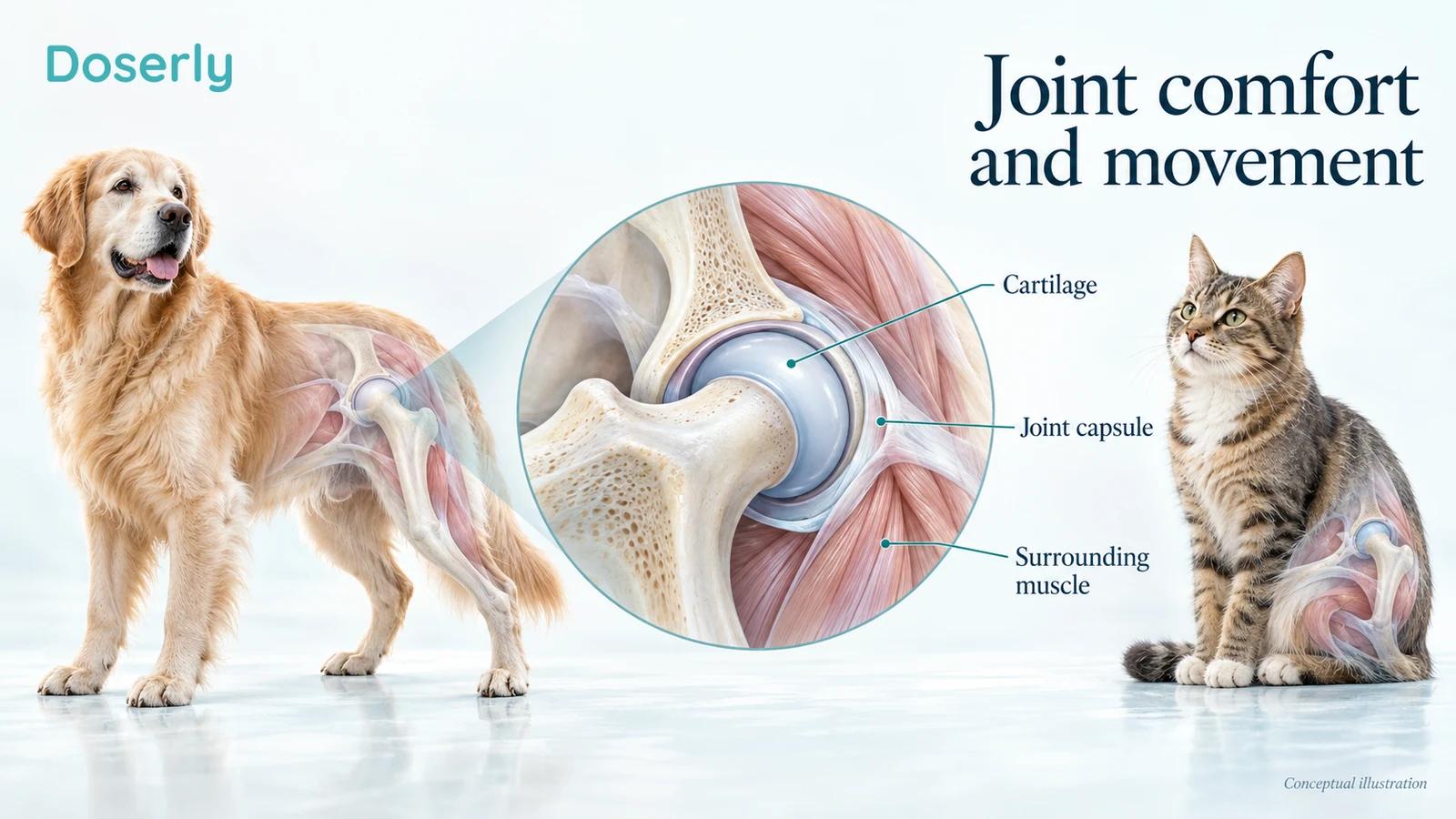
Start with the reason your pet is moving differently
A change in movement is information, not a diagnosis. A dog struggling to rise may have joint pain, but the next step is a veterinary examination rather than choosing a device. The treatment plan depends on what is causing the difficulty and what else is happening medically.
Cats can be particularly subtle. Cornell's Feline Health Center describes reduced activity, difficulty using stairs or a litter box, and less thorough grooming as possible signs of joint discomfort. An owner may notice these changes long before seeing an obvious limp. Mentioning that the cat now pauses before jumping can be more informative than simply saying that the cat is getting old.
The AAHA pain-management guidelines place assessment, treatment, reassessment and adjustment in an ongoing cycle. Owner observations are part of that process because you see the animal in its familiar environment. They are most useful when they describe a specific change: shorter walks, more difficulty getting into the car, or reluctance to use a normal resting place.
A light treatment should have a place within that assessment. If nobody has established the source of the pain, a series of sessions can consume time without answering the most important question.
Veterinary PBM is not one standardized treatment
PBM uses light to influence biological processes without intending to cut or destroy tissue. Research includes red and near-infrared wavelengths, with different devices, powers, treatment areas and schedules. Near-infrared light is invisible, so the amount of red glow is not a reliable description of the exposure.
The terminology can be confusing. Some veterinary studies described as PBM use Class IV therapeutic lasers, while others use lower-output equipment. Class IV is a laser hazard classification; it does not, by itself, tell you the biological mechanism or prove that a treatment is better. High-output protocols can carry substantial heating and eye risks and should not be treated as equivalent to gentle, nonthermal exposure from a consumer panel.
For example, the 2022 hip-arthritis trial used a Class IV clinical laser. Its findings belong to that treatment approach, not to every device advertised as red-light therapy. A result from a contact handpiece used by trained staff cannot simply be transferred to a wrap, lamp or human skin-care mask.
This is also why a list of wavelengths is not a complete prescription. Light must pass through the animal's coat and tissues, reach the relevant area, and be delivered without causing distress or injury. The clinical plan involves much more than selecting a color.
A small elbow-arthritis trial found a meaningful signal
One of the more useful direct comparisons is a 2018 blinded, sham-controlled study of 20 dogs with elbow osteoarthritis. Eleven received active PBM and nine received sham treatment. After the six-week treatment period, lameness and several pain measures favored active treatment. Nine of the 11 active-treatment dogs had a reduction in NSAID dose, compared with none of the nine sham-treated dogs.
That is encouraging, particularly because the trial included an inactive comparison. It is also a small study of a specific joint problem, with medication changes made within the study's clinical supervision. It does not establish that owners should reduce medication after buying a light device or that the treatment repairs damaged cartilage.
The authors acknowledged equipment donation, guidance and technical support from the manufacturer. Those contributions do not erase the results, but they belong in an honest reading alongside the small sample and limited follow-up. A larger independent replication would make the estimate of benefit more dependable.
For an owner, this trial supports asking whether the offered treatment resembles the studied approach. It does not supply a universal success rate for every dog with arthritis.
Hip-arthritis studies ask somewhat different questions
The 2022 randomized hip-arthritis study involved 20 dogs with bilateral disease, reported as 40 joints. Both hips in each dog received the same treatment. The comparison was clinical laser therapy versus a course of meloxicam, with sham laser sessions in the medication group. Several pain and function outcomes favored PBM at selected follow-up points, and joint range of motion improved.
There are two reasons to read this carefully. Forty joints are not 40 independent animals, and a comparison with a time-limited medication course is not the same as a large sham-controlled test of adding PBM to stable long-term care. The study offers a positive signal, not a basis for declaring laser superior to appropriately individualized arthritis management.
An activity-monitoring study published online in 2022 and in a 2023 journal issue followed 23 dogs through six weekly laser sessions. Recorded activity and step counts increased, while estimated daily energy expenditure did not change significantly. Analgesic treatment was reduced in half the dogs during the study.
Activity monitoring adds something useful beyond an owner's general impression. However, this study did not include a parallel sham group. A more active dog is a welcome observation, but this design cannot determine how much of the change was caused by the light, other care or changes in daily routine.
These studies are best viewed together: there are signals worth investigating, but the designs and comparators differ enough that their findings should not be merged into one confident promise.
What the newer combination studies can and cannot tell us
A 2025 long-term crossover report studied 30 dogs assigned to platelet-rich plasma injections, PBM or their combination. The investigators assessed weight-bearing distribution and owner-reported outcomes over successive treatment periods. The combined approach produced greater and more sustained improvements on several measures than the individual approaches.
This is a comparison among active treatment strategies, without an untreated or inactive-light-only control. A crossover design can also be complicated when an earlier treatment has lasting effects that continue into a later period. The findings are interesting for veterinary treatment planning, but they do not isolate a universal effect of light or prove that joint tissue regenerated. This report should not be counted as several independent trials merely because the dogs received different treatments over time.
A March 2026 trial randomized 30 dogs to bedinvetmab alone or bedinvetmab plus a rehabilitation package containing both PBM and pulsed electromagnetic field therapy. Both groups improved on owner pain questionnaires. The combined group had better pressure-pain thresholds from day 30 onward.
The primary outcome was algometry, a response to controlled pressure, rather than a direct demonstration of cartilage repair. The trial was open-label, and there was no PBM-only add-on group. Consequently, the study cannot tell us whether the extra benefit came from light, electromagnetic treatment, additional handling or the combined package. It also does not establish the relative contribution of each component to everyday mobility.
This distinction matters when a study appears in advertising. “A combination helped” is not the same claim as “this light device alone caused the benefit.” Both may sound similar in a short headline, but they support different decisions.
After knee surgery, results have been mixed
Tibial plateau leveling osteotomy, or TPLO, is a surgery used for dogs with cranial cruciate ligament disease. Recovery involves pain control, rehabilitation and bone healing, which are related but separate outcomes. Laser studies in this setting show why it is worth asking exactly what improved.
A 2017 randomized trial involving 27 dogs tested a single preoperative treatment. At eight weeks, a force-plate measure of limb loading favored the laser group. The other measured outcomes did not differ significantly, and the groups differed in age. The proportion with radiographic healing was numerically higher with laser but was not statistically significant. This was a functional signal, not proof of faster bone union.
In a 2018 trial of 95 dogs, the only detected advantage was in the owner-assessed gait section of an orthopedic questionnaire. Other questionnaire outcomes and bone healing did not improve. The trial used a specific multiwavelength Class IV laser protocol, so even its limited positive finding cannot be generalized to any postoperative red-light exposure.
Another 2018 randomized study of 12 dogs found no benefit from the tested laser protocol. At some early follow-up points, the control group had better force-plate results and lower owner-assigned pain scores. The sample was very small, so it cannot establish that all laser therapy worsens recovery. But it plainly does not support a claim of consistently faster or less painful recovery.
For a dog recovering from surgery, the surgeon's restrictions and reassessment plan remain essential. Looking more comfortable is not confirmation that an osteotomy has healed sufficiently for unrestricted activity. Light treatment should not become a reason to advance exercise ahead of the surgical plan.
Spinal rehabilitation is a separate question again
A 2017 study of 32 nonambulatory dogs after spinal decompression surgery compared postoperative PBM, physical rehabilitation with sham light, and sham light alone, all with standard postoperative care. It found no significant differences in time to reach the measured recovery stages or in the duration of intravenous opioid treatment.
This was a small study, and it does not exclude every possible benefit from every rehabilitation protocol. It does show that a light treatment cannot be assumed to accelerate neurological recovery just because it helped a pain score in an arthritis study. A dog recovering from spinal cord injury has different problems from one with chronic elbow discomfort.
That boundary is useful for owners reading clinic websites. A long list of conditions treated with a device may describe where it is used, without showing equally strong evidence for every condition on the list.

Why owner impressions matter, and why they need support
You know your pet's normal behavior better than a study questionnaire does. At the same time, wanting a treatment to help can influence how both owners and clinicians interpret a change.
A study of 58 placebo-treated dogs with osteoarthritis found a caregiver placebo effect in owner lameness assessments about 40% of the time. Veterinarian assessments also showed this effect. Mean ground-reaction forces, an objective measure of limb loading, remained unchanged. This does not mean owners were careless or dishonest. It means observation is vulnerable to expectation even when people are trying hard to be accurate.
A 2017 analysis using data from five feline analgesic studies found a similarly important issue in cats. Among 96 cats with available data, owner-defined success during placebo treatment ranged from 54% to 74% across studies. Changes in activity did not consistently match those owner judgments. These were medication studies, not tests of laser therapy, but they demonstrate why a convincing comparison matters in feline pain research too.
The answer is not to discard owner observations. It is to make them more specific and combine them with other information. “She is happier” is worth hearing. “She now uses the low step to reach the sofa twice most evenings, whereas she avoided it last week” is easier to discuss and reassess.
A short video can help show the veterinarian what happens at home, provided the pet is doing an ordinary activity voluntarily. There is no need to provoke a painful jump or repeatedly make an animal climb stairs to test whether treatment worked.
Cats need their own evidence
In the research searched for this article through October 17, 2026, we did not identify a robust sham-controlled trial establishing PBM's effectiveness for feline osteoarthritis. That is an evidence gap, not proof that no cat can benefit. It means confidence should be lower than a general “works for pets” claim suggests.
A 2025 case report described a cat with persistent problems after femoral fracture surgery and implant failure. After implant removal and a course of laser therapy, the cat's mobility and clinical findings improved. The report is useful as an observation, but surgery, subsequent healing and rehabilitation occurred together. It cannot establish how much improvement was caused by laser, and it was not a controlled arthritis study.
There is also a three-cat adverse-effect report. Cats receiving laser treatment for osteoarthritis developed discomfort and behavioral changes after the first session, including restlessness, tail movement and flinching away from touch. No visible burns were detected. The authors proposed skin overheating as an explanation, but did not establish it as the cause.
A case series cannot tell us how frequently this happens. It does tell us to take post-treatment behavior seriously. An animal that is restless, avoiding touch or repeatedly changing position should not automatically be described as experiencing a normal healing response. Those observations belong in a prompt conversation with the treating team.
For cats, the stress of travel and handling also belongs in the benefit assessment. A possible improvement that requires repeated distressing visits needs to be weighed differently from the same improvement in an animal that travels and settles comfortably.
Coat, pigmentation and tissue depth change the exposure
A study in 47 healthy dogs measured light transmission through selected tissues using two veterinary lasers. Wavelength, power, coat color and whether the area was shaved influenced transmission. Less light passed through darker and unshaved areas; coat length itself was not a significant predictor in the study's analysis.
This was a light-delivery experiment, not an arthritis-treatment trial. It does not tell us that a darker dog should receive a particular higher setting, or that increasing power will improve pain. More energy at the surface can create a different safety problem without guaranteeing a therapeutic dose at the target.
It also explains why copying a human exposure schedule is unreliable. A bare human knee, a thick-coated dog's hip and a cat's elbow are not interchangeable targets. The animal's size does not supply a simple conversion factor for minutes, distance or intensity.
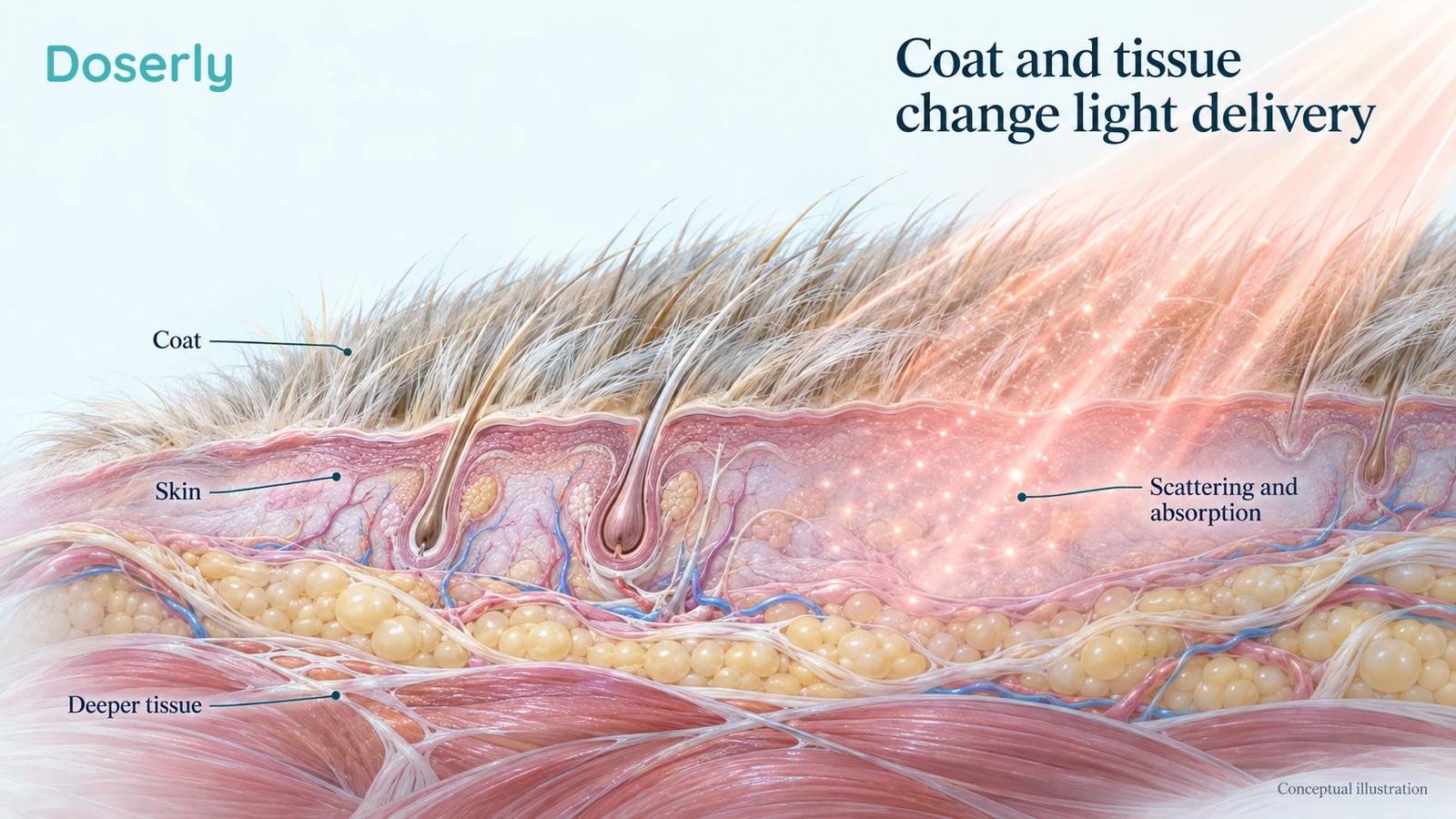
The same caution applies to devices that look similar. A red LED on a product may be an indicator, part of the treatment output, or only one component of a multiwavelength system. What matters is the documented exposure and the evidence for the intended use, not how bright or warm the device appears.
Eye protection and comfort are part of treatment quality
AAHA's laser-safety guidance notes that higher-powered units can cause burns when used incorrectly and that direct laser exposure can damage the retina. Proper protective eyewear and device-specific precautions are clinical requirements, not decorative accessories in a treatment photograph.
A pet cannot reliably report a hot spot in words. The team needs to watch behavior and skin response, control the treatment area and follow the appropriate safety procedures. An owner should know whom to contact if the animal seems more uncomfortable afterward. “Low-level” or “cold laser” should not be taken to mean that inappropriate exposure is incapable of harm.
A human home panel or mask is not validated for an animal just because it uses a familiar wavelength. Ask the veterinarian about any proposed home device before applying it, including how eyes would be protected and how treatment tolerance would be assessed. This article does not provide a pet dosing schedule because the available studies do not establish one universal protocol.
Keep the wider arthritis plan in view
AAHA's guidance on non-drug pain care emphasizes weight optimization, appropriate activity, rehabilitation and environmental adjustments. A useful plan often combines several approaches, with medication chosen for the animal's health and reassessed over time. PBM may be considered as one component, but it should not crowd out a treatment that is already providing reliable comfort.
At home, practical changes can remove barriers without requiring the pet to perform through pain. Cornell describes steps or ramps to favored resting places and easier access to food, water and litter boxes. These changes are not evidence that light works; they are separate ways to make daily life easier while the medical plan is reviewed.
It is reasonable to discuss money and time openly. If a course of sessions would make it difficult to afford examinations, prescribed medication or necessary follow-up, the veterinarian should help prioritize. Choosing against an uncertain add-on does not mean choosing against your pet's comfort.

Agree on what would make a course worthwhile
Before beginning, choose a small number of goals with the veterinary team. For one dog, the goal might be rising more comfortably and completing a usual short walk. For a cat, it might be easier access to a resting place or more normal grooming. These goals should reflect the animal's everyday life, not a dramatic performance after treatment.
Ask which clinical study most closely matches the diagnosis and device, what other care will continue, and when the response will be reviewed. Record medication changes, unusual activity and any discomfort after sessions. If several treatments begin together, the record can show whether the overall plan helps, even though it cannot identify which component deserves the credit.
Medication reduction should be a veterinarian-led decision. The favorable medication finding in one small elbow trial is not permission to withhold pain relief to see whether the light is enough. Likewise, increasing activity after surgery should follow the surgeon's guidance rather than an encouraging video or a better-looking walk.
The current evidence supports cautious interest in clinical PBM for some dogs with arthritis, with substantially more uncertainty for cats and mixed results in surgical rehabilitation. A good decision keeps the species, diagnosis, device and outcome connected. The standard of success is a pet that moves and lives more comfortably within a safe, manageable care plan.