
Red Light Therapy
October 17, 2026
Red light therapy for mouth sores during cancer treatment: a stronger clinical use
On this page
When your mouth hurts, an ordinary day can become a series of negotiations. A sip of water stings. Toothpaste feels too strong. Dinner takes longer, and eventually eating enough becomes difficult. During cancer treatment, those problems deserve the same careful attention as other treatment side effects.
Oral mucositis is one setting where photobiomodulation, often called red light therapy, has moved beyond an interesting laboratory idea. Professional guidance supports specific clinical prevention protocols, and randomized human trials have measured meaningful outcomes. The useful question is whether a particular protocol fits your cancer treatment and care setting.
That is more precise than asking whether red light heals mouth sores. A device inside the mouth, used under an oncology team's supervision, is a different intervention from a home panel aimed at the face. Prevention before severe injury develops is also a different task from treating an established ulcer. Understanding those distinctions makes the evidence much easier to use.
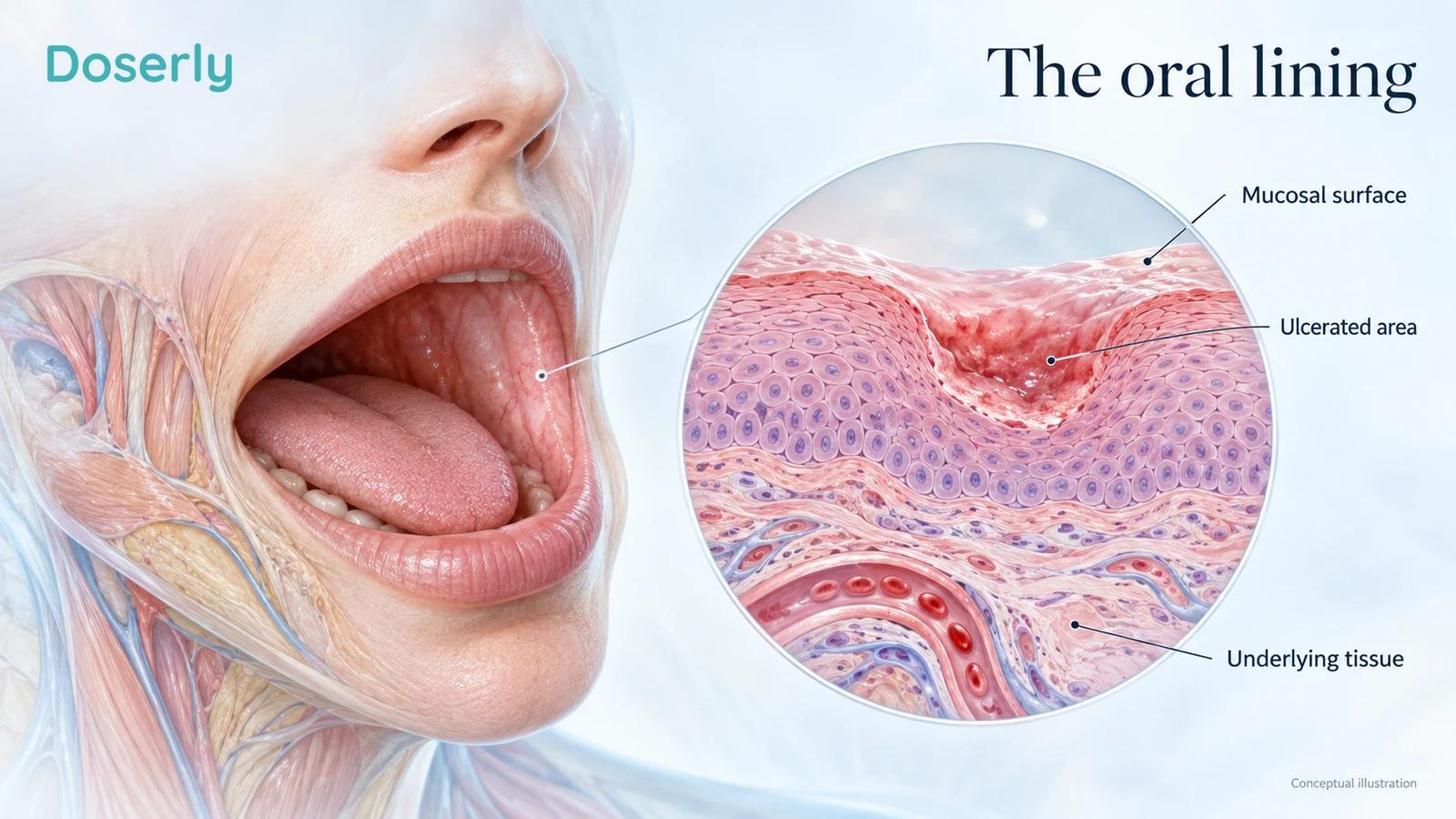
Conceptual oral lining and ulcer anatomy. The illustration explains tissue injury; it does not show a treatment response.
Why cancer treatment can make the mouth so sore
The lining of the mouth continually renews itself. Some cancer treatments damage those rapidly dividing normal cells along with their intended targets. Radiation directed at the head and neck can also injure local tissues and salivary glands. The resulting inflammation and breakdown can leave tender red areas or open ulcers.
This injury matters beyond its appearance. Pain can interfere with drinking, eating and speaking. Reduced saliva can add friction and discomfort. When immune defenses are weakened, a damaged barrier can also make infection more concerning. The National Cancer Institute's oral-complications guidance describes these overlapping problems and the need for coordinated dental and oncology care.
However, every painful mouth during cancer treatment is not necessarily the same condition. Thrush, dental disease, traumatic irritation and other treatment-related changes can coexist with mucositis. An examination helps establish what needs treatment. A light session cannot substitute for identifying the cause of a new lesion.
That distinction is especially useful when someone says, “My mouth feels worse, but the sores look smaller.” The symptom deserves attention even if a photograph seems reassuring. Your experience and the clinician's examination contribute different information.
What the clinical recommendations actually cover
The 2019/2020 MASCC/ISOO guideline update recommends specified intraoral PBM protocols for prevention in three adult settings:
- Hematopoietic stem-cell transplantation after high-dose chemotherapy, with or without total-body irradiation.
- Head and neck radiotherapy without chemotherapy.
- Head and neck radiotherapy combined with chemotherapy.
These are recommendations for particular treatment circumstances, using selected protocols. They are not a blanket endorsement for every anticancer drug, every age group or every oral device. The guidance also calls attention to safety considerations in people with oral cancer.
“Intraoral” means that light is delivered within the mouth. The PBM-specific guideline review evaluates prevention and treatment separately and organizes evidence by cancer-treatment setting. That structure matters: a strong prevention recommendation does not automatically establish how well the same intervention works after severe mucositis has developed.
For a patient, the next step is therefore a discussion with the treating service. Ask whether it provides PBM for your regimen, which clinical protocol it follows, and whether the aim is prevention or treatment of an existing problem. Those answers are more informative than a manufacturer's general claim about tissue healing.
Why this evidence is stronger than a mechanism alone
Researchers propose that absorbed light can influence cellular signaling and responses to injury. Those ideas help explain why PBM has been studied, but they do not tell us whether a person can swallow comfortably next week. Human comparisons are what make this clinical use more persuasive.
An early multicenter randomized study published in 1999 enrolled 30 people receiving head and neck radiotherapy without chemotherapy. It reported less severe mucositis and severe pain with low-energy laser treatment than with placebo light. The trial was small and used older cancer-treatment methods. It nevertheless tested patients rather than relying on laboratory changes. It also required the tumor to lie outside the tested light-application areas, an important boundary when interpreting its safety experience.
A 2012 sham-controlled trial randomized 221 people receiving concurrent chemoradiotherapy. It reported reductions in severe mucositis, pain, swallowing difficulty and opioid use with the studied laser protocol. This adds clinically relevant evidence, although its results still belong to that treatment schedule and delivery method.
In a 2013 phase III trial, severe grade 3–4 mucositis occurred in 6.4% of the PBM group and 40.5% of the placebo group. That is an absolute difference of about 34 percentage points in that study. Patient-reported functioning and several symptom measures also favored PBM. It is a substantial result, but it should not become a promised success rate for a different device or clinic.
Taken together, these trials explain why oral mucositis occupies a stronger position in PBM research. They also show why “red light” is too broad a label for clinical decisions. The intervention includes where the light goes, when it is delivered, the treatment course and the accompanying care.
A useful 2026 trial, with important details
A randomized, double-blind trial published in June 2026 tested an intraoral LED device at 12 US sites. Eighty-five participants received either PBM or sham treatment during high-dose intensity-modulated radiotherapy, with or without concurrent chemotherapy.
In the intention-to-treat analysis, severe mucositis across six weeks occurred in 36.8% with PBM and 57.1% with sham. The absolute difference was about 20 percentage points. The study also reported less severe mucositis two weeks after radiotherapy.
Some symptom benefits came from the per-protocol population, which is a different analysis from including everyone as randomized. The feeding-tube comparison did not reach conventional statistical significance: its reported p value was 0.073. It should not be described as proven prevention of tube feeding.
No device-related adverse events were observed, but short-term tolerability does not settle long-term cancer safety. Two authors disclosed consulting fees from the device company. The findings are encouraging and clinically relevant; replication and longer follow-up remain valuable. They support this studied intraoral approach, not an assumption that an external consumer panel will reproduce it.
The important trial that did not show the expected benefit
The UK's LiTEFORM randomized trial, published in 2022, deserves equal attention. Recruitment stopped far below its planned sample: 87 people were randomized and 71 contributed to the primary analysis.
At six weeks, the patient-reported mouth and throat score averaged 33.2 with active treatment and 27.4 with sham. Higher scores meant worse well-being and oral function. The estimated difference favored sham, with a confidence interval of 0.1 to 11.5 points. The active group had fewer people with severe mucositis on examination, but that estimate was imprecise and its confidence interval included no difference.
The appropriate interpretation is not that LiTEFORM secretly confirmed benefit. It did not establish the hoped-for clinical advantage. Equally, its small achieved sample cannot precisely resolve every question about PBM.
The investigators' discussion also describes delivery difficulties: staffing and service capacity affected recruitment, and treatment sessions could be challenging for patients. This helps explain why a protocol must work in real life as well as on paper. An additional procedure has to earn its place in an already demanding treatment day.
Different outcomes can point in different directions
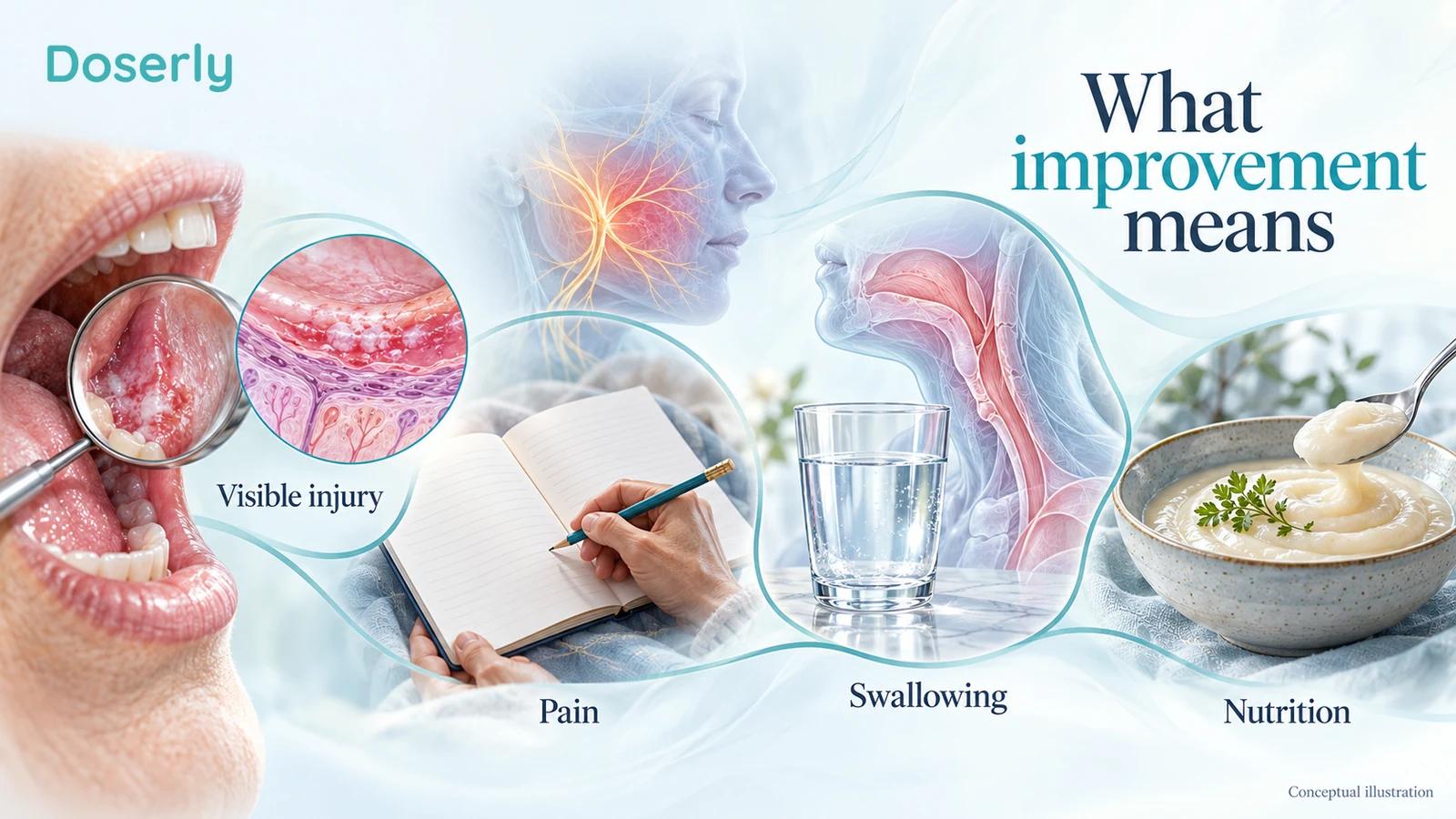
Visible sores, pain, swallowing and nutritional support are related outcomes that trials must assess separately. No measured trial data are depicted.
A clinician can grade visible injury while a patient reports pain, swallowing difficulty or trouble eating. These measures overlap, but none replaces the others. A person may have a modest-looking lesion in a particularly sensitive location. Another may tolerate visible injury reasonably well with appropriate symptom support.
This is why the most useful trial report does not simply say “mucositis improved.” It tells you whether fewer people developed severe disease, whether severe symptoms lasted fewer days, and what happened to eating or treatment interruptions. It also identifies the main outcome selected before results were known.
A 2025 randomized study of 53 patients illustrates the distinctions. PBM was associated with less mucositis progression and better preservation of salivary function, with benefits for pain and taste at important assessment points. However, the groups did not differ significantly in dry-mouth symptoms, restricted mouth opening, analgesic use or oral candidiasis.
Saliva production and the feeling of dryness are connected, but they are not identical. Likewise, less pain does not automatically mean fewer pain medicines, because prescribing and individual needs vary. A balanced account keeps both the positive and null outcomes visible.
For someone receiving treatment, a brief description of what has become difficult can be more useful than trying to choose a research score. “I can drink water but cannot manage soft food” gives the team something concrete to assess. Recording when that changed also helps them respond.
Can light delivered outside the cheek work as well?
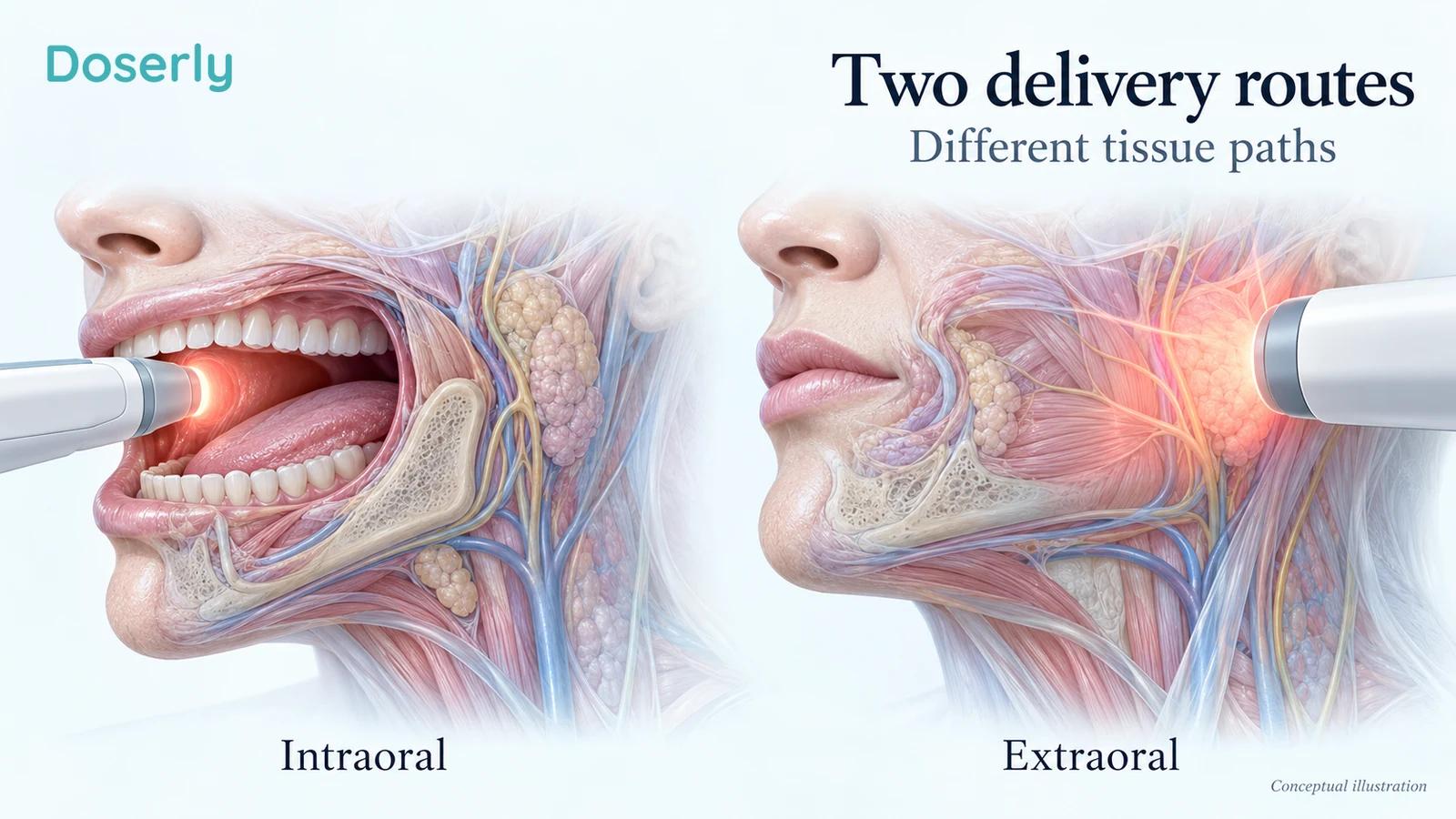
Intraoral and extraoral delivery reach tissue through different routes. Their protocols and clinical evidence are not interchangeable.
Extraoral treatment is attractive because it might reduce the need to hold a sore mouth open. But light applied outside the cheek must travel through intervening tissue. The relevant question is whether a specific external protocol delivers clinical benefit, not whether its wavelength sounds similar to an intraoral device.
A 2025 multicenter randomized trial compared intraoral and extraoral PBM in 58 people receiving radiotherapy for oral or oropharyngeal cancer. Everyone developed some degree of mucositis. The groups did not differ significantly in mucositis grades or time to ulcerated mucositis. Some swallowing and taste assessments favored extraoral treatment at individual time points.
That finding is useful, but “no statistically significant difference” does not by itself prove that two methods are equivalent. Both groups received active treatment, so the comparison also cannot tell us the size of either method's benefit over sham. One author disclosed a consultancy with a medical-device company.
Another 2025 randomized trial involving 75 patients asked a different question. Everyone received intraoral PBM; one group also received active extraoral treatment, while the other received simulated extraoral treatment. The combination produced better mucositis grades, salivary-flow measures and several quality-of-life scores. That supports further study of the added external component. It is not a comparison of PBM against no PBM.
There is a practical lesson here: “outside versus inside” and “outside added to inside” are separate research questions. A clinic should be able to explain which question its evidence answers. Convenience is valuable, especially during exhausting treatment, but convenience and demonstrated effectiveness need to be considered together.
Chemotherapy alone is a broader, less settled category
The chemotherapy label covers many drugs, combinations and schedules. Evidence from head and neck chemoradiotherapy cannot simply be carried across to every regimen for breast, bowel or blood cancer.
A 2025 preconditioning trial enrolled 45 people before their first chemotherapy treatment. It compared basic oral care alone with oral care plus intraoral PBM, or oral care plus intraoral and extraoral PBM. Overall mucositis scores favored the PBM groups during the short follow-up.
However, the comparison for ulcerative mucositis was not statistically significant, despite ulcers occurring only in the control group. With just 15 people per group and assessments over two weeks, the trial cannot establish durable prevention across repeated cycles or all chemotherapy regimens. The report also contains inconsistencies in its stated laser parameters, making it unsuitable as a recipe to reproduce from an abstract.
This is promising early clinical evidence rather than a reason to assume everyone receiving chemotherapy should buy a device. It may help a specialist frame a discussion, particularly when standard supportive measures have not been enough. The details of the anticancer regimen still come first.
The same care applies to wavelength comparisons. A 2022 trial involving 80 patients compared three active laser approaches during radiotherapy. A combined-wavelength group had better mucositis scores, but pain did not differ significantly among groups. Without a sham arm, it cannot establish the benefit of each approach over placebo. It certainly does not show that adding wavelengths always improves every outcome.
Why a clinical protocol is more than a device name
PBM is intended to influence tissue responses without cutting or ablating tissue. It should not be confused with a surgical laser, ultraviolet treatment or a light-activated cancer treatment that uses a photosensitizing drug. A machine's ability to emit red light does not establish that it can reproduce a mucositis protocol.
The PBM-specific guideline review links its recommendations to defined treatment parameters. Wavelength is only one part. The amount of light reaching each area, the size of that area, the application sites and the schedule all contribute to the intervention. Changing several of those features creates a different treatment, even if the product description uses the same PBM terminology.
This also explains why a published energy number is not a sensible home instruction. A number without the corresponding delivery geometry and clinical context does not describe what the tissue receives. More light is not automatically a better version of the studied procedure. The practical safeguard is a trained service using a documented protocol, with a way to monitor comfort and respond to unexpected symptoms.
Prevention can help without eliminating every sore
Imagine two people who both develop a mouth sore during treatment. One can continue eating soft food; the other develops extensive painful ulcers and needs much more support. A trial designed to reduce severe mucositis could count the first person's course as a better outcome even though it did not prevent all injury.
That is why “everyone still developed some mucositis” does not automatically make a trial useless. Conversely, a later first sore does not necessarily establish a shorter total period of suffering. Timing, maximum severity and duration answer different questions. Ask which of those outcomes a proposed treatment has actually improved.
The same principle helps with personal expectations. If symptoms appear despite preventive PBM, contact the team rather than assuming the treatment has failed completely or continuing silently because improvement is supposed to happen. The prevention plan and the response to a new problem need to work together. A planned review is useful, but it should never become a reason to defer reporting a meaningful change.
What can we say about cancer safety?
This question deserves a direct answer. PBM for mucositis is supportive care delivered around cancer treatment. It is not an established anticancer treatment, and the clinical evidence does not justify unsupervised illumination of a tumor.
A 2017 follow-up of the earlier randomized phase III trial evaluated 94 participants, with median follow-up of about 41 months. It did not reveal the feared worse cancer outcomes; some measures favored the PBM group. Overall survival was not conclusively improved. This is reassuring within the studied circumstances, but it is follow-up of an existing trial, not a new independent group proving universal safety or a survival treatment.
A 2024 retrospective analysis of 751 head and neck cancer records also associated PBM exposure with longer survival. That association cannot show that light caused the difference. People receiving more sessions may differ in health, access to care, treatment completion or opportunity to remain under observation. Such factors can affect both treatment exposure and survival.
The responsible clinical position is therefore specific. Ask how the oncology team handles treatment near known disease, what evidence supports its protocol, and how follow-up is coordinated. Short-term absence of device side effects and long-term tumor behavior are separate safety questions. Neither should be replaced by the slogan that light is “natural.”
A light treatment is part of a larger care plan
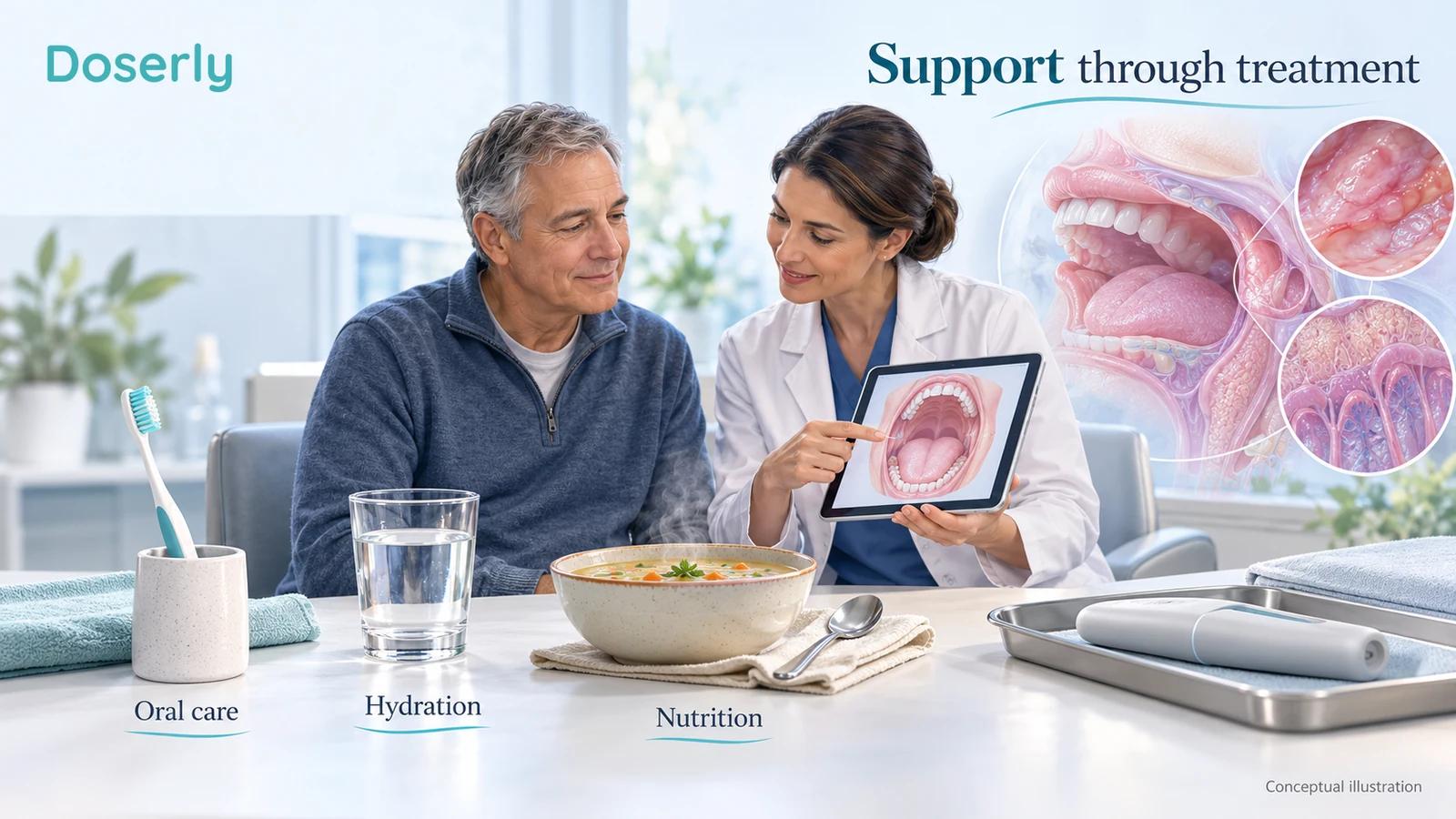
PBM belongs within coordinated oncology and oral care. Assessment, symptom relief, hydration and nutrition remain essential even when light treatment is available.
The most valuable appointment may begin with a simple question: what is making eating or drinking difficult today? The answer might lead to a mouth examination, an adjustment in symptom treatment, advice about food texture, or help with hydration. PBM, when appropriate, joins that work rather than taking over all of it.
The NCI's nutrition guidance discusses softer foods and adapting eating when treatment makes the mouth sore. The aim is to make nourishment manageable. A dietitian can help translate that into meals you tolerate and an intake plan that fits your treatment needs. Needing nutritional support is not a personal failure or evidence that you have done oral care incorrectly.
Keep the team's urgent-contact instructions available. NCI guidance on infection during cancer treatment emphasizes that infection can require urgent attention, particularly when immune defenses are reduced. Fever or feeling acutely unwell should trigger the oncology service's instructions rather than waiting for a planned light session. Difficulty maintaining fluids also needs prompt assessment.
PBM should not become another task that makes you feel responsible for controlling every side effect. If holding your mouth open is intolerable, say so. If traveling for extra appointments is exhausting, that matters. The care team needs those details to judge whether the likely benefit is worth the practical burden.
Questions that make a consultation more useful
A 2023 survey of MASCC/ISOO practitioners found substantial variation in PBM parameters and reported barriers involving cost, time, training and safety concerns. It was a clinician survey, not a randomized patient-outcome trial. Its value is showing why availability and delivery can differ between services.
Before agreeing to treatment, consider asking:
- Does the evidence match my cancer-treatment regimen and the problem I have now?
- Are we trying to prevent severe mucositis or treat established symptoms?
- Who examines my mouth and coordinates care with my oncologist?
- What would count as a worthwhile improvement in eating, drinking or pain?
- What happens if I cannot tolerate the sessions or my symptoms worsen?
- How much additional appointment time and personal expense will this involve?
You do not need to arrive knowing the correct wavelength or energy setting. Those are professional responsibilities. What you can contribute is a clear account of your symptoms, treatment schedule and priorities. For one person, comfortable swallowing may matter most. For another, avoiding an additional exhausting trip may change the decision.
Oral mucositis is a credible clinical use of PBM because meaningful human evidence and specific professional recommendations exist. The strongest case is for defined prevention protocols within cancer care. A good service should be able to explain both why it offers treatment and where uncertainty remains, while continuing to help with the everyday work of eating, drinking and getting through therapy.