
Red Light Therapy
October 17, 2026
Red light therapy for neck and shoulder pain: what is worth knowing?
On this page
A stiff neck after a workday and a shoulder that hurts when you reach for a shelf can feel like one connected problem. Sometimes they are connected. But the label “neck and shoulder pain” also brings together several different conditions, and a treatment that helps one cannot be assumed to help them all.
Light therapy has produced encouraging results in some human trials, particularly for short-term pain relief. Other studies have found little additional benefit, including recent trials testing light alongside rehabilitation. The most useful answer is therefore more specific than “red light works” or “red light does nothing.” We need to know what was treated, what equipment was used and which outcome actually improved.
For someone weighing an appointment or a device, the goal is usually ordinary life: looking over a shoulder, sleeping comfortably, dressing or lifting an object without hesitation. Those goals provide a better starting point than an advertisement about cellular energy. Biology can explain why researchers are interested. Human outcomes tell us whether that interest has translated into help.
The location of pain is not the whole diagnosis
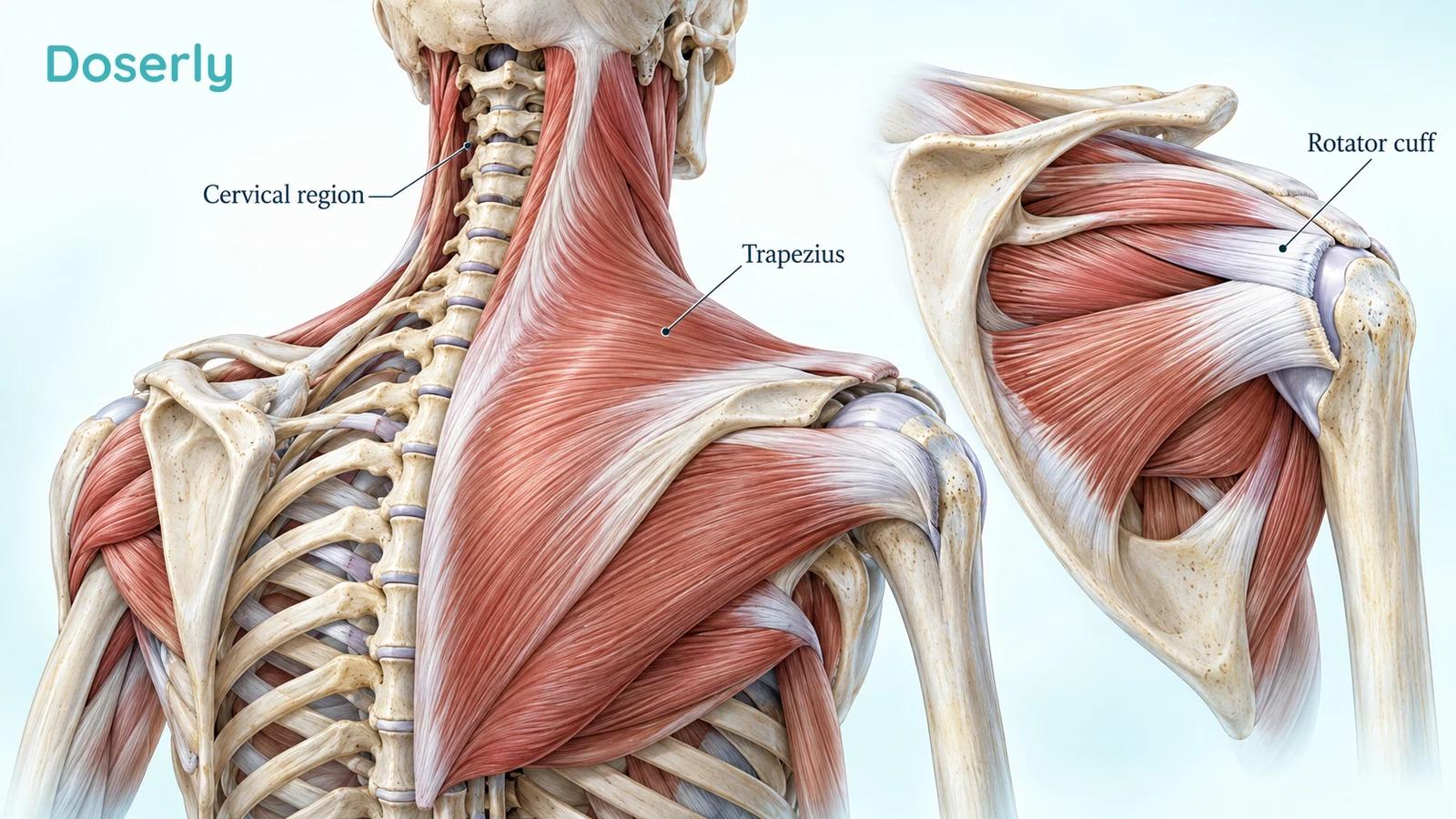
The neck contains vertebrae, joints, discs, muscles and nerves. The shoulder has its own joint, tendons, bursa and supporting muscles. Pain near the upper trapezius can overlap with either region, and a clinician may examine the neck when evaluating shoulder symptoms to check for a nerve-related source. AAOS explanation of shoulder assessment
Research often uses the term chronic nonspecific neck pain. Chronic means persistent symptoms, commonly for more than three months. Nonspecific means that the study is not focusing on a particular identified injury or disease. This does not mean the symptoms are trivial or imaginary. It defines the group researchers are trying to study.
Shoulder studies may instead enroll people with rotator cuff tendinopathy, calcific tendinopathy, subacromial pain or frozen shoulder. Others examine recovery after surgery. Those categories have different treatment contexts and different expectations about recovery.
This distinction protects you from a common advertising shortcut. A study showing less pain after rotator cuff surgery is not evidence that light can repair an untreated tear. A study of chronic neck discomfort is not automatically evidence for a compressed nerve. The word “shoulder” in two paper titles does not make their participants interchangeable.
A practical first step is to ask what your working diagnosis is and whether the cited study enrolled people with that diagnosis. That question often clarifies the evidence faster than comparing lists of wavelengths.
What “red light therapy” includes in these studies
Photobiomodulation, or PBM, is intended to influence biological activity using light without relying primarily on tissue heating. Many clinical papers use the older term low-level laser therapy. The light may be near-infrared and invisible, rather than the visible red glow people associate with home devices.
The research also includes high-intensity lasers and multiwave clinical systems. Some trials combine PBM with a static magnetic field, electrical stimulation or exercise. These distinctions matter because an observed effect belongs to the treatment that was actually tested.
A small contact applicator, a scanning clinical laser and a panel across the room do not deliver the same exposure. Nor is a higher output automatically more suitable. A paper's device settings describe a controlled study; they are not a transferable recipe for the neck, the eyes or a home panel.
Throughout this article, “improved” will also need an object. Did pain improve? Did movement improve? Did participants find daily activities easier? Did active treatment outperform the comparison group? Without those details, the word can promise more than a trial establishes.
Why an older neck-pain study remains influential
A 2006 placebo-controlled trial enrolled 90 people with chronic neck pain and compared a course of low-level laser treatment with sham treatment. Participants received 14 sessions across seven weeks, with outcomes assessed through 12 weeks from baseline.
Average pain improved by 2.7 points in the active group and worsened by 0.3 in the control group, creating a three-point difference on a 10-point scale. That was a substantial pain signal in this particular trial and helps explain why low-level laser became a serious clinical research topic for neck pain. Original 2006 neck-pain trial
The finding deserves to be described accurately rather than dismissed because it is older. It also needs its boundaries: a selected chronic-pain population, a specific treatment course and follow-up measured in weeks. It does not tell us that every neck-pain presentation responds or that a modern consumer product reproduces the exposure.
Older positive research is most useful when placed beside newer studies that ask related questions. It should not become a permanent answer that newer negative findings are required to explain away.
Newer neck trials give a more mixed picture
A 2024 four-group trial enrolled 144 people with chronic neck pain. It compared PBM, transcutaneous electrical nerve stimulation known as TENS, the combination and sham treatment. There was no significant between-group difference in pain at rest. Isolated PBM did not demonstrate benefit with the tested protocol. The combination improved some movement-related pain and perceived recovery outcomes compared with PBM alone and sham. 2024 PBM and TENS trial
That is not evidence that PBM alone worked. It also shows why the circumstances of a pain measurement matter. Resting quietly and turning the head can produce different experiences, and a treatment may affect one outcome without clearly changing the other. Attendance and some follow-up losses differed among groups, adding uncertainty to the comparisons.
A September 2026 trial asked whether PBM added value to an eight-week multimodal program for chronic nonspecific neck pain. Sixty-two people were randomized, 56 completed the treatment-period follow-up and 52 completed the later assessment. The primary disability outcome and resting pain favored the multimodal program alone rather than the group receiving added PBM. The authors concluded that the tested PBM approach did not provide additional improvement. 2026 rehabilitation-add-on trial
This was an assessor-blinded trial without a matched sham-light group. It cannot settle every possible device question, and the clinical size of a statistically significant difference still needs consideration. But it directly challenges the assumption that adding light necessarily improves an already active rehabilitation program.
For a person being offered an extra treatment, that is a relevant question. The comparison is not between receiving help and being left alone. It is between two care plans, one with an additional component whose value must be demonstrated.
A combined light-and-magnetic-field treatment is not light alone
A 2022 trial studied 72 people with chronic nonspecific neck or shoulder pain. Active PBM combined with a static magnetic field reduced pain more than placebo over follow-up ending seven days after the last treatment. Range of motion and treatment satisfaction did not differ between groups. 2022 combined-treatment trial
This offers a short-term pain finding, not evidence of lasting functional recovery. It also cannot separate the contribution of light from the contribution of the magnetic field. Describing it simply as a “red light study” would remove a meaningful part of the intervention.
The paper disclosed manufacturer-related relationships: one author received research support, and another was an employee and shareholder of the device manufacturer. Those relationships do not prove that the result is wrong. They make independent replication particularly useful and should remain visible when the study is used to promote the treatment.
If this is the evidence behind a proposed service, ask whether the service uses the same combined technology and what is known after the first week. A short-term reduction in pain may be welcome, but it should not be sold as a long-term repair effect.
Movement gains do not always mean a meaningful pain benefit
A 2025 trial in 47 people with chronic nonspecific neck pain compared eight sessions of MLS laser with sham treatment. The paper describes MLS as a high-power clinical laser system. Some neck movements, particularly lateral bending and rotation, improved more with active treatment. Both groups improved in pain and disability, but the primary changes did not meet the study's thresholds for a clinically meaningful benefit. A later pain comparison was borderline. 2025 MLS neck trial
This is an example of why the conclusion cannot be reduced to “laser improved the neck.” The movement findings and the patient-reported findings tell different parts of the story. The small sample and one-month post-treatment follow-up also limit what can be said about durability.
Imagine gaining a little more rotation during a clinic test while still struggling to sleep or sit through a meeting. The movement change may be real, but its personal value depends on whether it helps with the activities that brought you to treatment. A clinician can acknowledge a measurement improvement without presenting it as a complete recovery.
The converse matters too. Someone may feel more comfortable while a range-of-motion test changes little. There is no need to dismiss that experience. The aim is to describe the benefit honestly, not to force every outcome to move in the same direction.

Rotator cuff problems require a different evidence set
The rotator cuff is a group of four muscles and their tendons that help control the shoulder. Tendinopathy, a partial tear, a full-thickness tear and a postoperative repair are not the same condition. Pain near the shoulder can also involve the bursa or other structures. A diagnosis helps determine which research is relevant. AAOS rotator cuff overview
An older placebo-controlled study of subacromial impingement syndrome compared active low-level laser with placebo while both groups also received exercise and cold therapy. It found no superiority for active laser in pain, range of motion or disability. The report contains inconsistent descriptions of some treatment parameters, another reason not to copy its settings into a home plan. 2010 subacromial trial
A 2025 trial in 42 people compared high-intensity laser plus exercise, low-level laser plus exercise and exercise alone. Both laser groups improved more than the exercise-only group after three weeks, with several outcomes favoring high-intensity treatment. Each group had only 14 people, and the short observation period does not establish long-term benefit. 2025 high-versus-low-intensity shoulder trial
The high-intensity result must stay in its own category. It is not proof that nonthermal PBM from a home panel has the same effect. It also does not demonstrate that using more energy at home is a sensible way to improve a result.
These studies leave room for further research on symptom relief as part of rehabilitation. They do not justify treating all shoulder pain with the same device before working out what is causing it.
The June 2026 supraspinatus trial needs a careful reading
A 2026 sham-controlled study reported results in 80 people with supraspinatus tendinopathy, a problem involving one rotator cuff tendon. It found advantages for active laser in pain, strength and several shoulder movements after treatment. Its broader conclusion described sustained functional improvement.
The detailed table provides a more qualified picture. The DASH disability score differed between groups at one month, but not immediately after treatment or at three months. At three months, the difference was about two points, with a confidence interval crossing no difference. Ultrasound was used to establish eligibility, not to measure tendon healing. The paper also reports inconsistent participant counts in different descriptions of randomization. 2026 supraspinatus trial, including Table 5
The appropriate interpretation is a promising but limited clinical signal. It is not proof of a sustained advantage at every follow-up, and it is not evidence that a tendon visibly repaired itself. This is why checking the actual outcome table can change the meaning of an enthusiastic headline.
Calcific tendinopathy is a narrower shoulder diagnosis
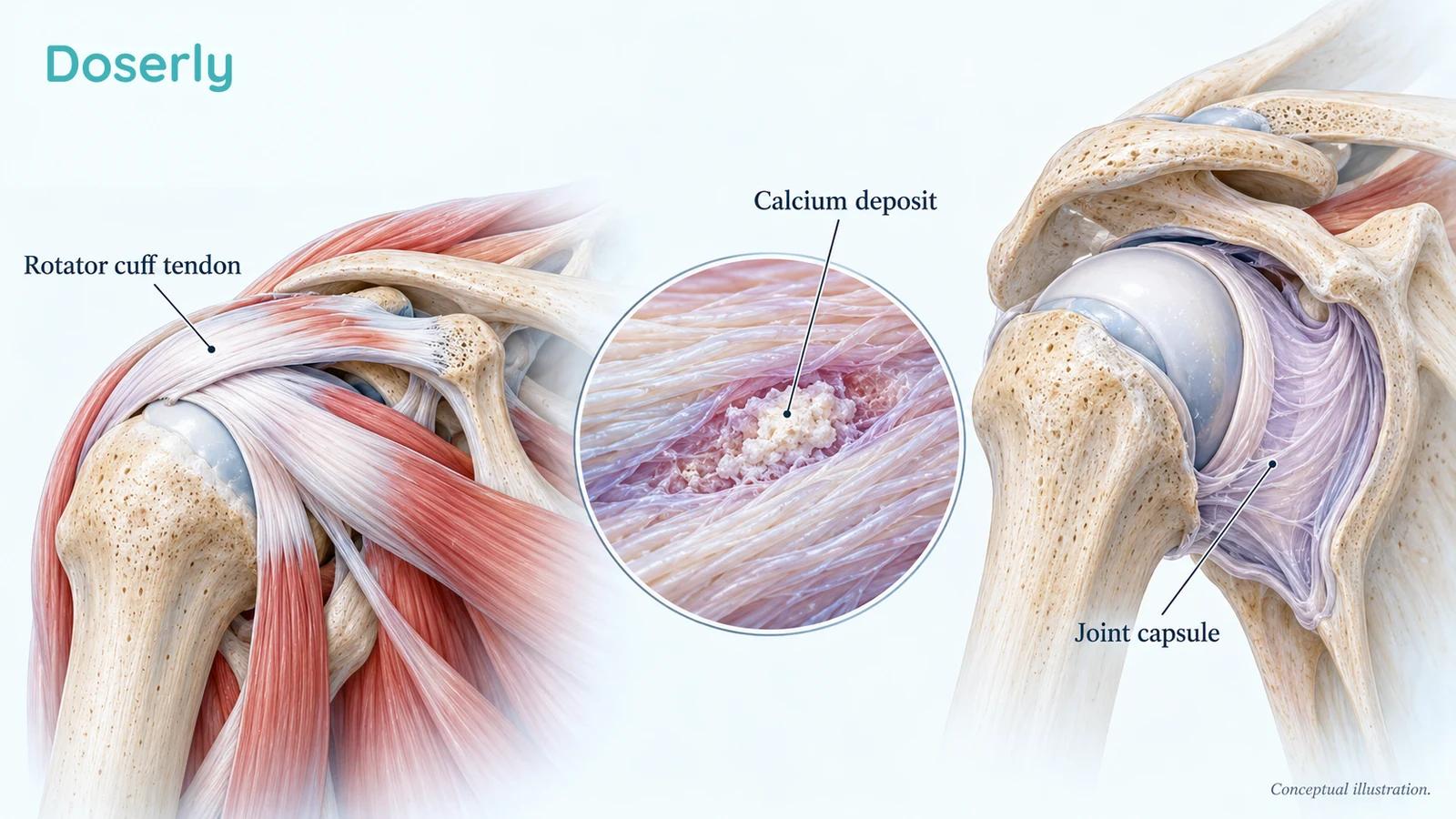
Calcific rotator cuff tendinopathy involves calcium deposits within a tendon. A study published online in September 2024 and in a 2025 journal issue examined 76 painful shoulders in 68 people with ultrasound-confirmed calcific disease. Low-level laser directed to marked calcified areas plus home exercise was compared with home exercise alone.
The active group showed greater short-term improvements in several pain, movement and disability measures, along with changes in the reported number and degree of calcifications. This is more anatomically specific than many pain trials, but it was a short study without a sham-light comparison. Some participants contributed two shoulders, which also matters when interpreting precision. Calcific tendinopathy trial
These findings should not become a claim that a home panel “dissolves calcium” or repairs every tendon problem. The diagnosis, targeted clinical application and comparator all matter. Even when imaging is measured, an imaging change and a useful improvement in a person's life are separate outcomes that deserve separate attention.
Frozen shoulder is not simply a sore rotator cuff
Frozen shoulder, or adhesive capsulitis, involves the shoulder capsule and can produce marked stiffness as well as pain. It can make reaching behind the back, putting on a coat or moving the arm overhead difficult. Its course and care differ from those of many tendon problems. AAOS explanation of frozen shoulder
A trial published online in August 2025 and in a February 2026 issue randomized 60 people with adhesive capsulitis to shockwave therapy, low-level laser or a control group. The active approaches were studied alongside exercise and heat-based care. Both active groups had early pain advantages, while the laser group showed advantages in selected movement, composite shoulder and quality-of-life outcomes at 12 weeks. Adhesive-capsulitis trial
This small, single-center, single-blind study is encouraging for a particular diagnosis and care setting. It does not establish an optimum home exposure, nor does it show that light can replace a tailored plan for a stiff shoulder. A person whose arm is suddenly weak after an injury needs assessment, not an assumption that the problem is frozen shoulder.
After surgery, the question changes again
A 2023 study tested self-applied PBM after arthroscopic rotator cuff repair, alongside standard postoperative care. Sixty-three people were initially randomized, but 13 were excluded before entering treatment; 50 were included in the analysis and 42 completed the six-month assessment. Some pain, disability and quality-of-life outcomes favored active treatment, while the groups had similar improvements in range of motion and the Constant-Murley score. Postoperative PBM trial
That is a useful home-use study, but “at home” does not mean “any home device.” It involved a specific device, postoperative population and clinical plan. The exclusions and follow-up losses also temper confidence in the findings.
Most importantly, the tendon had been surgically repaired. The study does not show that light can replace repair, prevent a retear or make it safe to advance activity faster than the surgical team advises. Less pain can make recovery feel easier without proving that healing tissue is ready for a greater load.
For someone recovering from surgery, decisions about an adjunct should therefore involve the team managing the repair. The meaningful question is whether it helps within the existing recovery plan, not whether it offers permission to bypass that plan.
What these findings mean for an actual care decision
The evidence offers several possible benefits, but it does not identify a universally effective treatment for the entire neck-and-shoulder region. Some studies show pain relief without a functional advantage. Some show no added benefit. Others test a different technology or a more specific diagnosis than the one named in an advertisement.
A useful care discussion begins with what is limiting you. Is it pain when turning your head, interrupted sleep, difficulty lifting a kettle or a reduced ability to reach? These problems may need different assessments and different measures of progress.
For example, consider a person whose neck feels easier immediately after treatment but who still cannot look comfortably to the side. That short-lived comfort may have value. It does not yet answer whether the treatment is helping the task that matters. Another person may gain confidence and function gradually while pain varies from day to day. A single pain score would miss part of that story.
The review point should be agreed in advance. Ask what improvement would make the time, travel and cost worthwhile, and what the plan will be if it does not occur. An open-ended sequence of appointments can make it difficult to notice that an adjunct is not adding much.
Keep the ordinary activity in the record
A simple record can make a follow-up visit more useful. Pick one or two activities that are already part of your life. For neck symptoms, that might be reading or turning to talk with someone beside you. For a shoulder problem, it might be dressing or placing a light object on a shelf, within the limits your clinician has set.
Note whether the activity became easier, whether you changed how you performed it and how long any benefit lasted. Include substantial changes in medication, exercise or workload. Avoid repeatedly provoking a painful movement to see whether a treatment “still works.” The purpose is to understand daily function, not create a new endurance test.
Context can explain an apparent change. A quiet week away from overhead work is different from a week spent painting a room. New exercises, better sleep or a change in pain medication can also influence the result. Your improvement is still real; the context helps avoid giving one part of care all the credit.
This kind of record cannot prove causation. It can support a more grounded conversation than trying to remember the best or worst moment of the previous month.

When the next step should be assessment
Persistent neck symptoms, pins and needles or a cold arm should be discussed with a clinician. New weakness, balance problems or difficulty walking need prompt assessment, especially if symptoms are progressing. These are not situations to explain away as a treatment adjustment. NHS neck-pain advice, NHS advice on urgent symptoms
Sudden shoulder pain with immediate weakness after a fall or forceful movement also deserves assessment. A light appointment cannot determine whether a tendon has torn or another injury needs attention. AAOS injury-related rotator cuff information
If light is being considered for an established condition, ask about the exact device, eye protection, skin sensitivity and any medication-related precautions. Clinical laser studies often use protective eyewear for both patient and operator. A treatment near the neck or shoulder should not become direct eye exposure, and a study's absence of serious reported harms is not a guarantee for every home arrangement.
What is worth knowing before paying for treatment
Ask for the study that best matches your diagnosis, not the longest bibliography. Then ask whether the device and care plan resemble that study, whether active treatment beat an appropriate comparison, and whether the benefit was pain relief, movement, disability or something else.
Light therapy may help some people with selected neck or shoulder conditions, especially as a short-term symptom treatment. The evidence remains uneven, and newer trials do not consistently show that it adds value to rehabilitation. The useful goal is a care plan that helps you move and live more comfortably, with each extra treatment judged by what it contributes to that goal.