
Red Light Therapy
October 17, 2026
Red light therapy for lymphedema after breast cancer: evidence and safety
On this page
An arm that feels heavy by lunchtime can change the shape of an entire day. Clothing fits differently, carrying shopping takes more thought, and a sleeve or bandaging routine becomes another task after cancer treatment. It makes sense to be interested in a treatment that might make the arm softer, lighter or easier to use.
Photobiomodulation, often called low-level laser therapy, has been studied for breast cancer-related lymphedema for more than two decades. Some trials report less swelling or better symptoms. Others find no additional benefit compared with sham treatment or rehabilitation alone. It is a reasonable clinical question, but the evidence does not support replacing compression and rehabilitation with a home red-light panel.
The most useful way to understand this research is to separate three promises: reducing fluid, improving how the arm feels and functions, and establishing long-term safety after cancer. A treatment can have evidence for one without having answered the others.
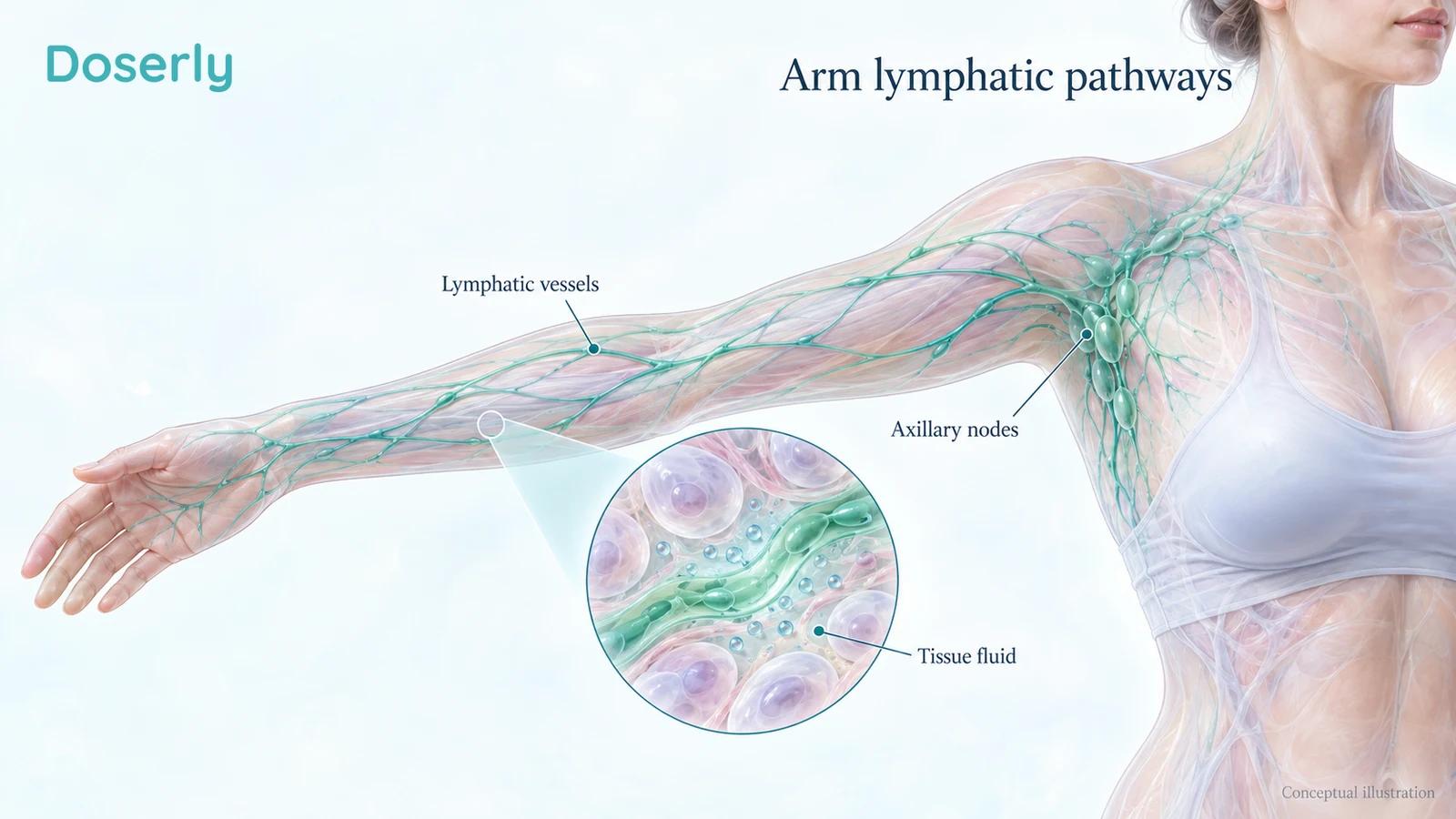
What is happening in the swollen arm?
Lymphatic vessels collect fluid from tissues and return it to the circulation. Breast cancer surgery and radiotherapy can damage this drainage system. Swelling may affect the arm, hand, breast or chest, and it can develop long after treatment. Heaviness, tightness or a change in how a ring or sleeve fits can be reasons to seek assessment. The National Cancer Institute's patient guidance describes lymphedema as a condition that can be managed, even though there is currently no general cure.
That distinction matters emotionally as well as medically. Needing ongoing care does not mean the original cancer treatment failed, and an imperfect response to one rehabilitation technique is not a personal failure. The goal is to make daily life easier and protect function while finding a manageable care routine.
The arm is also more than a container of fluid. Longer-standing lymphedema can involve changes in the surrounding tissues. A measurement of total arm size therefore does not tell the whole story about tissue water, firmness or movement. The APTA diagnostic guideline explains that bioimpedance, which helps assess fluid-related changes, may not capture fibrosis or fatty tissue changes in later disease. Different tools are looking at different parts of the problem.
For someone deciding whether an additional treatment is worthwhile, this suggests a practical starting point: establish what is most troublesome now. Is it swelling that makes a sleeve difficult to fit? A firm patch of tissue? Pain? Difficulty reaching overhead? A useful consultation connects the proposed treatment to that particular problem.
What kind of light treatment is being studied?
These studies generally concern nonthermal photobiomodulation, abbreviated PBM, delivered with clinical low-level laser devices. Some use near-infrared light, including 904 nanometers, which is invisible. Calling the whole field “red light” can obscure that detail. The treatments are intended to influence biological signaling without cutting, ablating or deliberately heating tissue.
A clinical device applied to selected locations is not interchangeable with a broad home panel. The treatment area, contact technique, pulse characteristics, delivered energy and accompanying rehabilitation all matter. Even studies using the same general name may be testing quite different interventions.
The 2020 APTA intervention guideline says low-level laser therapy may be considered with compression or complete decongestive therapy for established upper-extremity lymphedema, with a Grade B recommendation. This is a qualified option within care, not a recommendation that everyone should receive it. The guideline also emphasizes compression tailored to the person's condition, impairments and preferences.
That wording leaves room for a thoughtful discussion with a lymphedema therapist. It does not resolve which device, person or clinical target is most likely to benefit. It also predates several newer trials, so it should be read alongside the subsequent research rather than treated as the final word.
The early trials explain why clinicians became interested
In Carati and colleagues' 2003 placebo-controlled trial, benefits were not immediate. After two treatment blocks, approximately 31% of participants had an arm-volume reduction greater than 200 milliliters at later follow-up. Measures of extracellular fluid and tissue hardness also improved, but shoulder range of motion did not.
That frequently cited result needs careful translation. It does not mean that everyone's arm became 31% smaller. It describes the proportion who passed a specified volume-reduction threshold. Nor does a smaller arm automatically mean easier shoulder movement. The delayed response makes this an interesting signal, while the uneven response makes it unsuitable as a guarantee. The publisher also disclosed an occasional consultancy with the device manufacturer for Carati, a relationship worth considering alongside the trial design.
A 2006 double-blind trial by Kaviani and colleagues enrolled just 11 patients, of whom eight completed treatment. Circumference reductions occurred in both groups and were more pronounced with active treatment; pain findings also tended to favor laser at some assessments. The other measured outcomes did not show substantial between-group differences. With so few completers, the result is a reason for larger testing rather than a reliable estimate of an individual patient's chances.
In Lau and Cheing's 2009 trial, 21 women were assigned to laser treatment or a group receiving no laser irradiation. Arm-volume and tissue-resistance findings favored laser at follow-up. The comparator is important: a no-laser group does not control for treatment attention and expectations as well as a convincing inactive device. The trial supports the possibility of a benefit, but its small size and design leave uncertainty about how much came specifically from the light.
A 50-woman sham-controlled trial published in 2011 found results favoring active treatment for limb-volume reduction at eight and 12 weeks, with improvements in shoulder mobility and grip strength. This is stronger evidence than an uncontrolled before-and-after report. Still, it is one protocol in one patient population. Its positive findings need to be considered alongside later studies that did not reproduce broad improvements.
These early studies were not all asking exactly the same question. Different treatment courses, follow-up periods and outcomes make a single headline success rate misleading. The sensible takeaway is that there was enough human evidence to justify further clinical investigation, not that the issue had been settled.
The negative studies belong in the same conversation
A particularly instructive 2017 placebo-controlled trial enrolled 40 people and tested eight sessions with a cluster laser over the axillary region. Median pain fell by 50% after active treatment, and some other measures improved compared with pretreatment. However, the study did not find statistically significant differences between groups in pain, quality of life, grip strength or limb volume over time.
This is why an appealing before-and-after number cannot carry the whole argument. People receiving sham treatment may also improve. Rehabilitation, ordinary fluctuations, attention and expectations can all contribute. The relevant question is whether active treatment produces an added benefit over its comparator, and this trial did not establish that.
The 2018 New Zealand feasibility trial provides a different caution. Seventeen participants received conventional care with or without additional PBM. Treatment adherence and satisfaction were encouraging, and no serious adverse reactions were reported. But clinical outcomes did not demonstrate additional benefit from the light treatment.
Feasibility is valuable: it tells researchers whether a larger study can realistically be delivered. Satisfaction is valuable too. Neither is interchangeable with an improvement in swelling or function. A patient can appreciate the care and still receive no measurable extra benefit from the device itself.
For a clinic offering PBM, these studies make a review point especially useful. A course should have a stated purpose and a way to decide whether continuing is worthwhile. Repeated visits should not become automatic simply because the treatment is comfortable or has an attractive biological explanation.
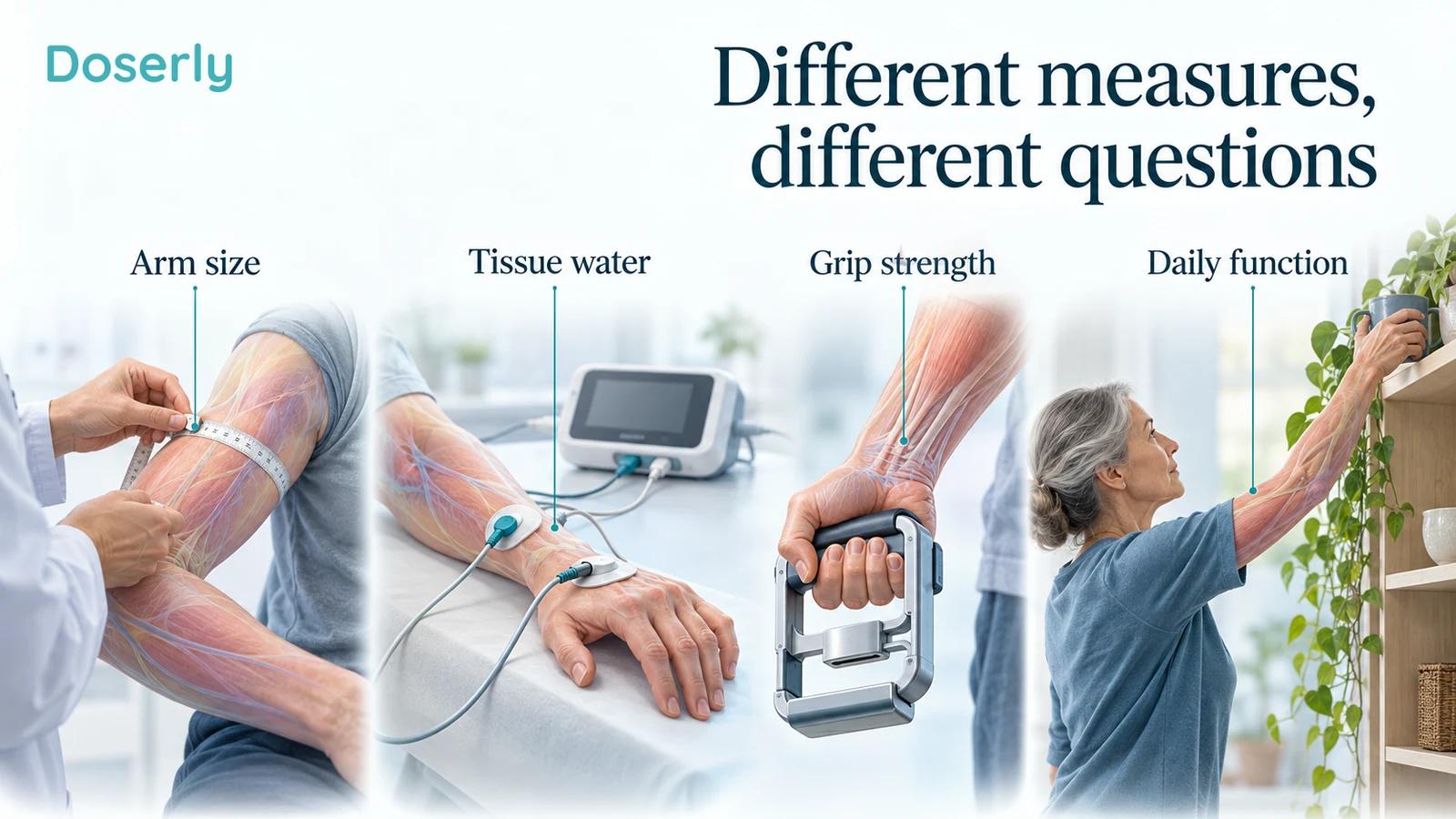
Feeling better and having less swelling are separate outcomes
A 22-person randomized pilot, published online in 2019, compared active and inactive laser alongside complete decongestive therapy. At 12 months, some symptom and emotional-distress findings favored active treatment. There was no significant reduction in limb volume.
That is not a meaningless result. Less heaviness, fewer mobility problems or less distress could matter greatly to someone living with the condition. But the correct description is possible symptom benefit in a small pilot, not proven drainage improvement or reversal of lymphedema. The small sample also makes the percentages look more precise than the underlying evidence really is.
A useful treatment record can therefore contain two parallel observations: what the clinician measures and what daily life feels like. If the arm's measured volume is unchanged but getting dressed is easier, that should be recorded accurately. If a number improves but the arm still feels painful and difficult to use, that deserves attention too.
The same discipline applies to what a treatment has not achieved. A quieter symptom week is not a reason, by itself, to stop a prescribed garment. A softer area is not proof that damaged lymphatic structures have regrown. These are different claims requiring different evidence.
Making measurements useful without making life revolve around them
A measurement is most helpful when everyone understands what it represents. Circumference is the distance around the arm at a particular location; a volume estimate combines information across the limb. A fluid-sensitive test asks another question. The APTA diagnostic guideline discusses these different approaches rather than treating one number as a complete description of the condition.
For a treatment review, ask the therapist to explain the baseline and the comparison being used. A change in the whole arm and a change in the excess size relative to the other arm are different quantities. If someone quotes a percentage improvement, it should be clear which quantity is in the denominator. A smaller percentage can still matter, while a dramatic percentage can be misleading without its starting value.
At home, a short record can support that conversation without becoming a daily examination. For example, note a task that matters to you, how troublesome heaviness felt, and any changes in the prescribed care routine. Bring those observations to the planned review. They are context for the clinical measurements, not a substitute for assessment or a way to diagnose a new swelling problem yourself.
Keeping the record simple is especially useful if several things change together. A newly fitted garment, a different work schedule and a light course may all begin in the same month. Improvement during that month is welcome, but an individual diary cannot reliably assign the credit to one component. Its purpose is to help the care team make the next decision with a clearer picture of your experience.
Does PBM add anything to the rest of rehabilitation?
In Ridner and colleagues' 2013 randomized pilot, 46 women received manual lymphatic drainage, low-level laser, or a combination. All groups received compression bandaging afterward. Fluid and arm-volume measures improved across the groups, without a statistically significant difference in the amount of improvement between them. Symptom burden also improved without a clear advantage for one group.
The shared bandaging is central to interpretation. The study cannot show that light alone produced the improvement, and it cannot justify removing compression from the care plan. It raises a service-delivery question about how different components might fit together, but a small pilot is not definitive evidence that all options are equivalent.
A 2023 trial with 45 analyzed patients compared laser, kinesio-taping and manual lymphatic drainage in stage II disease. Every group also received compression bandaging, exercises, skin care and education. There were improvements within the treatment programs, while between-group comparisons did not establish a laser advantage for quality of life, arm disability or neuropathic pain.
The paper also reports that three people allocated to taping were excluded after allergic skin reactions. That detail reminds us that a comparison of rehabilitation packages has practical tolerability issues as well as statistical ones. It is not a simple contest in which the most modern-looking device wins.
For patients, the question becomes more specific: “What might this add to the care I already receive?” That is more useful than asking whether laser works in isolation. It also helps protect the parts of care that are already helping, rather than replacing several things at once and losing track of what changed.
The September 2026 study tested fluid and firmness directly
A trial published on September 24, 2026 randomized 46 patients to 904-nanometer laser, 650-nanometer laser or sham, all alongside the same conventional decongestive program. Treatment targeted individually selected areas of chronic tissue change. The investigators measured lymphatic imaging, extracellular fluid, local tissue water and ultrasound-based tissue properties.
Neither active treatment produced significant additional improvements in the fluid-related or lymphatic imaging outcomes. One regional stiffness measure favored 904 nanometers over 650 nanometers. That was an active-device comparison, not consistent evidence of superiority over sham, and the authors describe the local findings as exploratory.
The study was small, lacked long-term follow-up, and used devices that differed in more than wavelength. It does not establish an optimal wavelength, generalized antifibrotic efficacy or restored lymphatic drainage. Its importance is the separation of these questions: a local mechanical change can occur without a measurable fluid or transport benefit.
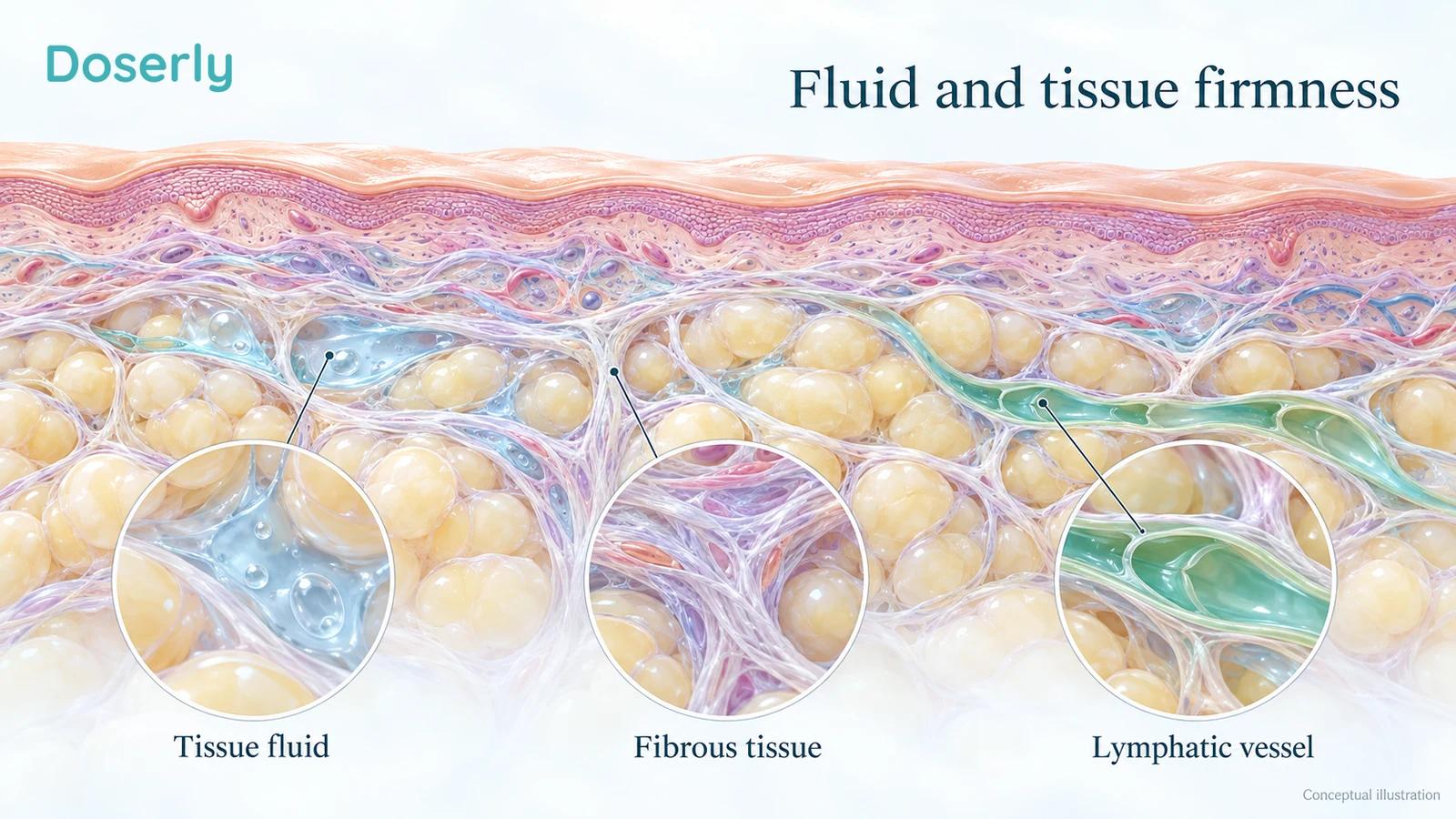
Earlier work had already hinted that local changes can be short-lived. A 2011 study of 38 arms and 38 legs measured tissue water and resistance to indentation around a small treated area. Immediate reductions followed active treatment, but a later sham session in a subgroup of 17 legs produced a similar pattern, with smaller reductions. This was not a randomized breast cancer efficacy trial, and the sham comparison involved legs. It cannot establish a lasting benefit for an arm after breast cancer.
Together, these findings encourage careful language. “The tissue felt softer immediately afterward” can be an honest observation. “The light repaired the lymphatic system” goes much further than those measurements allow.
Does light actually speed up lymph flow?
A November 2025 study in 32 healthy volunteers used indocyanine-green imaging to observe lymphatic transport. Participants received manual lymphatic drainage followed by one of two laser approaches. Lymph-packet counts rose after manual drainage and fell during the subsequent laser period; there was no significant difference between wavelength groups in lymphatic motility.
Because the participants did not have lymphedema, and the treatments occurred in sequence without a sham comparison, this does not establish that PBM worsens lymphedema. It does, however, challenge the simple claim that light necessarily makes human lymph flow faster. A proposed mechanism should remain a proposal until the relevant clinical measurements support it.
This distinction is particularly useful when evaluating an illustration or a clinic explanation. A diagram showing fluid moving through a vessel is a teaching aid. Unless the treatment study actually measured and demonstrated improved transport, the diagram is not evidence that the device restored that transport.
Compression and movement remain the foundation
The NCI's professional lymphedema summary describes complete decongestive therapy as a combination of skin care, exercise, manual techniques and compression, with an intensive phase followed by maintenance. A plan may look different during active swelling reduction than after the arm has stabilized.
The time commitment is real. Garment comfort, hand function, work responsibilities and access to a trained therapist all affect whether a plan can be followed. When treatment feels unmanageable, the useful response is to discuss fit, technique and priorities with the care team. Adding another appointment does not necessarily solve the practical difficulty that made the existing routine hard.
Movement also deserves a more reassuring explanation than simply “protect the arm.” In a randomized trial of 141 women with stable lymphedema, slowly progressive weight lifting did not increase arm swelling compared with control. Participants wore well-fitted compression garments during lifting. The exercise group improved strength and symptoms and had fewer specialist-assessed exacerbations, 14% versus 29%.
This supports appropriately guided progression in that population, not a sudden return to any load or activity without assessment. It also shows that meaningful rehabilitation outcomes can improve even when arm swelling itself does not change substantially. A stronger arm that manages everyday tasks more comfortably is a worthwhile outcome in its own right.

What can the studies say about cancer safety?
Someone who has been through breast cancer is entitled to a direct answer about recurrence concerns. The lymphedema studies discussed here were mainly designed to assess swelling, symptoms or function. They do not provide a large, long-term randomized answer about breast cancer recurrence after PBM. An absence of reported serious reactions during a small rehabilitation trial cannot answer that separate question.
It would be equally misleading to claim that these studies prove PBM causes recurrence. They do not. The honest position is that an individualized oncology discussion remains necessary, especially when there is active disease, a new unexplained lump or a proposed treatment area close to previously treated tissues. Evidence for supportive care should not be presented as evidence that light treats cancer.
The distinction also affects what “safe” means in a consent discussion. Immediate tolerance, skin reactions, device-related injury and long-term cancer outcomes are not one combined endpoint. A clinic should be able to explain what was monitored in the relevant studies and what remains uncertain, rather than offering an unqualified assurance based on the word “nonthermal.”
New redness, warmth, tenderness or increased swelling, particularly with fever, needs prompt clinical attention because it may indicate cellulitis. The NCI advises contacting the health care team right away for these signs. Such a change should not be interpreted as a desirable treatment response or something to wait out while finishing a light course.
Questions that make an appointment more useful
If PBM is being considered, a few concrete questions can keep the discussion grounded:
- Which problem are we trying to improve: volume, firmness, heaviness, pain or function?
- Which study most closely matches my type and stage of lymphedema and this device?
- What will continue alongside treatment, including compression and exercise?
- How will we measure progress, and when will we review whether the visits are worthwhile?
- What does my oncology team need to know about the proposed treatment area?
It is reasonable to ask about cost and time before beginning. A possible modest benefit may be worthwhile to one person and not to another, particularly when travel or appointments are exhausting. Choosing against an uncertain additional treatment does not mean neglecting rehabilitation.
It also helps to agree on how an improvement will be described. “Less heaviness and easier dressing, without a measurable volume change” is a clear, useful result. “Lymphedema reversed” is a much larger claim. A careful clinician should welcome the more precise description.
PBM has a legitimate place in the research conversation and may be considered as an adjunct in selected clinical care. The evidence remains mixed, and the latest objective trial does not establish improved fluid clearance. The strongest practical approach is to keep compression, movement and follow-up in place, define the hoped-for benefit clearly, and judge the additional treatment by what it actually changes in your arm and your life.