
Red Light Therapy
October 17, 2026
Red light therapy for knee arthritis: pain relief, movement and mixed trial results
On this page
Knee arthritis can make ordinary plans feel negotiable. A walk depends on how the knee feels that morning. Stairs need more thought. Getting up from a low chair becomes something you notice every time. It is understandable to be interested in a treatment that might make movement easier without another medicine or an invasive procedure.
Red light therapy has been studied for that purpose, usually under the names photobiomodulation, PBM, or low-level laser therapy, LLLT. Some randomized trials have reported improvements in pain and function. Others, including a larger trial that added PBM to a strengthening program, found no extra benefit. The disagreement is part of the evidence, not a detail to hide at the end.
As of October 17, 2026, PBM may provide symptom relief in some knee-osteoarthritis settings, but the results are inconsistent and do not establish cartilage regrowth or a reliable added benefit over good exercise-based care. A clinical laser study also does not establish that a home red-light panel will produce the same result.
The useful question is therefore specific: could a particular treatment meaningfully improve your pain or everyday movement, beyond the care you are already receiving, at a cost and inconvenience you consider worthwhile? Answering that question requires looking at the comparisons rather than counting positive study titles.
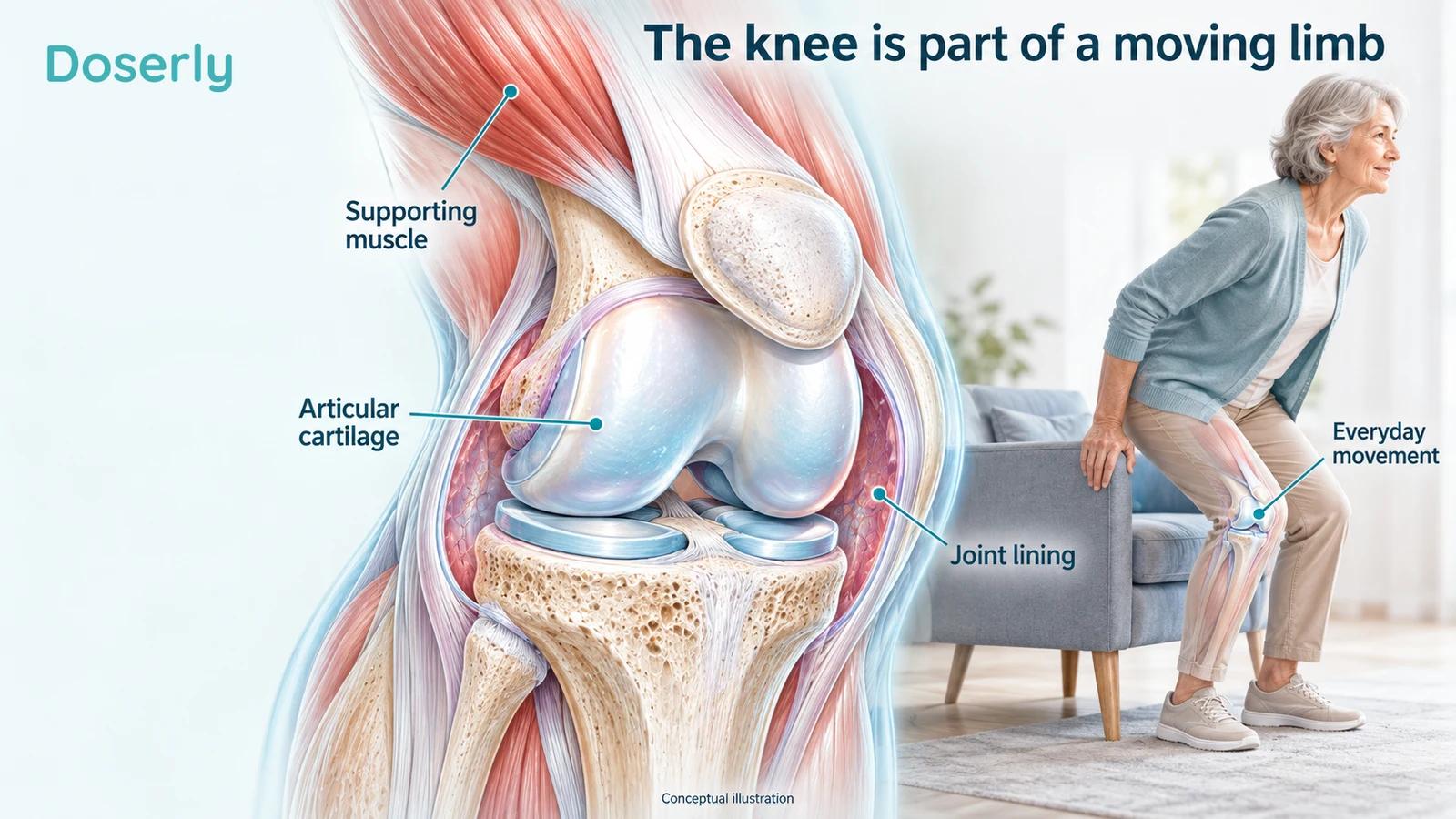
Knee osteoarthritis is more than a worn surface
Articular cartilage is the smooth tissue covering the ends of bones where they meet in a joint. In osteoarthritis, cartilage changes occur alongside changes in other joint structures and the tissues that support movement. Treating the knee as a simple piece of worn rubber misses much of what a person actually experiences.
The surrounding muscles influence how tasks are performed. Joint stiffness, confidence, balance and the demands of a particular activity also affect function. Someone who can walk comfortably on level ground may still find stairs difficult. A pain score taken while sitting quietly may not reflect the problem that brought them to a clinic.
This is one reason osteoarthritis trials use several measures. The WOMAC questionnaire asks about pain, stiffness and physical function. The KOOS includes different aspects of knee-related symptoms and life. A chair-rise or walking test measures an actual task. Those outcomes overlap, but each contributes something different.
A 2023 randomized study compared 808-nm and 660-nm low-level laser treatment with a sham condition, measuring muscle strength and functional outcomes. It reported a greater knee-extensor strength improvement with the 808-nm treatment. The relevance is that function can be studied directly rather than inferred from a tissue hypothesis. The study does not establish a universally best wavelength or tell us that every knee problem should receive that exposure. Original wavelength and function trial
Before choosing any adjunct, it helps to name the task you want to improve. Perhaps it is walking to the shops, standing to cook or using stairs with less hesitation. That goal gives a clinician a clearer starting point than simply asking to improve the knee.
What kind of light was studied?
Most knee studies used a clinician-operated laser applied at selected points near the joint. The treatment parameters included wavelength, power, energy per location and repeated visits. These were defined exposures, often delivered with the probe in contact with the skin.
A home panel creates a different situation. Light is spread over a larger area from a distance, and its distribution changes with positioning. Even when the advertised wavelength resembles a research device, the light reaching the relevant tissues may differ. You cannot calculate a reliable clinical effect from wavelength alone.
Low-level nonthermal PBM should also be distinguished from high-intensity laser therapy. A 2023 trial compared the two approaches alongside rehabilitation exercises in 34 adults. The high-intensity intervention produced greater improvements on several outcomes than the low-level scanning intervention. That comparison is about two different clinical modalities. It cannot be used as proof that an ordinary red-light panel has the effects of the high-intensity laser, or that more heat is a better PBM treatment. Low-level versus high-intensity comparison
This distinction is especially important when a clinic or device seller groups every laser paper under one heading. Ask which treatment was used, whether the study included a sham and whether the equipment being offered is comparable. Those questions help prevent a citation from carrying more weight than the actual experiment permits.
The positive 2025 trial deserves a careful reading
A study published in June 2025 randomized people with symptomatic knee osteoarthritis to PBM, sham treatment or no intervention. Seventy-three people entered the initial sample and 65 were included in the final analysis. Most participants were women. The active group received a specified 790-nm laser treatment at selected points around the knee.
Pain improved compared with the sham and untreated groups. The abstract also described improvements in WOMAC measures within the PBM group and reported favorable clinical conclusions. However, a within-group improvement is not the same statistical comparison as a difference between treatment groups. The accessed abstract does not provide enough absolute effect and durability detail to translate the result into a reliable personal prediction. 2025 randomized knee trial
The reasonable response is interest, with boundaries. This is human controlled evidence for a specific treatment, not merely a laboratory mechanism. It is also a modest study with withdrawals and a particular application method. It does not tell us that all red-light devices work, that the benefit persists indefinitely or that the joint structure was repaired.
If someone cites the paper to you, ask what change in pain an average participant experienced compared with sham, how long it lasted and whether the proposed treatment resembles the study. If those details are unavailable, uncertainty should remain visible. A small p value cannot substitute for the size of a benefit you might actually notice.
The larger exercise trial found no extra benefit
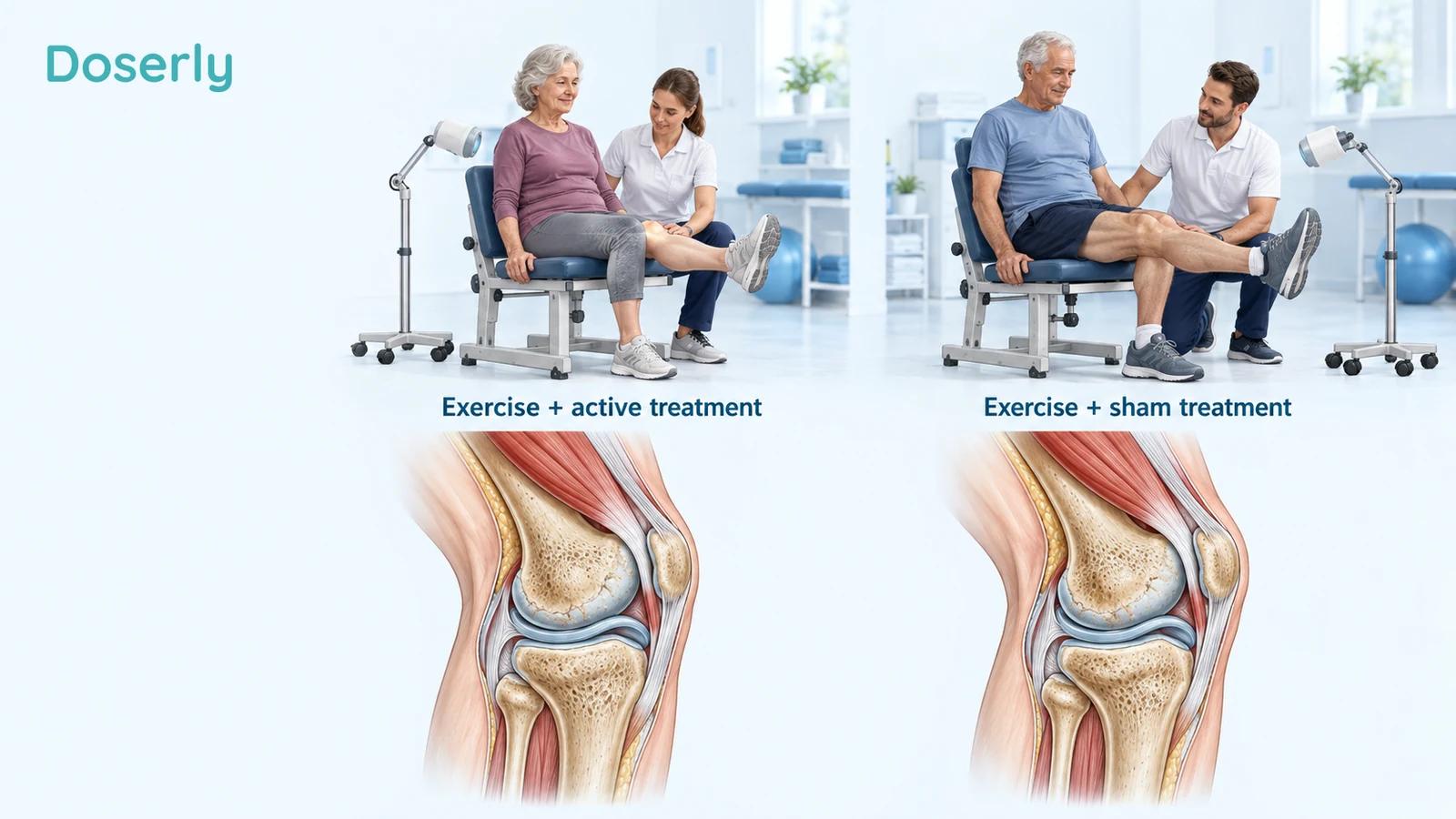
The key counterpoint is a 2023 trial involving 127 participants. People received exercise alone, exercise plus active PBM, or exercise plus placebo PBM. Treatment ran for eight weeks, and outcomes were followed after treatment and at three and six months.
The groups did not differ in improvement in pain, physical function or quality of life. All groups showed clinically relevant improvement after the treatment program, but adding PBM did not improve the outcome beyond the exercise-based comparison. This is particularly relevant for someone already participating in a strengthening program, because it asks about the extra value of the light treatment. 2023 exercise-add-on trial
The longer follow-up also had a limitation: dropout reached 18% after treatment and 45% by six months, and the analysis imputed missing observations. That reduces confidence in the durability estimate, even though the reported comparisons did not show added benefit.
The finding does not mean that the participants failed to improve. They improved without evidence that active light added something. That is an encouraging result for exercise care and a caution about paying for an adjunct whose additional effect is uncertain.
It also explains why this trial and the 2025 trial are not identical questions. Comparing PBM with no intervention or sham alone differs from adding PBM to an active program. When the background treatment changes, the amount of additional benefit available to detect may change too. The studies can disagree without either being irrelevant.
Earlier studies also contain both signals and limitations
A 2003 randomized trial assigned 90 people to two low-power laser regimens plus exercise or placebo laser plus exercise. It reported favorable pain and functional findings for the active regimens. That is part of the reason the approach has remained a research topic. It does not settle which modern device, treatment schedule or patient subgroup is most likely to benefit. Foundational low-power laser trial
A 2004 study of 60 people compared two active laser dose regimens with placebo and found no significant benefit at the assessed time points. Its result is a useful reminder that mixed findings are not only a recent development. Exposure differences may matter, but they do not justify treating every negative study as automatically irrelevant. Earlier placebo-controlled null trial
A small 2009 trial reported improvements in pain, flexion and other measures after local laser treatment, along with thermographic changes. Only 27 participants completed the study, with unequal numbers in the active and placebo groups. Temperature changes on thermography should not be interpreted as evidence that cartilage has regenerated. Pain and thermography trial
A 2012 trial combined laser or placebo treatment with exercises in 40 participants. The original abstract reported a between-group difference in activity but not in the other measured variables, even though the active group's before-and-after results were favorable. This is an important example of why the conclusion should be read alongside the actual comparison. Laser plus exercise trial
A 2014 study in 49 people applied active or placebo low-level laser at selected acupuncture points alongside exercise and advice. It reported a pain advantage at six weeks and six months. This is a distinct application method, not evidence that any spot on the knee or any broad light exposure will produce the same result. Point-specific laser trial
Another 2014 randomized study in 40 people found short-term advantages for pain, knee function and walking duration with active treatment compared with placebo. The follow-up described in its abstract was short, so it informs symptom relief more directly than long-term disease management. Short-term pain and walking trial
Taken together, these experiments justify neither dismissing the entire idea nor presenting it as settled care. They identify possible symptom benefits while leaving uncertainty about consistency, added value and durability.
What longer follow-up can and cannot tell us
A 2022 placebo-controlled trial followed 50 people receiving strength training with active or placebo low-level laser. Assessments extended to one year. The primary pain outcomes did not differ significantly between groups. At 52 weeks, the active group had favorable findings for medication use and chair-stand performance, while other comparisons were not uniformly favorable. Those later secondary findings are worth studying, but they do not erase the null primary pain results. One-year strength-training trial
For a person deciding about treatment, follow-up matters because the burden is ongoing. A temporary reduction in discomfort can be useful, especially if it supports an important activity. But a benefit that disappears quickly has a different value from one that persists after appointments stop.
Ask whether maintenance treatment was studied or merely suggested. If a provider recommends indefinite sessions, the evidence should support that ongoing plan rather than only a short initial course. It is also reasonable to ask how the plan will be reassessed if your walking or daily function does not change.
A favorable average at one year does not mean every participant maintained the same benefit throughout the year. Likewise, a single disappointing follow-up does not explain each person's experience. The strongest practical approach combines the trial's overall result with a clear, individual goal and a planned review of whether that goal is being met.
Pain relief does not demonstrate cartilage regrowth
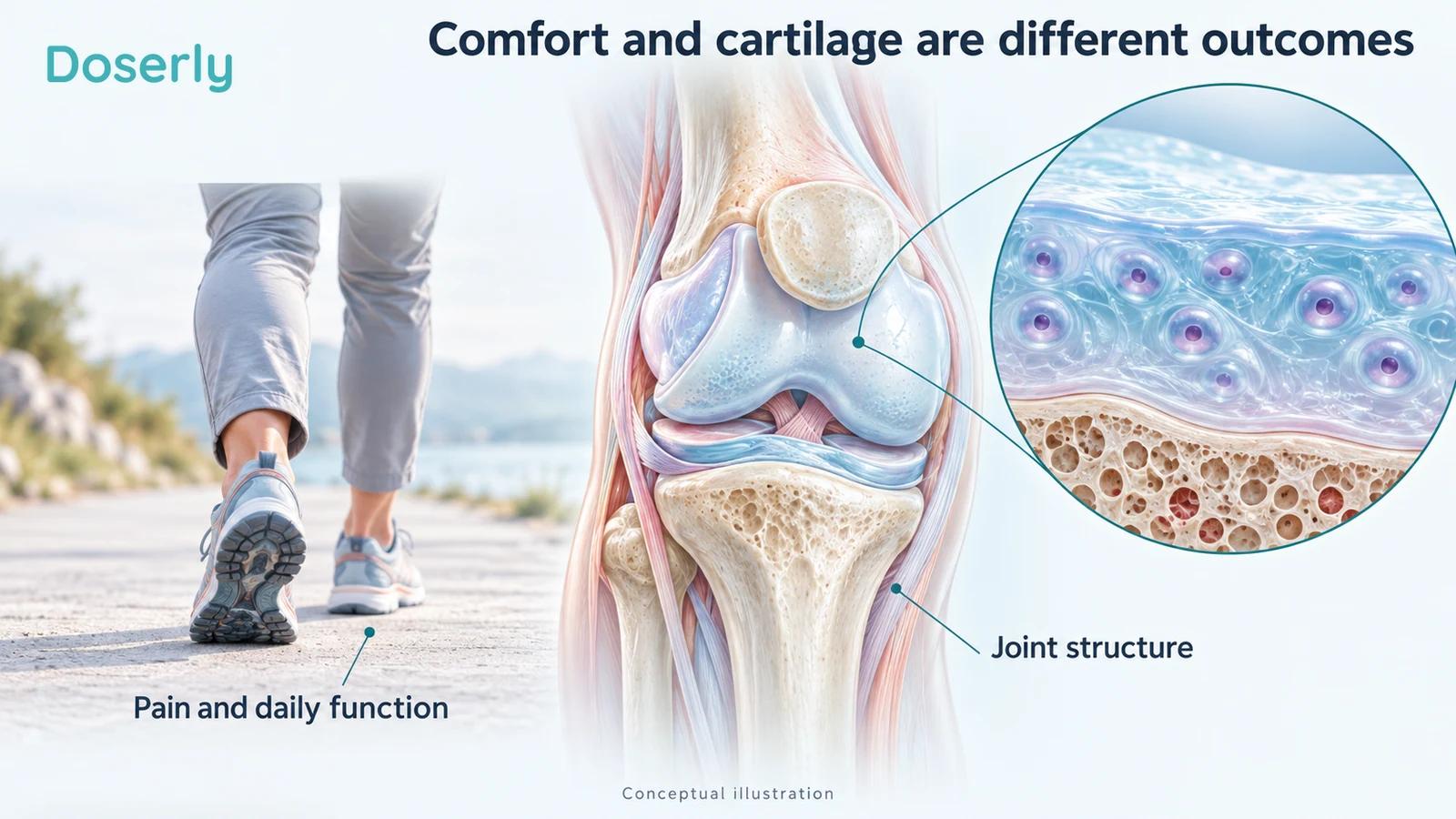
This distinction deserves its own space because it is easy to lose in a persuasive illustration or before-and-after story. Pain and function are valuable clinical outcomes. They are not interchangeable with changes in joint structure.
A 2025 randomized comparison of high-intensity and low-level laser, both combined with exercise, included ultrasound cartilage-thickness measurements. Both groups changed on several measures, and the high-intensity group had greater improvements in some symptoms and motion outcomes. There was no significant difference between the groups in cartilage thickness. Because this was a comparison between active treatment packages, the findings do not establish that light regenerated cartilage or reversed osteoarthritis. 2025 clinical and ultrasound comparison
An imaging measurement also needs its own interpretation. The position of the knee, measurement technique, the structure being sampled and follow-up duration matter. A small numerical change on ultrasound is not automatically new durable cartilage. A claim about structural repair requires a design capable of distinguishing a treatment effect from measurement variation and other influences.
For someone living with pain, this boundary does not diminish symptom relief. Walking more comfortably can be a meaningful success even when the joint has not been rebuilt. The problem arises when relief is used to justify a larger promise, such as reversing arthritis, avoiding every future operation or making normal clinical follow-up unnecessary.
How current guidance fits the mixed evidence
NICE's osteoarthritis guidance recommends tailored therapeutic exercise and considers supervised sessions. It advises against offering laser therapy because evidence of benefit is insufficient. That recommendation is a statement about routine care, not a claim that no individual trial has ever found improvement. NICE osteoarthritis recommendations
Guidelines must consider the overall evidence, its reliability and how an intervention fits into care. A newly published positive study can inform future review without instantly overturning an existing recommendation. It is therefore possible to acknowledge the 2025 trial while also explaining that routine laser therapy remains unsupported by this guideline.
A clinician may discuss an adjunct differently depending on local guidance, the available equipment and your circumstances. The important conversation is transparent: what benefit is expected, what evidence supports it, what alternatives exist and what would lead to stopping? The answer should not depend on calling uncertainty a lack of open-mindedness.
If appointments or money are limited, consider what each option adds to your ability to manage the condition. A supervised exercise session may teach something you can continue at home. A passive treatment may offer temporary relief but require repeated attendance. Those differences matter even before the size of the treatment effect is known.
Make movement goals concrete
A useful goal is something you would notice in daily life. Walking a familiar route with fewer stops, standing from a chair with less difficulty or using the stairs more confidently are clearer targets than improving inflammation in general.
Choose a task that is safe and relevant to you. Record the conditions that affect it, such as the distance walked, use of a handrail or a particularly demanding day. A lower pain score after doing much less activity can be a misleading sign of progress if the real goal is to move more.
It can help to track symptoms and function separately. One person may have less pain but still avoid activity because of fear or weakness. Another may walk farther while experiencing a similar level of discomfort. Both patterns deserve discussion, and neither can be understood from a single number alone.
Keep medication use in context as well. If it changes during a treatment course, note that change rather than assuming the light explains every improvement. Do not stop prescribed treatment to create a cleaner personal experiment. The purpose of tracking is to improve care, not to make a device comparison more dramatic.
If you are also exploring supplements, the Doserly collagen guide provides background on a separate question. A possible symptom benefit from a supplement does not validate PBM, and a PBM study does not establish that a combination repairs cartilage. Each claim needs its own evidence.
Compare a useful week, not just a good afternoon
A knee can feel different from day to day even when the underlying treatment has not changed. That makes a single pleasant afternoon after a clinic visit encouraging but difficult to interpret. A more useful comparison looks at a familiar pattern of activity over time, including days when symptoms are less convenient.
For example, consider someone whose goal is to walk to a nearby shop. Before treatment, they might stop halfway, carry less shopping or avoid the trip after another demanding activity. A meaningful improvement might be completing the same route more comfortably on several occasions. Simply reporting less pain on a day spent mostly sitting would answer a different question.
Another person may care most about getting out of a chair. Chair height, use of the arms and footwear change the task. If those conditions vary between checks, an apparent gain may reflect the easier setup. Keeping the task reasonably consistent makes an improvement more believable and makes it easier to describe at a follow-up appointment.
You can also distinguish immediate relief from a sustained change. Note how the knee feels later that day and during the next usual activity, rather than recording only the moment the session ends. This is not a requirement to prove that an experience is real. It is a way to understand whether the benefit fits the part of life you want treatment to improve.
Include the treatment burden in that record. Travel, waiting time, cost and arranging help may be substantial even for a procedure that is physically easy. If the result is temporary comfort but the appointments make the week harder, that tradeoff deserves an honest discussion. If a modest benefit allows an important activity, that can matter too.
A clinician can help decide which changes are large enough to be meaningful and which tests are appropriate. The goal is not to monitor every sensation or repeatedly challenge a painful knee. It is to collect enough consistent information to make the next decision together: continue, adjust the broader care plan or stop an adjunct that is not adding useful value.
A reasonable discussion before paying for treatment
Start with diagnosis. Knee pain can arise from several conditions, and this article concerns osteoarthritis. An acutely hot, markedly swollen knee, fever, a recent major injury or a sudden inability to bear weight needs clinical assessment rather than an assumption that the usual arthritis has simply flared. NHS advice on knee symptoms requiring urgent assessment
Ask a provider to identify the closest human trial to the proposed treatment. Was the study about osteoarthritis of similar severity? Did it use a local probe, a scanning laser or another device? Was exercise included? Did active treatment outperform sham, and for which outcome?
Ask about the expected size and duration of benefit. An honest answer may be that those details are uncertain. That uncertainty should influence the cost you are willing to accept and the point at which you reassess. A prepaid long course is harder to evaluate if no one has defined what success would look like.
Discuss device-specific safety, including eye protection and how the operator avoids excessive heating. Greater discomfort during treatment is not evidence of deeper healing. A result from high-intensity laser therapy cannot justify increasing exposure with a different home device.

What a useful outcome would look like
The most persuasive result would be a repeatable improvement in an activity that matters to you, sustained long enough to justify the treatment burden, without crowding out effective care. It would not require a claim that the knee has become biologically younger or that cartilage has grown back.
Some people may decide that a carefully discussed adjunct is worth trying within their clinical care. Others may prefer to invest their time in exercise support, practical adaptations or a review of established treatment options. The mixed evidence makes both decisions understandable when expectations are realistic.
The research remains worth following. Better trials can clarify which exposures, patients and outcomes are most promising. For now, the strongest reading keeps the whole picture intact: positive symptom trials exist, a larger exercise-add-on trial was negative, and symptom relief should be judged on its own merits without being promoted into proof of joint repair.