
Red Light Therapy
October 17, 2026
How long does red light therapy take to work, and do results last?
On this page
If you have been using a red light device for a few weeks, it is reasonable to want a clear answer: should you be noticing something by now? The difficulty is that “something” might mean smoother skin, more hair, less knee pain or better recovery after exercise. Those outcomes have different research timelines, and some have much stronger evidence than others.
The human studies do not support a single countdown that applies to every use of red light therapy. Some skin trials assess changes after four weeks. Hair studies often look over several months. Pain studies may measure an immediate response, the end of a treatment course and later follow-up separately. A result at one of those points cannot fill in all the others.
There is a second question that deserves just as much attention: what happens when treatment stops? A six-month study can mean six months of continuing treatment. It does not necessarily mean that a benefit lasted six months after the final session. Understanding that distinction helps set more realistic expectations before investing time or money.
Start with the result you actually want
“Working” needs a definition. For skin, you might care about the appearance of a particular fine line. For hair, you might care about density in a thinning area. For pain, the meaningful change might be walking more comfortably or sleeping through the night. Those are more useful targets than a general promise about cellular energy.
The first thing to check in a paper is whether its outcome resembles yours. An instrument that detects a small change in skin texture is not measuring exactly the same thing as a person deciding whether their face looks different. A hair count within a marked scalp area is more specific than an overall impression of fullness. A pain score at rest does not describe every activity.
This does not make laboratory measurements unimportant. They can detect changes that are hard to assess consistently by eye. It means that a convincing article should explain both the measurement and its practical meaning. A small measurable effect can be scientifically useful while remaining difficult to notice in daily life.
The American Academy of Dermatology describes red light as a potential option for selected skin and hereditary hair-loss concerns, while emphasizing variation between devices, studies and individual responses. It also notes that use generally needs to be repeated and that not everyone sees a result. That is a better starting point than a guaranteed week-by-week transformation. AAD overview of red light therapy
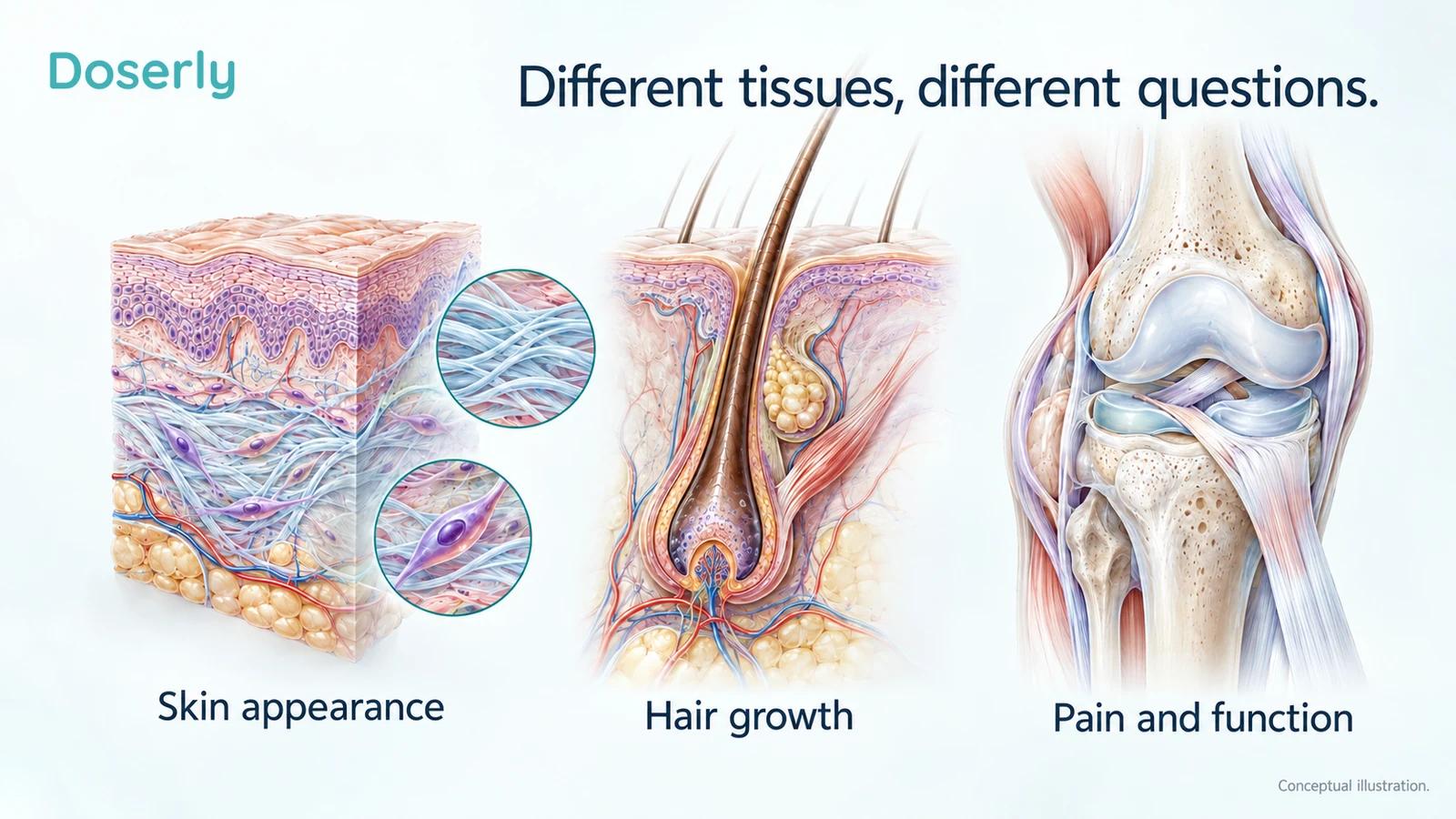
Four weeks can be a research checkpoint, not a promise
A 2025 randomized, sham-controlled trial studied 95 women using a red LED mask. The researchers compared two and three applications per week over four weeks, then evaluated photographs 30 days after treatment. The findings depended on how wrinkles were assessed: the specialist-rated Wrinkle Assessment Scale did not distinguish the groups, while software measurements favored PBM for selected wrinkle locations. Satisfaction also favored the active groups. More sessions did not clearly produce better results. 2025 facial-rejuvenation frequency trial
That gives a useful, specific expectation: this study looked for differences after a defined course and short follow-up, and its outcomes were mixed. It does not mean every person should see improvement in four weeks, or that an unchanged photograph at that point proves that all possible benefits have been ruled out.
A separate 2023 split-face trial recruited 137 women and compared red with amber light over ten sessions in four weeks. Both sides showed reductions in measured wrinkle volume, but hydration and viscoelasticity did not improve. Because both sides received active light, the design does not answer every question that a sham comparison would. It also does not establish how long an effect persists after treatment ends. Red-versus-amber wrinkle trial
Together, these trials explain why a “four-week result” should always be followed by two details: which result, and compared with what? The treatment period is only part of the evidence.
The first measurement is not necessarily the first response
Suppose a study measures an outcome before treatment and again at four weeks. If the second measurement improves, we know that a change was detected by that visit. We do not know whether it began on day three, day twelve or the day before the assessment. A paper needs measurements between those visits to describe that part of the timeline.
The same reasoning applies to stopping. If a study checks one month after the final session, a remaining difference provides information at that point. It does not establish the exact day on which a response would disappear later. Describing the observation window honestly is more informative than inventing a precise expiry date.
This also explains why two reasonable articles can give different time estimates without necessarily contradicting each other. One may be discussing the earliest measured signal, another the end of a treatment course, and another a visible change that participants noticed. Before comparing their estimates, check that they are answering the same question.
For your own expectations, use the studied assessment window as context rather than a deadline. If a clinician recommends a review, ask which outcome will be reassessed and what the next decision will depend on. That produces a more useful plan than simply waiting for a particular number of days to pass.
What longer skin studies add
An older randomized, placebo-controlled study enrolled 76 people with facial wrinkles. It tested red light, near-infrared light, their combination and sham treatment, using a four-week treatment course with a three-month follow-up period. The investigators reported improvements in selected clinical measurements and examined tissue samples for changes in collagen, elastic fibers and related markers. 2007 clinical and tissue study
This is one reason skin research extends beyond whether someone feels an immediate glow. The tissue observations provide biological context, while the clinical measurements address appearance. But the study still concerns particular devices and conditions. It does not establish that every mask produces the same response, or that a visible benefit continues indefinitely.
A 2023 study followed 20 women through three months of use of a particular 630 nm mask. The authors reported progressive improvements and persistence of findings for up to one month after stopping. That is actual off-treatment follow-up, but it came from a small study without a randomized sham comparison. The participants were White women, and the authors included people affiliated with the companies involved in the product. Three-month mask study
The useful conclusion is narrower than “lasting rejuvenation.” Some observed changes remained during the month that researchers checked. The study cannot tell us the typical duration for other populations, establish the best maintenance schedule or show that the changes would remain a year later.
Hair results are usually assessed over months
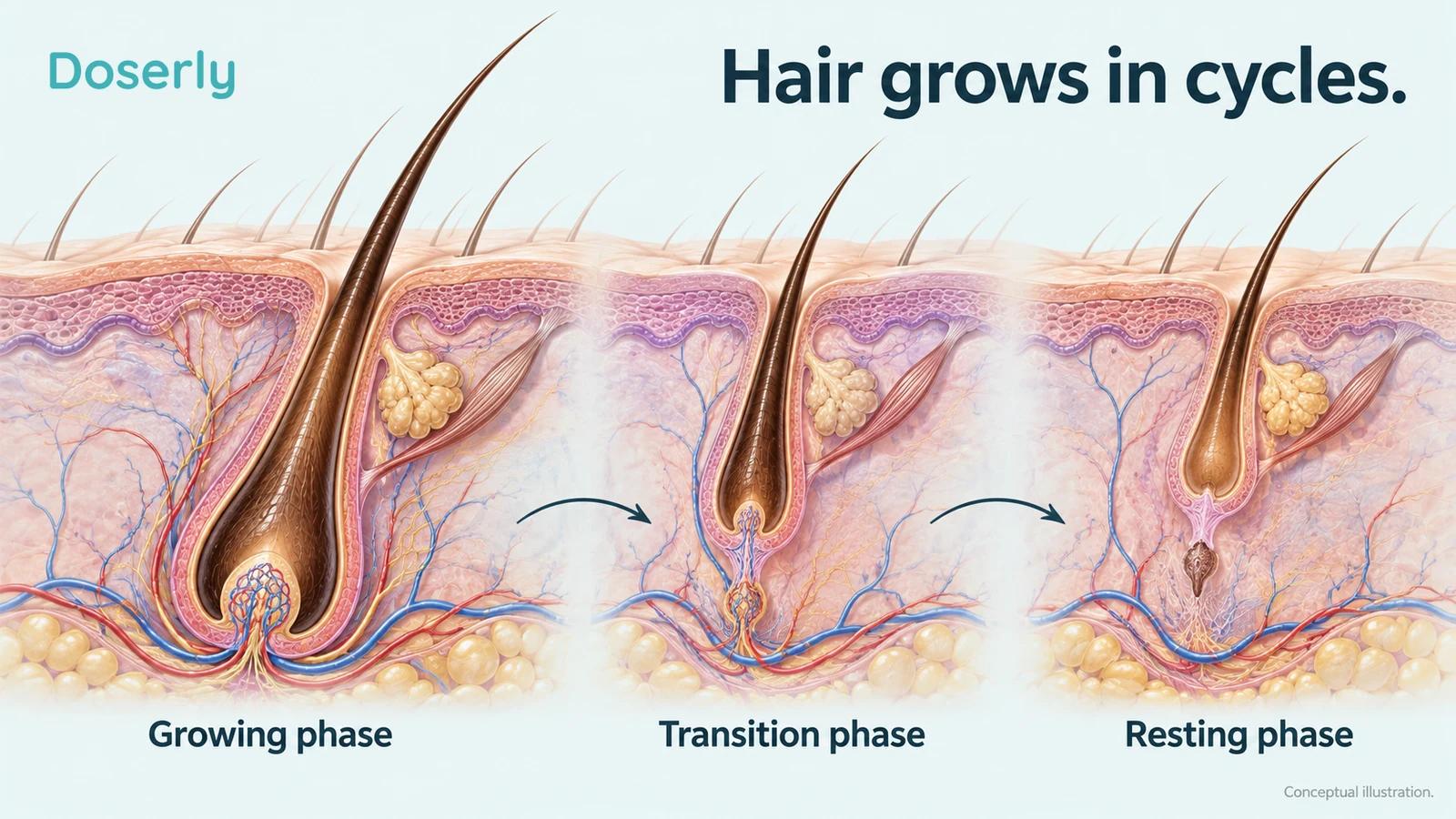
Hair follicles move through growth, transition and resting phases. A change in follicle activity and a visible change in scalp coverage are therefore different events. Seeing no obvious difference after a few sessions does not provide a meaningful test of a treatment intended to alter hair growth. Hair-cycle physiology
A 2025 report of a randomized LED-cap trial illustrates the longer observation window. The study lasted 26 weeks, with its primary hair-count endpoint at week 16. It randomized 160 people, but 91 were excluded from the per-protocol analysis. The individual active groups did not significantly outperform sham on the primary endpoint; a pooled analysis of the three active groups did. Several authors had device-company affiliations. LED-cap trial
This is not a straightforward guarantee of regrowth by week 16. It is a study with a defined assessment point, a positive pooled finding and important analytical limitations. It also shows why an advertisement can sound more conclusive than the underlying paper if it reports only the pooled result and leaves out exclusions.
When comparing your own progress with a study, the diagnosis matters too. Evidence in androgenetic alopecia, or hereditary pattern hair loss, should not automatically be applied to sudden shedding, patchy loss or scarring conditions. A device cannot tell you which process is causing a change in your hair.
A nine-month result may include maintenance treatment
A 2025 study compared three light approaches and a control group in 68 participants. It described an initial three-month treatment period followed by maintenance treatments every four to six weeks, with assessments through nine months. Hair density improved in the treatment groups in the published abstract. Three-wavelength hair study
For the question “do results last?”, the maintenance detail is essential. These were not simply nine months of observation after all treatment stopped. The report therefore cannot establish that the same changes would have remained without further exposure. Nor does its inclusion of very different infrared technologies make every consumer red-light device equivalent.
Maintenance may be reasonable for a particular ongoing condition, but it is a separate question to study. Ideally, researchers would first identify a response and then compare continued treatment, reduced treatment and stopping, with appropriate controls and adequate follow-up. Without that design, the minimum effective maintenance schedule remains uncertain.
For a purchasing decision, ask whether a long-term claim describes continuous use, occasional additional sessions or no further treatment. Those options involve different commitments. A result that requires ongoing use can still have value, but it should be described honestly before someone buys a device expecting a permanent change.
Hair shedding can also improve for reasons unrelated to light
The AAD distinguishes excessive shedding after a stressor from other forms of hair loss. Illness, surgery, childbirth and other major changes can be followed by delayed shedding, which may settle as the underlying situation resolves. Some people have more than one process at the same time. AAD explanation of shedding and hair loss
That creates a challenge for personal accounts. Someone may start a cap at the same time that temporary shedding is beginning to recover. Their observation of fuller hair can be completely sincere while the contribution of the device remains uncertain. A before-and-after story alone cannot separate those explanations.
The answer is not to dismiss personal experience. It is to avoid treating the timing as proof. A dermatologist can help identify the likely cause, choose suitable measures and explain the expected course. That context is more informative than comparing your photograph with someone whose diagnosis, treatment and starting point are unknown.
Pain studies ask a different timing question
For pain, an early improvement may matter even if it is not permanent. The question is whether it helps enough, lasts long enough and adds something useful to the rest of care. A temporary reduction that makes ordinary movement easier is different from evidence that damaged tissue has been repaired.
A 2023 knee-osteoarthritis trial randomized 127 people to exercise, exercise plus active PBM or exercise plus placebo PBM. Treatment lasted eight weeks, with later assessments three and six months after treatment. Adding PBM did not produce an incremental benefit in pain, function or quality of life. Follow-up losses were substantial, reaching 45% at six months, which adds uncertainty to the longer-term findings. Exercise and PBM knee trial
This matters when someone says that improvement “lasted for months.” In that study, improvement within a treatment group did not establish that light was responsible, because the comparison groups also improved. Duration and attribution are separate questions. A long-lasting improvement can occur without demonstrating a long-lasting effect of the additional device.
There is a similar lesson in newer back-pain research. An October 2026 randomized trial of 148 people compared motor-control exercise plus PBM with the same exercise plus sham. It found negligible additional effects on pain and disability, including at longer follow-up through 12 months. 2026 back-pain trial
Waiting longer does not automatically turn a treatment into an effective one. The appropriate response to a disappointing result may be to reconsider the diagnosis, outcome or care plan, rather than assume that an unlimited number of additional sessions will eventually succeed.
Continuing treatment is not the same as proving durability
A 2025 Parkinson's study makes this distinction especially clear. Sixty-three participants were initially randomized to active or sham PBM while continuing exercise. The controlled stage did not show an advantage for active treatment. Later, participants could choose whether to continue active treatment for an extended period; selected outcomes favored those who continued. Randomized study with optional extended treatment
The later finding is worth investigating, but people who choose to continue may differ from those who stop. They may have different expectations, experiences or ability to maintain the routine. The extension therefore does not have the same protection against bias as the randomized stage. It also describes continuing treatment, rather than persistence of a benefit after stopping.
This example is useful even if your interest is skin or pain. Whenever a headline emphasizes long follow-up, look for what participants were doing during that time. “Followed for a year” tells you when researchers checked. It does not, by itself, tell you whether treatment continued or whether a comparison remained randomized.
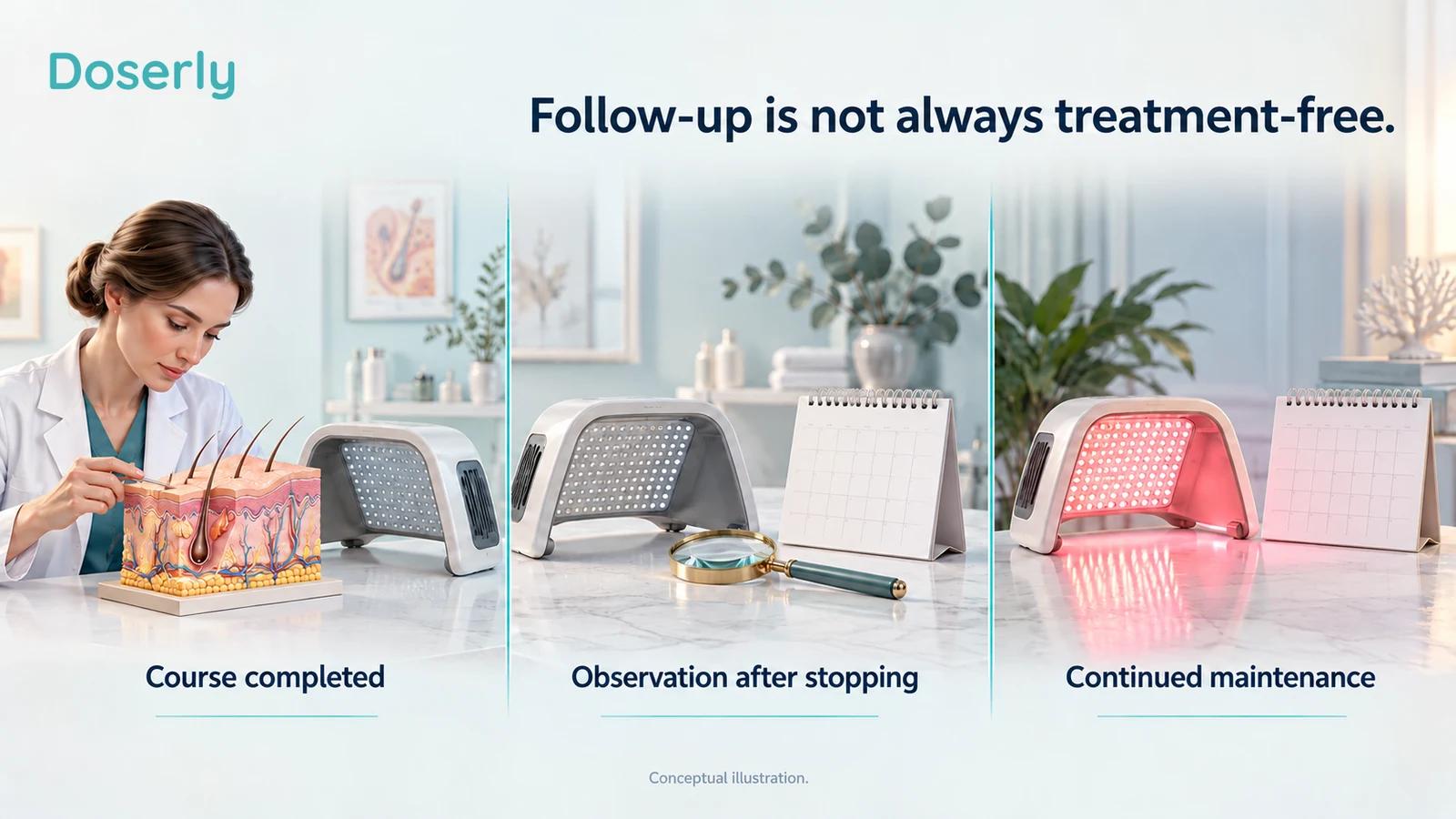
How to make your own observations more useful
Choose a small number of outcomes before starting, rather than deciding afterward which change counts as success. For a cosmetic concern, that might be a consistent photograph and a description of the feature you care about. For a symptom, it might be comfort during one ordinary activity and how long any change lasts. This is a practical way to organize observations, not a substitute for a controlled study.
Keep the measurement conditions reasonably similar. A portrait taken in soft window light is difficult to compare with one taken under an overhead bathroom lamp. A wet scalp can look different from a dry one, and changes in hair length or parting can alter the apparent coverage. For pain, note whether you are comparing similar activities rather than a quiet day with an unusually demanding one.
You do not need an elaborate spreadsheet or a daily photo collection. A record that you can maintain and understand is more useful than a complicated routine that makes you anxious about every small fluctuation. Agreeing on a review interval with a clinician can also help avoid repeatedly checking for a change too small to interpret.
Include other important changes in the record. Starting a retinoid, changing a hair-loss medicine, beginning exercise or altering pain medication makes it harder to attribute an improvement to light alone. That does not invalidate the improvement. It changes the question from “did the device cause this?” to “how is the overall plan working?”
For readers using copper-peptide skin care alongside a device, our GHK-Cu guide explains that separate evidence base. A plausible relationship between treatments does not establish that the combination works better, or that one shortens the other's timeline.
Decide what would make continued use worthwhile
Before committing to an open-ended routine, consider the benefit you would need to justify it. A subtle cosmetic difference may be worthwhile to one person and unimportant to another. A treatment that takes substantial time but makes a valued activity easier may be worthwhile even if it does not eliminate symptoms. The decision should reflect the outcome, burden and uncertainty together.
It helps to separate three situations. First, a clear useful change with acceptable burden may support a discussion about continuing. Second, an uncertain change may call for better measurement or a review of what else has changed. Third, no worthwhile improvement after a reasonable, device-appropriate trial may be a reason to stop or reassess. These are decision questions, not universal medical instructions.
Avoid moving the target every time an expected result fails to appear. If the original goal was better function, a new claim about an unmeasured cellular effect does not demonstrate that the goal was achieved. Likewise, buying a more powerful device is not an evidence-based answer to every nonresponse.
A clinician can help judge whether the trial was suitable and whether a different explanation needs attention. The aim is to make a useful decision with the information available, rather than remain committed because of money already spent.

More exposure is not a shortcut to faster results
The absence of an early visible response does not establish that the dose was too small. Different devices deliver different exposures, and a schedule from one study cannot simply be transferred to another. Adding sessions also changes the intervention, making comparisons with the original evidence less reliable.
In two controlled red-LED skin-safety trials, researchers used escalating exposures and observed dose-limiting reactions, including blistering or persistent redness at high exposures. Those experiments do not define a universal home-use limit, but they show why “more” cannot be assumed harmless. Human red-LED safety trials
Persistent irritation, pain or new visual symptoms should not be interpreted as proof that treatment is becoming effective. Follow the device's intended-use instructions and seek appropriate assessment when symptoms occur. Direct eye exposure with an arbitrary panel is not justified by a skin or hair study. If you take a medicine that affects light sensitivity, ask the prescribing clinician about the particular device and application.
What a realistic expectation sounds like
A useful expectation is specific: this device has been studied for this condition, using this outcome, over this period. It includes the possibility of no meaningful benefit and distinguishes continued treatment from observation after stopping. It does not require pretending that every interesting result is certain, or that all uncertainty means the research has no value.
For skin, several trials assess changes over weeks to months, with limited off-treatment follow-up. For hair, the relevant studies generally require longer observation and do not guarantee that a visible response will occur. For pain, the duration of relief matters, but so does whether light adds anything to rehabilitation or other care.
The best review point is one that helps you decide what to do next. Define the change you want, measure it reasonably consistently and check the result against evidence that matches your situation. That approach gives a treatment a fair assessment without turning patience into an obligation to continue indefinitely.