
Red Light Therapy
October 17, 2026
Red light therapy for hair growth: what the clinical trials show
On this page
A widening part or thinning crown can make a light cap look unusually appealing. It offers a treatment that does not involve another pill, another scalp solution or a procedure. The question is whether the light changes hair growth enough to justify the time and expense.
There is credible human research behind certain low-level light devices for pattern hair loss. Several randomized trials found greater hair-density improvements with active devices than with sham devices. That is a stronger foundation than a laboratory experiment or a collection of photographs. But the research also includes unsuccessful comparisons, small combination studies and important gaps about maintenance. The answer is more specific than “red light grows hair.”
The useful question is whether a particular device has evidence for your diagnosis, how much visible improvement is plausible, and where it belongs alongside other options. Research available through October 2026 helps answer those questions, although it cannot guarantee that a cap will restore someone's former hairline.
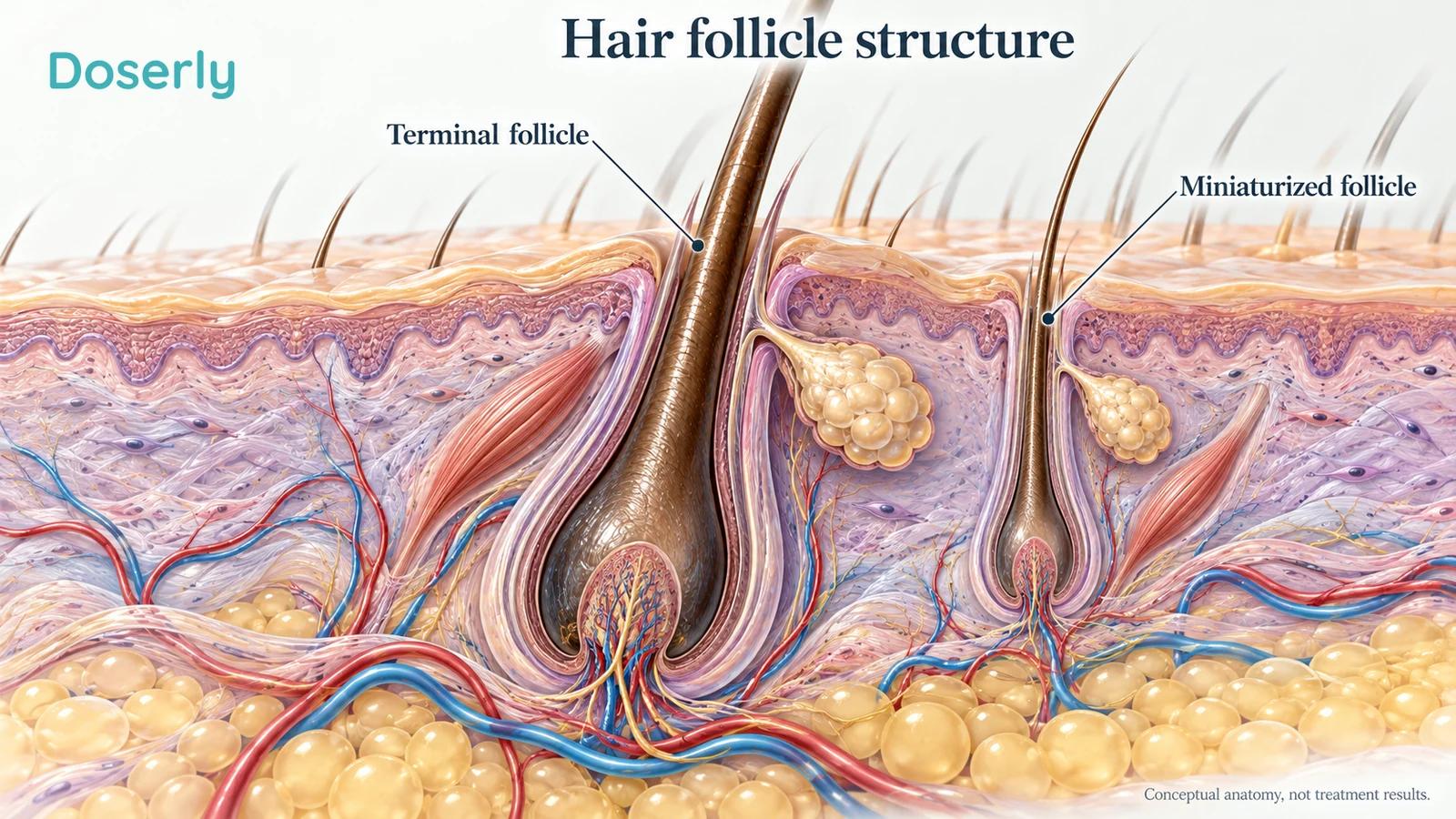
Conceptual follicle anatomy illustrates miniaturization in pattern hair loss. These are different structures, not before-and-after results from light treatment.
Start with the kind of hair loss
Most of the trials discussed here concern androgenetic alopecia, commonly called male or female pattern hair loss. In this condition, affected follicles gradually produce finer hairs. The visible change can be a receding hairline, thinning crown or widening part, depending on the person and pattern. A follicle becoming smaller is a different problem from hair shafts breaking or a temporary increase in shedding.
The American Academy of Dermatology's diagnostic guidance explains why a scalp examination comes first. Clinicians consider the timing, distribution, hair and scalp findings, and relevant history. Selected patients need blood tests or a biopsy. More than one cause can coexist: someone with postpartum shedding can also have early hereditary thinning.
That changes what a treatment result means. Hair can recover spontaneously after some temporary shedding episodes. A person who starts a cap during that recovery might reasonably notice improvement without knowing how much the device contributed. Conversely, a trial involving established pattern hair loss cannot show that a cap treats every unexplained patch or painful scalp condition.
Bring the pattern and timeline into the conversation before bringing a device specification sheet. “My part has slowly widened over three years” and “my hair began falling out in handfuls last month” deserve different evaluations. A purchase should not have to serve as a diagnostic experiment.
Hair growth is a cycle, not a switch
A hair follicle is a living structure below the skin surface. The visible shaft is the product of that structure. Follicles move through a growth phase, anagen; a transitional regression phase, catagen; and a resting phase, telogen. Neighbouring follicles do not all move through these phases together.
This matters when people talk about “activating follicles.” The phrase can suggest that every empty-looking spot contains a dormant hair ready to grow as soon as light reaches it. Clinical studies do not establish that picture. A change in the number of measurable hairs can reflect changes in cycling or shaft thickness without the creation of new follicles.
The scientific rationale for photobiomodulation is that absorbed light may alter cellular activity in existing tissue. That rationale is a reason to test a device, not a substitute for testing it. A diagram of a healthy-looking follicle cannot tell us whether a treatment produces a cosmetically meaningful change in a person with years of thinning.
A 2021 experiment using human follicles removed during hair transplantation helps illustrate the distinction. In culture, 650-nanometre red light delayed the transition from growth into regression and changed markers of cell activity. These were living human follicles studied outside the body, not people wearing a cap. The experiment gives researchers a way to investigate possible pathways, but cannot predict visible coverage, long-term tolerability or an effective home schedule. Its results support asking a clinical question rather than skipping the clinical trial.
It also explains why a bright scalp after a session is not an outcome. The relevant changes are assessed over months, using repeat measurements and photographs. A device that feels active has not necessarily changed the hair cycle in a useful way.
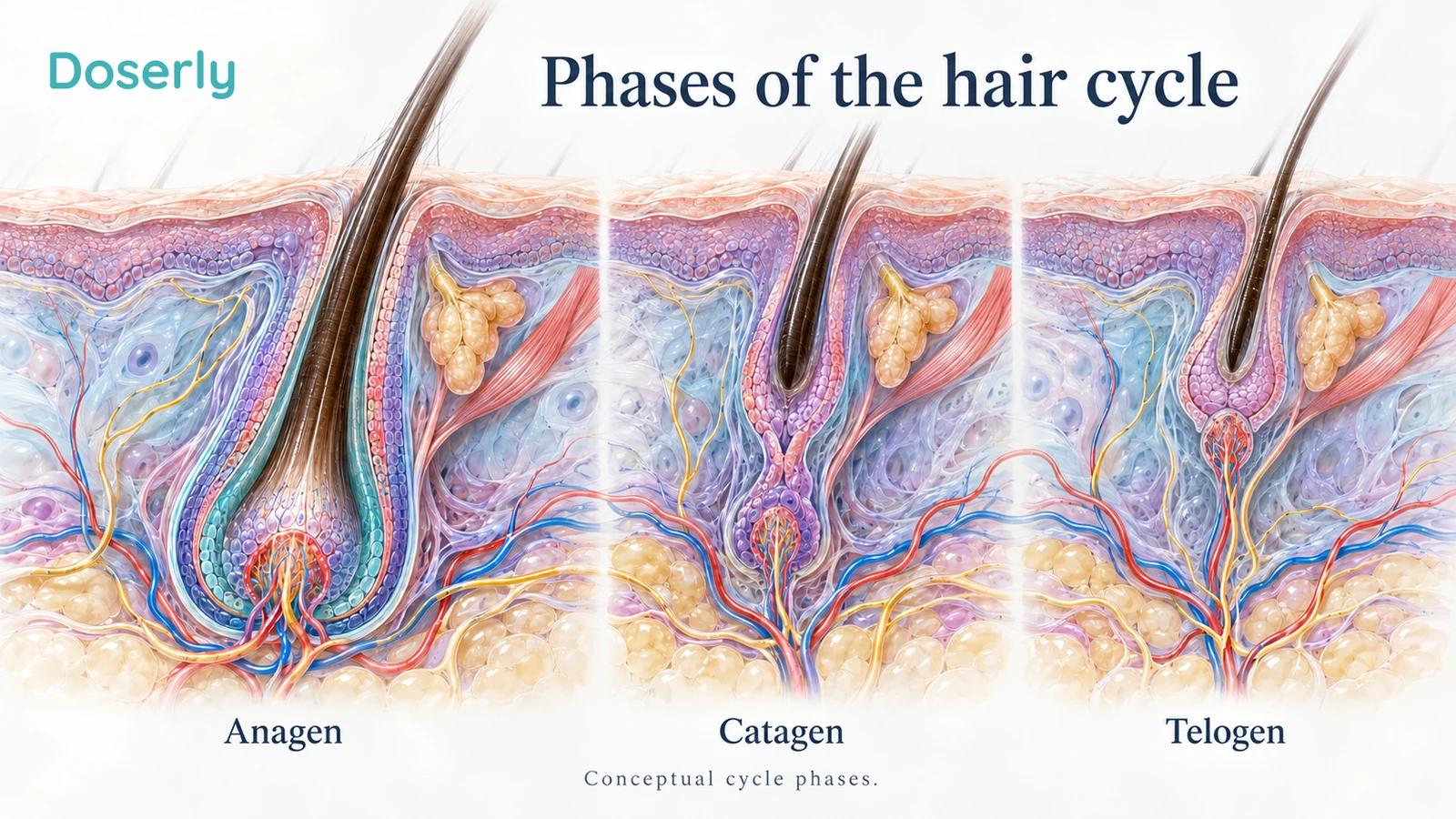
Conceptual hair-cycle phases show how follicle structure changes over time. The illustration does not depict light driving a follicle into growth or establish a treatment response.
The early controlled trials established a real signal
A 2009 multicentre trial studied a red-light laser comb in men with androgenetic alopecia. The twenty-six-week study used a sham device and blinded assessment; 110 participants completed it. Terminal hair density increased more with the active device than with sham. No serious adverse events were reported.
The engineering detail is relevant. The comb's teeth parted hair so the light could reach the scalp. This was a specific device used in a specific manner, rather than evidence that any red illumination reaching the top of the head has the same effect. A room lamp, a face mask held overhead and a scalp device should not inherit one another's clinical results.
A larger 2014 report of four randomized trials extended the evidence to men and women. Across the trials, 269 participants were randomized and 225 were included in the efficacy analysis. After twenty-six weeks, active laser-comb groups showed larger increases in terminal hair density than their sham groups. The size of the change varied by trial and device configuration.
These findings matter because a sham comparison helps distinguish a device effect from ordinary fluctuation and expectations. They support the possibility of improving measurable density in selected people with pattern hair loss. They do not demonstrate complete restoration, identical responses across scalp regions, or permanent benefit after treatment ends.
A careful scalp measurement is not the same as a fuller-looking head
Hair studies often measure a small, repeatedly located area. Density describes how many hairs are counted within that area. Diameter describes how thick the shafts are. Global photographs assess how the overall scalp looks. Patient ratings ask whether the change feels worthwhile. These outcomes can move together, but they are not interchangeable.
A Thai randomized trial published in 2019 enrolled forty men and women and assessed a helmet device over twenty-four weeks. Mean density increased by about 10.2 hairs per square centimetre in the active group and 4.0 in the sham group. The approximate difference in change was therefore 6.3 hairs per square centimetre, rather than the full active-group increase. Shaft measurements and photographic assessments also favored treatment.
The study used carefully located measurement areas and standardized photographs. Its sham emitted weak red light, which the authors acknowledged was not a completely inactive control. This is useful evidence, with a specific comparison and a defined scale of improvement.
For someone considering treatment, the distinction between counting and appearance is practical. A statistically detectable gain in a small patch does not tell you exactly how a hairstyle will look. Existing shaft thickness, hair length, contrast between hair and scalp, and the distribution of thinning all influence the visual impression. Ask to see the study's photographic assessment as well as its headline count.

Hair density and shaft diameter measure different features. This conceptual illustration contains no measured patient data and does not represent a treatment-related increase.
The newer evidence is not uniformly positive
A dual-wavelength cap trial published in 2025 is an important counterweight to the earlier positive studies. It randomized 160 participants among red, blue, combined red-blue and sham groups. The primary endpoint was change in nonvellus hair count at sixteen weeks.
None of the individual active groups significantly outperformed sham on that endpoint. A comparison pooling all three active groups did reach statistical significance. The per-protocol analysis excluded ninety-one randomized participants because of its completion, adherence and protocol requirements. That number should not be misreported as ninety-one people simply dropping out.
Pooling can address an overall treatment question, but it does not establish that each color configuration worked. The restricted analysis also makes the finding less straightforward to apply to everyone who started treatment. Several authors had company affiliations, another reason to look for independent replication.
This trial does not erase earlier positive studies. It does prevent the evidence from being presented as unanimous. A fair explanation leaves room for variation between devices, study populations and analyses, and for the possibility that a particular product will not deliver a useful benefit.
For a buyer, a product page saying “clinically studied” is therefore only the beginning. Was its own active group successful against sham? Was the reported result the planned primary outcome? Were results presented for all randomized participants or a more selected group? Those questions can materially change what the label communicates.
How does light compare with minoxidil?
A direct comparison is more useful for choosing between treatments than separate claims that each improved from baseline. A randomized trial appearing in a 2025 journal issue, first published online in 2024, compared low-level light therapy with topical 5% minoxidil in men. Ninety-one were randomized and seventy-five completed six months.
Both groups improved in measured hair density. The investigators did not find a statistically significant difference between groups at three or six months. That is encouraging for considering light as an option, but it is not proof that the treatments are equivalent. The study was not a definitive equivalence trial, and the number completing treatment was modest.
Its light intervention also cannot be automatically transferred to every retail cap. A treatment choice should match the studied equipment and population as closely as possible. “Light performed similarly in this study” is a narrower statement than “this product replaces minoxidil.”
The decision includes more than average density. A person may dislike applying a solution, find a wearable device inconvenient, or have medical reasons that affect medication choices. Cost, scalp tolerability and the likelihood of continuing treatment deserve discussion alongside the results. None of those considerations turns a small nonsignificant comparison into proof that there is no meaningful difference.
Does adding light to minoxidil help more?
Combination treatment is plausible, but the clinical results are mixed. The important comparison is light plus the same background treatment versus that background treatment alone. Otherwise, an improvement can be wrongly credited to the device when the accompanying medication is doing some or all of the work.
In a 2017 randomized study of forty-five women, participants received light, topical 5% minoxidil or both. After four months, combination treatment had advantages in some clinical ratings and satisfaction. Hair-diameter changes were not statistically significant. The groups were small, and the findings did not establish that either treatment alone was equivalent to the other.
A separate study of ninety women, published online in 2020 and in print in 2021, also compared those three approaches. The combination produced better density and diameter outcomes than either treatment alone. That supports an added-benefit hypothesis for the particular helmet and population studied, rather than a universal rule about layering treatments.
A 2018 randomized study of fifty people compared minoxidil with active light against minoxidil with an inactive comb. It reported advantages for the combination in density, diameter and satisfaction. The authors noted limitations including the sample size, treatment compliance and participants' awareness of treatment.
However, a 2023 randomized trial of fifty-four men found no statistically significant added benefit after sixteen weeks. Density improved by approximately 14.8% with light plus minoxidil and 11.4% with minoxidil alone. Physician ratings and patient satisfaction also did not differ significantly. A numerical difference should not be relabeled a demonstrated advantage.
These studies leave a reasonable possibility of extra benefit for some patients, alongside uncertainty about its size and consistency. They do not justify adding every available treatment at once. If a clinician recommends a combination, agree on what improvement would make the extra device worthwhile and how that improvement will be judged.
What the 2026 long-term study adds, and what it cannot settle
A prospective study published in January 2026 followed sixty-eight people using a red-light helmet, with sixty-four completing forty-eight weeks. Average hair density and shaft diameter increased during continued use. The longer observation period is valuable, but there was no control group.
The medication reporting also needs caution. The methods describe restrictions on other hair treatments, while the results report participants using minoxidil or finasteride at entry. That unclear background-treatment record makes a light-only interpretation especially difficult. The study received LG Electronics funding.
Most importantly, forty-eight weeks of continued treatment is not evidence that benefits persist for forty-eight weeks after stopping. The study supports further investigation of longer use; it does not establish a permanent effect or the minimum maintenance schedule.
That distinction matters financially as well as clinically. The cost of a device includes the routine it asks you to maintain. Before interpreting “long-term results” as a one-time investment, ask whether the study actually stopped treatment and observed what happened next.
A cap, comb and panel are different delivery systems
A cap can appear more convenient than a comb, but convenience is not a clinical ranking. A comb may separate hair; a helmet fixes the positions of its emitters; a panel illuminates from outside the scalp contour. The light that leaves the device and the light reaching a particular patch of skin are not necessarily the same quantity.
The controlled trials above tested complete systems: wavelength, output, geometry, treatment schedule and handling. They did not test the proposition that more diodes always produce more growth. Nor do they establish that adding blue or near-infrared light improves a red-light product simply because its specification list becomes longer.
A useful comparison starts with the exact model and its evidence. If the manufacturer's study used a different model, look for a clear explanation of what changed. Similar-looking hardware is not enough to establish similar delivery. A study of a comb does not validate an unrelated helmet through color alone.
Consider whether the device fits the areas that concern you, whether its instructions are understandable, and whether the manufacturer provides meaningful technical and safety information. Those are reasonable purchasing questions, not reasons to invent a stronger home protocol. Longer exposure or closer positioning should not be used to compensate for uncertainty about the equipment.
Tolerability deserves its own assessment
The absence of serious adverse events in a modest trial is reassuring within that study. It is not a guarantee that every user or device will be problem-free. In the Thai trial, reported issues included transient shedding in one active-treatment participant and itching in both active and sham groups. A symptom occurring early is not automatically evidence that treatment is working.
The AAD's red-light guidance advises checking suitability and following device-specific instructions, including any required eye protection. A scalp device should not become an improvised facial or eye treatment. People with light sensitivity or relevant medical treatment should discuss the actual equipment with their clinician.
It helps to decide in advance how new symptoms will be handled. Persistent scalp irritation, discomfort or a change in the pattern of loss deserves reassessment rather than an automatic increase in exposure. Record when the symptom began and what else changed, including scalp products and medication. That gives the clinician something more useful than “the cap might be doing something.”
A comfortable device also needs to be tolerable as a routine. The clinical value of a treatment that is rarely used may differ from its value in a carefully followed trial. Honest discussion of that burden helps set realistic expectations without blaming someone for preferring another option.
Make progress easier to judge
Daily mirror checks can be emotionally exhausting and visually misleading. A sensible assessment plan begins before treatment, with a clear description of the areas and outcomes that matter to you. Is the priority less visible scalp at the crown, a narrower-looking part, or slowing a documented decline? Those are more useful targets than a general promise of “healthier hair.”
Repeat photographs work best when the part, distance, angle, lighting and styling are consistent. Wet hair, styling fibres and a different camera angle can change the appearance dramatically. This is a practical extension of the standardized photography used in clinical trials, not a demand that someone reproduce a research laboratory at home.
Keep the treatment history alongside the pictures. Starting minoxidil, changing a prescription, recovering from an illness or switching hairstyles can all complicate interpretation. A simple record helps identify what changed when. It does not prove causation, but it prevents a device from receiving automatic credit for every improvement.
At review, compare the agreed outcomes and discuss whether any change is sufficient to justify continuing. A professional density measurement and personal satisfaction can both be relevant. Neither should erase the other: a small numerical gain may feel unimportant, while someone may value a modest visible improvement very highly.
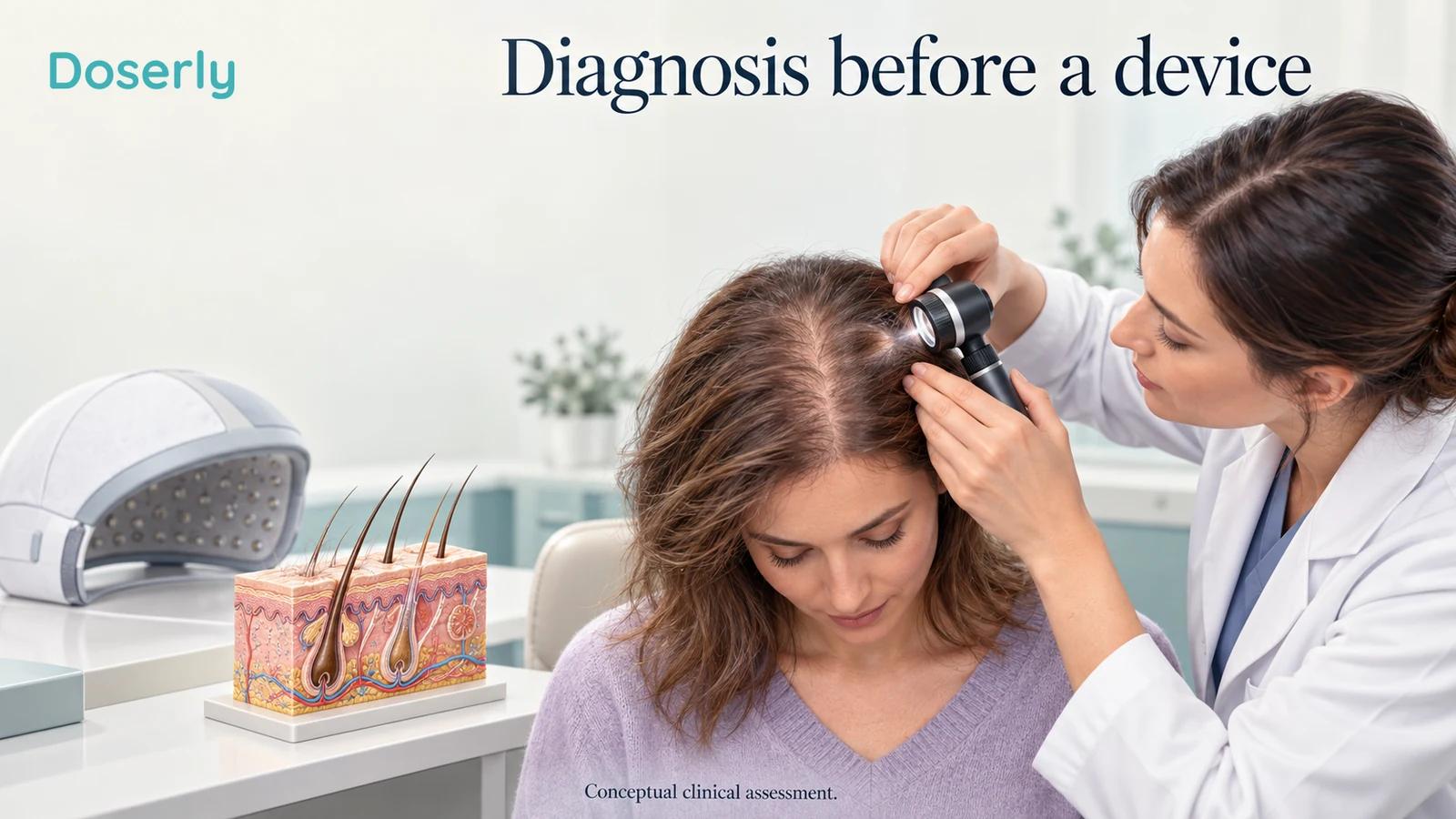
Conceptual clinical assessment places diagnosis and follow-up before device selection. The person shown is not a trial participant and the image does not document regrowth.
Questions worth taking to a consultation
A focused discussion can keep the decision manageable:
- Is my diagnosis pattern hair loss, temporary shedding, another scalp disorder, or a combination?
- Does the proposed device have a controlled trial in people reasonably similar to me?
- Did that trial improve overall appearance as well as a small-area hair count?
- What would light add to my current treatment, and how would we assess that added value?
- What follow-up period and review criteria make sense before deciding whether the cost is worthwhile?
- What is known about continued use, and what remains unknown about stopping?
You do not need to become a device engineer to ask these questions. Their purpose is to connect research to the decision in front of you. A clear answer may support trying a studied device, choosing another treatment, or postponing a purchase until the diagnosis is settled.
Red-light devices have earned a place in the conversation about pattern hair loss because controlled human trials have found benefits. They have not earned a promise of complete regrowth, a universal advantage over medication, or an assumption that every newer cap is better. The most useful expectation is a possible, measurable improvement assessed over time, with enough honesty about its size and burden to decide whether it matters to you.