
Red Light Therapy
October 17, 2026
Red light therapy for eczema and psoriasis: how it differs from medical phototherapy
On this page
If you have lived with itchy, inflamed skin, the appeal of a quiet light treatment is easy to understand. A few minutes beside a panel sounds simpler than another cream, another appointment or another night interrupted by scratching. The difficulty is that “light therapy” describes several very different treatments, with very different evidence.
Medical ultraviolet phototherapy has a recognized place in treating selected cases of psoriasis and atopic dermatitis. Red and near-infrared photobiomodulation are separate approaches. Small human studies give reasons to investigate them, particularly for psoriasis, but they do not establish that a consumer red-light panel can replace prescribed care. Blue-light eczema studies add another layer: some symptoms have improved even when objective disease scores have not.
The useful question is therefore more specific than whether light works. Which wavelength was tested, in which condition, against what comparison, and did it improve the problem you most want help with? Those distinctions can protect both your expectations and the treatment plan that is already supporting your skin.
Eczema and psoriasis are not the same skin problem
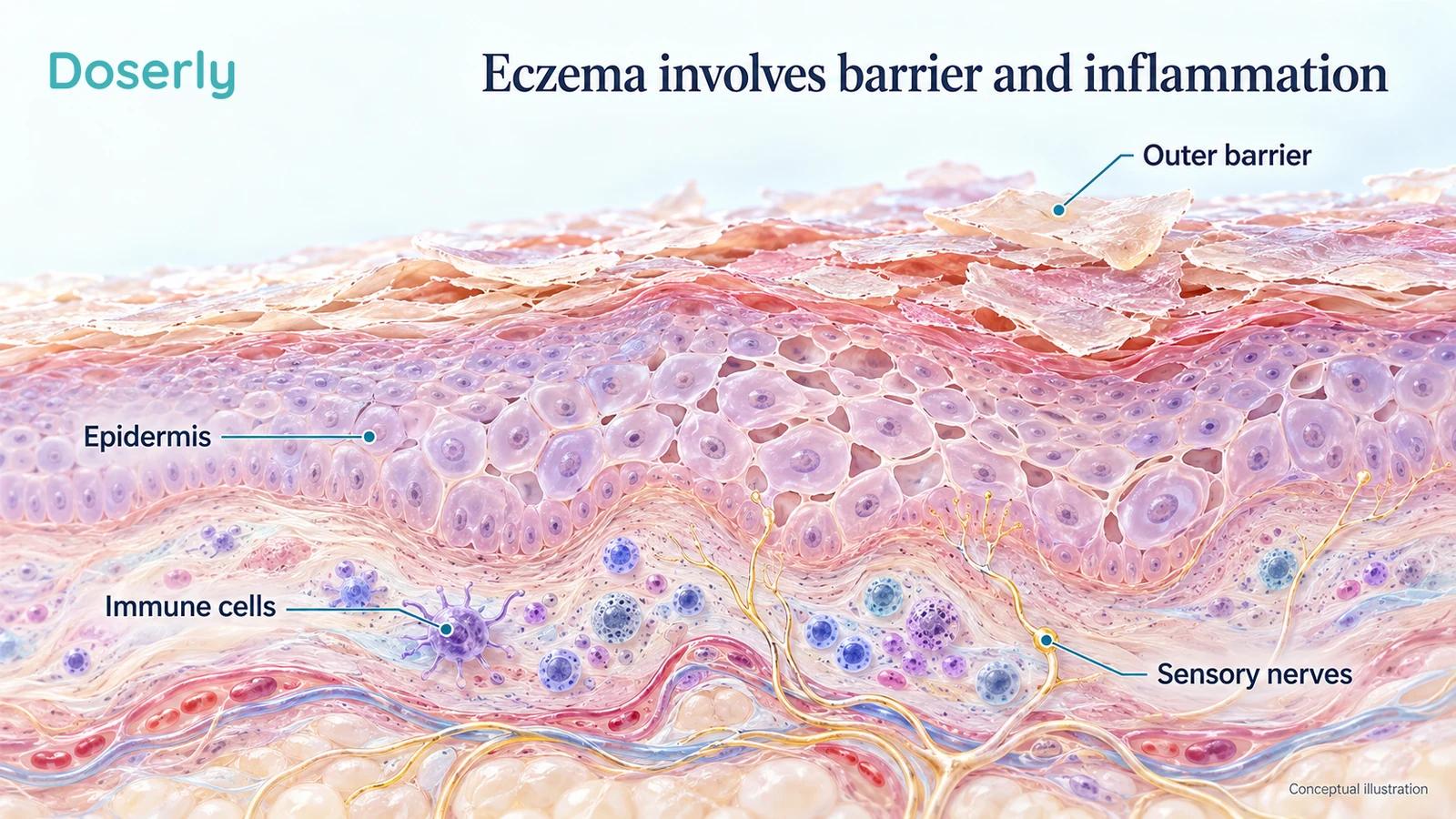
Atopic dermatitis is the form of eczema discussed in most of the studies below. It involves interacting barrier and immune problems, with itch often dominating daily life. The American Academy of Dermatology explains the barrier's role: the outer skin layer helps retain moisture and protect against substances that touch the skin. When that protection is disturbed, skin can become more vulnerable to irritation.
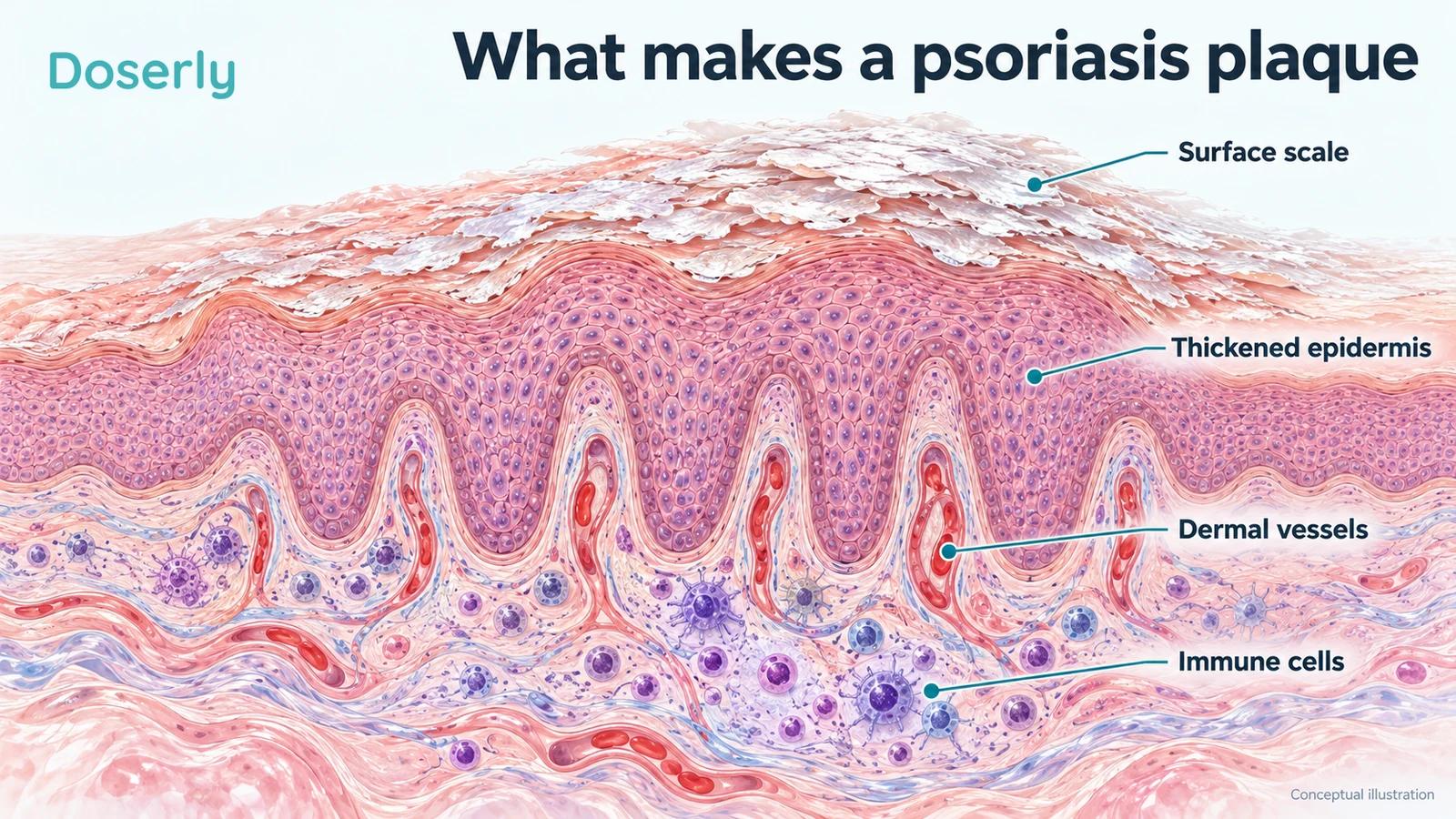
Psoriasis has a different disease pattern. Plaques involve altered skin-cell growth and inflammation, often producing areas that are thick and scaly. Their visible color is only one feature. A treatment that changes redness without changing thickness, scaling or symptoms may leave much of the problem unresolved.
Neither diagnosis should be inferred simply from a photograph of a red patch. Contact dermatitis, infection and other conditions can resemble parts of the picture. Even within eczema, an atopic-dermatitis trial does not automatically apply to a rash caused by something contacting the skin. Getting the diagnosis right comes before deciding which device might help.
These distinctions also explain why a general claim about reducing inflammation is insufficient. Many conditions involve inflammation, but that shared word does not make their treatments interchangeable. A plausible effect on one cellular signal is an invitation to test a treatment in people, not a shortcut around that test.
What medical phototherapy actually means
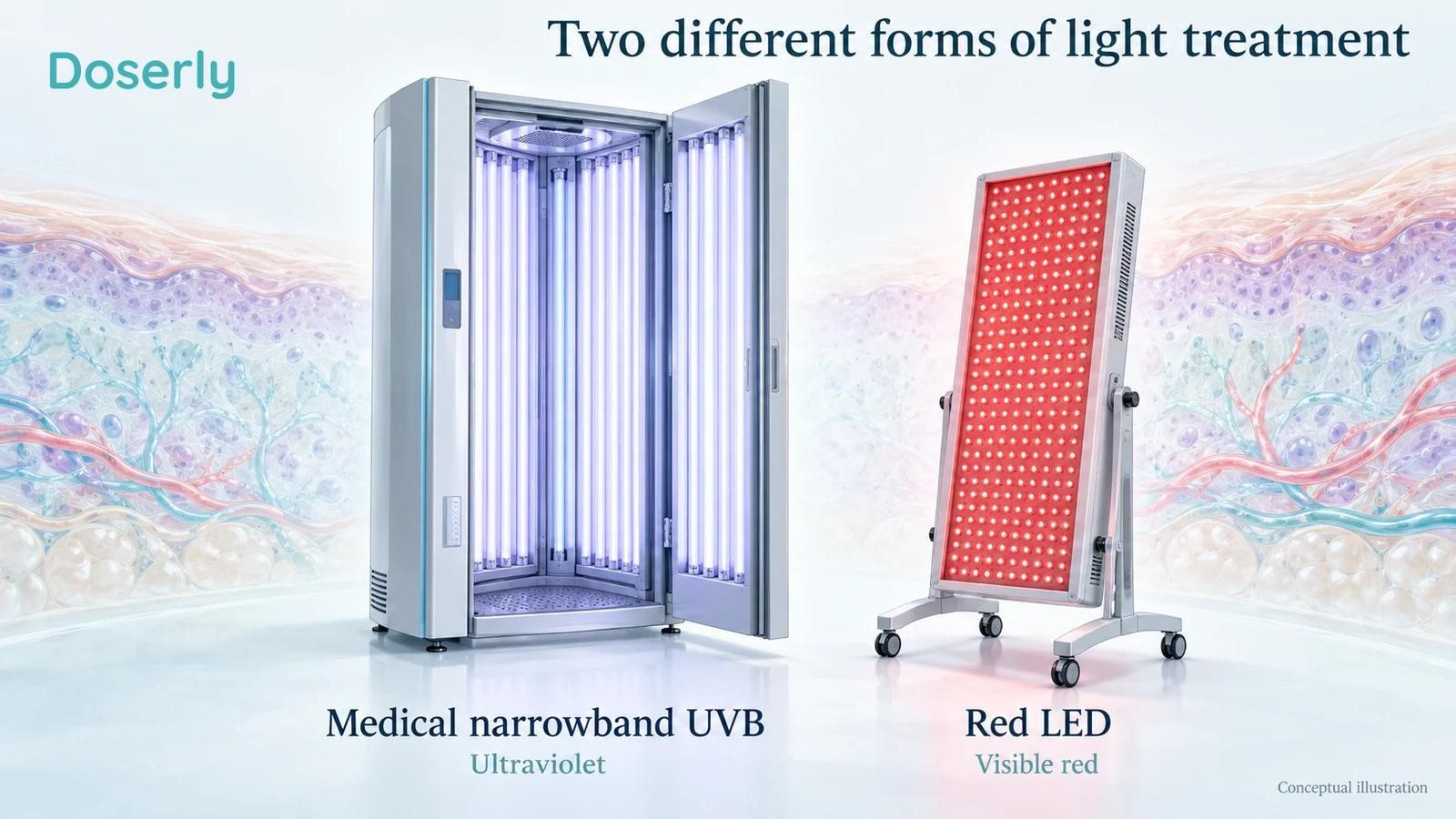
For psoriasis, common medical approaches include narrowband UVB and targeted ultraviolet devices. The AAD's phototherapy guidance describes treatment that can slow excessive skin-cell growth and reduce inflammation. A dermatologist chooses the approach with the person's diagnosis, medical history, medicines and treatment area in mind.
Red light is visible light. Near-infrared lies beyond visible red. Neither is ultraviolet. Their exposure settings and biological effects cannot be converted into a UVB treatment simply by matching session length or placing a device closer to the skin. Likewise, a blue LED is not a lower-powered version of a red LED in any clinically meaningful sense.
The hardware label can be misleading too. “LED” tells you about the light source, not which wavelength it emits. A 2023 psoriasis study compared a 308 nm LED with a 308 nm excimer laser. Both delivered ultraviolet light. Only ten of twenty-two participants completed twelve weeks; the completing participants improved on both sides without a significant difference between devices. That small study, with substantial attrition, says nothing about a red LED panel.
This is why a study's actual wavelength matters more than a product category. An advertisement citing successful “LED phototherapy for psoriasis” may be pointing to a treatment whose light is entirely different from what the advertised device produces.
The small red and near-infrared psoriasis study
A frequently cited 2010 preliminary study enrolled nine people with chronic psoriasis, much of it resistant to conventional treatment. They received sequential near-infrared and red LED treatments. Four completed one treatment course; five required another. Two participants were lost during follow-up.
The report described substantial clearance and high satisfaction, with reported clearance ranging from sixty to one hundred percent at the end of follow-up. Those figures sound striking, but there was no untreated or sham comparison group. The study cannot tell us how much improvement would have occurred with time, continued care or expectations alone.
It also tested a combination. Even if the benefit were confirmed, it would not tell us that red light alone was responsible. The authors themselves called for a larger controlled, double-blind study. Their broad reassurance about tolerability should not be read as proof of safety for every skin type or device, given the small selected sample.
The fair interpretation is a promising clinical observation that justified further work. It is not a reliable percentage improvement to quote to someone buying a panel today.
A red-versus-blue trial gives a more qualified picture
A randomized comparative study published in 2012 treated two stable psoriasis plaques in each of twenty participants with red or blue light. Both areas also received a salicylic-acid preparation to reduce scale that could interfere with light penetration.
Both colors were associated with clinical improvement. Scaling and thickness did not show major differences between the light sources. Redness continued improving with blue light, while the red-light side did not show further significant improvement after six treatments.
This was a comparison between two active light approaches, not a clean test of red light against no light. The shared scale-removing treatment also matters. The result cannot tell us how much of the overall improvement came from that accompanying treatment rather than light itself.
It is also a study of selected plaques, not proof that widespread disease, scalp psoriasis, nail psoriasis and joint symptoms will respond similarly. The wording “psoriasis improved” needs that context. A local plaque score and the burden of psoriasis across a person's life are related, but they are not the same endpoint.
A newer wearable study remains exploratory
A 2023 pilot study of red and near-infrared emitting fabric illustrates another challenge: a new delivery method does not remove the need for a convincing comparison. Fourteen participants with three different skin conditions entered the study, but only five had psoriasis. Of those five, three completed the twelve-week study and two stopped on their own.
All three psoriasis completers reported improvement. Two showed improvement in at least one assessed plaque feature, while one remained clinically stable. There was no randomized control group. The total study size should therefore not be described as fourteen people demonstrating a psoriasis benefit, and the experiences of three completers cannot establish a dependable response rate.
This was also a light-emitting textile rather than a standard red LED panel. Its results raise questions for future research about delivery and feasibility; they do not establish equivalence among garments, masks and panels. For a reader comparing products, that is a useful distinction to keep attached to any study cited in the sales material.
Newer psoriasis research is still partly laboratory research
A December 2025 Scientific Reports study tested red LEDs in cultured skin cells, reconstructed skin models and mice with psoriasis-like changes. The investigators found reduced keratinocyte proliferation and epidermal thickening, with changes in cellular signaling that offered a possible explanation.
That is mechanistic research, not a human treatment trial. A reconstructed skin model cannot report itch, sleep, treatment burden or a flare after stopping treatment. A mouse model also cannot establish the benefit or long-term safety of a home device in someone with psoriasis.
The exposures used in those experiments should not be copied into a household routine. Laboratory methods are chosen to answer experimental questions under controlled conditions. A detailed methods section is not a clinical prescription.
This study keeps the biological question interesting. It does not resolve the practical questions left by the small human studies: which patients benefit, how much, for how long, and compared with which existing option?
What the older near-infrared eczema report found
Human investigation of low intensity light for atopic dermatitis is not new. A 1993 clinical report described 112 patients treated with an 830 nm diode laser. The authors reported less itch in seventy-nine patients and improved skin eruptions in sixty-nine.
There was no randomized sham comparison. Participants generally continued their existing internal or topical medicines unchanged. That means the before-and-after improvement cannot isolate the laser's contribution. The investigators also used their clinic's symptom grading, which is different from the standardized outcome sets common in more recent trials.
No side effects were reported, but an uncontrolled report from that era cannot establish long-term safety or equivalence with modern treatment. It is near-infrared laser evidence, not evidence for every red LED product. It belongs in the history of promising observations, with its design limitations kept attached.
For someone hoping to reduce steroid use, the key missing information is not whether itch sometimes improved. It is whether a controlled trial showed that adding the device allowed medication to be reduced safely while maintaining disease control. This report does not answer that question.
The blue-light eczema trial separates itch from disease severity
The 2023 AD-Blue trial provides a useful example of why wavelength and outcome both matter. Eighty-seven people with atopic dermatitis were randomized to full-body light at 415 nm, 450 nm or sham treatment in a double-blind design.
The 450 nm group had a statistically significant improvement in itch compared with sham, averaging about 1.6 points on the study's itch scale. The 415 nm group improved on a patient-reported eczema-severity measure. However, neither wavelength significantly improved the objective disease measures, and the other reported outcomes, including the dermatology quality-of-life score, did not significantly change.
The authors therefore did not conclude that blue light improved objective atopic-dermatitis severity. The distinction matters: itch relief can be valuable, especially when symptoms are exhausting, but it does not automatically mean the underlying rash is controlled or that another treatment can be stopped.
A 2024 prospective study in twenty patients reported improvements in several eczema and itch scores after a course of full-body blue light. It lacked a sham comparison, and outcomes were assessed shortly after the treatment course. One author had a device-company affiliation. Those encouraging before-and-after results do not cancel the stronger comparison in AD-Blue.
Neither study tested red light. They belong here because blue-light findings are sometimes folded into a general story about LED treatment for eczema. Keeping the color attached to the evidence prevents that accidental substitution.
Why UVB has a different clinical standing
Medical UVB has been tested against a comparison that many small red-light reports lack. In a 2001 randomized trial, seventy-three adults with moderate-to-severe atopic eczema were assigned narrowband UVB, UVA or visible fluorescent light as an additional treatment.
Narrowband UVB produced greater improvement than visible light in disease activity and the extent of affected skin. Thirteen participants withdrew or were excluded from analysis. Some people experienced redness or an eczema flare sufficient to stop treatment. The trial supports a clinical role for UVB while showing that treatment is neither universally effective nor free of adverse effects.
That comparison should not be turned into a contest in which every UV treatment is good and every visible-light treatment is useless. It shows that these approaches have different bodies of evidence. A clinician can discuss an established option using disease-specific trials, known precautions and a plan for assessing response.
The AAD's eczema phototherapy information describes supervised treatment, possible combinations with other eczema care and the practical burden of repeated visits. Access and convenience matter, but they do not make an untested substitute equivalent.
The 2026 eczema trials add useful limits
A Canadian randomized trial published in 2026 compared broadband with narrowband UVB in sixty-nine adults whose atopic dermatitis had not responded adequately to topical corticosteroid treatment. Sixty-six received at least one session and entered the main analysis. Both groups continued topical treatment.
At twelve weeks, eczema scores improved similarly, without a significant difference between UVB types. Four people stopped broadband treatment because of adverse events; none did so in the narrowband group. Patients were blinded, but treating and assessing clinicians were not. There was no no-light control, and the study did not establish how long improvement persisted after treatment ended.
A separate September 2026 French trial asked a longer-term question. It combined a UVB-versus-observation comparison with a separate vitamin D-versus-placebo comparison, on top of topical anti-inflammatory care. Of 110 allocated participants, ninety-three were available for the main primary-endpoint analysis.
The study did not demonstrate a clinically meaningful long-term benefit from the UVB regimen. Vitamin D produced a statistically significant change in patient-reported severity, but it fell below the prespecified threshold for clinical importance. Recruitment was lower than planned, leaving the study underpowered. This is not a basis for starting supplements or concluding that UVB never helps a flare.
Together, the newer studies emphasize that short-term clearing, tolerability and long-term control are separate questions. Even an established treatment deserves an honest account of what it has and has not demonstrated.
Home phototherapy can still be medical treatment
“At home” does not necessarily mean an unprescribed consumer device. The 2024 LITE trial randomized 783 people with plaque or guttate psoriasis to home or office-based narrowband UVB. The home machines included guided dosing, within a clinical treatment framework.
Home treatment was noninferior to office treatment on the study's clinician- and patient-reported outcomes across the studied skin-tone groups. Adherence was better and indirect costs were lower. Persistent redness occurred more often with home treatment, although neither group had discontinuations because of adverse events.
This is useful evidence for discussing access to prescribed home UVB. It does not validate purchasing any light panel and using it independently. The wavelength, device safeguards, patient selection and clinical oversight were part of what was tested.
If travel is the reason you are considering red light, say that directly at an appointment. The relevant conversation may be about access to established treatment, a different medication plan or prescribed home phototherapy, rather than whether a generic panel can approximate a clinic visit.
Measuring progress without being misled by a photograph
A photograph can show scale, extent and some color changes. It cannot show how long you lay awake, how much a sleeve irritated your skin or whether you needed more rescue treatment that week. Conversely, feeling less itchy for an evening does not establish that the affected area is shrinking.
For eczema, distinguish visible skin activity from itch, sleep and day-to-day control. For psoriasis, distinguish local plaque changes from overall disease burden and any joint symptoms. This is not about dismissing a small benefit. It is about recognizing what that benefit actually is.
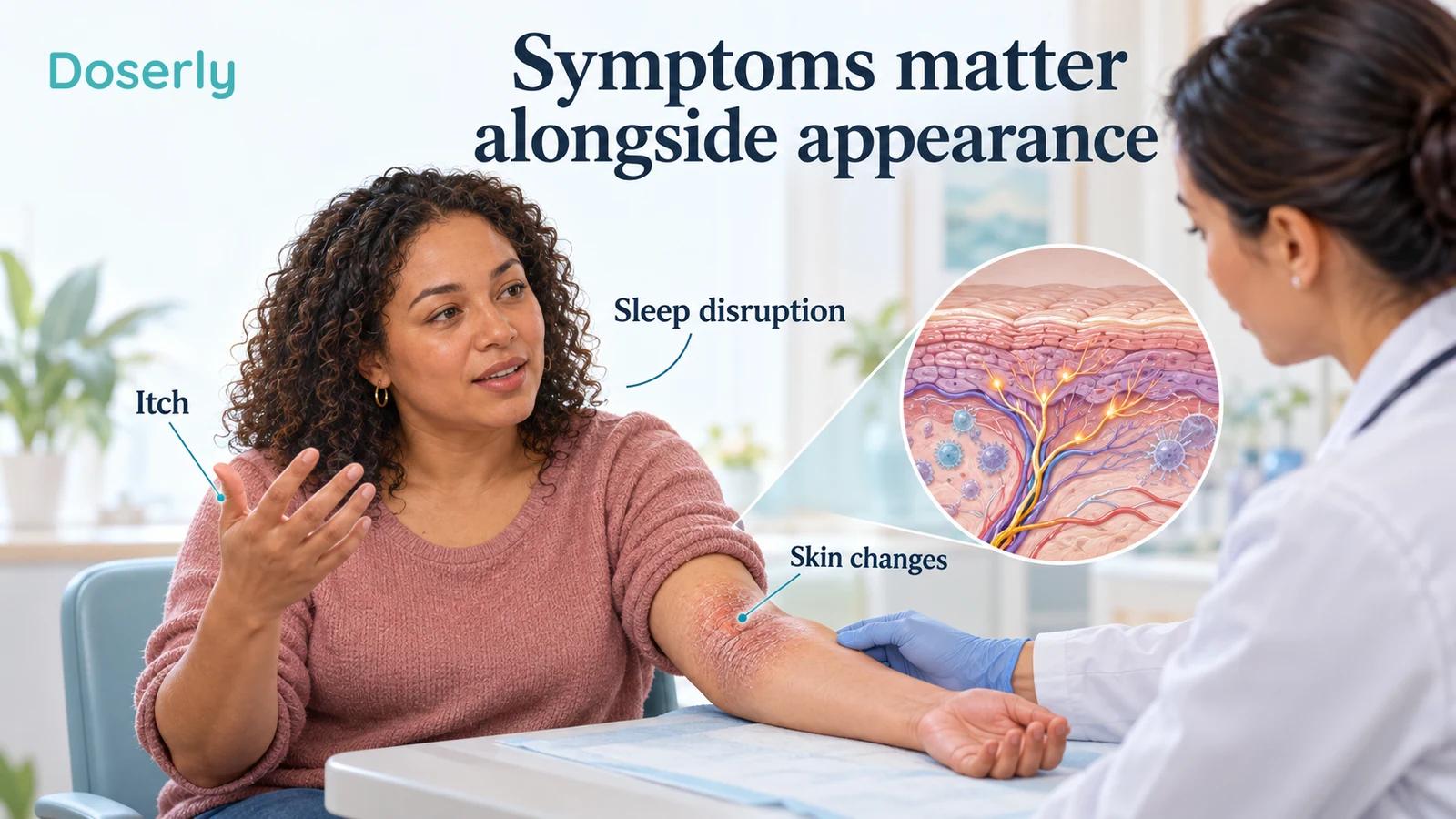
If you and your clinician decide to assess an additional treatment, keep a brief record of symptoms, sleep disruption and the treatments you used. Take photographs in comparable lighting and positions. Note changes in soaps, moisturizers, medicines or exposures that could help explain a change. Do not withhold needed treatment to make the experiment cleaner.
Agree on the intended benefit and a follow-up point. A plan to reduce nighttime itch can be evaluated differently from a plan to clear thick plaques. Without a defined goal, it is easy to keep extending sessions while ordinary fluctuations are interpreted as progress.
It can help to bring one ordinary example to the appointment: “I woke up scratching on four nights this week,” or “The plaque catches on clothing even though it looks less red.” Such observations give the clinician something concrete to assess alongside the examination. They also make room for improvement that matters to you without requiring a dramatic photograph. A device that adds cost and effort without changing that daily problem may not be earning its place in the routine.
Keep effective skin care and safety in the picture
The AAD's atopic-dermatitis overview emphasizes moisturizer as part of care for excessively dry skin. Light does not replace a tolerable skin-care routine or an individualized anti-inflammatory plan. If a device routine requires abandoning what keeps your skin comfortable, that tradeoff deserves discussion before continuing.
For children, adult device studies are not an adequate guide. The AAD's April 2026 pediatric guideline announcement describes evidence-based topical, systemic and selected phototherapy options. The presence of phototherapy in a guideline does not mean a child's eczema can be treated with any home light device. Pediatric treatment decisions account for age, disease severity and the family burden of care.
Tell your clinician about medicines, light sensitivity, previous reactions and any history of skin cancer before discussing phototherapy. Follow the protection and exposure instructions for the specific prescribed treatment. A feeling of heat, burning or worsening symptoms is a reason to stop and seek advice, not evidence that inflammation is being “drawn out.”
Tanning beds are not a substitute. The AAD's psoriasis treatment guidance warns that unsupervised ultraviolet exposure can damage skin and worsen psoriasis through sunburn. Choosing between therapies should involve their demonstrated benefit and risks, not the assumption that all light is either harmless or dangerous.
When a device should give way to an assessment
An eczema flare with increasing pain, pus, spreading inflammation or fever needs medical attention. The AAD describes infection signs and eczema herpeticum, a potentially serious viral complication that can involve blisters and systemic illness. New painful blistering with fever deserves urgent assessment rather than another home session.
Psoriasis also deserves attention beyond the skin. New swollen joints, a swollen finger or toe, or persistent morning stiffness should be discussed promptly. The AAD's psoriatic-arthritis guidance explains why early diagnosis and treatment matter. Improvement in a skin plaque does not establish that joint inflammation is being treated.
Red and near-infrared research remains worth following, but the current human evidence supports modest expectations. A possible additional symptom benefit is different from reliable disease control, and neither should be promised from a general mechanism or an attractive before-and-after image. The most useful plan starts with a clear diagnosis, keeps effective care in place and asks the light treatment to prove a specific benefit that matters to you.