
Red Light Therapy
October 17, 2026
Red light therapy for diabetic foot ulcers: a possible addition to wound care
On this page
A foot ulcer can turn daily life into a careful routine of dressings, appointments and decisions about how much weight to put on the foot. When healing is slow, the possibility that light might help the wound close is understandably attractive. There is human research behind that idea, but the treatment has not earned a routine place in care.
The most important context comes first: the International Working Group on the Diabetic Foot's 2023 wound-healing guideline recommends against the physical therapies it assessed, including light and laser treatments, either as first-line care or as additions to standard treatment. The recommendation reflects low-certainty, inconsistent evidence and concerns about resources. It is not an endorsement of home treatment. IWGDF wound-healing guideline
Some small trials nevertheless report encouraging wound-size changes. Newer studies include important null comparisons, and research published in 2026 explores physiological responses without establishing better healing. The useful question is whether a specific light intervention adds meaningful benefit to good wound care, not whether light can influence cells in a laboratory.
Why a diabetic foot ulcer is more than a skin problem
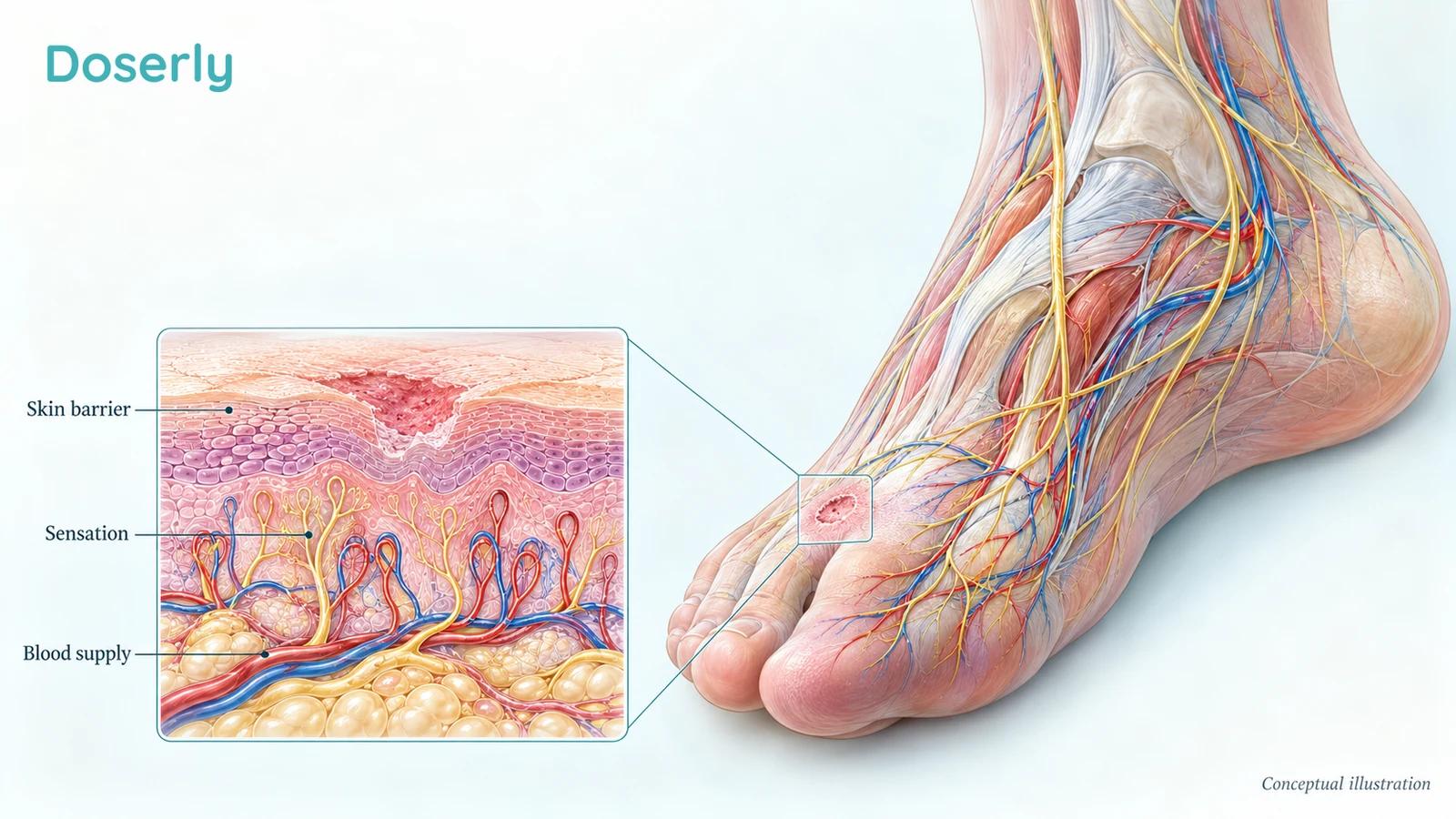
Diabetes can affect both sensation and circulation. Reduced sensation may allow an injury to go unnoticed, while poor blood flow can make healing more difficult. A wound can then become a problem even when it is not very painful. These overlapping issues are why an open foot wound deserves clinical assessment rather than a trial of a consumer device. NIDDK foot information
The wound's location matters. A shallow ulcer under the forefoot experiences different mechanical stress from a wound on the side of a toe. Depth, infection, blood supply, deformity and the person's ability to protect the area all influence care. “Diabetic foot ulcer” is therefore a broad category, not one uniform treatment target.
This makes trial eligibility important. A study restricted to superficial, uninfected ulcers cannot answer what happens in a deep infected wound with severely impaired circulation. Conversely, an exploratory study in frail patients with complicated ulcers may not provide a dependable estimate for an otherwise well person with a small superficial lesion.
A useful treatment claim should identify the type of wound studied. If that detail is missing, impressive percentages can become disconnected from the person deciding what to do next.
What light therapy is trying to add
Photobiomodulation, or PBM, uses light with the intention of influencing biological activity without relying on destructive heat. Wound studies have used low-level lasers and LEDs, with different wavelengths, exposure methods and schedules. They are not all versions of the same treatment.
The proposed role is to support repair processes in tissue already receiving appropriate care. That proposal should not be confused with removing pressure from the wound, restoring an obstructed blood supply or treating an infection. Even a useful local biological effect would not automatically solve those other problems.
PBM also differs from photodynamic treatment, which uses a light-sensitive substance together with illumination, and from procedures that deliberately heat or remove tissue. A study of one approach cannot be relabeled as evidence for another because both involve a light source.
In clinical research, the comparison is usually standard wound care plus light versus standard care alone or plus sham. That shared care is not background noise. It is the foundation against which any additional benefit must be measured.
Smaller is encouraging, but it is not the same as healed
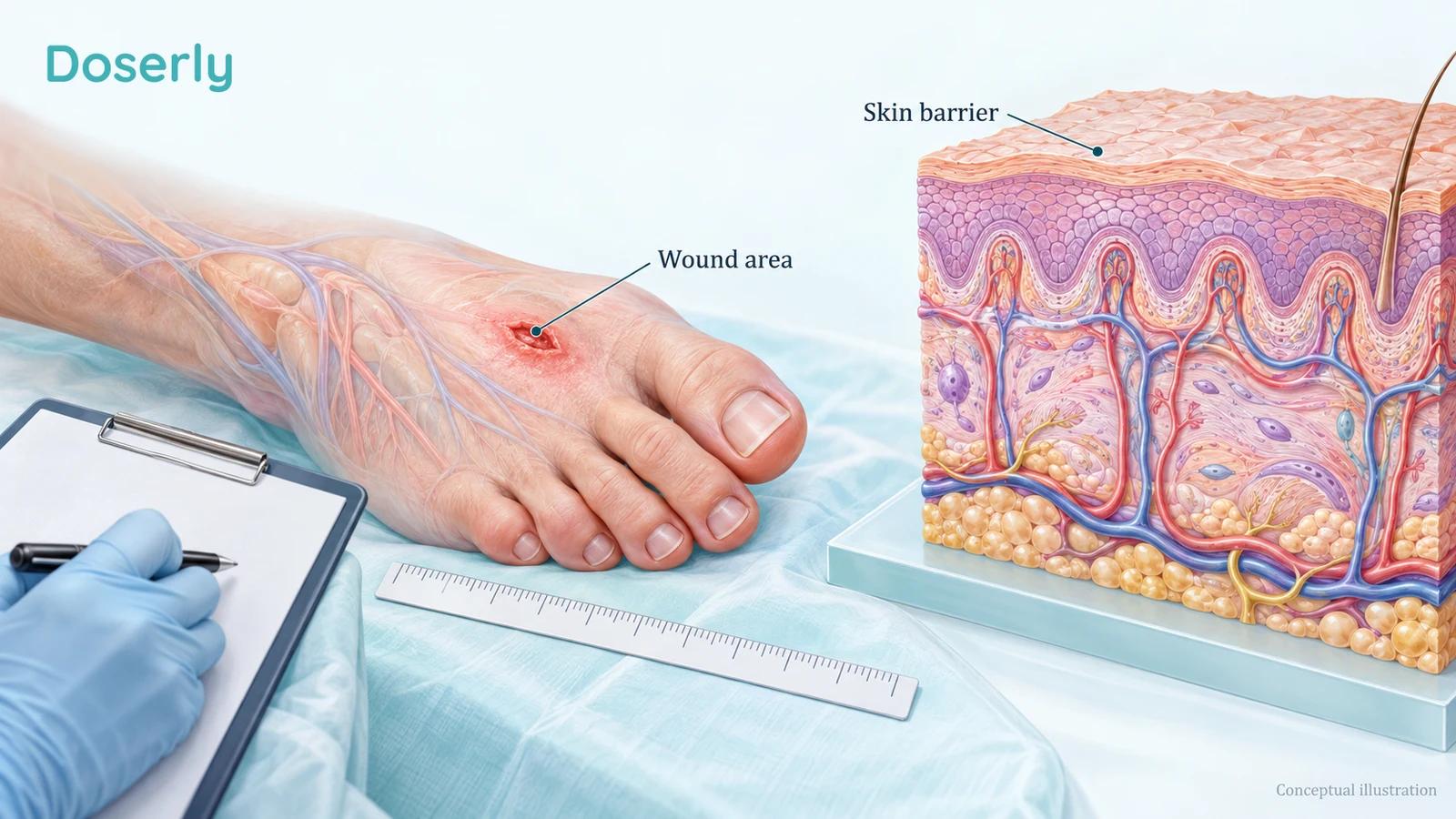
Wound area is relatively easy to measure repeatedly, so it appears frequently in early trials. A reduction can be a useful sign of progress. However, a wound that has become much smaller can still remain open and vulnerable. Percentage reduction does not tell us whether the skin barrier has fully closed.
Complete healing, time to healing and sustained closure are therefore especially useful outcomes. Infection, hospitalization, amputation, recurrence and the burden of care also matter. A treatment that improves area over two weeks has not necessarily been shown to improve those later outcomes.
The denominator changes the meaning of a result. “A 50% reduction in wound area” describes a change in size. “Half the participants healed” describes a proportion of people reaching closure. They are not interchangeable. Similarly, more than 90% closure is not complete closure, even if the remaining wound looks small.
Absolute and relative comparisons deserve the same care. If one group improves from a larger starting wound, its numerical area change can look impressive without establishing a superior final result. Randomization, baseline balance, consistent measurement and a suitable analysis help make the comparison fair.
For someone living with an ulcer, the question is straightforward: will this addition help the wound close sooner and stay closed, with acceptable burden and risk? The available PBM studies only partly answer that question.
Early placebo-controlled evidence was promising and small
A 2011 double-blind trial randomized 23 people with chronic diabetic foot wounds to low-level laser or placebo, alongside conventional treatment. After 20 weeks, eight of 13 people in the laser group and three of ten in the placebo group had complete healing. The reported mean healing times were 11 and 14 weeks, but that time difference was not statistically significant. Kaviani trial
These are encouraging counts, especially because the study included a placebo comparison. They are also based on very few people. A difference involving several participants can produce a large-looking percentage while leaving substantial uncertainty about the true effect.
The nonsignificant healing-time result should remain visible. It would be inaccurate to turn the reported means into a promise that treatment saves three weeks. The study suggests a possible benefit and supports a larger trial; it does not establish a predictable healing timetable for an individual wound.
This is a recurring pattern in the literature. There is enough signal to make research reasonable, but less certainty than a simple “accelerates healing” claim suggests.
Short studies often measured area rather than closure
A 2012 randomized study of 68 people reported greater wound contraction with low-level laser added to conventional care. The reported percentage area reduction over a short treatment period was about 40% with laser and 12% with conventional care alone. Its main finding concerned wound size, not a durable complete-healing endpoint. Kajagar trial
A later 30-person trial studied superficial ulcers with negative cultures. At two weeks, average area reduction was approximately 37% with laser plus conventional care and 15% with conventional care alone. The primary outcome was the change in wound size. The comparison did not include a sham laser procedure. Mathur trial
Those findings are relevant to early wound progress. They cannot establish that light prevents amputation, eradicates infection or replaces the need for offloading. The selected ulcer populations and short observation periods also limit generalization to more complicated wounds.
It is tempting to regard a short positive study as the first part of an inevitable healing story. Research does not work that way. Early contraction can be followed by a plateau, recurrence or a complication. Those possibilities need follow-up rather than assumption.
A home-device pilot did not test unsupervised self-care
A sham-controlled pilot in a frail population randomized 20 people with severe diabetic foot ulcers and substantial coexisting illness. Active home PBM was added to standard care. The active group had a greater reduction in wound size; more than 90% closure occurred in seven of ten active-treatment participants and one of ten sham participants. Home-device pilot
This study is sometimes particularly appealing because treatment occurred at home. Its design still involved a defined device, a clinical study and standard wound care. The result does not authorize substituting a consumer panel for the wound team's plan. More than 90% closure also should not be rewritten as seven completely healed wounds.
No adverse device effects were observed in this small pilot. That is reassuring within the study but insufficient to establish safety across all devices, wounds and medical conditions. A ten-person active-treatment group cannot reliably identify uncommon harms.
Home delivery can reduce travel burden when it is part of a supervised plan. It does not remove the need to monitor the wound, assess circulation, manage infection or ensure that the device and its use match the evidence.
Newer LED and dose-comparison trials leave open questions
A 2024 randomized study compared red LEDs, infrared LEDs, their combination and a control condition. It examined home-based treatment over 12 weeks in people with grade I or II ulcers. The abstract reported large standardized effects and a tendency toward faster area reduction with individual red or infrared treatment. It did not establish a clear complete-healing advantage in the accessible report. Red and infrared LED trial
The language of a tendency matters. A large standardized effect in a small study is not the same as a precise, replicated estimate of clinical benefit. Without full comparative results and their uncertainty, the abstract should not be promoted as proof that one wavelength is best.
An October 2025 double-blind trial compared several red-light exposures with an active infrared-light comparison. Every group also received conventional wound treatment. There was no statistically significant between-group difference in ulcer reduction at five or ten weeks, although wounds became smaller over time within groups. Dose-response trial
Because all groups received active light, this study cannot establish how much improvement came from PBM rather than the shared wound care or time. It also did not demonstrate a reliable superiority of one tested regimen on its main area-reduction comparison. It should not become a universal dosing guide.
Together, these studies refine the research questions. They do not overturn the need for a convincing comparison against good care without active light.
Two recent pilots include null between-group findings
A 2025 pilot randomized 11 people with peripheral artery disease and diabetic foot ulcers to supervised exercise with or without PBM. Wound and walking outcomes improved from baseline in the combined group, but there were no significant between-group differences. The tiny sample makes the result imprecise. PBM plus exercise feasibility trial
This is a good example of why a favorable conclusion must be read alongside the actual comparison. Improvement after combined treatment does not show that adding light caused extra healing. Nor does this supervised pilot supply an exercise prescription for people with open wounds.
A separate multicenter, nonrandomized pilot published in a November 2025 issue included 25 participants with diabetes and lower-limb wounds. It compared laser plus hydrogel with hydrogel care. Wound area improved over time in the intervention group, but the reported between-group comparisons did not show a significant wound-area advantage. Cytokine-expression comparisons were also null. Nonrandomized wound pilot
The later PubMed indexing of a paper does not make it a newly conducted 2026 trial. Its publication details and design should remain clear. These pilots add information about feasibility and uncertainty; they do not provide decisive confirmation of an added healing benefit.
Cell findings and thermal images are not closure outcomes
A 2025 study assessed 20 people with type 2 diabetes and also investigated cultured skin cells. It reported clinical improvements after PBM and laboratory changes related to cell proliferation and repair signaling. The accessible abstract does not describe a randomized sham comparison for the human component. Human and cell-culture study
The distinction between the two parts is essential. A response in cultured fibroblasts can support a biological hypothesis. It cannot establish how much a person's ulcer will improve, or whether the same pathway explains a clinical change. The laboratory result should not be presented as a demonstrated mechanism of benefit in every patient.
In 2026, researchers examined acute thermal responses after PBM in 33 chronic wounds from 20 people, including diabetic and venous ulcers. Diabetic wounds showed a temperature response that differed from the venous-wound pattern. This was a physiological imaging study, not a randomized test of complete healing. Dynamic thermal-imaging study
A warmer wound image is therefore not proof of closure, restored large-artery circulation or infection control. It may help generate questions about tissue responses and patient selection. Those questions still require trials that measure outcomes people need, including whether the wound actually heals.
Why positive pooled results have not settled practice
A 2021 meta-analysis combined 13 randomized trials involving 413 participants and reported favorable pooled healing results. It also rated the certainty of evidence very low. That qualification is central: combining small studies does not automatically remove their risks of bias, inconsistent methods or incomplete reporting. Meta-analysis
The IWGDF review later identified eight light or laser studies, only three of which reported complete healing or time to healing. The others focused on area reduction. Its recommendation against these physical therapies reflects that broader appraisal of evidence quality and clinical value, rather than a claim that no experiment ever produced a positive result.
New studies should be evaluated on their design and outcomes, not simply added to a count of favorable titles. The more recent active-dose comparison and null between-group pilots do not provide a strong reason to present PBM as established routine care. A future large, well-conducted trial could change that assessment; a protocol or registration alone cannot.
Pressure relief can determine whether healing has a chance
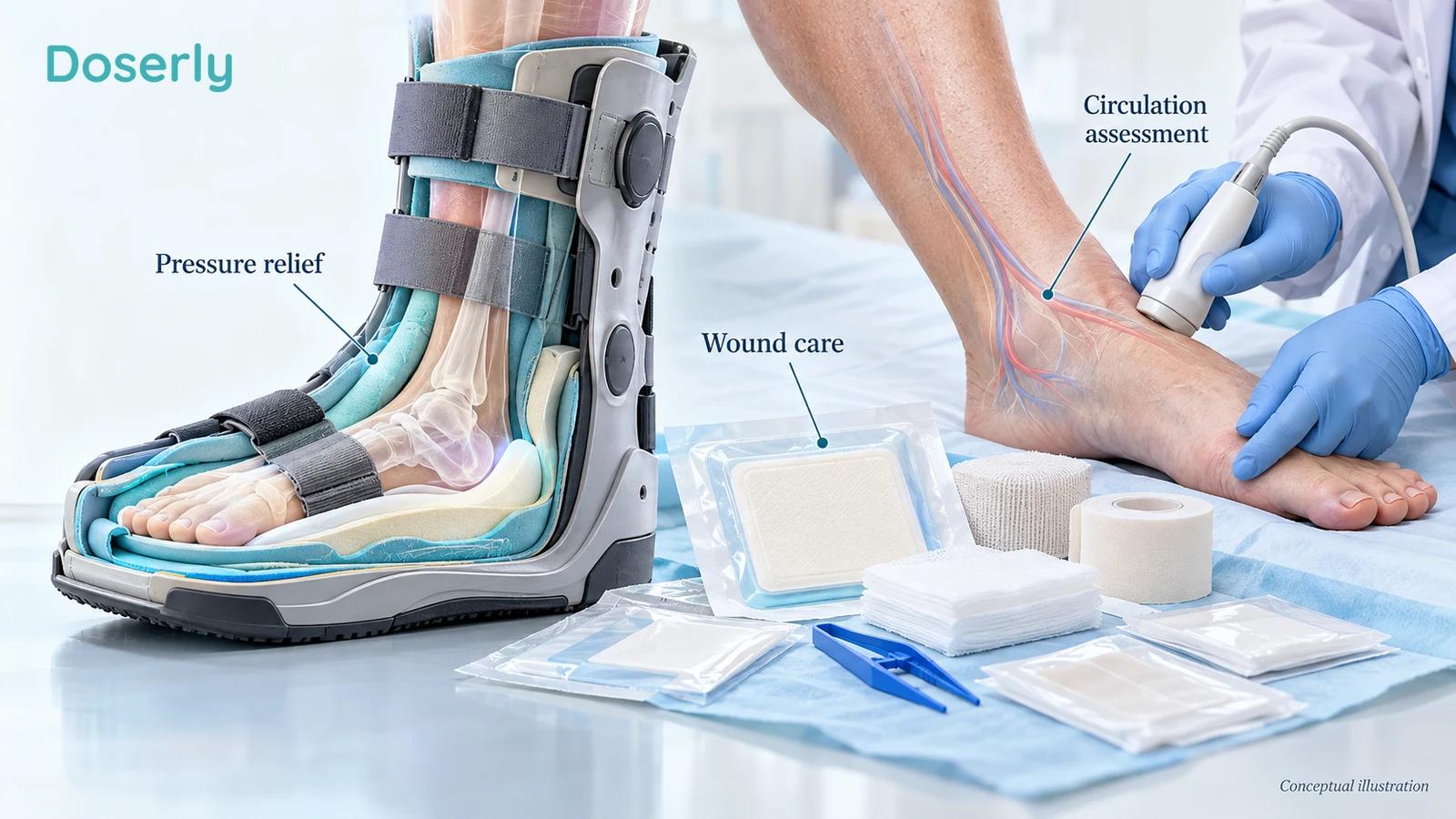
For an ulcer on a weight-bearing part of the foot, repeated mechanical stress can work against repair. Offloading means reducing that stress with an appropriate clinical strategy. The 2023 IWGDF guideline recommends a nonremovable knee-high device as first choice for suitable neuropathic plantar forefoot or midfoot ulcers, with alternatives when contraindications or intolerance apply. Infection, ischemia and wound location change the decision. Offloading guideline
This is not a recommendation to buy or apply a cast independently. Device selection, fit, skin checks, balance and follow-up require a clinical plan. The principle is that the wound needs protection during the activities that load it, not just during an appointment.
In a randomized trial comparing offloading approaches, the reported complete-healing proportion was higher with total-contact casting than with removable walkers or half-shoes. The participants had superficial, noninfected, nonischemic plantar ulcers, so the finding was specific to that clinical setting. Offloading trial
A separate prospective study of 79 people used activity monitors to measure adherence to removable offloading. Devices were worn during about 59% of recorded activity on average, and better adherence predicted more healing. Postural instability was an important barrier. Offloading adherence study
That result invites a practical conversation rather than blame. If a device is difficult to use safely, the team needs to know. Solving access, balance or comfort problems may be more consequential than adding another wound treatment while the main source of repeated stress remains.
Circulation and infection need their own decisions
Light-related temperature changes cannot replace a vascular assessment. The intersocietal peripheral artery disease guideline advises reassessing vascular status when a wound deteriorates or fails to improve adequately despite appropriate wound care, infection and glucose management, and offloading. It gives less than 50% area reduction within four weeks as an example that should prompt reassessment, not a rule for waiting when the foot is worsening. Peripheral artery disease guideline
Infection is also a clinical question. The IWGDF/IDSA guideline distinguishes infected from clinically uninfected ulcers. Antibiotics are not recommended simply to make an uninfected ulcer heal, while genuine infection may require antimicrobial treatment and sometimes urgent surgical care. A PBM study does not establish an antibiotic substitute. IWGDF/IDSA infection guideline
New spreading redness, swelling, drainage, discoloration or systemic illness should prompt contact with the wound-care team; severe or rapidly worsening illness needs urgent assessment. Reduced pain sensitivity can make waiting for pain especially unreliable. Do not postpone assessment to complete a light-treatment course.
What a useful consultation should clarify
Start by asking what is currently limiting healing. The answer may involve pressure, blood supply, infection, wound depth, the dressing plan or several factors together. A discussion that jumps directly to a device without reviewing those issues is incomplete.
If PBM is proposed, ask how the clinician interprets the guideline recommendation and which study matches your wound. Was the study sham-controlled? Did it measure complete closure or only area reduction? Did it exclude infection or significant vascular disease? What standard care did both groups receive?
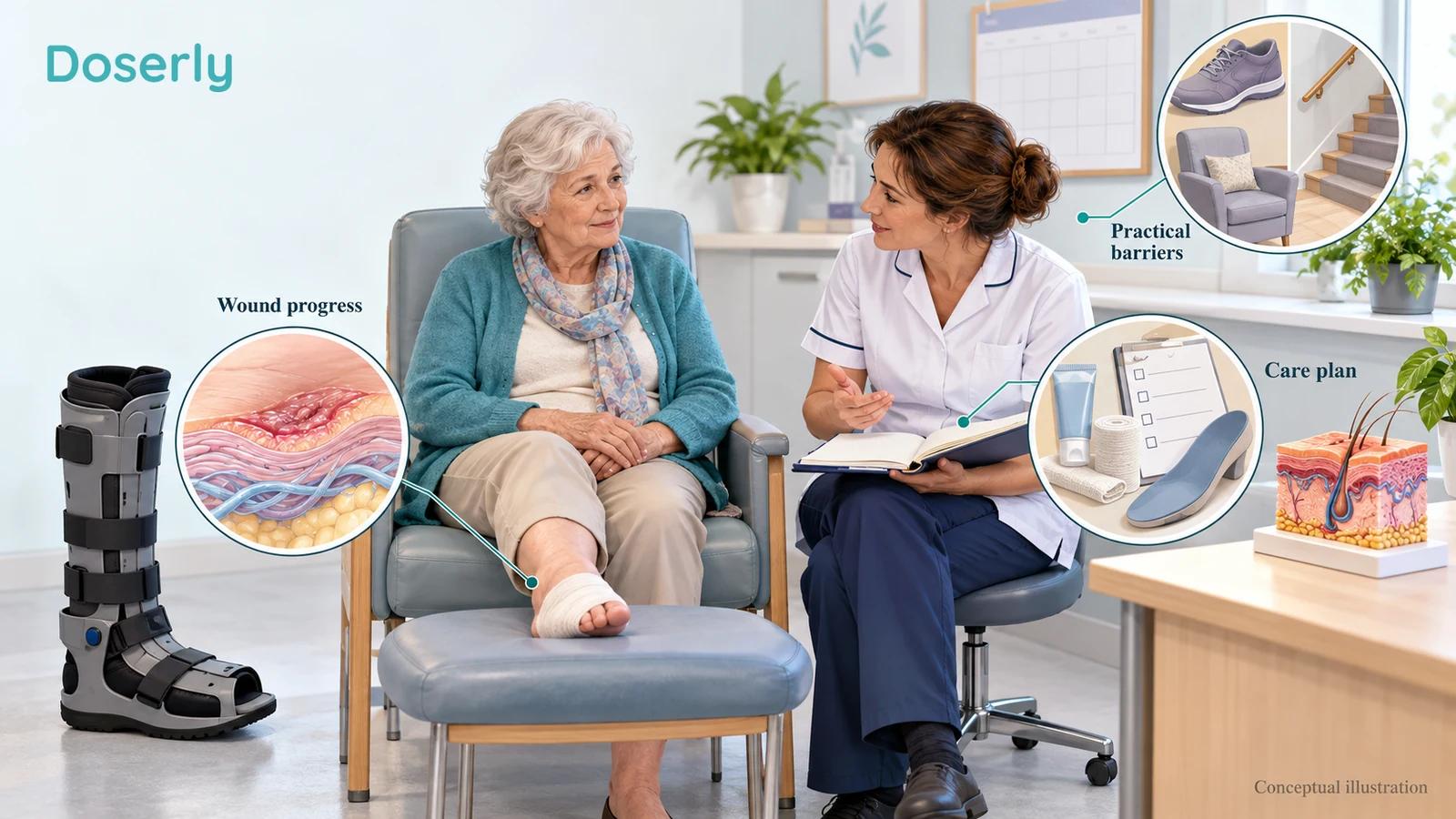
Ask how progress will be documented and who will review deterioration. A consistent clinical record is more useful than occasional photographs taken under different lighting. A smaller-looking wound in a brighter image is not a dependable measurement. The wound team can explain what changes they are following and why.
Practical burden belongs in the discussion as well. Extra visits can mean travel, time away from work and more weight-bearing on the affected foot. Home treatment can have different challenges, including device handling, access to the wound and maintaining the prescribed dressing routine. Those details should be considered before any additional intervention is started.
Finally, agree on a review point. An uncertain treatment should not become an indefinite commitment because healing remains slow. If the wound is not progressing, reassessment of the whole plan is more useful than automatically increasing exposure or buying a stronger device.
Where red light therapy fits today
PBM is a possible subject of further clinical research for diabetic foot ulcers, with small positive studies and substantial uncertainty. Current guideline advice does not support its routine use as an addition to wound care. The newer evidence includes active-treatment comparisons, uncontrolled observations and null results that should remain visible.
For someone with an ulcer, the priority is a coordinated plan that protects the wound, assesses circulation, addresses infection when present and follows healing carefully. Any discussion of light should take place inside that plan. A reduction in wound area is encouraging; a reliably closed, protected and functional foot is the outcome that matters most.