
Red Light Therapy
October 17, 2026
Red light therapy for jaw pain and dental recovery: what the studies measure
On this page
A sore jaw can make small things surprisingly tiring. Chewing, yawning, speaking through a meeting or sitting through a dental appointment may become uncomfortable. After oral surgery, the question is often more immediate: will an extra treatment make the next few days easier?
Red light therapy, usually called photobiomodulation in dental research, has been studied for both problems. Some trials report less pain or better mouth opening. Others find no meaningful advantage over sham treatment. The evidence becomes clearer when persistent jaw pain and recovery from a specific operation are considered separately.
There is also a difference between feeling better and rebuilding tissue. A lower pain score does not show that a jaw disc has moved into place, an extraction socket has grown bone faster or a tooth has regenerated. Good research identifies the outcome it measured. A useful clinical conversation should do the same.
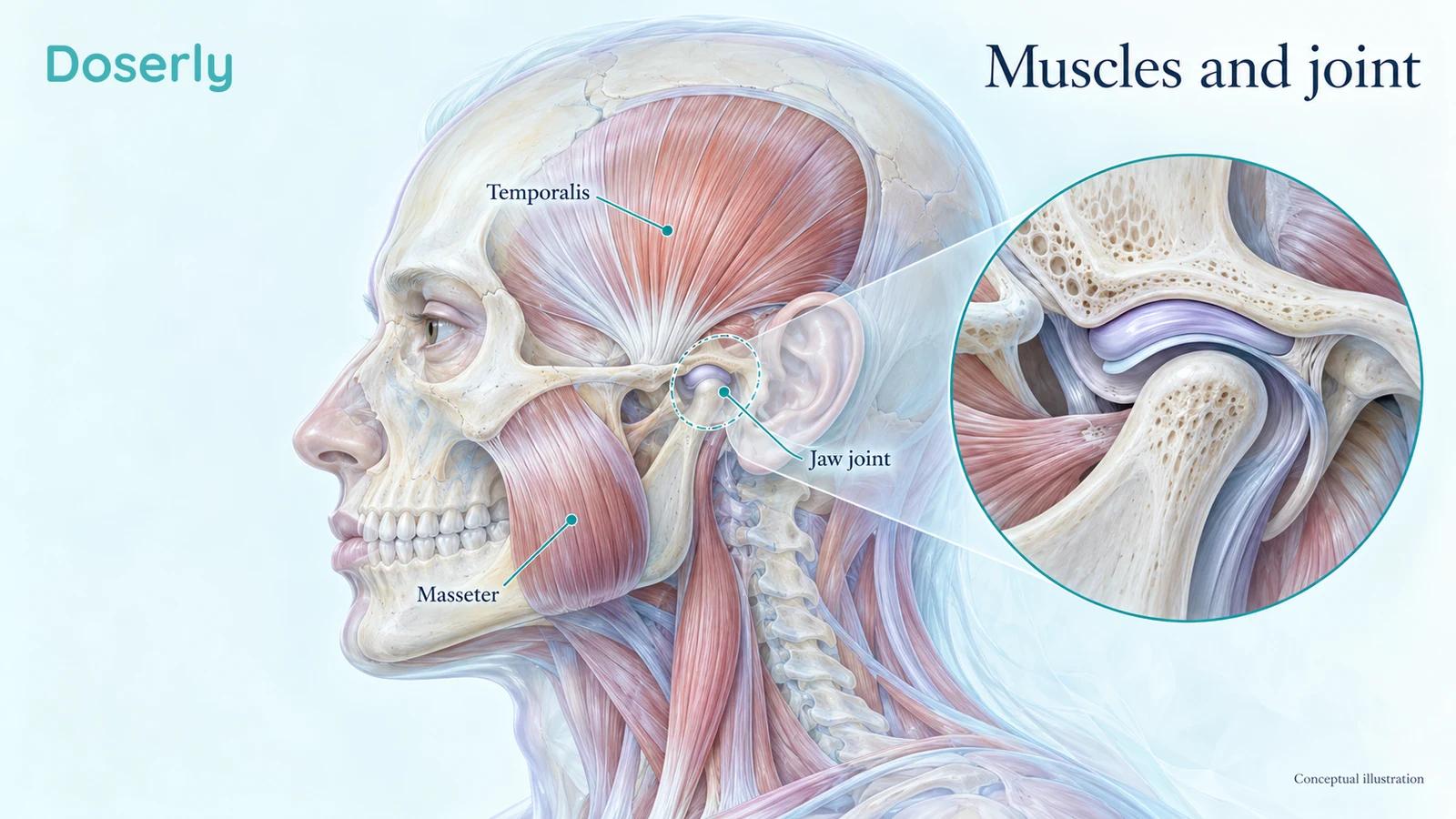
Conceptual jaw anatomy. Pain can arise from the chewing muscles, the joint or another source; this illustration does not diagnose the cause.
Start with the cause of the jaw pain
The temporomandibular joints sit just in front of the ears. They work with the chewing muscles to move the lower jaw. Temporomandibular disorders, or TMDs, describe a group of conditions involving these joints, muscles and related structures. The abbreviation identifies a family of problems rather than a single diagnosis.
The National Institute of Dental and Craniofacial Research emphasizes that pain in the mouth, jaw or face may have another cause. A dentist or clinician considers the history, examines movement and tenderness, and decides whether further investigation is needed. Clicking without pain is common and often needs no treatment.
That last point can be reassuring. A sound alone does not mean the joint is wearing out or that you need a device to prevent damage. When pain is present, the location and circumstances matter. Discomfort in a chewing muscle may require a different approach from painful movement within the joint or pain from a tooth.
It is worth describing what happens rather than arriving with a fixed label. Does breakfast hurt more than dinner? Is opening difficult, or is closing and chewing the problem? Has the jaw locked? These details help the clinician connect the symptom to a useful examination.
Professional guidance is more cautious than many advertisements
For pain lasting at least three months, a 2023 BMJ clinical practice guideline conditionally recommends against low-level laser therapy, whether used alone or with other interventions. It gives stronger support to approaches including supervised jaw exercise and stretching, therapist-assisted mobilization, manual trigger-point treatment, cognitive behavioral therapy and usual care involving education and reassurance.
“Conditionally against” does not mean light has been proved harmful or that no individual could benefit. It means the panel did not consider it a preferred option given the available evidence and tradeoffs. That recommendation applies to chronic TMD pain; it is not a verdict on recovery after a tooth extraction.
Guidelines do not entirely agree. The Japanese Society for the Temporomandibular Joint's 2023 edition, published in English in 2025, conditionally suggests low-level laser among initial conservative options. It explicitly rates the evidence as very low certainty and notes problems with small studies and bias. Its scope concerns primary treatment in general practice, whereas the BMJ guidance addresses chronic pain.
The disagreement is a reason to ask about the evidence behind a particular recommendation. It is not a reason to choose whichever guideline sounds most appealing. Both the clinical setting and the uncertainty need to be part of the discussion.
Muscle pain and joint pain may respond differently
A 2021 placebo-controlled trial separated people with pain centered in the masseter muscle from those with pain centered in the jaw joint. Of 147 randomized participants, 100 completed all sessions, so attrition is an important limitation.
Pain improved over time in both active and placebo groups. The active treatment produced a greater reduction for joint pain, but the muscle-pain comparison did not reach statistical significance. Pressure-pain thresholds also changed without a clear advantage for active treatment. Some movement outcomes favored PBM modestly.
This is a more useful finding than saying that laser either works or does not work for “TMJ.” The same treatment may produce different results in different groups. It also shows why improvement after a series of appointments cannot automatically be attributed to the light itself.
A 2023 trial report provides a different signal. It analyzed 145 people after active or sham treatment and found immediate advantages for total pain, tender points and mouth opening. However, the report concerns immediate effects after irradiation. It does not establish that those changes persist for months or eliminate the need for ongoing care.
Immediate relief can be worthwhile. If it makes a meal or an examination easier, that may matter to a patient. The promise should nevertheless match the observation: an immediate symptom response and durable control of a recurrent condition are different achievements.
What the newer TMD trials add
A 2026 LED study randomized 29 people to active or inactive treatment. It used a cluster device over jaw and neck regions. Pain decreased within the active group, while the placebo group did not show the same statistically significant before-and-after change. Mouth opening did not clearly improve more with active treatment.
There are two reasons for caution. First, a significant change in one group and a nonsignificant change in another do not, by themselves, establish a significant difference between groups. Second, the report says the treating investigators also performed assessments without blinding. The small sample and reporting inconsistencies about timing further limit confidence. The paper is an encouraging signal to investigate, not a definitive demonstration of better jaw function.
A small trial published in 2026 applied PBM to selected acupuncture points. Twenty patients were randomized, ten per group. Pain and maximum mouth opening favored active treatment, but an oral-health quality-of-life measure did not differ significantly. A physical-health subscale gave a more favorable result. This is a distinct delivery approach and a very small study; its findings should not be transferred automatically to a home mask or panel.
These studies help refine questions rather than settle the entire field. Which type of pain is present? Does the treatment add benefit beyond the attention and expectation of a visit? Does any improvement last? Does the person eat and speak more comfortably? Those questions matter more than whether the newest abstract uses an enthusiastic conclusion.
Comparing wavelengths does not identify a universal winner
A 2025 randomized study of 30 people with myofascial pain compared two laser approaches. Both groups improved, with larger pain and mouth-opening changes reported for the 980-nanometer approach than the 635-nanometer approach.
However, the groups also received different power and energy settings. The experiment therefore did not isolate wavelength as the only difference. It had no placebo group, was registered retrospectively and followed a small, selected population. Its explanation involving deeper penetration is a proposed interpretation, not a measured demonstration that deeper light caused the benefit.
This is why a product comparison based on one wavelength number is incomplete. The tissue, delivery method and treatment schedule belong to the intervention too. A study using a clinician-held device over selected sites cannot validate any product that happens to emit a similar color.
For the same reason, the term “cold laser” should not be treated as a complete safety specification. PBM is intended to influence biological responses without relying on tissue destruction. A surgical laser that cuts or coagulates tissue is doing a different job. More powerful treatment is not simply a stronger version of the evidence for nonthermal PBM.
Mouth opening is useful, but it is not the whole goal
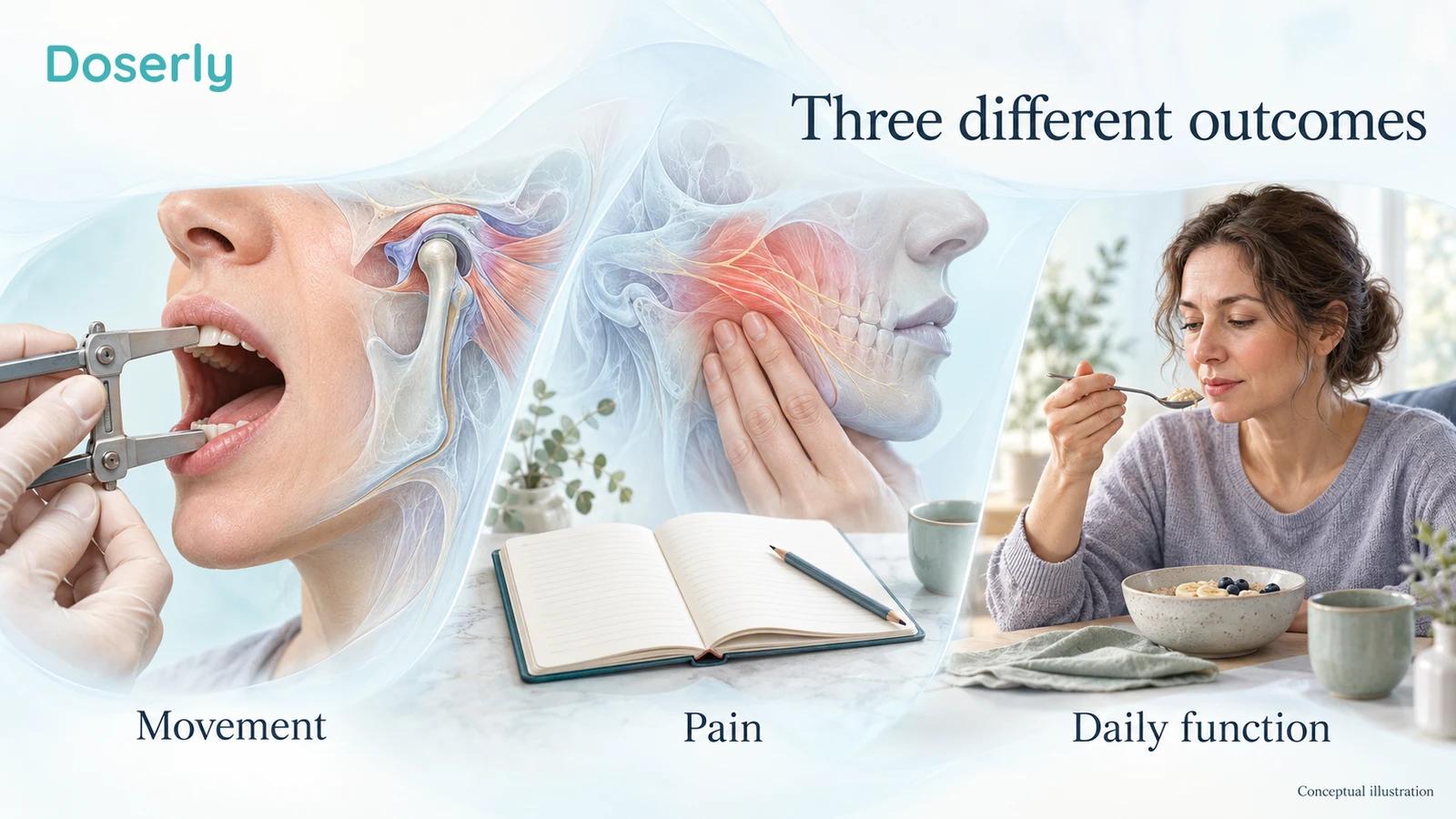
Pain, mouth opening and comfortable daily activities are separate outcomes. The illustration contains no measured improvement or treatment result.
Researchers can measure the distance between the front teeth when the mouth opens. They may record pain-free opening, maximum unassisted opening or opening with assistance. Those measurements are related but not interchangeable. The test instructions affect what the number represents.
Suppose a person can open slightly farther after treatment but still avoids chewing on one side. Another person may have unchanged maximum opening but less pain during ordinary meals. Neither experience can be summarized adequately by the same single number.
Pressure-pain testing answers another question: how sensitive is a location to a standardized stimulus? A change can be informative without establishing that everyday pain or disability has improved. Muscle electrical recordings and imaging have their own limits as well. They may help describe a condition or investigate a mechanism, but they are not substitutes for the patient's functional experience.
A practical goal might be finishing a normal meal comfortably or getting through a work conversation without increasing jaw pain. Agreeing on that goal before treatment makes reassessment more useful. It also helps prevent an endless sequence of sessions justified only by a small change on an instrument.
Dental surgery creates a different research question
After a lower wisdom tooth is removed, pain, swelling and temporary restriction in opening can occur as part of recovery. PBM trials in this setting usually ask whether adding a light procedure makes that recovery easier. They do not test whether light should replace the operation or its normal aftercare.
The NHS explanation of wisdom-tooth removal describes the protective clot that forms over the wound and the importance of following the surgical team's instructions. Recovery varies with the procedure. A person's symptoms commonly change over time even without an extra intervention.
That makes the comparison group especially important. If pain falls between the second and seventh day, we need to know whether it fell more than it did in otherwise similar patients receiving sham or standard care. A dramatic before-and-after story may simply capture expected recovery.
The timing of measurement also changes the question. Relief during the first difficult days may be valuable even if both groups feel similar later. Conversely, a tiny numerical difference after most people have recovered may add little practical benefit.
Recent wisdom-tooth trials show both benefits and limits
A 42-person placebo-controlled LED trial available online in May 2026 reported better pain, mouth opening and analgesic-use outcomes on days two and four. It did not find significant differences in facial swelling or quality of life. Although assigned to a November journal issue, the study was available before this article's October research cutoff.
That pattern supports a possible early comfort benefit for the tested protocol. It does not establish that every aspect of recovery improves together. The small sample also limits how precisely we can estimate the expected benefit for another patient.
A 2026 trial of preoperative and postoperative PBM randomized 80 people, but excluded nine from each group for not following postoperative instructions. Pain favored active treatment at 48 hours, with no significant difference on day seven. Swelling and some quality-of-life outcomes were favorable, while restriction in opening did not differ significantly.
The post-randomization exclusions matter: the reported comparison no longer includes everyone originally assigned. In addition, treatment occurred both before and after surgery. Its findings cannot be attributed solely to the preoperative session, despite the emphasis in the paper's title.
A September 2026 trial involving 70 patients found less pain and better reported quality of life on day two after a single extraoral session. It did not use a sham comparator. By day seven, the remaining pain difference was just 2.6 millimeters on the pain scale, which the authors considered clinically negligible. Swelling and restricted opening did not differ significantly at either assessment.
These are not interchangeable recipes. They used different devices, schedules and comparators. Their common message is narrower: some approaches may improve early symptoms, but persistent benefit and broader recovery claims require separate evidence.
The null studies belong in the discussion too
The Italian multicenter BIOSTOTT trial, appearing in a 2026 journal issue after an earlier online report, randomized 79 patients across five centers. It tested a multiband device after lower third-molar surgery.
The investigators found no statistically significant differences in the measured outcomes, including pain, swelling, restricted opening, quality of life and analgesic consumption. Describing favorable trends as established benefit would misrepresent the result. The trial was designed to detect a relatively large effect, so it cannot precisely exclude every smaller benefit either.
Its device combined blue, red and near-infrared wavelengths. That makes it another specific protocol rather than a clean test of red light alone. The result still matters when evaluating broad claims that dental PBM reliably improves recovery.
A 2026 randomized oral-biopsy study compared a single PBM session with sham in 62 people. Pain and inflammation declined in both groups over seven days, without a significant added benefit from PBM. The authors noted limitations including the absence of an advance sample-size calculation and incomplete recording of pain-medicine use.
This was a small soft-tissue procedure rather than a wisdom-tooth extraction. Its null result should not be used to dismiss every surgical application. It does, however, argue against assuming that a light session is useful after any dental procedure simply because it is available.
Pain relief is not proof of accelerated healing
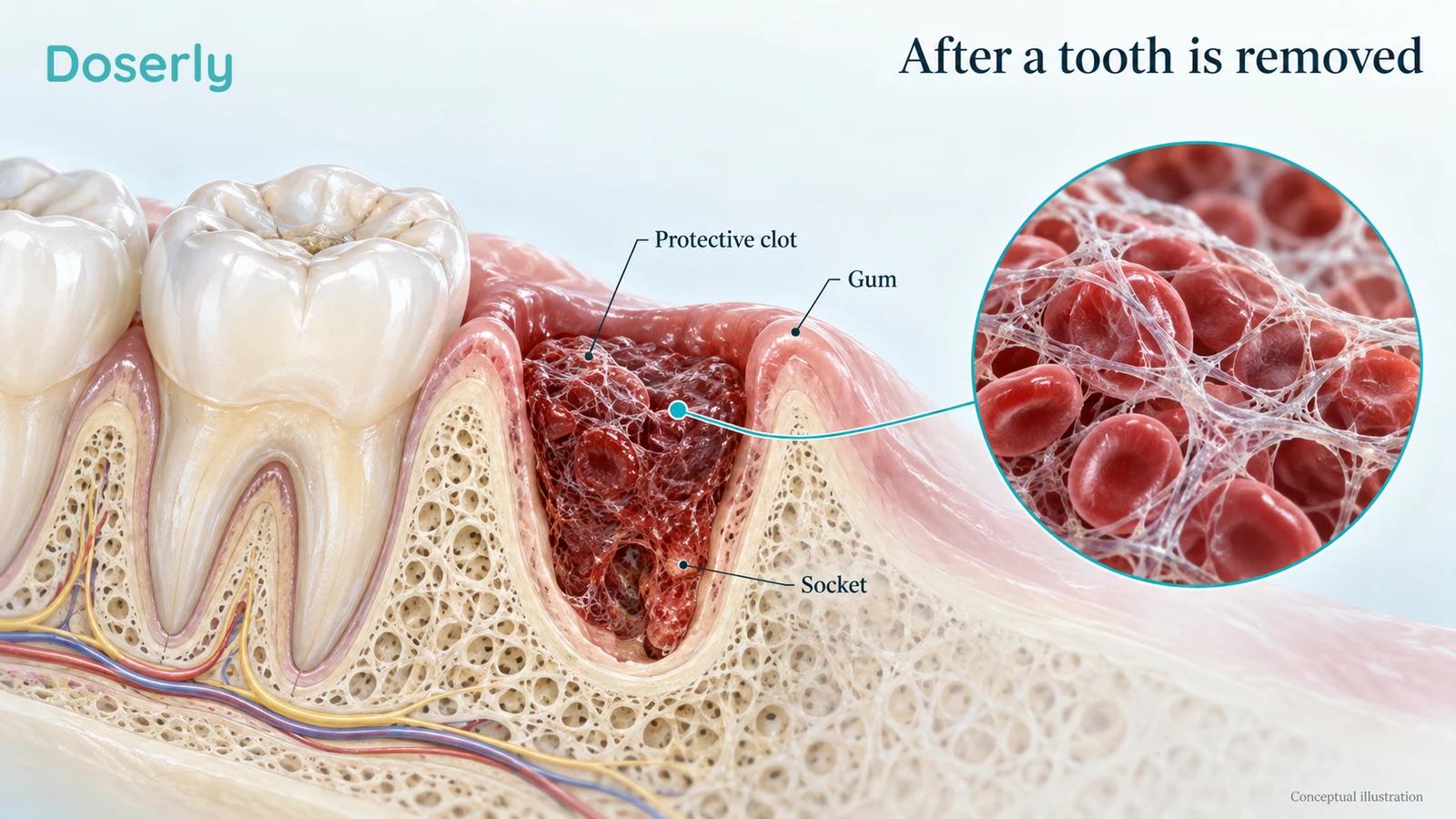
Conceptual early extraction-site anatomy. A pain-relief study does not by itself establish faster bone healing, fewer infections or tooth regrowth.
“Recovery” can refer to several things: reduced pain, less swelling, easier opening, soft-tissue closure or deeper repair. A trial must measure the specific process before making a claim about it. Short-term symptom scales cannot establish all of those outcomes at once.
An extraction socket eventually changes as healing proceeds, but a person feeling better at 48 hours does not demonstrate that new bone formed faster. A reduction in tenderness does not establish fewer infections. Better mouth opening does not show that a missing tooth is growing back.
The human trials discussed here do not provide clinical evidence that a consumer red-light device regrows lost teeth or repairs cavities. Nor do they establish that symptomatic TMD improvement means a displaced disc has been restored to its original position. Those are much larger structural claims requiring their own evidence.
This distinction also protects against false reassurance. If a symptom becomes less noticeable, the underlying dental problem may still need treatment. The purpose of a follow-up examination is to assess the site and the diagnosis, not merely to ask whether a device session felt pleasant.
How to judge an offer of PBM after a procedure
Start with the expected recovery from your actual operation. Ask what the proposed light treatment is intended to improve, when that improvement should occur and how the evidence compares with the same aftercare alone. A claim about early pain should come with an explanation of early pain, not a vague promise of cellular regeneration.
The cost and appointment burden matter. An optional add-on performed at the end of a scheduled visit creates a different practical commitment from returning several times during the following week. If the likely benefit is temporary, that may still be worthwhile to you, but it should be described honestly.
Ask whether the clinic's device and schedule resemble those in the cited research. “We use laser too” is not enough information. The clinician should also explain eye protection, application-site precautions and how unexpected discomfort is handled. You do not need to derive a personal dose from the paper.
Keep your agreed pain-management and wound-care plan in place. If medication changes are appropriate, they should be part of the treating clinician's instructions rather than an assumption that light will replace them. The research generally studies PBM alongside care, so abandoning that care changes the situation.
Make room for the care that supports daily function
An optional technology should fit around a plan you understand. For persistent TMD, that may include learning how to use the jaw more comfortably and working with a clinician on movement or pain-management strategies. The BMJ guideline supports several active and educational approaches. Their inclusion does not mean the pain is imagined or that a patient should simply tolerate it.
It can help to bring a concrete example to the appointment. “I stop halfway through lunch because chewing becomes painful” invites a discussion about a functional problem. “I need every joint sound to disappear” may lead toward treating something that does not necessarily need treatment. The clinician can help distinguish those goals without dismissing the experience.
If an appliance is proposed, ask what it is intended to do. The NIDCR's TMD guidance cautions against approaches that permanently change the teeth, bite or jaw joints when conservative care is appropriate. A light procedure does not make an otherwise unnecessary irreversible intervention more justified.
The same principle applies after surgery: comfort matters, but so does confidence in what is normal, what to report and whom to contact. A clear explanation can reduce the uncertainty around recovery even when an optional add-on offers little extra benefit.
A reassessment plan is more useful than an open-ended package
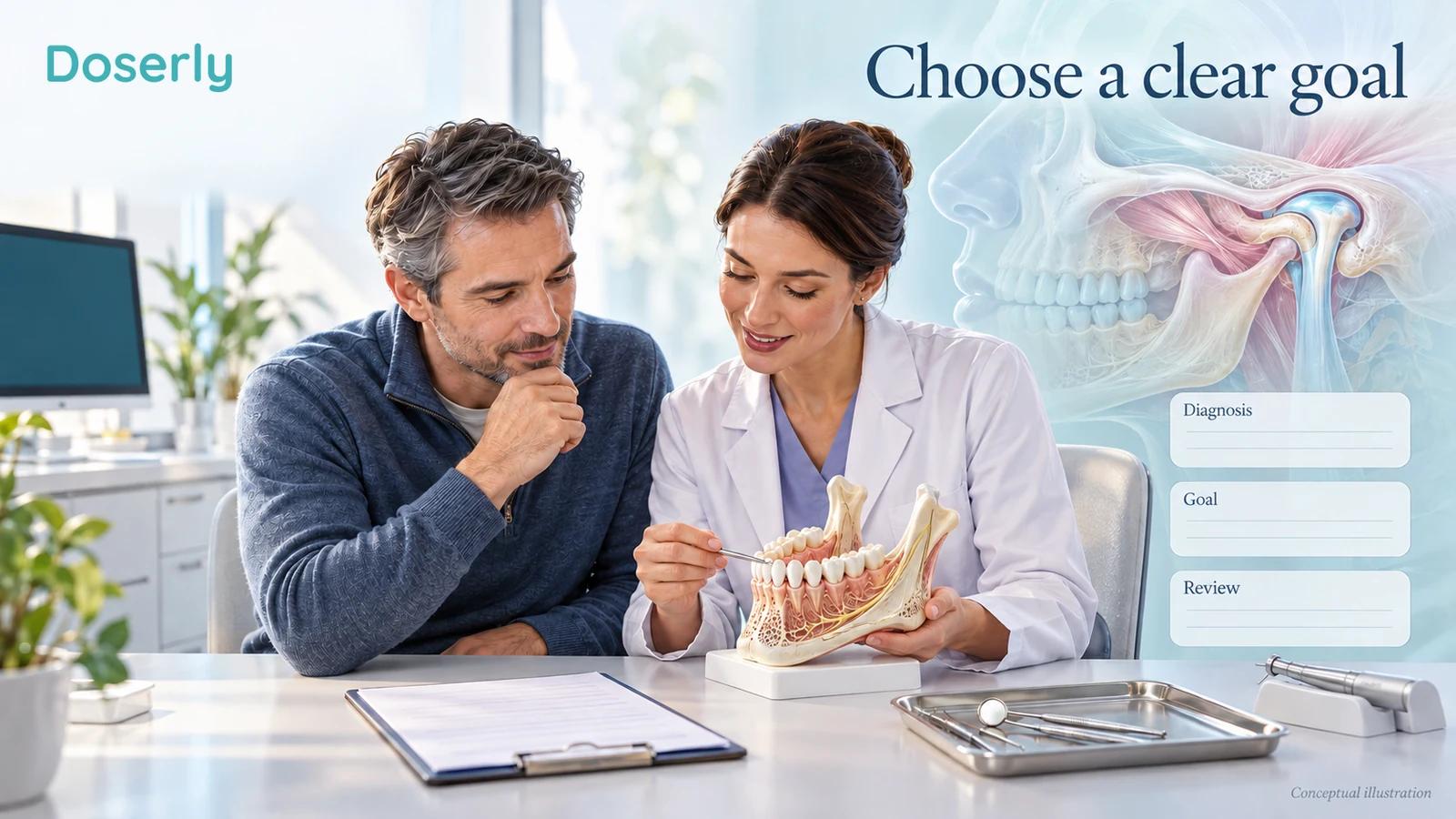
A useful discussion starts with the diagnosis, the expected benefit and the plan for reassessment. A light device is only one possible part of dental care.
For persistent jaw pain, it helps to agree on a review point and a small set of meaningful outcomes. You might track pain during an ordinary meal, difficulty opening for dental care and the activity you most want to regain. Avoid repeatedly forcing the jaw open to see whether a measurement has improved.
Record other changes that could affect symptoms, such as a new exercise program, a change in clenching habits or a medication adjustment. This does not turn home tracking into a controlled trial, but it gives the clinician a more accurate picture than remembering only the best or worst day.
After surgery, worsening symptoms need assessment rather than more exposure. NHS advice recommends urgent dental help for persistent bleeding, severe or worsening pain and swelling, or pain accompanied by a bad taste, fever or feeling unwell. A planned light appointment should not delay that review.
The goal is a treatment plan that becomes clearer over time. If PBM is tried and does not provide a worthwhile benefit, that is useful information. It should lead to reassessment, not automatically to a stronger device or a longer package.
Red light therapy has plausible and sometimes encouraging roles in dental symptom management, but its value depends on the problem and the outcome. For chronic TMD, uncertainty and conflicting guidance remain. After dental surgery, some protocols may ease early discomfort while others show no added benefit. A clear diagnosis, a realistic goal and a defined follow-up make that evidence much easier to use.