
Red Light Therapy
October 17, 2026
Red light therapy after concussion: what human brain injury studies show
On this page
After a concussion, ordinary things can become surprisingly demanding. Reading a page, following a conversation in a busy room, or getting through a workday may require more effort than they used to. If symptoms persist, a treatment described as helping brain cells recover naturally deserves a careful explanation rather than a quick dismissal or a sales pitch.
Red and near-infrared light therapy, usually called photobiomodulation in research, has produced interesting findings after traumatic brain injury. Some small studies report improvements in memory, symptoms, or balance. Others show changes on specialized brain imaging. A controlled trial of persistent post-concussion symptoms, however, found no benefit over placebo. These results do not yet establish light therapy as a reliable concussion treatment.
The most useful way to read this literature is to ask which injury was studied, when treatment began, and what actually improved. A finding in hospitalized adults with moderate brain injury does not automatically apply to a teenager with a sports concussion. A seasonal imaging difference in football players does not mean that light prevents concussions or makes further impacts safe.
This review covers human research available through October 17, 2026, including the recent athlete trial. The aim is to make the evidence understandable while keeping recovery, rehabilitation, and return-to-activity decisions connected to clinical care.
Start with the injury and the person
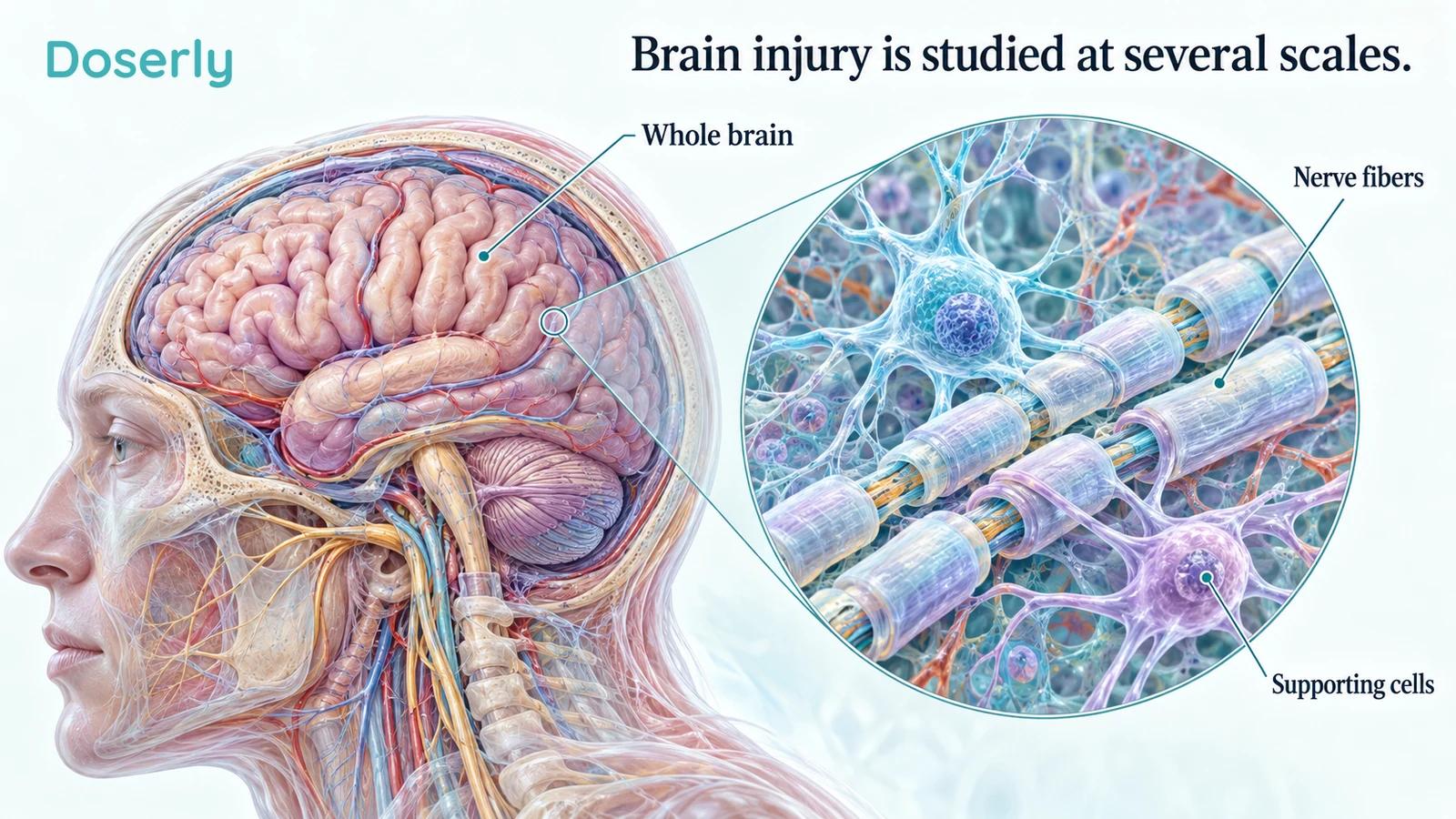
Concussion is a form of mild traumatic brain injury. The word mild describes the injury classification; it does not mean that headaches, dizziness, slowed thinking, sleep disruption, or difficulty concentrating feel mild. Symptoms can affect how someone learns, works, drives, and interacts with other people. The CDC describes several symptom groups, including physical, cognitive, emotional, and sleep changes.
It also identifies danger signs that require urgent assessment after a head injury. These include a worsening headache that does not go away, repeated vomiting, seizures, increasing difficulty waking, and new weakness or marked confusion. A light device is not an appropriate response to those signs. Immediate medical assessment takes priority over any discussion of an experimental recovery treatment.
Even outside an emergency, a proper evaluation matters because a symptom is not a diagnosis of one biological mechanism. Someone who cannot tolerate reading might have several overlapping difficulties. The clinical task is to understand the pattern and identify problems that can be addressed. Choosing a device before that assessment can make a complicated recovery feel simpler without actually making the treatment more specific.
Time since injury is equally important. Early studies sometimes examine treatment within days of trauma, when many biological and clinical changes are happening quickly. Other studies enroll people months or years later. Those are different questions: influencing an acute injury process, helping persistent symptoms, and preventing cumulative consequences of repeated exposure should not be treated as interchangeable goals.
What transcranial photobiomodulation is trying to do
Transcranial means that the treatment is directed through the head's outer tissues toward the brain. Researchers have studied red and near-infrared light using different arrangements of LEDs or lasers. Some investigations add an intranasal component. These are specific research devices and treatment schedules, not evidence that any red lamp or consumer panel delivers the same exposure.
The biological interest concerns cellular energy handling, blood flow, and responses to injury. These ideas can explain why investigators run trials. They cannot tell us, by themselves, whether a person will recover faster, return to work sooner, or have fewer persistent symptoms. Those outcomes require direct measurement in people with an appropriate comparison group.
An instructive example is a 2025 experimental study of mild traumatic brain injury. Its title describes improved functional recovery, but the work involved an injury model in adult rats. Researchers tested light exposure, behavior, and tissue markers, including markers related to glial activation and cell death. It contributes to the biological rationale. It is not a clinical trial in injured people and does not establish a human treatment dose.
There is also a physical distinction between light arriving at the scalp and light reaching a relevant brain region. Wavelength, device geometry, contact, and the intervening tissues influence exposure. Quoting the wavelength from a paper does not establish that a different product reproduces its effects. Buying a device with a matching number on the label is not the same as reproducing a clinical intervention.
Early reports explain the enthusiasm, with important limits
Some of the earliest human interest came from two chronic brain injury case reports published in 2011. The authors described improvements in cognition and everyday functioning after transcranial LED treatment. These accounts were meaningful enough to justify more research, particularly because the participants had longstanding difficulties.
A case report, however, cannot determine how often an outcome will occur or how much of a change was caused by the treatment. There is no randomized comparison, and the clinician and participant know what is being used. Reports of deterioration when treatment stops also do not establish that everyone needs indefinite treatment. They are observations from particular people, not a maintenance prescription.
A 2014 open-protocol study enrolled 11 people with chronic mild traumatic brain injury, beginning treatment between 10 months and eight years after injury. After a six-week course, investigators reported favorable trends on selected executive-function and verbal-memory tests, along with participant and family reports of improvements. There was no sham group. The authors appropriately called for placebo-controlled research.
These studies help answer whether a treatment is worth investigating. They are much less able to answer whether it works beyond the effects of attention, expectation, repeated testing, and changes occurring during the same period. In persistent symptoms, those distinctions are especially important because patients often try several approaches together. A compelling personal improvement can be real while its cause remains uncertain.
The controlled persistent-concussion trial was negative
The 2024 randomized, double-blind, placebo-controlled trial is central to this discussion. It studied people aged 11 years or older receiving care for persistent post-concussion symptoms. Forty-eight participants completed the study, most were female, and most injuries occurred during sports or exercise.
The trial compared six weeks of transcranial photobiomodulation with placebo. Its main measures included a post-concussion symptom scale and computerized cognitive testing. Despite randomization, the active group reported more previous concussions. After adjustment for that difference and multiple comparisons, investigators found no significant treatment advantage at three or six weeks.
That result does not prove that every possible light device or schedule is ineffective. It does mean that the tested approach did not demonstrate benefit over placebo in that population. A responsible explanation keeps that finding visible instead of treating it as an inconvenient footnote to the early positive reports. Although the paper appeared in 2024, recruitment occurred in 2012–2015; publication year and treatment era are different details.
A small positive 2025 trial adds a different piece
A 2025 randomized crossover study enrolled 17 people with mild traumatic brain injury. Participants received both real and sham treatment in a counterbalanced order, with a one-week washout between conditions. Assessments included cognitive tests, self-reported symptoms and sleep, and an optical measure of oxygenated hemoglobin during a working-memory task.
The abstract reports improvements after active treatment in several cognitive and symptom measures, with no significant improvement after sham. It also reports changes reaching a minimal clinically important difference for behavioral symptoms. These are encouraging findings, but the sample is small. The accessible abstract does not provide a complete set of direct active-versus-sham effect estimates and uncertainty intervals.
That distinction matters statistically: an improvement reaching significance in one condition and failing to reach significance in another is not, on its own, a formal test that the two conditions differ. Crossover studies also need careful consideration of order and carryover. The result supports further controlled study; it does not erase the negative trial or establish a broadly reliable effect.
A newer acute-concussion pilot tested tolerability
The RECOVERY study, published in September 2026, adds a different kind of evidence. It enrolled 50 adult sportspeople within 72 hours of concussion and randomized them between two pulse frequencies. Both groups received a device combining brain photobiomodulation with a static magnetic field. There was no sham group.
The primary outcome was adverse device effects, not faster recovery. At least one such effect occurred in 10 of 26 participants in one group and 10 of 24 in the other. All were mild, non-serious, and resolved; examples included sleepiness and discomfort at the device site. No difference was detected between the frequencies, but the study was not designed to establish equivalence.
Secondary symptom, function, and blood-marker analyses were exploratory and unadjusted for multiple comparisons. Their changes cannot establish efficacy without sham, particularly during acute recovery. REGEnLIFE funded and was involved in the research. The combination device also prevents attributing observations specifically to light. This is useful feasibility work for planning a controlled trial, not evidence that the treatment speeds concussion recovery.
Moderate brain injury studies found imaging changes
A separate line of investigation studied hospitalized patients with moderate traumatic brain injury. In a 2020 randomized trial, 68 people were assigned to a custom light helmet or sham treatment beginning within 72 hours of injury. The primary focus was feasibility and safety, with imaging and symptom measures as secondary outcomes.
No adverse events attributed to light therapy were reported. Forty-three participants had at least one MRI scan available for the imaging analysis. Investigators found differences in several diffusion-imaging measures over recovery. This was evidence that the intervention might influence measurable features of brain tissue, but it did not establish a clear symptom benefit. The setting and injury severity also differ from routine outpatient sports concussion.
A 2024 secondary analysis of the same trial examined resting-state functional connectivity. It included 17 treated participants, 21 sham participants, and 23 healthy controls. Some connections changed differently between treatment groups during early recovery, but there was no evidence of a difference in clinical outcomes measured with the Rivermead symptom questionnaire.
This later paper is not an independent clinical replication. It asks another imaging question using the same underlying trial. Counting both publications as two successful treatment trials would exaggerate the evidence. Together they support further investigation of brain responses, while leaving the question of meaningful recovery benefit unresolved.
Why an imaging signal and recovery can disagree
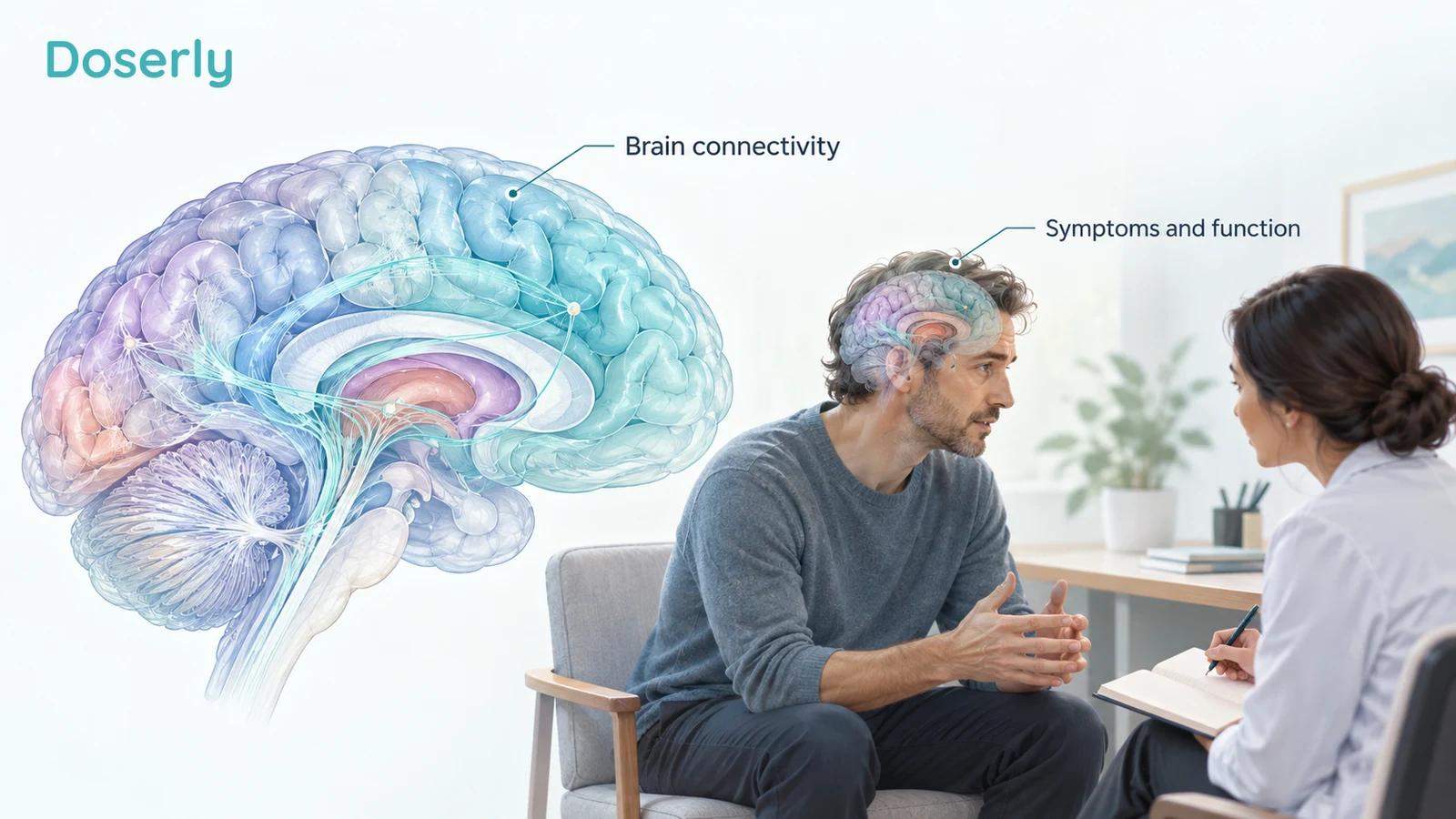
A brain scan can detect a pattern that is too subtle to notice in everyday behavior. That makes imaging valuable for studying a possible mechanism. It does not automatically make the pattern a validated substitute for how a person feels or functions.
Consider two possible research findings. In one, a treatment changes a brain-network measure but people report no additional symptom relief. In another, symptoms improve while the selected imaging measure stays the same. Neither is logically impossible. A measurement samples one part of a complex process, and its relationship with recovery needs to be demonstrated rather than assumed.
Diffusion imaging concerns the behavior of water within tissue. Functional connectivity concerns statistical relationships between signals from brain regions. Neither is a direct photograph of a healed axon, an inflammatory cell switching off, or a memory being restored. Words such as repair and neuroprotection can sound more definitive than the measurement allows.
For a patient, the clinical questions remain concrete. Can they complete a school day with manageable symptoms? Are headaches less disruptive? Is activity tolerance improving? Can they sustain work without an excessive setback? A strong treatment study connects its biological observations with outcomes like these and follows them long enough to show whether gains persist.
This does not make biomarker research unimportant. It gives it a useful role: helping investigators decide what to test next, rather than standing in for a treatment benefit that has not yet been shown.
What the 2026 football-player trial actually measured
The 2026 collegiate football study randomized 26 players, 13 to active treatment and 13 to sham. The intervention combined transcranial and intranasal photobiomodulation over a 16-week preseason and competitive season. Brain diffusion imaging was collected before and after the season.
The investigators examined restricted diffusion imaging and quantitative anisotropy, interpreting these as markers relevant to inflammation and axonal remodeling. The sham group showed increases across parts of the brain, whereas the active group showed relative stability or reductions in some areas. This is an interesting controlled finding in actively competing athletes.
The outcome was an imaging pattern, not demonstrated prevention of concussion, chronic traumatic encephalopathy, or later dementia. The study also did not establish that continuing to sustain head impacts was safe. Its abstract calls for longer follow-up and functional outcomes. The title's language about neurological resilience should be understood within those measurement limits.
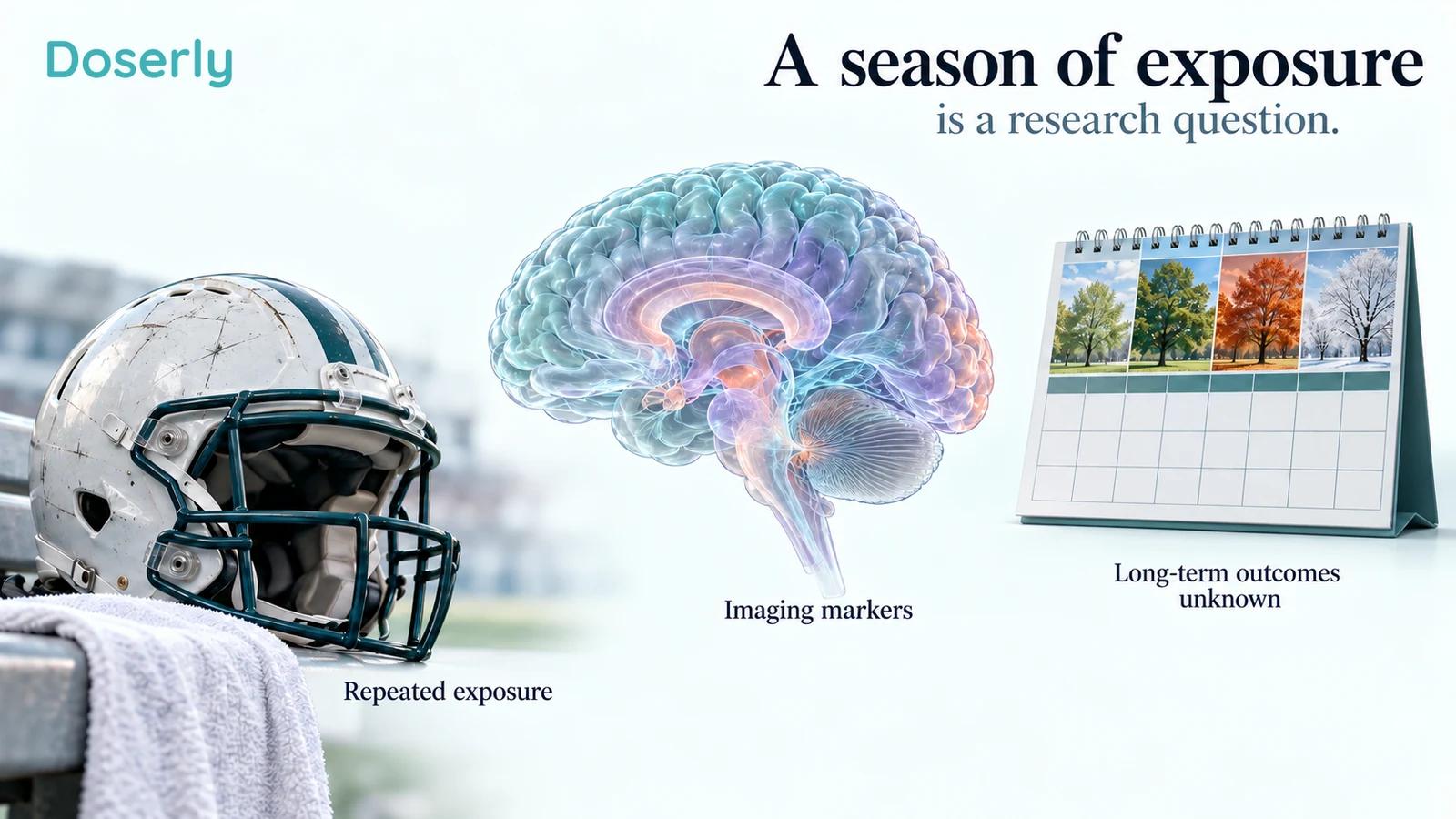
For a player, parent, or coach, that boundary has immediate consequences. A device must not become a reason to ignore symptoms, stay in a game, or accept additional impacts. The CDC's sports-concussion guidance calls for immediate removal when concussion is suspected, no same-day return, and assessment and clearance by a healthcare professional. An experimental imaging finding cannot replace that process.
Repeated head acceleration exposure is also not identical to a diagnosed concussion. Research may investigate cumulative exposure in people who remain in competition, while concussion care concerns an identified injury and its consequences. Prevention claims need evidence designed for prevention, including the outcomes and duration relevant to the claim.
Balance findings are promising but still preliminary
A 2024 proof-of-concept study examined 43 adults with self-reported histories of concussion or repetitive head acceleration and related complaints. After eight weeks of combined intranasal and transcranial treatment, group averages improved on reaction time, part of a balance assessment, and grip strength. Most participants were men, and their ages ranged widely.
There was no concurrent sham comparison. The findings therefore cannot separate treatment effects from practice, expectation, or other changes during the study. They also do not show fewer falls, fewer future injuries, or safe return to collision sports. A laboratory or clinic test can be useful without answering all of those larger questions.
It is worth asking what the test represents in daily life. Faster performance on a familiar task is not necessarily the same as navigating a crowded environment, tolerating a full shift, or making decisions under competitive pressure. Future studies should connect test changes with durable functional outcomes rather than assuming that one guarantees the other.
Recovery care has evidence of its own
Considering an experimental treatment should not obscure options that already have relevant clinical evidence. Recovery care is individualized, and the right approach depends on symptoms, examination, and stage of recovery. It is more useful to ask which problem needs attention than to assume that every persistent symptom has the same treatment.
In a 2019 randomized trial, 103 adolescents with recent sports concussion received individualized, subthreshold aerobic exercise or a placebo-like stretching program. Median recovery was 13 days with aerobic exercise and 17 days with stretching. Recovery included physician assessment and normal exercise tolerance, not just a lower questionnaire score. This was a supervised clinical approach based on assessment, not permission to push through symptoms.
A 2021 multicenter trial in 118 adolescents supported the benefit of individually prescribed aerobic activity below the symptom threshold compared with stretching. Its findings concern early adolescent sports-concussion care. They should not be converted into a universal exercise schedule for everyone with a brain injury, but they demonstrate why rehabilitation deserves attention alongside new technologies.
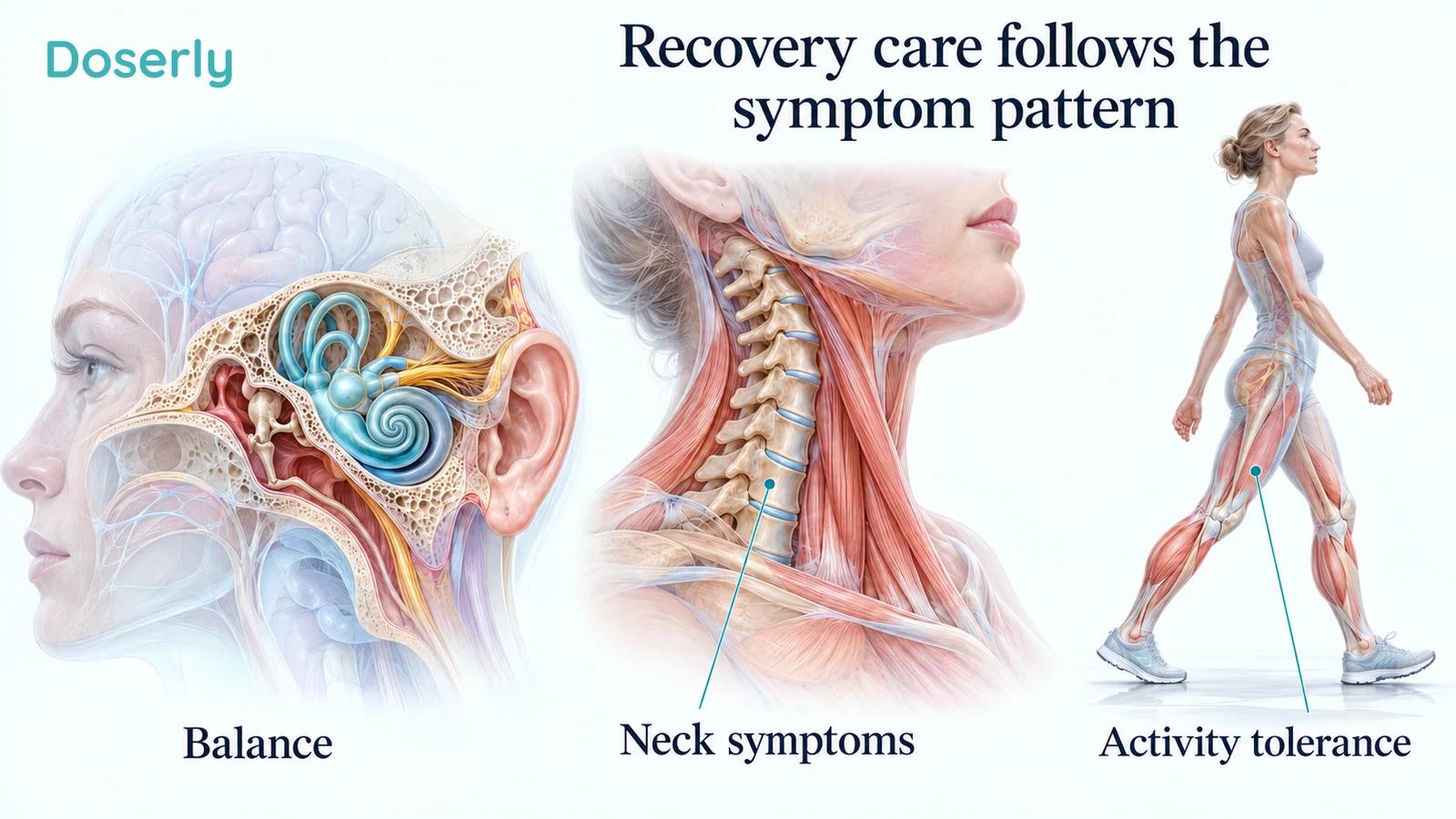
For a different symptom pattern, a 2014 randomized trial studied young people with persistent dizziness, neck pain, or headaches. Adding cervical and vestibular rehabilitation led to more participants receiving medical clearance within eight weeks: 11 of 15 compared with 1 of 14 in the control group. This was a small study with a specific population, yet it measured a clinically relevant outcome and helps explain the value of targeted assessment.
Sleep, daily demands, and a realistic recovery record
The CDC advises a brief initial period of rest followed by a gradual return to activity, adjusting activity if symptoms worsen. It also advises follow-up when symptoms persist or worsen. Spending an indefinite period waiting for a device to work can delay that reassessment.
Sleep belongs in the conversation because it is both a symptom domain and part of everyday functioning. If supplements are being considered, our melatonin guide explains the separate sleep-timing question. A discussion of melatonin is not evidence that it repairs concussion injury, and adding several supplements and a light device together makes individual effects harder to interpret.
A useful recovery record can remain simple. Note the main symptom that limits the day, the activity that brings it on, and how long it takes to settle. Record medication changes, rehabilitation sessions, disrupted sleep, and unusually demanding days. The purpose is to give the treating clinician a clearer pattern, not to turn every normal fluctuation into a treatment verdict.
For example, a headache score after a quiet weekend is not directly comparable with a score after a full day of meetings. Both observations are valuable, but the demands were different. Likewise, being able to do more while reporting the same symptom score can be meaningful progress. Function and symptoms should be interpreted together.
Return to driving, work, and sport can require different judgments. The CDC's clinical guidance emphasizes symptoms, cognition, exertion, and the demands of the activity. A self-tracked improvement or a better test result does not independently establish readiness for every situation.
Questions that make a treatment discussion more useful
If photobiomodulation comes up with a clinician or research team, start with the intended outcome. Is the proposal aimed at headache, cognition, sleep, exercise tolerance, or an exploratory imaging measure? Those are different targets, and a claim about one should not quietly become a promise about all of them.
Next ask whether the evidence matches the person and the device. A study in chronic symptoms may not answer an acute-injury question. A combined intranasal and transcranial system may not answer a question about a standalone panel. A hospital feasibility study cannot determine the safety of years of unsupervised home exposure.
The follow-up plan matters as much as the proposed mechanism. There should be a clear way to record adverse effects, review progress, and reconsider the approach if it is not helping. More sessions or stronger exposure should not become the automatic explanation for every disappointing result. The studies do not establish a universal home protocol, and none of the findings discussed here justify direct eye exposure.
Finally, ask what would change the plan. This keeps the conversation connected to meaningful outcomes rather than an open-ended promise. A person deserves to know whether the evidence supports a reasonable expectation of benefit, participation in a research study, or simply continued scientific interest.
Photobiomodulation remains an active research area after brain injury. The human literature contains enough signals to justify better trials, but it also contains clear reasons for restraint: a negative controlled concussion study, small positive samples, and imaging findings without established clinical benefit. For someone recovering now, the strongest approach is to keep those distinctions intact while pursuing assessment and rehabilitation directed at the difficulties that actually shape daily life.