
Red Light Therapy
October 17, 2026
Red light therapy and cancer: supportive care, tumor biology and safety
On this page
If you have cancer, or have been treated for it, hearing that red light therapy helps cells repair themselves can raise two very different questions. Could it make treatment easier to tolerate? And could the same light also affect cancer cells?
Both questions deserve a proper answer. Photobiomodulation, usually shortened to PBM, has a legitimate role in parts of cancer supportive care. There are human trials and professional recommendations for specific applications. That does not turn every red-light device into an appropriate treatment for every person with a cancer history. It also does not mean PBM has been established as a way to shrink tumors.
The useful distinction is the purpose of treatment. Preventing painful mouth sores, helping someone eat during radiotherapy, and controlling the cancer itself are different goals. Understanding which goal a study tested makes the research much easier to interpret.
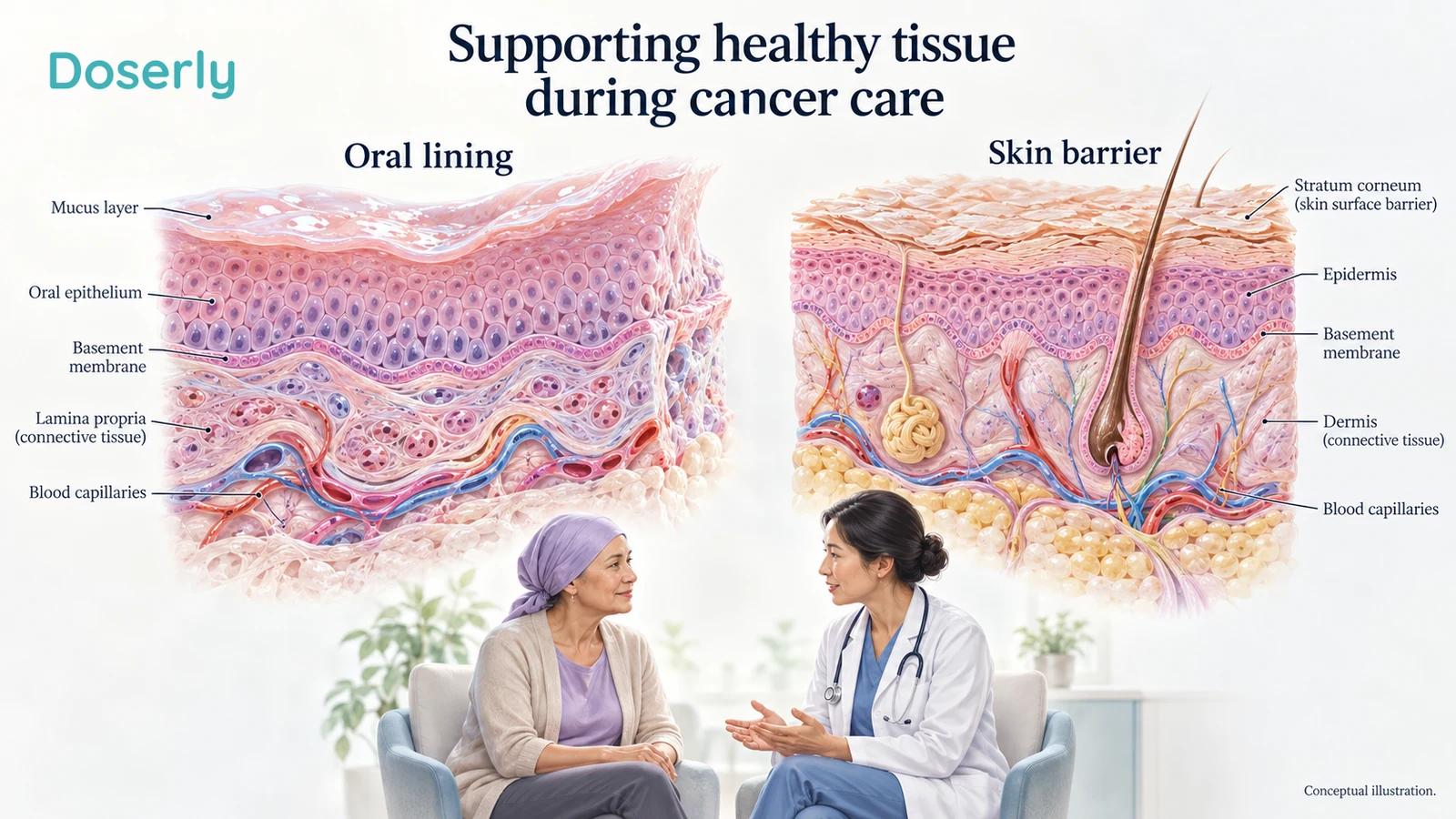
Conceptual anatomy of healthy tissues that can be affected by cancer treatment. The image does not show a treatment response or tumor removal.
What clinicians mean by supportive care
Supportive care addresses problems that arise from cancer and its treatment. An intervention can be valuable because it reduces discomfort or helps a person maintain everyday function, even when it has no direct effect on the tumor. Eating more comfortably during a difficult treatment course is a meaningful goal in its own right.
PBM usually involves red or near-infrared light delivered at settings intended to influence biological responses without cutting tissue or deliberately destroying it with heat. In oncology research, the intervention includes the device, the body area, the treatment schedule and the surrounding clinical care. The name alone does not describe all of those features.
For example, light delivered inside the mouth by a trained team before radiotherapy is a different intervention from standing in front of a consumer panel. Even if the products share a wavelength, the amount of light reaching a particular tissue and the tissues exposed may differ substantially. A favorable clinical result belongs to the tested intervention before it belongs to a product category.
This is why the first question at an appointment should be straightforward: what problem are we trying to improve? If the answer changes from mouth soreness to immune enhancement to cancer control during the same explanation, those claims need to be separated and supported individually.
Where professional recommendations are most specific
The MASCC/ISOO mucositis guidelines recommend selected intraoral PBM protocols to prevent oral mucositis in particular adult treatment settings. These include stem-cell transplantation with high-dose chemotherapy, with or without total-body irradiation, and head-and-neck radiotherapy with or without concurrent chemotherapy.
Oral mucositis means inflammation and injury of the mouth lining. It can make swallowing and eating difficult. A recommendation to prevent it is therefore clinically important. However, the guideline ties its recommendations to defined populations and treatment parameters; it is not an endorsement of unsupervised exposure over any cancer site.
There is also a distinction between prevention and treatment of an established complication. Evidence that a protocol lowers the chance of severe sores does not automatically establish how it should be used after extensive ulceration has developed. A clinician needs to match the question, timing and treatment setting.
For a patient, this specificity is useful. It gives you something concrete to ask the oncology service: is PBM available for my particular treatment-related problem, and does the proposed approach match a guideline or a relevant trial?
A 2026 mouth-sore trial provides encouraging human evidence
A June 2026 randomized, double-blind trial enrolled 85 people at 12 US sites. Participants undergoing head-and-neck radiotherapy received an intraoral LED treatment or sham. In the intention-to-treat analysis, severe mucositis during six weeks of radiotherapy occurred in 36.8% with PBM versus 57.1% with sham. That is a difference of 20.3 percentage points in this study.
Some symptom findings were favorable in the per-protocol analysis, which considers participants meeting specified protocol requirements. Fewer feeding-tube placements were reported, but that comparison was not statistically significant. No device-related adverse events were observed during the reported study period. Two investigators disclosed consulting fees from the device company.
The result supports a particular supportive-care approach. Its short follow-up does not establish long-term recurrence safety, and it does not show that light treats the underlying head-and-neck cancer. Those are separate questions requiring separate measurements.
Why an unfavorable trial also matters
The UK LiTEFORM randomized trial did not deliver the hoped-for symptom result. It recruited 87 patients, with primary outcome data available for 71, far fewer than originally planned. At six weeks, the mouth-and-throat symptom questionnaire score was worse in the active group: 33.2 versus 27.4, where higher scores represent more problems. The estimated difference was 5.8 points, with a 95% confidence interval of 0.1 to 11.5.
The recruitment difficulty limits the precision of the findings, but it does not justify describing the trial as a success. Its result belongs alongside the positive studies. Different delivery schedules, devices, patient populations and outcomes can produce different results within the broad PBM category.
That is a practical reason to ask a clinic for the study most similar to its service. A general statement that hundreds of light studies exist is less useful than knowing whether its actual approach helped patients with your treatment-related problem.
Skin reactions during breast radiotherapy are another distinct use
The 2023 MASCC radiation-dermatitis recommendations include PBM as an option for preventing acute radiation dermatitis in people with breast cancer. These recommendations used a review and an international expert-consensus process. Their scope should remain visible: preventing a skin complication in a studied cancer-treatment setting is different from recommending PBM for every irritated area or every tumor type.
The trials are not uniformly positive. In the LABRA randomized trial, 71 patients receiving a shorter-course whole-breast radiotherapy regimen received standard skin care with PBM or placebo. At the final radiotherapy session, moderate-to-severe skin reactions were reported in 28% of controls versus 10% of the PBM group. The difference did not reach statistical significance, with a reported p value of 0.053.
It is tempting to call that “almost proof,” but the more accurate description is an uncertain estimate favoring PBM in a small study. The findings neither establish the benefit conclusively nor prove that the true effect is exactly zero. They also cannot tell us whether a different home device would produce the same result.
What a case report can add
A 2026 report of radiation recall described a 36-year-old woman with cervical cancer who developed a skin and mucosal reaction after cisplatin in previously irradiated areas. The authors reported improvement after a clinical PBM approach using several wavelengths for different symptoms.
This is an example of a potentially useful observation, rather than proof of a broadly effective treatment. There was no randomized comparison, the approach involved several components, and the course of the reaction could not be separated from the surrounding cancer care. It cannot establish how often another patient would improve or which part of treatment produced the change.
Most importantly, the reported improvement concerned a treatment complication. It was not evidence that the cervical cancer had been cured by light. That distinction can disappear when an encouraging case is shortened into a social-media headline.
Why researchers examine cancer cells in the laboratory
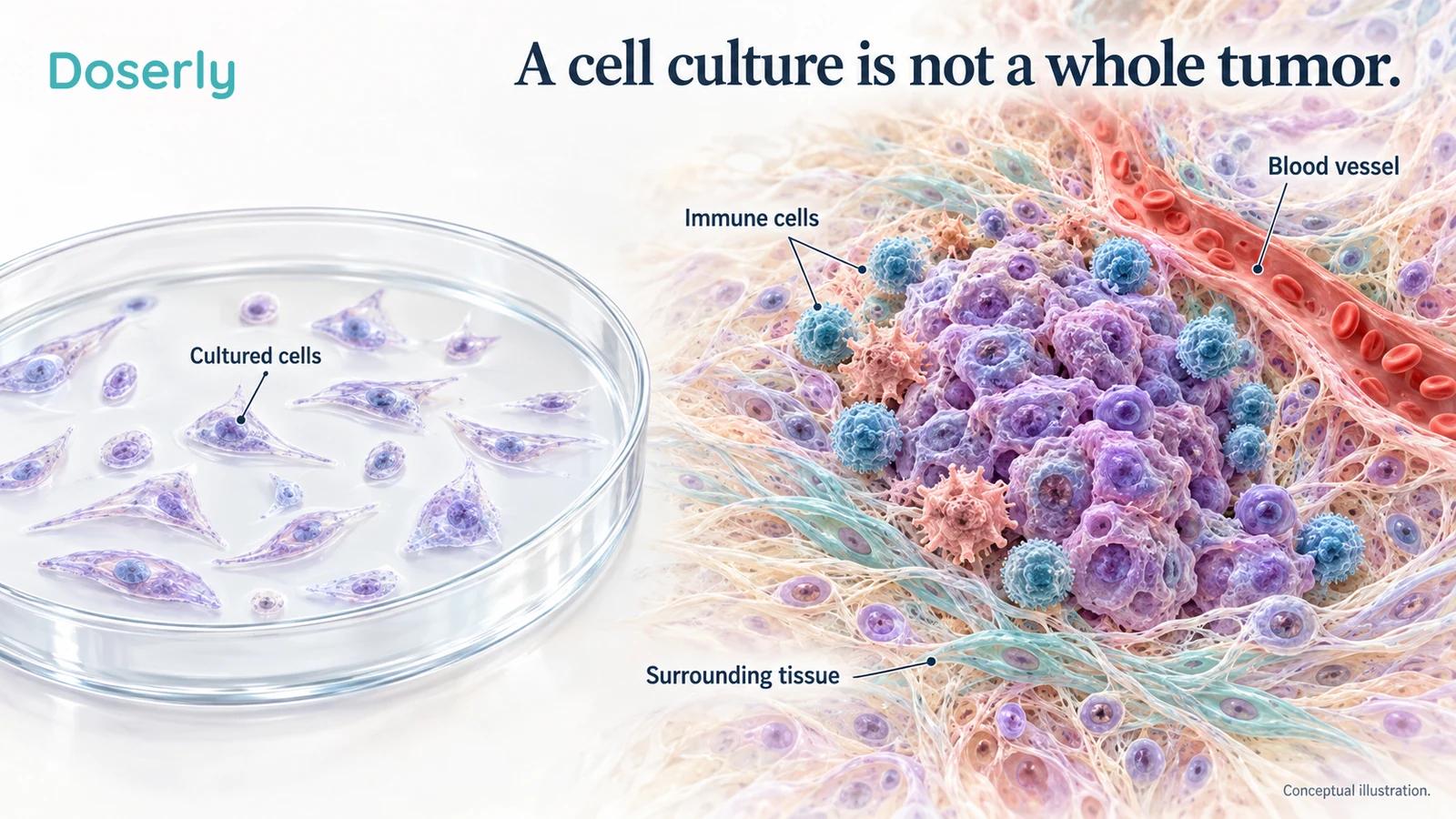
Conceptual comparison of laboratory cells and a tissue environment. Neither side depicts a measured response to light, and the tumor illustration is not a patient specimen.
The concern about tumor stimulation is not irrational. A therapy intended to alter cellular signaling needs to be studied in malignant as well as healthy tissues. However, a biological effect is not automatically beneficial or harmful in every setting. Cell type, exposure and the surrounding environment can change the response.
In a 2013 laboratory study, researchers exposed dysplastic oral cells and two oral-cancer cell lines to red or near-infrared laser light. Depending on the cell line and settings, they observed increased or decreased viability and changes in signaling proteins related to growth. Some findings raised concern about more aggressive cellular behavior. Dysplastic cells are abnormal cells that may precede cancer, not a diagnosis of invasive cancer by themselves.
The experiment gives a reason to investigate safety carefully. It does not measure recurrence in patients. Cells directly illuminated in a dish lack the tissue layers, blood supply, immune interactions and treatment history of a person. Nor can a growth-inhibiting condition in the same experiment be converted into an anticancer home protocol.
A mechanism is a question to test, not a verdict
You may hear PBM described as changing mitochondrial activity, inflammation or repair signaling. These are research concepts, not a guarantee that a response will be selective for healthy cells. “Supports cells” is too vague to answer a cancer-safety question.
The WALT 2022 position paper considers the biological and clinical evidence in cancer supportive care. Its expert panel supports PBM use in appropriate cancer-care contexts but does not recommend direct treatment over the tumor site. That qualification matters just as much as the favorable assessment of supportive use.
The practical interpretation is not that every person with a remote cancer history must avoid every light treatment forever. It is that active disease, the intended exposure area and the specific clinical reason belong in the decision. A blanket rule based only on the word “cancer” loses useful detail; blanket reassurance based only on the word “nonthermal” does too.
If someone proposes treating a known tumor with a general-purpose panel, the supportive-care studies described here do not establish that use. A plausible cellular explanation cannot substitute for a clinical cancer-treatment trial.
What longer-term head-and-neck follow-up found
A 2017 follow-up of a randomized phase III trial examined 94 people receiving chemoradiotherapy for specified head-and-neck cancers. The original PBM intervention aimed to prevent mouth sores. Median follow-up was about 41 months.
The investigators reported a higher complete-response proportion and better progression-free survival in the PBM group. The overall-survival finding was not conclusive. The study did not detect worse cancer outcomes with the tested protocol, but it was too small to exclude an important risk.
It is not proof that PBM independently kills cancer cells or prolongs life. This was a small follow-up study within a specific chemoradiotherapy setting. A favorable cancer outcome could involve supportive effects on treatment tolerance, differences occurring by chance or other factors; the study does not establish the biological explanation. Larger trials designed around cancer outcomes would be needed to clarify any survival benefit.
A 2018 retrospective report of 152 people with advanced oral squamous cell carcinoma adds another clinical perspective. All received PBM to help prevent mouth sores during cancer care. Their recurrence and survival outcomes were broadly comparable with previously published outcomes from conventional treatment. However, this was a comparison with historical reports, not a concurrent randomized group that received otherwise identical care without PBM. It provides useful clinical experience without reliably isolating an effect of the light treatment.
Researchers have also examined a different concern after hematopoietic cell transplantation: whether supportive PBM might be associated with later oral malignancies. A 2021 retrospective study covering a 15-year surveillance period found no immediate adverse effect or secondary oral malignancy associated with the PBM protocols used. That does not mean every patient was individually followed for 15 years, nor does it rule out uncommon risks. It adds setting-specific follow-up to the discussion without establishing universal safety.
The breast-cancer follow-up asks a different safety question
A 2022 long-term TRANSDERMIS follow-up analyzed 120 early breast-cancer patients from a placebo-controlled trial in which PBM had been used during radiotherapy to prevent skin reactions. Median follow-up was 66 months. The investigators found no statistically significant differences in disease-free, cancer-free or overall survival between groups.
That is useful reassurance about the studied patients and exposure. It extends the discussion beyond whether skin felt comfortable immediately after a session. However, the analysis was a retrospective follow-up of the original trial and was not a large trial designed to rule out every possible recurrence risk.
The result should not be generalized to illuminating an untreated breast tumor, metastatic disease, a different cancer type or an unrelated whole-body device. “No significant difference detected” is a finding about the data available, not a mathematical demonstration that every possible risk is absent.
A safety discussion becomes more informative when it states the population, exposure and follow-up period. “Used in a trial of patients after breast-conserving surgery during radiotherapy” tells us more than “safe for cancer.”
A larger survival association still needs careful interpretation
A 2024 retrospective study analyzed records of 751 head-and-neck cancer patients treated over many years. PBM exposure was associated with longer survival, and more sessions were associated with better outcomes. The authors called for further investigation.
This is not the same as randomly assigning otherwise comparable patients to PBM and following survival from a common starting point. Patients who remain well enough to attend more sessions may differ from those who do not. They also need to survive long enough to receive those sessions. Differences in cancer stage, treatment, calendar period and access to supportive care may influence the comparison.
Those are possible sources of bias, not a claim that we know precisely what caused the observed association. They explain why the report cannot establish that buying more sessions will extend a patient's life. It provides a hypothesis to test more rigorously, rather than a reliable survival promise for a clinic advertisement.
Symptom improvement and cancer control need separate records

Conceptual clinical follow-up. Symptom relief, completion of treatment and long-term cancer outcomes are separate measures.
Imagine that eating becomes easier during a course of supportive treatment. That is worth recording. It may help the team understand nutrition, comfort and whether the care plan is manageable. It does not show what happened to a tumor. Cancer control is assessed through the disease-specific follow-up plan, which may include examination, imaging or other tests.
The same distinction applies to the word “safe.” No immediate discomfort, no observed device-related injury and no detected increase in recurrence are three different observations. A short trial can be informative about the first two while providing little information about the third.
For long-term safety, it matters how many people were followed, whether outcomes were actively checked, how long follow-up lasted and whether the study could detect a clinically important difference. These questions become particularly important when a sales page cites a small symptom study as proof of universal oncologic safety.
You do not need to become a statistician to ask for an understandable answer. “Was recurrence actually measured, and for how long?” is a reasonable question. So is, “Does that study involve people with my diagnosis and current treatment status?”
Other cancer-related symptoms do not inherit the same evidence
PBM is also studied in rehabilitation after cancer. But evidence for one complication should not be borrowed to support another. Preventing mouth sores does not establish treatment for arm swelling, nerve symptoms or fatigue.
For example, a September 2026 lymphedema trial randomized 46 patients to two laser approaches or sham alongside conventional decongestive treatment. Neither active approach produced significant additional improvement in the fluid or lymphatic-imaging outcomes. A local stiffness comparison favored one active wavelength over the other, but that exploratory observation did not establish improved drainage or consistent superiority over sham.
This does not negate the mouth-sore evidence. It illustrates why the symptom and the measured outcome matter. A broad advertisement promising better recovery “after cancer” leaves too much unanswered to guide a useful decision.
Photodynamic therapy is a different cancer treatment
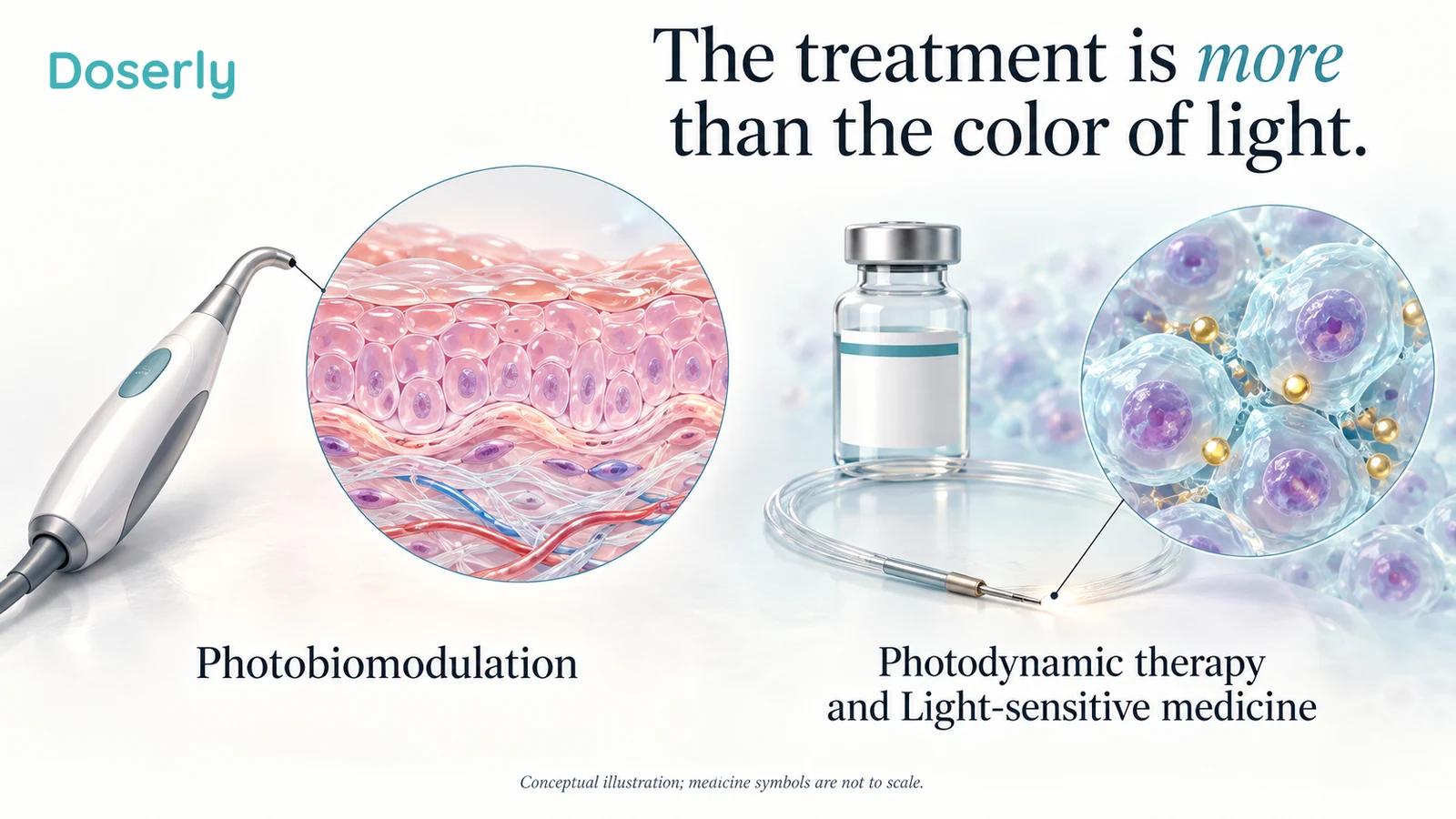
Conceptual comparison. Photodynamic therapy includes a light-sensitive medicine; the gold symbols are not molecules or a dosing guide.
Some legitimate cancer treatments use light, which can make terminology confusing. The National Cancer Institute explains photodynamic therapy as a treatment combining a photosensitizing drug with light to damage target cells. The drug, the light delivery and the clinical indication are parts of the treatment together.
PBM does not become photodynamic therapy simply because both may use red wavelengths. A consumer panel by itself does not reproduce a prescription photosensitizer, targeted delivery or the evidence for a particular PDT indication. Likewise, a study of a light-activated cancer medicine cannot be used to claim that general red-light exposure kills tumors.
When a video mentions “light therapy for cancer,” look for the complete intervention name. Is it PBM for side effects, PDT with a medicine, or another specialized technology? Sorting that out often resolves an apparent contradiction before it becomes a debate about whether light is good or bad.
Make the clinical discussion specific
Bring the proposed device information and your intended treatment area to the oncology team. “Can I use red light?” leaves important details missing. “This is the device, this is the area, and this is the symptom I want to improve” gives the clinician a clearer question.
Ask how the approach fits with your current care, what evidence supports that particular use and what would count as a worthwhile improvement. If the proposal involves a series of paid visits, ask when you will review the benefit. The answer should be tied to something you value, such as eating more comfortably, rather than only a general promise about cellular energy.
It also helps to identify who is responsible for follow-up. A supportive-care dentist, rehabilitation clinician and oncologist may each assess different parts of the problem. Ask who will hear about a new symptom, who can change the plan and how the team will communicate. A written explanation of the intended benefit and review date is more useful than a vague reassurance that everyone involved considers the device beneficial. Choosing not to add an uncertain treatment is also a reasonable outcome of that discussion, particularly when travel, cost or appointment fatigue already make cancer care demanding.
Keep new or changing symptoms within the usual assessment pathway. Improvement in discomfort does not remove the need to investigate a persistent lesion, a new lump or another change your oncology team has asked you to report. A light appointment should not become a substitute for that evaluation.
There is room for evidence-based optimism here. PBM has useful clinical research behind selected supportive-care applications, and available longer-term studies offer reassurance within their studied settings. The evidence is much narrower than a claim that all red-light exposure is safe for every cancer situation, and it does not establish home PBM as an anticancer treatment. Matching the clinical purpose, the protocol and the follow-up is what turns an interesting technology into a sensible care discussion.