
Red Light Therapy
October 17, 2026
Red light therapy for memory and mild cognitive impairment: the latest human trials
On this page
When someone you love starts forgetting conversations, a treatment that sounds gentle and can be used at home is understandably appealing. Light applied to the head may seem unlikely to influence memory. Yet there are now randomized human trials of transcranial photobiomodulation, including two published in 2026. This is a real research field, with findings worth discussing carefully.
The encouraging part is that several studies report better cognitive-test performance than a comparison treatment. The unfinished part is whether those changes translate into sustained independence, less caregiver burden or a lower chance of developing dementia. Those are different questions, and the distinction matters much more than the brightness of a device or the confidence of its advertising.
As of October 2026, the useful position is interested but specific: near-infrared brain stimulation has promising short-term results in selected people with cognitive impairment. That is a reason for larger, longer trials and a conversation with a memory-care clinician. It is not evidence that any red light panel can prevent Alzheimer's disease.
First, what kind of memory problem are we discussing?
Mild cognitive impairment, usually shortened to MCI, means measurable difficulty with thinking that goes beyond what would be expected for the person's circumstances, while substantial everyday independence remains. It can involve memory, language, attention or planning. Dementia describes a level of cognitive impairment that interferes more substantially with independent life. These labels describe function; identifying the underlying cause is another step. NIA–Alzheimer's Association diagnostic recommendations
MCI due to Alzheimer's disease is therefore narrower than “I feel forgetful.” Someone with poor sleep, medication effects or depression may have cognitive symptoms without having the same disease process as a participant recruited to an Alzheimer's-related MCI trial. Conversely, a person who still manages most activities can have meaningful early disease. A label on a light device cannot make that distinction.
A clinical evaluation can look at the history, objective testing, medication exposure, neurological findings and appropriate investigations. The National Institute on Aging specifically identifies medication side effects, metabolic or endocrine problems, depression, delirium and several forms of dementia among potential explanations for cognitive impairment. NIA assessment guidance
For a family, this translates into a practical first step: describe what has changed. “Memory is worse” is useful, but examples help more. Is the person repeating questions, missing familiar appointments, struggling to follow a recipe, or forgetting a name that later returns? When did it start? Has it changed gradually, or suddenly after illness? Bring those observations to an assessment rather than trying to diagnose the cause through a device experiment.
What researchers mean by transcranial photobiomodulation
Photobiomodulation, or PBM, uses light intended to influence biological processes without deliberately destroying tissue. In brain research, “transcranial” means that light is delivered through the scalp and skull. Many studies use near-infrared wavelengths, which are largely invisible, rather than the bright red glow associated with consumer panels. Some studies combine scalp treatment with an intranasal component. These are distinct device configurations, not interchangeable ways to reproduce a result.
Light must interact with multiple tissues before it could affect the brain. A human cadaver study investigated propagation through scalp, skull, meninges and brain, demonstrating that light delivery depends on wavelength and tissue interactions. It did not establish a universally effective dose for a living person's memory. Its linked correction also matters when following the technical literature. Tedford and colleagues, 2015, published correction
That helps explain why knowing a wavelength is insufficient. Emitter arrangement, contact with the scalp, beam coverage, hair, exposure duration and the instrument's output all contribute to what is delivered. A panel advertised for skin care cannot be assumed to reproduce a research headset. Increasing exposure to compensate for uncertainty is not a validated solution.
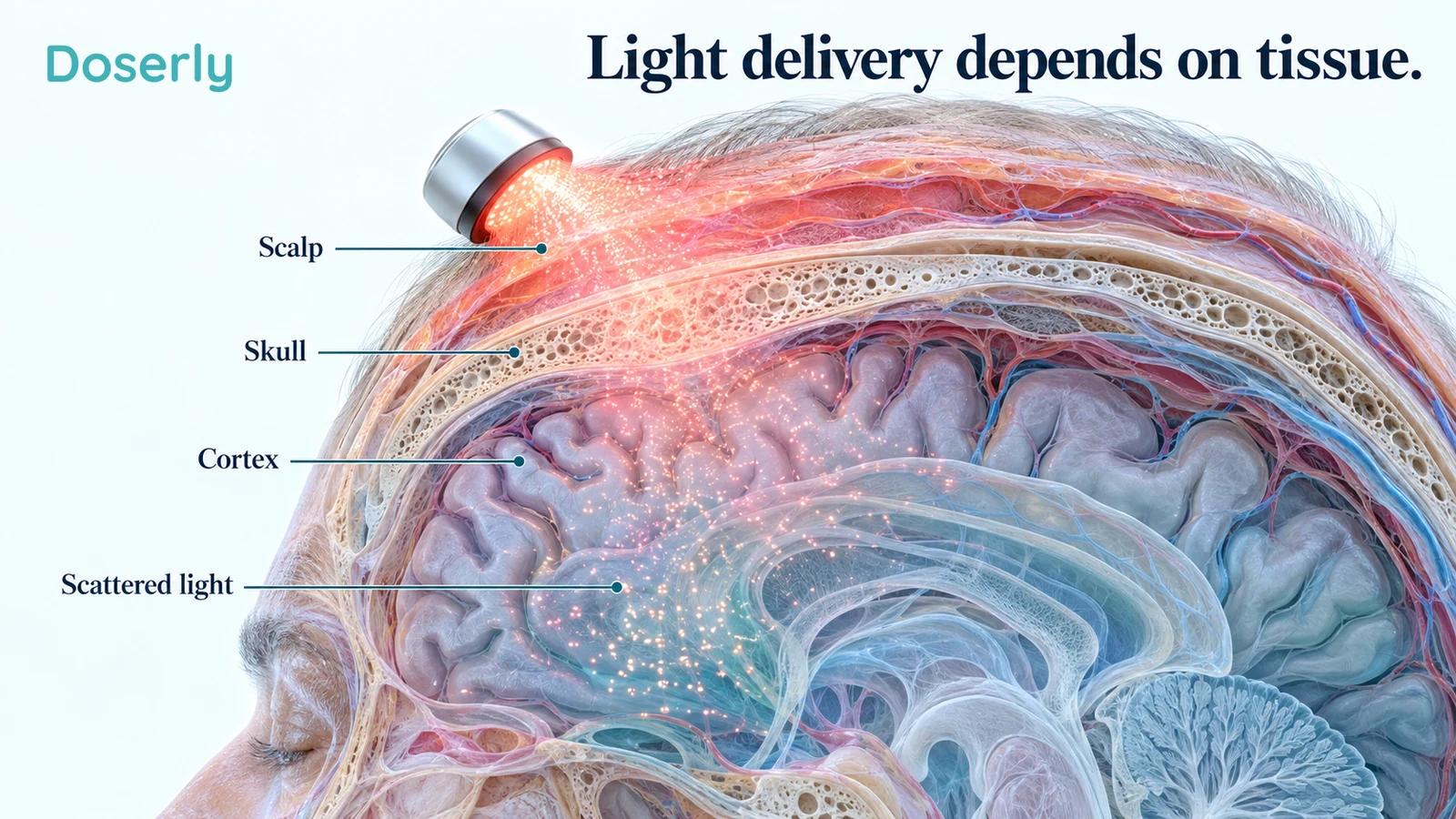
Light delivery is a tissue-specific research problem. This conceptual illustration does not show a measured dose, guaranteed penetration depth or treatment placement instructions.
The 2026 trial that deserves attention
Hyelim Chun and colleagues reported a randomized, double-blind, placebo-controlled trial involving 80 people meeting criteria for MCI due to Alzheimer's disease. The home-administered intervention used an 808-nanometer device over both dorsolateral prefrontal regions for a 12-week research course. The prespecified primary outcome reported in the abstract was change in the Korean Montreal Cognitive Assessment, or MoCA-K, at week 13. Chun and colleagues, 2026
The active group improved by an average of 3.87 points, while the placebo group declined by 0.74 points. Subtracting those changes gives a 4.61-point difference favoring active treatment. Other cognitive measures also favored treatment; the depression measure did not change. The authors reported no device-related adverse events and high adherence. They declared no potential conflicts of interest.
That is an encouraging controlled result. It is stronger evidence than a testimonial or a before-and-after series. However, a week-13 cognitive endpoint does not measure whether fewer participants develop dementia years later. The paper's prevention language reaches beyond the outcome summarized in its abstract. The practical interpretation is a short-term cognitive benefit in this studied population and device setting, with durability and disease modification still unresolved.
It is tempting to convert a point difference into a familiar promise: a certain percentage of memory restored, a number of years of aging reversed, or a reduced chance of needing care. The reported result does not provide those conversions. A cognitive scale has a particular structure and range; it is not a percentage meter for the brain. Whether a change is noticeable at home also depends on baseline impairment and which abilities improved.
A second 2026 study asks a different question
Neda Rashidi-Ranjbar and colleagues published a single-blind, sham-controlled pilot involving 20 people with MCI. Participants used active or sham devices at home for six weeks. The active system combined transcranial and intranasal stimulation, targeting a different configuration from the Korean study. The authors reported greater improvement on global cognition and a long-delay recognition measure, alongside exploratory metabolic and network findings. Rashidi-Ranjbar and colleagues, 2026
Adverse events occurred in four active-treatment and six sham participants; none were serious. This is more informative than saying simply that no major problem appeared. The publication also disclosed manufacturer-related relationships, including consulting, research funding and a company executive's involvement in technical device description; it stated that academic investigators performed analyses and the manufacturer lacked interim results.
With only ten participants per group and numerous measurements, the estimates are preliminary. Blood metabolites, inflammatory markers and functional connectivity may help explain a future replicated effect, but they do not independently establish that brain mitochondria were repaired or Alzheimer's progression slowed. This pilot supports further testing. It does not make the larger study unnecessary, and the two studies should not be treated as identical replications.
There is a constructive reason to study several kinds of outcomes at once. If a treatment changes cognition, researchers want to understand how. The discipline is to keep that investigation separate from the treatment claim. A blood result can suggest a pathway to examine while remaining an imperfect reflection of what is happening inside a neuron.
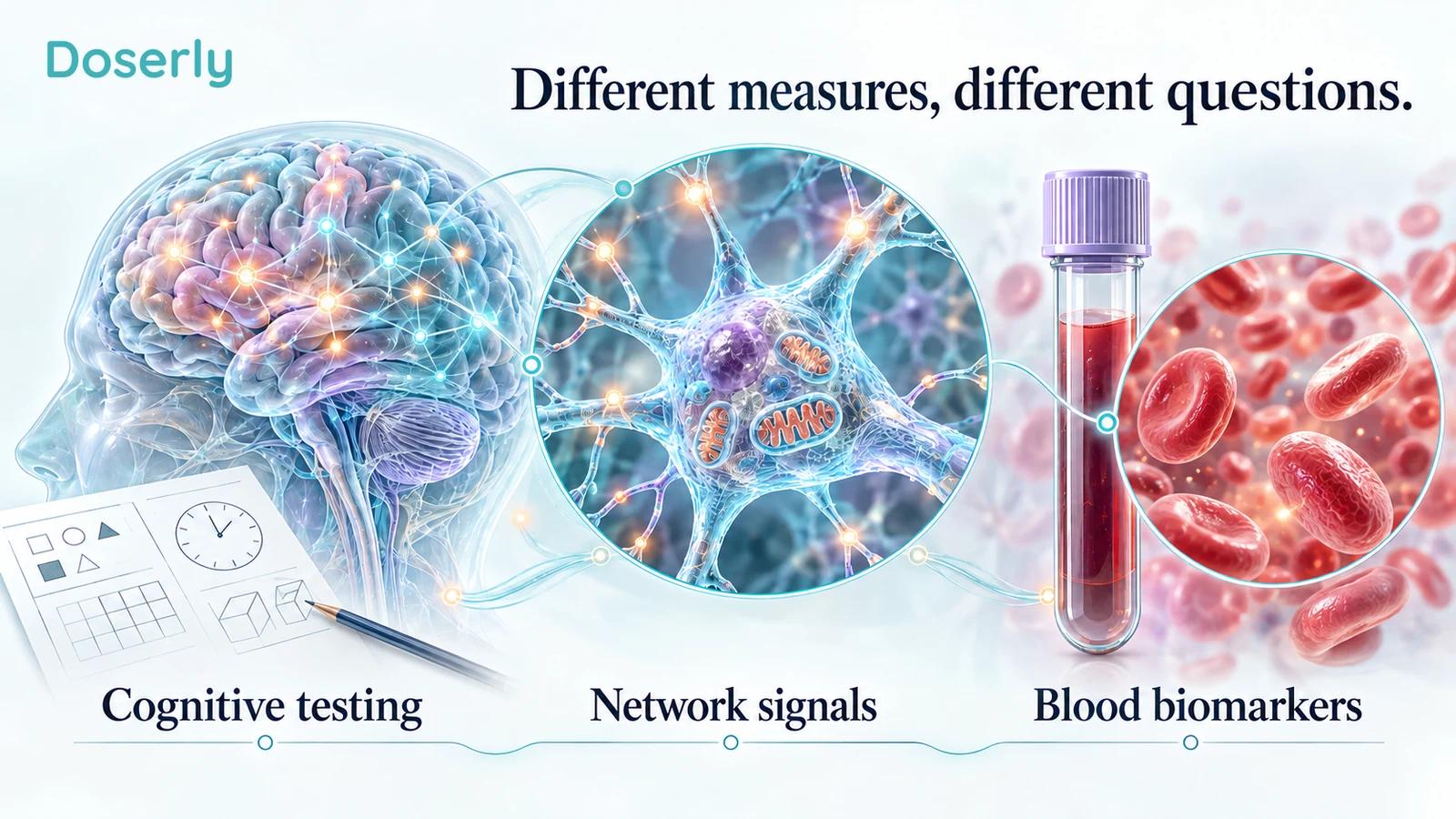
These measurements answer different questions. The illustration is conceptual and contains no patient scan or measured treatment effect; a biomarker change does not itself establish everyday benefit.
What the earlier trials contribute
The newer studies did not appear in isolation. Earlier work helps show how the field developed, why enthusiasm exists and why the remaining uncertainty is substantial.
A larger MCI trial in 2024
A Brazilian randomized, double-blind study assigned 93 adults with MCI to active PBM or placebo; 76 completed the study. The reported MoCA change was 3.20 points with active treatment and 1.97 with placebo, a between-group difference of 1.23 points in those reported changes. The authors described persistence at a three-month follow-up and increased serum BDNF, a protein involved in plasticity. Depression, anxiety, resilience and two other biomarkers did not improve. de Oliveira and colleagues, 2024
This study adds a controlled signal and some follow-up beyond the treatment period. It also shows why a headline about the active group's improvement alone is incomplete: the comparison group improved too. Attrition matters, and the abstract cannot settle how every missing observation affected the estimate. BDNF findings should remain separate from claims of preventing neurodegeneration.
A dementia trial in 2021
A study by Damir Nizamutdinov and colleagues enrolled 60 people with mild-to-moderate dementia, randomized in a two-to-one ratio to active or sham treatment. Fifty-seven completed eight weeks. The abstract reported a 4.8-point average MMSE improvement in the active group, with changes in other tests and caregiver observations. Nizamutdinov and colleagues, 2021
The 4.8-point figure is an active-group change, not automatically the treatment effect after subtracting sham. The population also differs from MCI. Caregiver observations about sleep or daily routine are valuable, but their interpretation depends on blinding and how they were collected. This trial contributes to the reason for further research; it does not provide years of evidence about independence or disease progression.
Very small early studies
In 2019, Linda Chao randomized eight people with dementia to home PBM or usual care, four per group. Cognitive and behavioral measures and imaging findings favored PBM after 12 weeks. The comparison was usual care, not an indistinguishable sham treatment. Four treated people can show feasibility and produce an interesting signal, but they cannot establish a dependable benefit estimate for a broad patient population. Chao, 2019
A 2017 helmet pilot described eleven enrolled participants, with six active, three controls and two dropouts. Changes across several cognitive tasks were reported. Such a small experiment is particularly sensitive to baseline differences and individual outliers. It belongs in the history of the idea, not at the center of a confident purchasing recommendation. Berman and colleagues, 2017
Another 2017 report followed five people with dementia through treatment and a period without treatment. The authors described improvement during treatment and decline after stopping, with manufacturer-related disclosures. Without a control group, that sequence cannot establish either efficacy or a need for indefinite maintenance. It raises a durability question that controlled withdrawal or follow-up studies would need to answer. Saltmarche and colleagues, 2017
Memory, attention and independence are different outcomes
A person can perform better on a brief test for several reasons. They may retain more information, concentrate more effectively, understand the testing procedure better or arrive on a better day. A well-designed trial uses a comparison group and consistent assessments to help distinguish these possibilities. That does not make cognitive tests unimportant; it explains why several kinds of outcomes are useful.
For families, a more tangible question is whether the person manages everyday tasks more reliably. Can they follow a conversation, keep track of appointments, prepare familiar meals or participate in activities they enjoy? A trial designed around those outcomes would need appropriate functional measures, enough participants and enough follow-up. It should also capture the work required from a caregiver to deliver the intervention.
This is why a claim such as “improves cognition” can be accurate in a study and still leave the purchase decision unresolved. The missing information may be the size of a noticeable benefit, its duration, the proportion of people who experience it, or the effort and cost required. These are practical uncertainties, not academic objections.
Population differences create another boundary. A randomized study of 30 older adults without a neuropsychiatric history examined frontal cognitive tasks after a single PBM session. It reported short-term task findings, but that design cannot answer whether repeated treatment changes Alzheimer's-related MCI. Chan and colleagues, 2019
Healthy volunteers, people with MCI and people with dementia should not be merged into a single promise. Their baseline performance, room for improvement, underlying conditions and treatment goals differ. A device page that combines all these populations under “brain health” may be hiding precisely the distinctions a buyer needs.
What the mitochondrial explanation can and cannot do
The attraction of PBM partly comes from the idea that light might influence cellular energy handling and signaling. Brain cells need a continuous energy supply, and researchers are investigating whether optical stimulation can alter metabolism, oxygenation and network behavior. The mechanism is worth studying without being presented as settled clinical proof.
For example, a 2016 human experiment used near-infrared spectroscopy to examine responses to forehead laser stimulation in healthy young adults. It found changes in oxygenated and deoxygenated hemoglobin consistent with altered cerebral oxygenation. The experiments were small and measured short-term physiology, not treatment of memory impairment or long-term neurological outcomes. Tian and colleagues, 2016
An immediate physiological response does not establish that damaged neurons recover, that memories are retained more reliably or that future decline slows. Cognitive performance depends on interacting brain systems and life circumstances. Researchers need to connect a plausible biological response to a measured clinical benefit rather than assume that one guarantees the other.
A scientifically useful account therefore keeps three questions visible: did light produce a biological response, did people perform better, and did that improvement matter over time? Positive evidence for the first question increases interest in the others. It cannot answer them by itself.
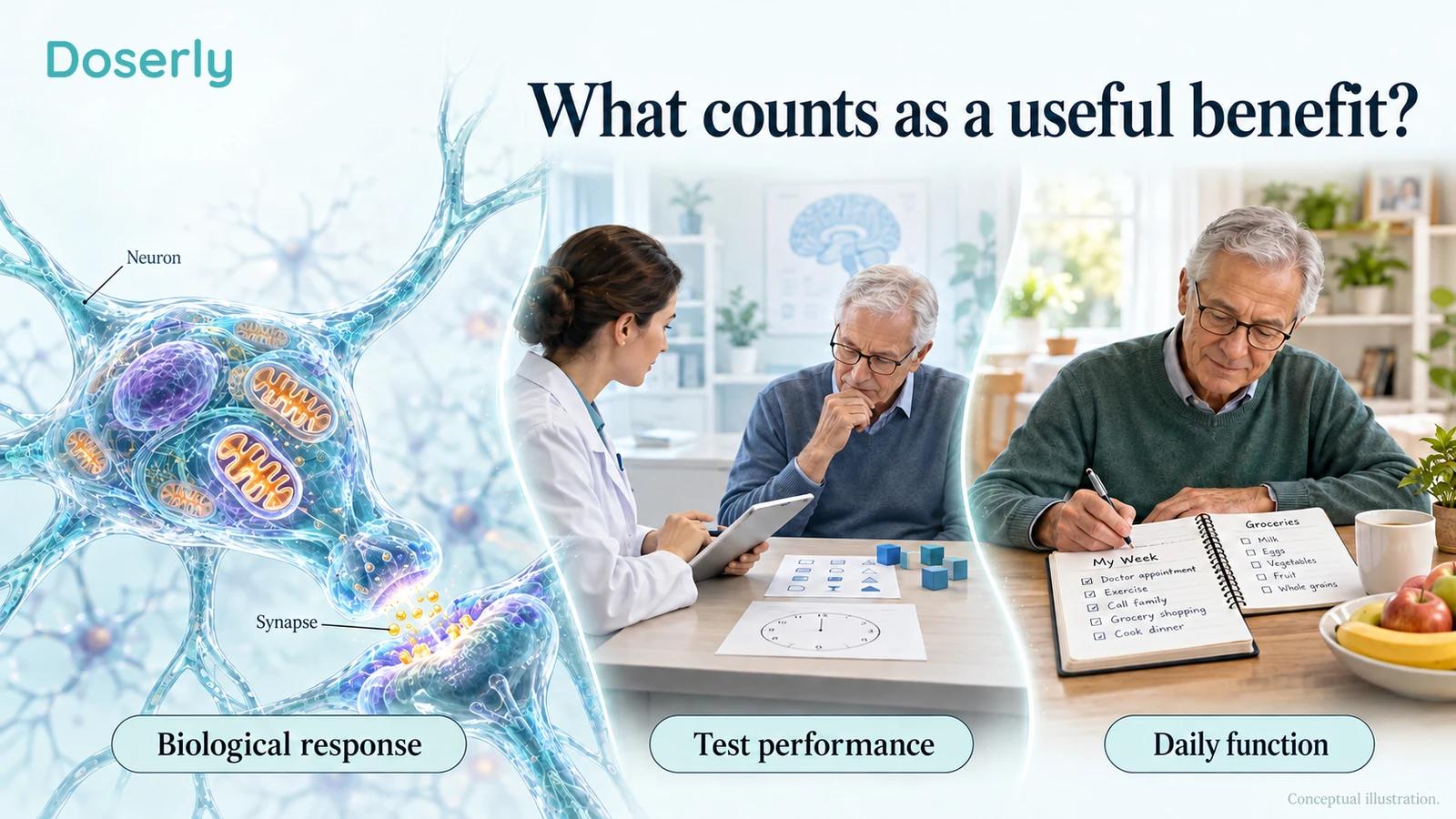
Biological response, test performance and daily function are separate outcomes. The scenes illustrate research questions, not a documented sequence of recovery.
Where established brain-health care fits
Considering experimental light treatment should not crowd out an evaluation or the care already appropriate to the person. The immediate value of an assessment is not only a diagnosis. It can identify contributors to symptoms, clarify what help is needed and establish a baseline against which future change can be judged.
Lifestyle research also supplies useful context without providing a direct comparison with PBM. The 2025 US POINTER trial randomized 2,111 older adults at elevated risk of cognitive decline to structured or self-guided multidomain lifestyle programs. Both addressed physical and cognitive activity, diet, social engagement and cardiovascular health; the structured intervention produced a greater improvement in global cognition over two years. It did not compare exercise with a light device, and its population was not the same as the MCI trials. US POINTER trial, 2025
The practical lesson is about priorities and breadth. Brain-health care can involve several manageable activities and medical factors rather than one purchased intervention. It is reasonable to ask a clinician which steps have the strongest relevance to your diagnosis and abilities, and how to make them sustainable. A plan that requires an exhausted caregiver to do everything perfectly is unlikely to be a good plan.
Supplements marketed for memory raise their own questions. Our bacopa monnieri guide explains that separate evidence base. Findings about a supplement do not establish benefit from combining it with PBM, and starting several interventions together makes a change in symptoms harder to interpret. A medication and supplement list is useful both for clinical review and for understanding what changed during follow-up.
What a careful device conversation sounds like
The most useful conversation begins with the actual device and the actual diagnosis. Ask whether a study used that model or merely a similar wavelength. Ask whether treatment was professionally supervised, how adherence was checked, and what participants did if they developed symptoms. “Used at home” describes a location; it does not mean the intervention was unsupervised or that all home devices are equivalent.
Regulatory wording needs the same precision. A product's registration, listing or authorization for some other purpose should not be converted into an Alzheimer's treatment claim. Request the specific indication and the relevant jurisdiction. Research participation and ordinary clinical availability are also different arrangements, with different responsibilities for monitoring, payment and follow-up.
Cost deserves an explicit place in this discussion. Include the initial device, replacement parts, clinician visits, time, caregiver support and the possibility of no noticeable benefit. A return policy may reduce financial exposure, but it cannot supply clinical evidence. Testimonials may help reveal usability problems; they cannot show how the average person would have done without the device.
Eye protection and device-specific instructions matter. This article does not provide settings, placement instructions, or a protocol for directing light into the eyes or nose. The studies' short-term tolerability findings do not validate improvisation with a different emitter. New symptoms should be discussed with the treating team rather than interpreted as evidence that the treatment is “working.”
Tracking change without turning home into a testing laboratory
If PBM is being considered through a clinician or trial, agree beforehand on a small number of goals that matter. One person may care most about following conversations; another may want to manage a familiar weekly activity more independently. Record the baseline in ordinary language, including what assistance is currently required.
A caregiver's observations can be useful when they are concrete. “Needed two reminders for Tuesday's appointment” is easier to interpret than “seemed sharper.” Note major changes in sleep, illness, mood, medicines and daily routine. The aim is to provide context at follow-up, not to generate a private proof of efficacy.
Avoid repeatedly administering online cognitive tests to chase improvement. Repeated familiarity can complicate interpretation, and scores without clinical context may create unnecessary anxiety or false reassurance. Formal reassessment is most useful when a professional chooses the measure, interval and interpretation for the person.
The follow-up conversation should allow several answers: helpful, unhelpful, uncertain, or too burdensome. An uncertain result is not a personal failure and does not automatically justify more exposure. Define in advance who will review concerns, when to reassess and what would make continuing worthwhile.
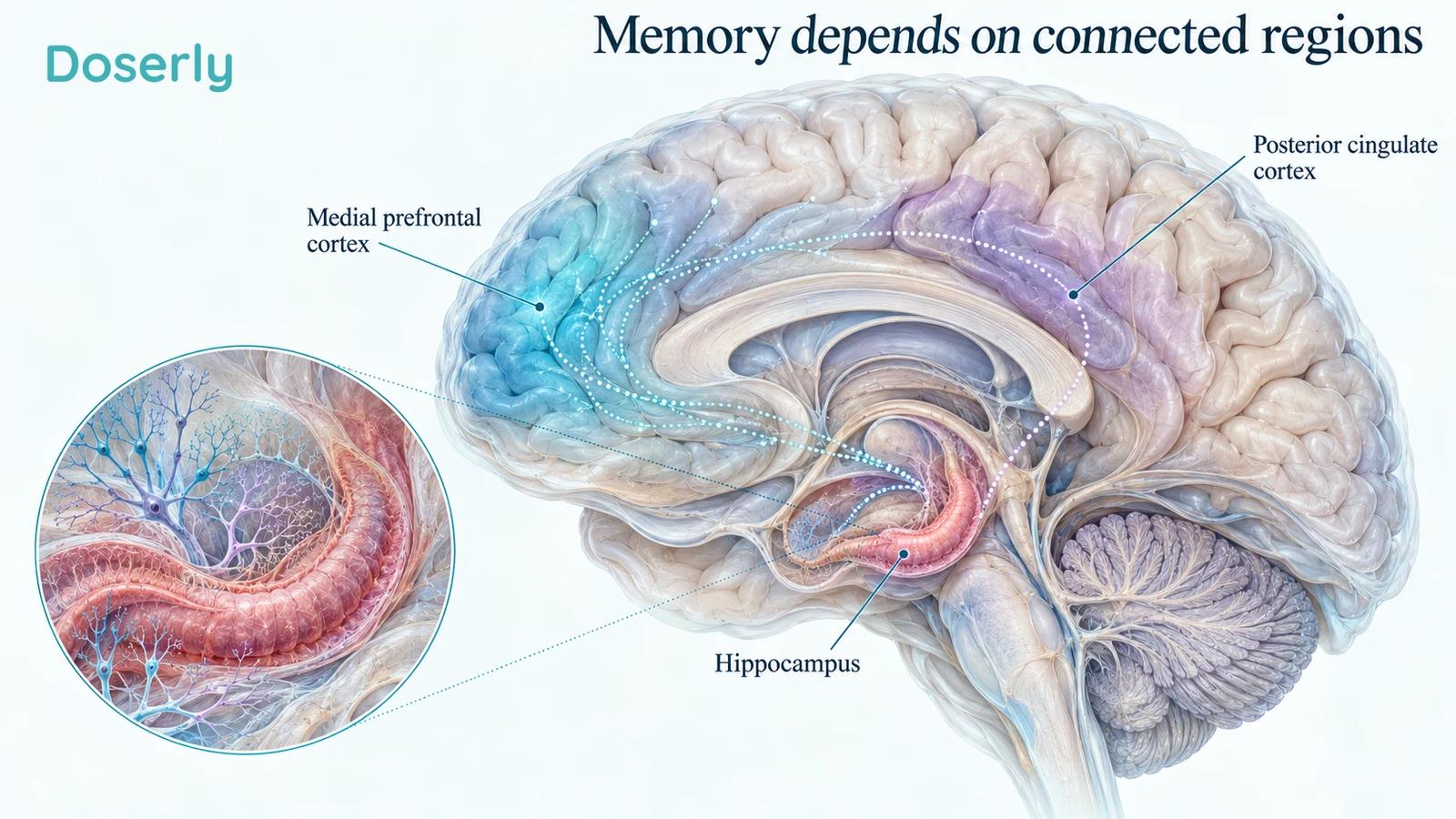
Memory involves distributed brain regions. The simplified anatomy is conceptual, not a patient scan, a measured connectivity result or a map for placing a light device.
A realistic answer for someone considering treatment today
The human evidence has moved beyond anecdotes. Controlled studies, including the 2026 trial in 80 people, justify serious attention to PBM for selected cognitive impairment. At the same time, different devices, populations, test batteries and follow-up periods limit how confidently one result can be transferred to another setting.
The next studies need to establish reproducible benefit, meaningful daily function, durability and safety over longer periods. They also need to show which patients benefit and whether the improvement is worth the burden of treatment. Those questions are especially important when memory difficulties make informed decisions and consistent device use more complicated.
For now, the strongest practical response is to get the memory problem evaluated, preserve useful ongoing care and bring the specific study and device to a clinician who understands the diagnosis. Hope is reasonable here. Keeping that hope attached to the outcomes actually measured makes it more useful to the person who needs help.