
Red Light Therapy
October 17, 2026
Red light therapy for low back pain: who was studied and what improved?
On this page
When your back has been uncomfortable for months, a treatment that asks you to lie still while someone applies light can sound wonderfully manageable. There is no new exercise to learn during the appointment, no injection and no recovery period. The difficult question comes afterward: will it help you get through a workday, walk farther or bend with less worry?
Clinical light therapy has been studied for persistent low back pain, and some small trials report worthwhile improvements. But the evidence is mixed. Two particularly relevant trials involving 148 people each found no meaningful advantage over placebo, including a study published in October 2026 that tested light alongside a structured exercise program. Positive findings from other devices and treatment combinations do not make those null results disappear.
It helps to approach this as a question about a particular person, treatment and goal. Pain intensity, physical performance and everyday disability are related, but they are not interchangeable. Neither a lower pain score nor a more comfortable appointment establishes that a disc has healed or that a long-standing back problem has been cured.
First, which kind of back pain are we talking about?
Much of the research concerns chronic nonspecific low back pain. Chronic generally means symptoms lasting at least three months. Nonspecific means that the pain cannot confidently be attributed to one identified disease or structural injury. It is a clinical category, not a judgment that someone is imagining their symptoms. WHO explanation of low back pain
That distinction matters because pain near the waist can have different causes. A study in people with persistent nonspecific pain does not automatically apply to a new vertebral fracture, inflammatory spinal disease, infection, cancer-related pain or a nerve problem causing progressive weakness. Those conditions require their own assessment and care.
Sciatica also deserves its own conversation. Pain traveling down a leg, especially with numbness or weakness, is not simply a stronger version of a sore lower back. A trial may include some people with leg symptoms, exclude them entirely or use a narrow definition. Before borrowing its result, we need to know which population was actually enrolled.
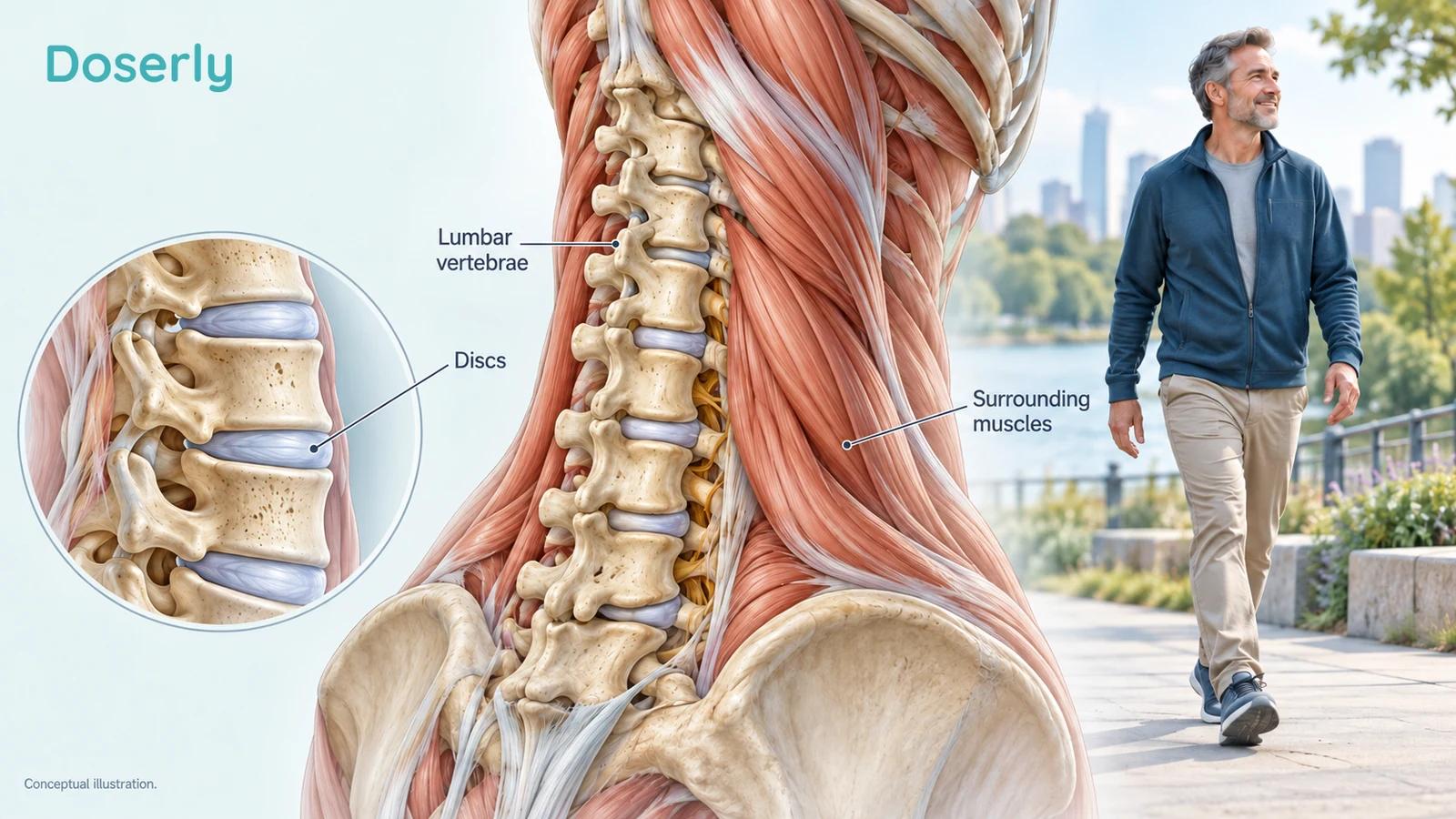
For a reader, a useful first question is therefore: does the study describe the problem my clinician thinks I have? The label on a light device cannot answer that. Nor can a diagram showing a beam reaching a spinal disc. An attractive illustration of penetration is not evidence that the treatment addresses the cause of your symptoms.
What researchers mean by light therapy
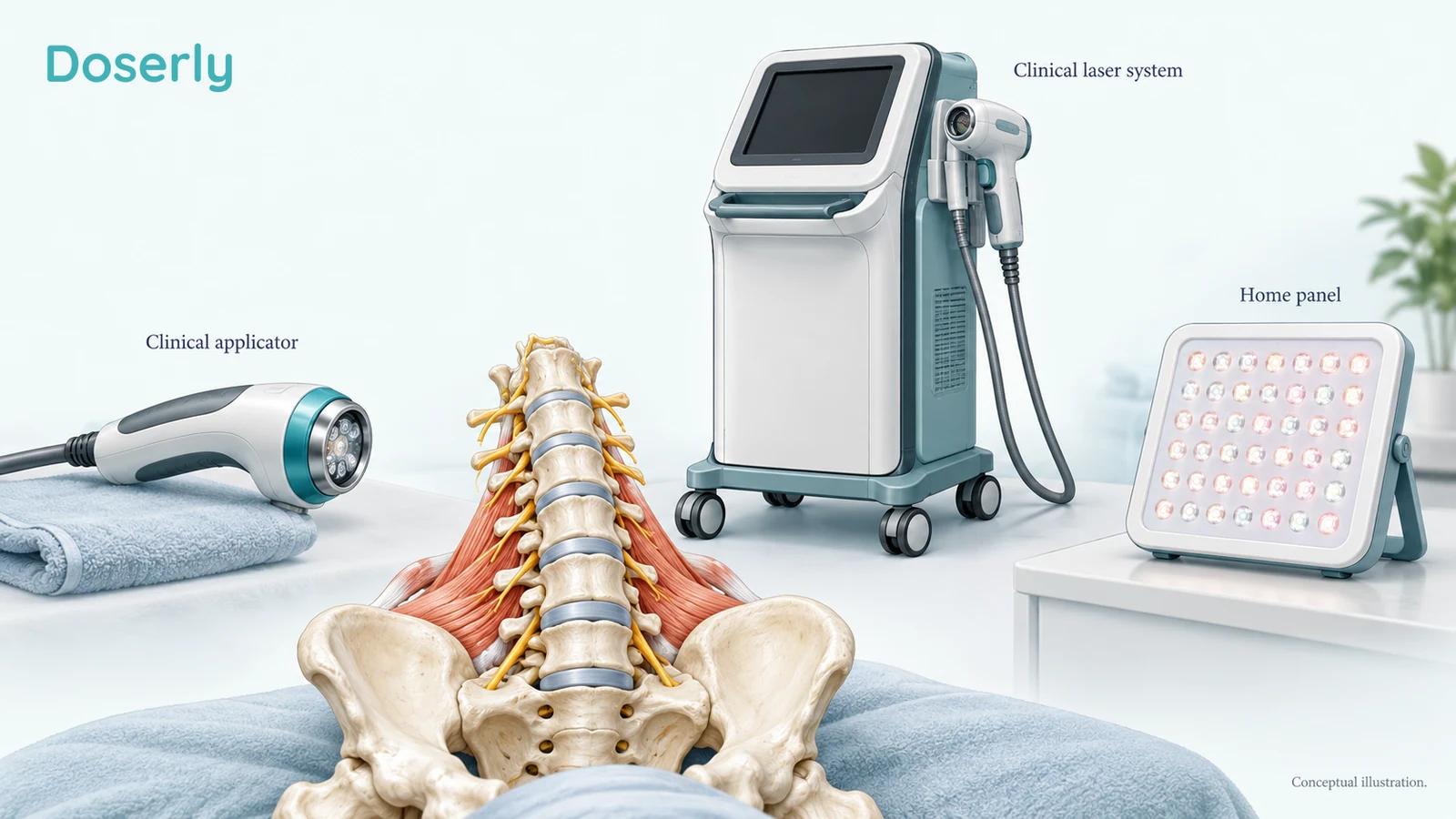
Photobiomodulation, often abbreviated PBM, uses light with the aim of influencing biological activity without making tissue heating the treatment's main purpose. Older papers often call it low-level laser therapy. Depending on the equipment, the light may be visible red or invisible near-infrared, delivered through a small applicator to selected areas.
The term “laser therapy” is broader. Some studies use high-intensity systems, others use laser acupuncture at selected points, and some combine light with mechanical treatments. A home panel illuminating a large area from a distance is another arrangement again. These are not interchangeable exposures merely because the advertising uses similar words.
It is reasonable to investigate whether light can influence processes relevant to pain. It is a separate task to show that an exposure produces a meaningful improvement in people. Clinical outcomes are the bridge between an appealing explanation and a useful treatment. A proposed cellular effect does not tell us how much light reaches a relevant structure, which patients respond or whether the change lasts.
This is why we will keep the equipment and comparison attached to each finding. A positive result for one clinic-based system should remain a result for that system and population. It should not quietly turn into a recommendation to buy any red light product or increase its intensity until something happens.
The October 2026 trial: did light add to exercise?
A randomized trial published on October 12, 2026 enrolled 148 adults aged 18 to 65 with nonspecific low back pain lasting at least three months. Everyone received motor control exercise. Half also received active PBM and half received sham treatment, across 12 sessions over six weeks. Participants, therapists and assessors were blinded, and the analysis followed the original randomization.
At six weeks, the active-light group differed from the sham group by only 0.4 points in pain on a 0-to-10 scale and 0.7 points in disability on a 0-to-24 scale, both favoring active treatment. The confidence intervals crossed no difference. The researchers judged the added effects negligible, with similarly small between-group differences through 12 months. Circulating prostaglandin E2 also showed no clinically important added improvement. October 2026 exercise-add-on trial
This is a useful study for someone who is already doing rehabilitation and considering an extra treatment. Its question was not whether a supported program could help. It was whether active light contributed something beyond the same exercise and treatment context. That additional benefit was not demonstrated.
The result applies to the tested approach, not every conceivable future device. But the possibility of a different future result is not a reason to disregard a well-designed present result when deciding what to add to care.
A separate 2021 trial also found no advantage
An earlier placebo-controlled trial randomized 148 people with chronic nonspecific low back pain to active PBM or placebo. Both groups received an educational booklet. Treatment involved 12 sessions over four weeks, with follow-up extending to a year.
At the primary four-week assessment, the between-group pain difference was approximately zero: 0.01 points, with a 95% confidence interval from −0.94 to 0.96. The disability difference was −0.63 points, with an interval from −2.23 to 0.97. The authors found no clinically important advantage for active treatment. 2021 placebo-controlled trial
These were separate trials, not two reports of the same participants. They also tested different background care: education in the earlier trial and motor control exercise in the newer one. Together, they make a broad promise of reliable pain relief difficult to defend.
A null trial does not mean that nobody felt better. Participants can improve in both groups because symptoms fluctuate, time passes, expectations matter or other parts of care help. The comparison tells us whether the active light added an identifiable benefit. That is the part a before-and-after testimonial cannot establish.
Why there are still encouraging studies
The literature is not uniformly negative. A 2007 randomized trial in 61 people compared low-level laser alone, laser plus exercise and sham laser plus exercise. Adding laser did not improve outcomes at the end of six weeks of treatment, but the combination showed advantages in pain and disability at the 12-week assessment. The paper has an indexed erratum, so its detailed numerical estimates should be checked with the corrected report before being quoted as definitive. 2007 exercise-combination trial
The time horizon is worth translating. Twelve weeks can be a useful follow-up, but it is not evidence of benefit lasting for years. A paper's use of “long term” must be read in the context of its actual observation period.
A 2003 study assigned 75 people to laser plus exercise, laser alone or exercise alone. Its abstract reports improvement across the groups and reaches a favorable conclusion about laser. However, improvement within each group is not by itself a clear estimate of how much laser adds beyond exercise. The abstract does not supply the kind of between-group effect estimate that would answer that question well. 2003 comparative trial
In a 2020 sham-controlled trial, 40 people entered and 34 were analyzed. Both groups could use naproxen. Pain and disability results favored the active-laser group, with improvements persisting at three months. Yet some later measurements were not obtained in the same way: the sham group lacked the three-month physical examination and was contacted by phone. The small sample, excluded participants and uneven follow-up reduce confidence in the apparent durability. 2020 trial and reported follow-up limitations
These studies provide reasons for further investigation. They do not establish that the people with positive results were a reliably identifiable subgroup, or that someone can reproduce the result by matching a wavelength on a consumer product.
Laser acupuncture asks a more specific question
Laser acupuncture applies light to selected acupuncture points. It avoids needles in these particular studies, but its placement strategy differs from broadly illuminating a painful area. It should be evaluated as the intervention it is.
A 2009 trial enrolled 100 people with chronic nonspecific low back pain. Active infrared laser acupuncture and sham treatment both produced improvements, but the study found no significant difference in the primary pain and disability outcomes. The authors also noted concern about baseline inequality between the groups, which complicates interpretation. 2009 laser-acupuncture trial
A larger 2014 trial randomized 144 adults to sham or one of two active doses. At six weeks after the treatment course, neither active group outperformed sham for pain or disability. Secondary outcomes improved over time without a specific laser advantage. The study followed participants beyond the primary assessment, including later follow-up to a year. 2014 dose-comparison trial
Then a July 2026 trial in 60 people found a different pattern. High-intensity and low-intensity laser acupuncture, each combined with exercise, improved several short-term outcomes compared with sham plus exercise. High-intensity treatment did better than low-intensity treatment for pain and trunk-extensor strength, but not for fatigue or disability. Follow-up extended only one month after treatment. 2026 laser-acupuncture comparison
That newer positive finding belongs in the discussion. So do the larger earlier null trials. Crucially, the high-intensity arm is not evidence for nonthermal home PBM, and a result for strength is not automatically a result for everyday disability. Reading only the most favorable endpoint would give an incomplete picture.
Multiwave systems and combination treatments need their own labels
A 2024 trial studied a Multiwave Locked System, or MLS, in 45 people with chronic nonspecific low back pain. After eight active or sham sessions, both groups improved. At one month after treatment, average pain was 2.2 in the active group and 3.6 in the sham group, a statistically significant difference. There was no between-group difference in function or disability. 2024 MLS trial
That is a pain signal, not a demonstration that the treatment restored bending mechanics or daily function. MLS also describes a particular clinical technology; its result should not be relabeled as a finding about every red-light panel. The accessible abstract does not provide enough technical detail to treat all MLS exposures as equivalent to low-power PBM.
A 2025 study in 30 people reported greater pain improvement with MLS than with an exercise comparison over six weeks. It was small and did not use the same sham-treatment comparison as the 2024 study. The outcomes do not support a claim of structural repair, and the comparison does not show what MLS would add to a matched exercise program. 2025 MLS study
A June 2026 trial examined five approaches, including laser combined with vacuum, rollers or ultrasound, point-applied laser and placebo laser. Its abstract reports improvements, especially with combined treatments, but does not provide a clear numerical between-group effect for each outcome. That limits how confidently we can describe the size of the benefit or isolate light's contribution. 2026 laser and mechanical-systems trial
For someone considering a clinic package, this distinction is practical. If the package includes exercise, hands-on treatment and light, improvement after the package cannot tell you which component helped. The package may still feel worthwhile, but its effectiveness and the specific value of its light component are different questions.
Pain relief, movement and disability can move separately
A pain scale asks about the intensity of the experience. A disability questionnaire asks how symptoms affect activities. A laboratory movement test measures something else again, such as bending speed, range or muscle activity. None is a perfect substitute for the others.
Imagine two people whose pain drops from six to four. One can now stand through cooking dinner and has resumed a short walk. The other still avoids both activities because fatigue, confidence or another health problem remains limiting. The same numerical pain improvement has different consequences for their lives.
The reverse can also happen. A person may gradually return to valued activities even while some discomfort persists. If an article reports only a pain score, it can miss that progress. If it reports only range of motion, it can miss whether moving farther actually helped the person do something important.
For a treatment decision, it is useful to ask for both a symptom outcome and a meaningful activity outcome. “Less pain after the session” and “able to complete a normal workday more comfortably” answer different questions. Both deserve to be heard, and neither should be inflated into proof that damaged tissue has regenerated.
The mixed findings in the clinical trials above make this more than a theoretical point. Some show a pain difference without a disability difference. A provider who describes that as broad functional recovery is going beyond the result.
Does light heal a disc or correct a scan?
The trials discussed here mainly measured symptoms, questionnaires and movement. They do not establish that red light reverses a disc bulge, rebuilds a degenerated disc or corrects an imaging finding. A person can feel better without a scan changing, and a scan can contain findings that do not fully explain their pain.
This does not mean anatomy is irrelevant. It means an anatomical claim needs an anatomical outcome and a suitable study. A treatment cannot inherit a disc-healing claim simply because a scientific diagram shows vertebrae beside a red beam.
Nor does considering light automatically create a need for imaging. The American College of Physicians has advised that routine imaging does not improve outcomes for uncomplicated low back pain; imaging is reserved for situations in which clinical findings make it useful, including suspected serious disease or severe or progressive neurological deficits. Your assessment should drive that decision. ACP advice on imaging
A sensible conversation is therefore about symptoms, examination, function and the reason for any proposed test. If a clinic promises to “repair what the scan shows,” ask which human study measured that repair with the same treatment. A change in a pain questionnaire is not the answer to that question.
Where this fits in a broader care plan
The World Health Organization's 2023 guideline emphasizes a person-centered approach to chronic primary low back pain. Education, suitable exercise and selected physical or psychological approaches can form part of care, with decisions shaped by a person's circumstances. It does not frame a single device as the answer to every persistent back problem. WHO guideline overview
You may also encounter the American College of Physicians' 2017 guideline in advertising. It included low-level laser among non-drug options for chronic low back pain, based on low-quality evidence. That is a historical recommendation, not high-certainty proof, and ACP now lists that guideline among its inactive guidelines. It also predates the 2021 and October 2026 null trials. Original 2017 recommendation, ACP guideline status
This history explains why two sensible clinicians may describe the evidence differently. One may recall an older guideline or a favorable small trial. Another may place more weight on newer sham-controlled research. The useful response is to discuss the actual evidence and the proposed goal, rather than treating an old guideline quotation as the final word.
There is also an opportunity cost. A treatment course takes appointments, travel, money and attention. Even a noninvasive option should earn its place by helping with something you value. If adding it makes an agreed rehabilitation program harder to sustain, that tradeoff belongs in the decision.
A useful way to track progress
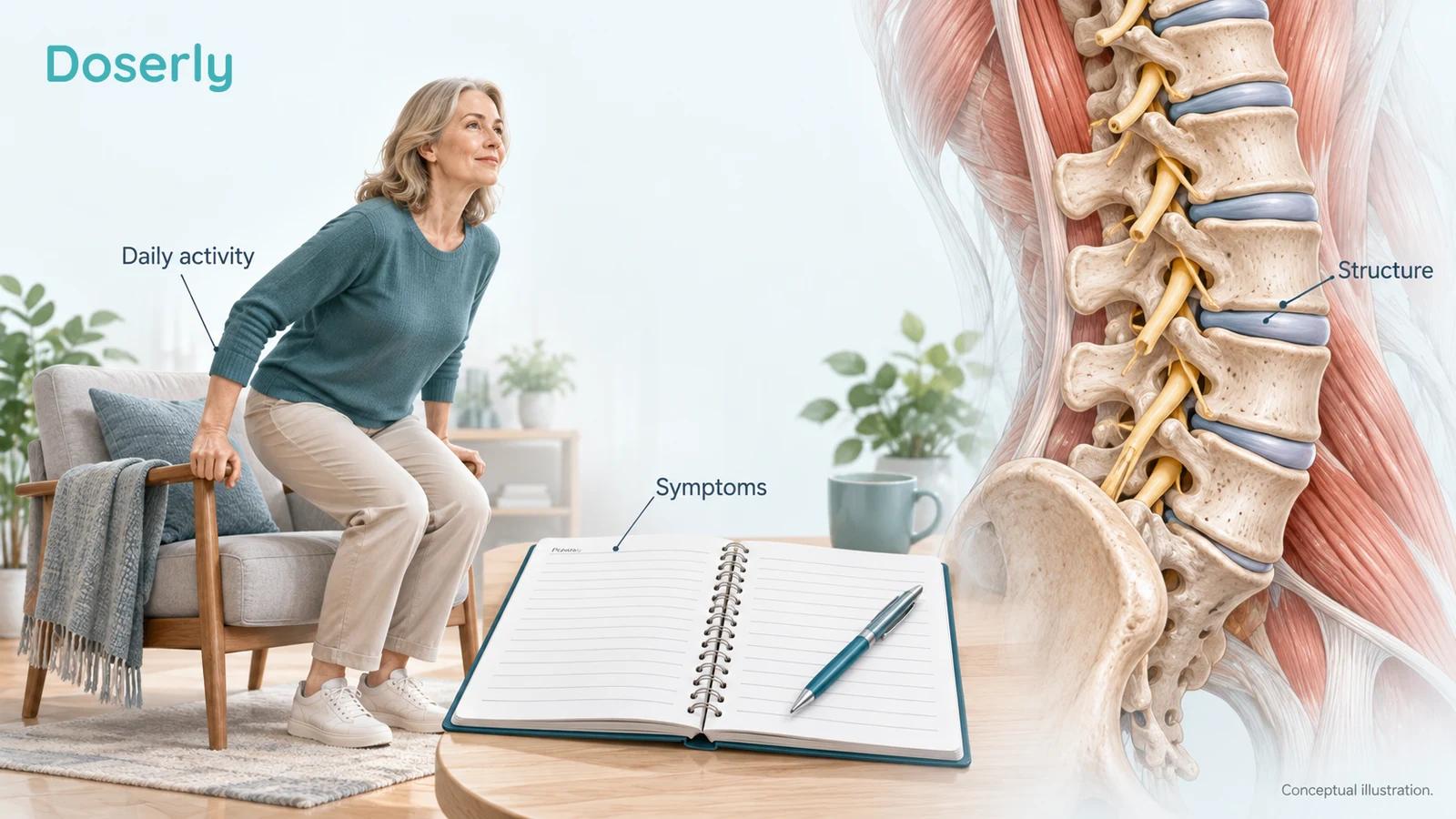
Choose a small number of ordinary activities before a treatment starts. They might be standing at a kitchen counter, walking to a nearby shop, sitting through a meeting or getting dressed. Use activities that already matter to you, rather than tests designed to provoke pain or prove toughness.
Record a brief description at a consistent time: what you did, how symptoms affected it and whether you needed to change the activity. Include major changes in medication, exercise, sleep or workload. These details help you and your clinician interpret a trend without turning daily life into a laboratory.
For example, a less painful week after treatment may also have been a week away from a demanding job. A more painful day may have followed an unusually long journey. Neither observation invalidates how you feel. The context simply prevents one event from being assigned all the credit or blame.
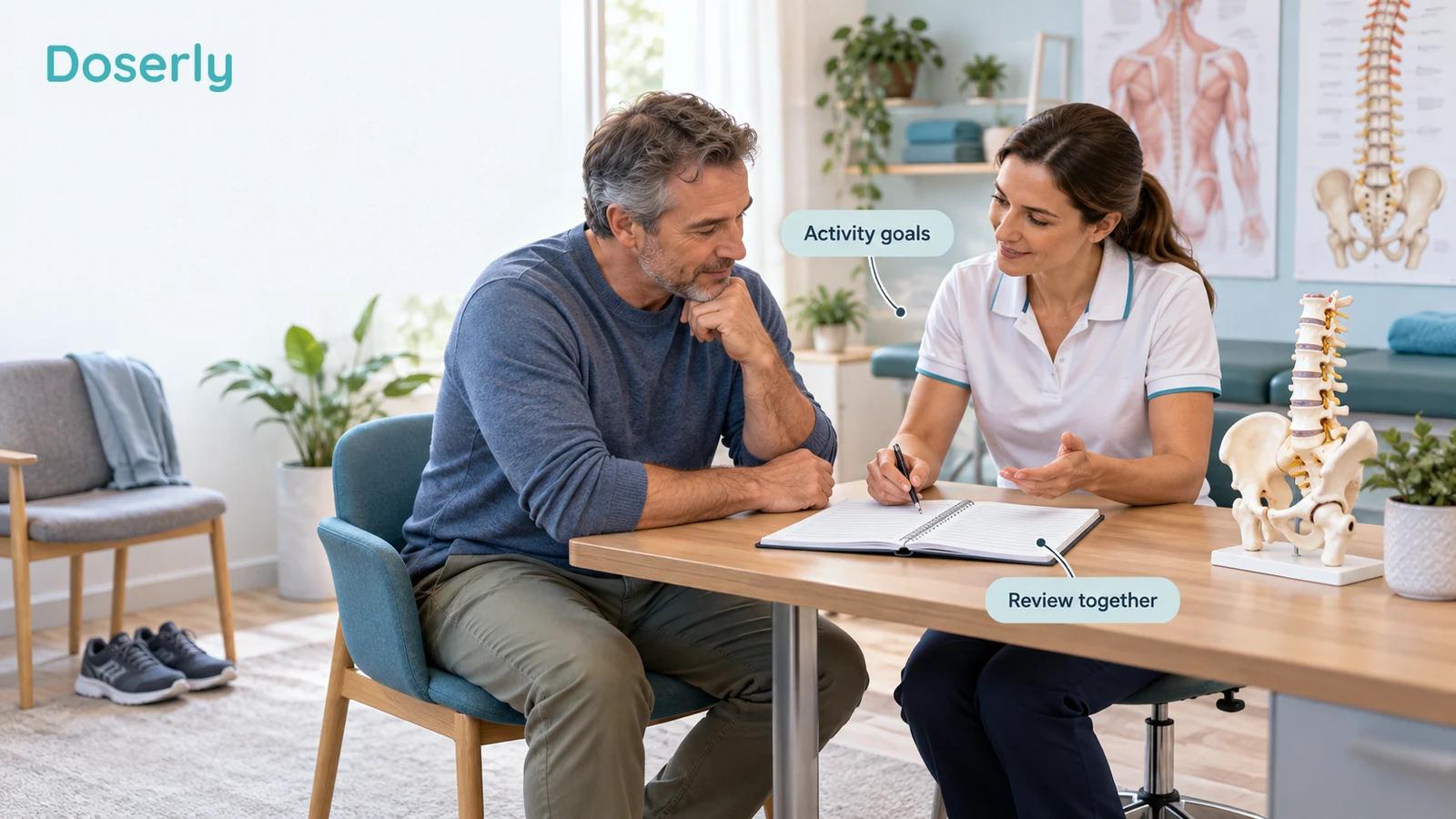
Agree on a review point and what would count as useful progress. A temporary pleasant sensation may be welcome, but it is different from a durable improvement in an activity you could not manage before. If the benefit remains unclear, reconsidering the treatment is a reasonable outcome, not a failure of commitment.
Symptoms that need assessment rather than a light appointment
New bladder or bowel changes, loss of sensation around the genitals or anus, or pain with weakness or numbness in both legs warrant emergency assessment. Back pain with fever or feeling generally unwell, or severe pain that begins suddenly or worsens quickly, also needs prompt medical attention. These are reasons to seek care, not situations in which to test whether a device helps. NHS back-pain guidance
For an established persistent problem, tell the treating clinician about changes in symptoms and ask about the specific device's precautions, including eye protection and skin sensitivity. The two 148-person trials reported no treatment-related adverse events, but that does not establish that every device, exposure or patient circumstance is risk-free.
Questions worth taking to an appointment
- Does my diagnosis match the people in the study supporting this treatment?
- Is this low-level PBM, high-intensity laser, laser acupuncture or a combination treatment?
- Did the study improve pain only, or also an activity outcome that matters to me?
- What did active treatment add beyond sham and the same rehabilitation?
- What is the total time and cost, and when will we review whether it is helping?
For chronic nonspecific low back pain, light therapy remains an uncertain adjunct. There are encouraging short-term findings, but substantial placebo-controlled trials have found little or no added benefit. The most useful promise a clinician can make is not that a beam will repair your back. It is that the plan will be assessed against your symptoms, your goals and the best available evidence, with room to change direction if it is not helping.