
Red Light Therapy
October 17, 2026
Masks, panels and lasers: choosing a red light device that fits the evidence
On this page
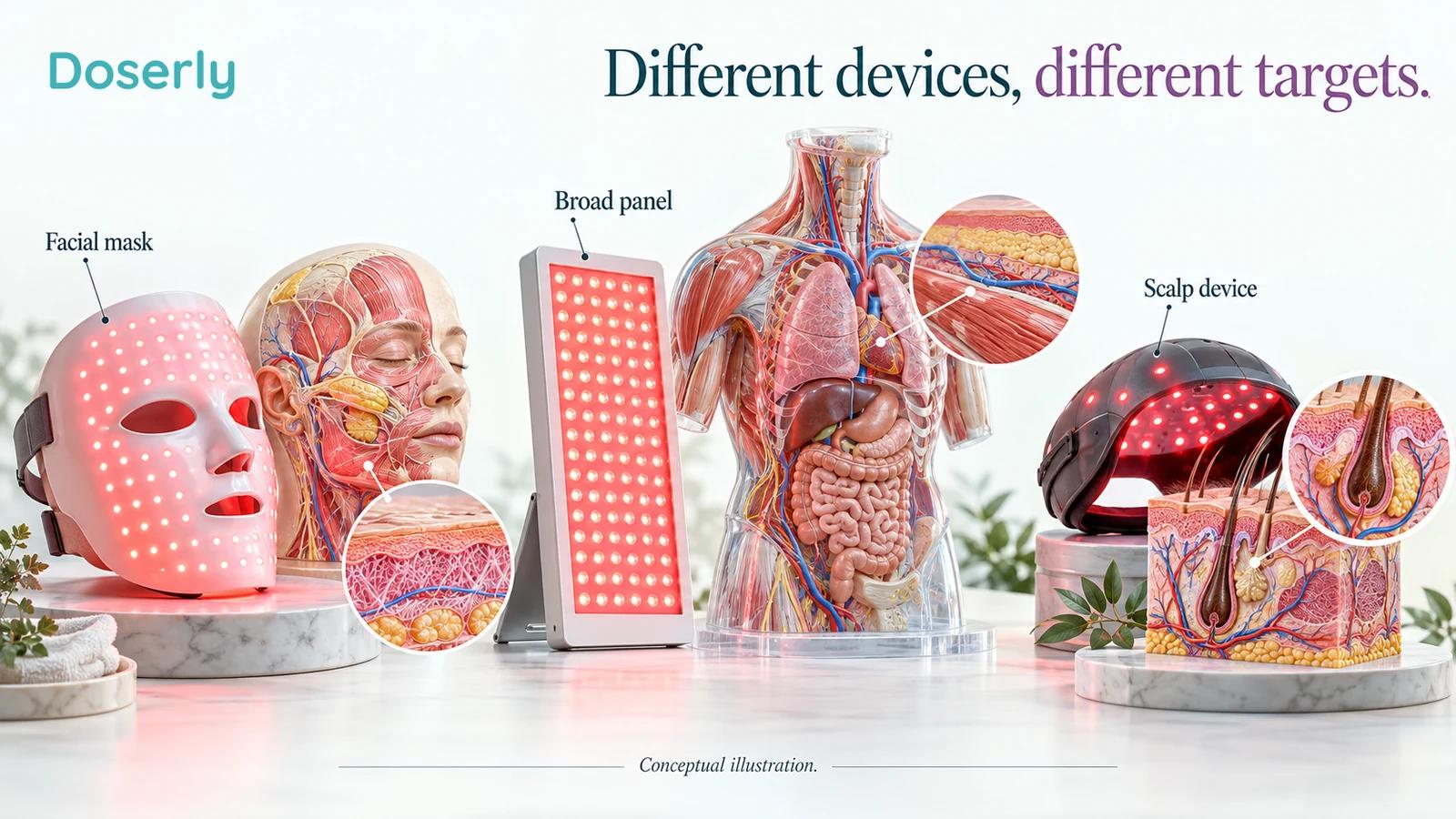
A red light mask, a large panel and a laser comb can all be described as light therapy. They can also be very different purchases. They illuminate different areas, ask different things of the user and may have evidence for entirely different outcomes.
The most useful starting point is therefore not the most powerful device or the longest list of wavelengths. It is a specific goal: improving a particular kind of facial wrinkle, treating diagnosed pattern hair loss, or adding a light-based option to a plan for inflammatory acne. Once that goal is clear, the relevant studies become easier to identify.
This does not mean home devices are inherently ineffective. Some have been studied in randomized trials. It means that a useful result belongs to the tested device, application and population. Moving that result to another product requires more than a shared red glow.
Here is how to compare masks, panels, handheld devices and lasers without letting the specifications outrun the evidence. Research available through October 17, 2026 is considered. There is no brand ranking: the aim is to help you recognize a better-supported purchase, including when the evidence does not justify buying anything yet.
Begin with the condition, not the form factor
A device that fits a face is designed around a different practical problem from one that reaches the scalp. Even within one body region, the diagnosis matters. Acne, rosacea, pigmentation and fine lines are not interchangeable reasons to use the same light setting.
A useful product claim should therefore name the intended condition and outcome. “Improves skin health” is difficult to test. “Temporarily improves the appearance of crow's feet” is more specific. “Treats mild-to-moderate inflammatory acne” refers to a defined type of lesion and severity, rather than every bump that appears on the face.
The same principle applies to hair. A study in androgenetic alopecia, commonly called pattern hair loss, does not establish treatment for sudden shedding, scarring alopecia or every patch of missing hair. Choosing a device before understanding the reason for hair loss can turn a potentially useful adjunct into a delay in appropriate assessment.
The American Academy of Dermatology's patient guidance describes home devices as an option that may fit within a broader treatment plan. Its practical emphasis on matching the treatment to the person is useful. A professional assessment is particularly valuable when a concern is painful, changing, inflammatory or difficult to identify, rather than simply cosmetic.
Try putting the goal into one sentence before comparing products. For example: “I want to know whether a home mask can improve fine lines around my eyes enough to justify the time and cost.” That sentence leads to a different evidence search from “I want a panel to improve every organ's mitochondria.” The second claim would need substantially broader clinical evidence.
What a mask can offer
A mask's practical appeal is straightforward: it holds emitters near much of the face at once. A fitted design may make positioning more repeatable than holding a wand in front of each region. A hands-free format can also make a repeated routine easier to complete.
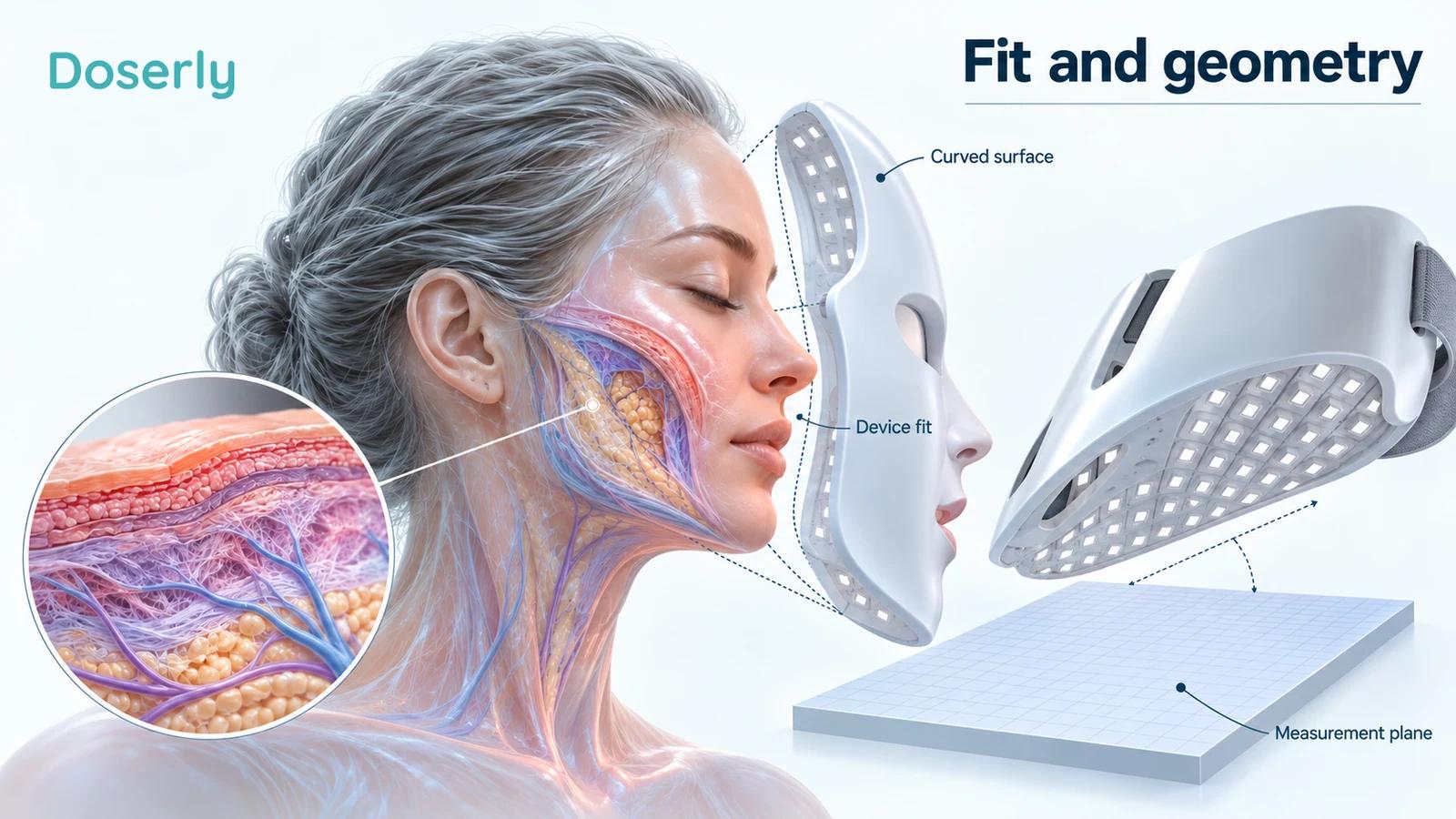
Fit is still an optical issue. The nose, cheeks, forehead and jaw create different gaps and angles. A rigid mask and a flexible mask may sit differently on the same person. Coverage of the face does not guarantee equal exposure at every point, and a device that looks comfortable in a photograph may press on a particular person's nose or cheekbones.
There is credible human research on specific masks. A 2025 sham-controlled study of a 630 nm and 850 nm home mask enrolled 60 Asian adults, predominantly women, with defined crow's-feet severity. At 12 weeks, independent raters found at least a one-point improvement in 25 of 29 participants in the active full-analysis group, compared with 5 of 30 controls. Treatment lasted 12 weeks, with another four weeks of follow-up.
That is a meaningful device-specific signal, but the details keep it in proportion. The sham emitted reduced red light rather than no light, and participant-rated aesthetic improvement did not separate clearly between groups in the reported analyses. The result concerns temporary wrinkle appearance in the studied population, not broad reversal of skin aging.
A separate 2025 trial of a 660 nm mask enrolled 95 women aged 45–60 and compared two schedules with sham. Specialist wrinkle-scale ratings did not differ significantly between groups, although some image-analysis regions and satisfaction measures favored treatment. More sessions did not clearly improve the findings.
Together, these trials support a careful conclusion: some masks may help some visible skin outcomes, but results depend on what was measured and how. They do not establish that every mask with similar wavelengths performs equally, or that the most expensive one will produce the most noticeable change.
Questions that make mask comparisons useful
Ask whether the study tested the actual product model, including the version now being sold. Identify the treatment region and the outcome measure. Check whether photographs were assessed by blinded raters and whether the control was a convincing sham.
Then consider the everyday design. Can you put it on consistently? Does it remain positioned without needing to tighten it uncomfortably? Can the contact surfaces be cleaned according to the instructions? Are the eye-related directions clear and realistic for the way the mask sits on your face?
These questions are not cosmetic details. A routine that is awkward enough to abandon cannot reproduce a repeated-use trial. Comfort and convenience do not prove efficacy, but they affect whether a studied application can be followed in ordinary life.
What a panel changes
A panel can illuminate a larger region without touching it. This may be convenient when a study or labeled use involves a broad accessible surface. It also introduces variables that a fitted device partly constrains: distance, angle, posture and the area actually within the light field.
A large panel is therefore not automatically a more capable version of a mask. It may deliver light to more skin while having little direct evidence for the particular facial outcome you care about. Likewise, a facial-mask trial cannot validate whole-body claims simply because the panel includes the same wavelengths.
The center of a panel's field may receive a different exposure from its edges. Moving closer can change beam overlap and local intensity. Moving farther away can change coverage. A photograph showing a person standing in front of a panel does not tell you the irradiance distribution across their body.
Look for measured output at a stated distance and a description of the area sampled. A single strongest reading is less informative than a report describing the treatment region. Electrical consumption, nominal LED wattage and optical output should be distinguished rather than presented as competing measures of treatment strength.
An original 2025 study of five home-use LED devices found heterogeneous optical characteristics and reporting issues relevant to exposure. The study also examined heating in porcine tissue. It was not a clinical comparison of masks against panels, and it cannot rank the entire market. It supports a more practical expectation: measurements and instructions should describe the actual device in use.
For a panel purchase, the main question is whether the proposed use is supported by a relevant human study. If the supporting evidence is a small contact probe applied to defined points, ask what evidence connects that intervention to broad noncontact illumination. Matching the total energy number does not establish equivalent delivery.
Handheld devices trade coverage for placement
A handheld light can be convenient for a small region. It can also require the user to move between sites, hold the source at a consistent angle or maintain contact without pressing excessively. The more placement matters, the more useful clear instructions become.
A trial involving a handheld device may specify individual treatment points. That pattern is part of the intervention. A person who sweeps the light quickly over a larger region may use the same device without reproducing the studied application. Conversely, holding it longer over one spot does not automatically improve the effect.
Handheld formats are not restricted to lasers. They may contain LEDs or different combinations of sources. The housing shape tells you little about the wavelength, measured output, beam area or clinical evidence. A device described as professional-looking should meet the same documentation standard as a simple consumer mask.
Consider the physical demands as well. If shoulder pain makes holding a device difficult, a technically plausible routine may not be practical. If treating several areas turns a brief advertised session into a much longer daily task, that extra time belongs in the purchase decision.
For a narrowly defined use, a small device may be entirely reasonable. For a broad goal, limited coverage may be inconvenient. Neither conclusion establishes effectiveness; it simply helps determine whether the form factor fits a use already supported by evidence.
Lasers and LEDs are not a simple quality hierarchy
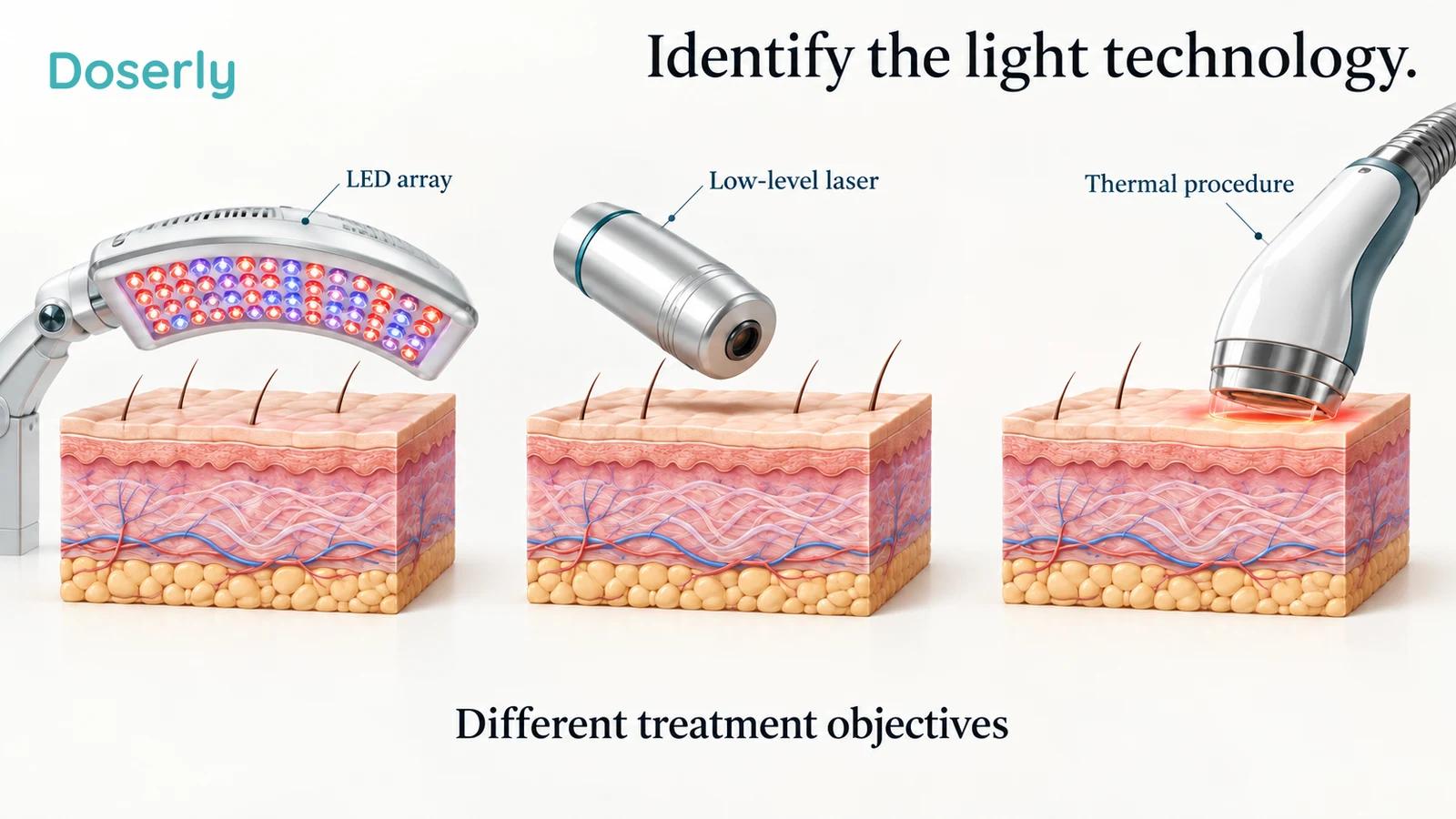
A laser generally emits a narrower spectral band and can produce a more directed beam than an LED. LEDs are commonly arranged in arrays to cover larger areas. These physical differences help describe how a device works, but they do not create a universal ranking of clinical value.
The word laser also covers very different medical interventions. A low-level laser used in PBM is not interchangeable with an ablative resurfacing laser, a hair-removal system or a high-intensity heating treatment. A photograph of one cannot serve as evidence for another.
Similarly, intense pulsed light, or IPL, is not simply a powerful red-light panel. It uses a different optical approach and is often intended to target pigment or hair through thermal effects. A home IPL hair-removal device and a light-based hair-growth device pursue opposite outcomes. The general phrase “light therapy” hides that distinction.
Clinical equipment still needs accurate characterization. In a 2022 study of 24 clinical laser devices, investigators found substantial variation between declared and measured power and beam characteristics. The equipment was relatively old, limiting generalization to new products. The finding is nevertheless a useful reminder that the setting and label do not replace calibration.
For a specific condition, the relevant comparison is between tested interventions. If both a laser device and an LED device have supportive trials, evaluate those trials and their practical demands. If only one has evidence for the intended outcome, the theoretical elegance of the other light source does not close the gap.
Hair devices need their own evidence
Caps, helmets and combs are designed around scalp coverage, hair interference and repeated use. Their evidence should concern people with the relevant diagnosis and should measure hair outcomes, rather than borrow results from facial skin studies.
A 2014 multicenter series of randomized sham-controlled trials evaluated laser combs in men and women with pattern hair loss. Terminal hair density increased more with the active devices than with sham over 26 weeks. There were losses to follow-up, and the authors called for further work on long-term effects and maintenance. These findings support the tested approach without establishing permanent regrowth after stopping.
Newer evidence is not always simpler. A 2025 trial of LED caps randomized 160 adults with androgenetic alopecia. Individual active arms did not reach statistical significance on the primary hair-count endpoint. A pooled analysis of three active arms favored treatment, but 91 randomized participants were excluded from the per-protocol analysis. Several authors had device-company affiliations.
A shopper reading only the conclusion might miss those qualifications. The useful question is not whether a product can cite a study, but whether the result supporting its claim was the intended primary comparison, how many participants were analyzed and how closely the device matches the one being sold.
A cap may simplify positioning. A comb may make it easier to part hair locally but require careful movement. Those practical differences matter for adherence; they do not prove one category delivers better hair growth. Diagnosis, evidence quality and tolerability remain more informative than the number of visible emitters.
Acne devices: combined colors do not automatically mean better results
Red and blue light are often combined in acne devices because their proposed biological roles differ. A combination can be reasonable to study, but adding a color is not itself proof of greater clinical benefit.
A 2013 sham-controlled trial in 35 Korean patients found improvements with a specific home-use blue-red device for mild-to-moderate acne. The small study included lesion counts and tissue-related assessments. Its findings support that intervention in the studied setting, rather than all masks displaying red and blue modes.
A 2026 randomized home-use comparison evaluated a combined red-blue device against a blue-only device. Twenty-three participants completed the study. Inflammatory lesions improved in both groups, and the study did not find significant between-group differences in lesion-count reduction. An investigator global assessment favored the combination at eight weeks. The trial was open-label and small.
That result is particularly useful when reading an advertisement that emphasizes improvement from baseline. People in both groups can improve while the difference between devices remains uncertain. A positive result within one group does not establish that adding red light was responsible for a superior outcome.
For acne that is deep, painful or leaving scars, a device comparison is only one part of the treatment decision. The goal is timely control of the disease and prevention of lasting marks, not simply finding a more elaborate light system. A home device should fit a suitable care plan rather than become a reason to postpone it.
What FDA wording does and does not tell you
Regulatory language deserves careful reading because several different terms appear together in device advertising. In the United States, FDA registration or device listing is not the same as clearance or approval. The FDA explicitly states that registration and listing do not denote approval, clearance or authorization. It does not issue registration certificates that establish a device's clinical performance.
A 510(k) clearance has a different meaning. It concerns substantial equivalence to a legally marketed device for the relevant intended use. It should not be confused with premarket approval, which is a separate pathway. The FDA's explanation of device approvals and clearances describes those distinctions.
Neither phrase should be stretched into a universal endorsement of every health claim on a product page. A device cleared for wrinkles has not thereby demonstrated benefit for depression, thyroid disease or exercise recovery. The exact indication matters, as do the model and application instructions.
You can use the FDA's searchable 510(k) information to look for a device name, applicant or clearance number. The record may include a summary describing its intended use and comparison with a predicate device. Check that the model identified in the record is the one being sold.
One public mask clearance document illustrates why reading the actual language helps. It distinguishes red-light wrinkle treatment, acne indications and an infrared topical-heating use. Those are separate claims within the documentation, not proof that all infrared applications work through the same mechanism. This is an example of how to read a record, not a recommendation for the named device.
Regulation also differs across countries. A United States clearance claim does not replace the rules or product authorization relevant where you live. For a purchase, the practical task is to verify the actual record and use rather than treat a regulatory-looking badge as a complete evidence review.
Compare the full cost of a routine
The price on the product page is only one cost. Repeated sessions take time. Some devices require awkward positioning, separate passes over multiple areas or accessories that need replacement. A warranty and a reachable support team become relevant if output changes or the device stops working.
A return window can help assess comfort and usability, but it may be shorter than the period needed to judge the outcome studied in a trial. That mismatch is worth noticing before purchase. A device can be easy to tolerate for two weeks while its claimed hair or wrinkle benefit remains impossible to assess in that time.
Consider what else changes when you start. If you also begin a retinoid, alter acne medication or add a hair treatment, improvement may come from the combination or the other intervention. That does not make the improvement unimportant. It does make it harder to decide whether the device earned its cost.
For visible outcomes, photographs are more useful when lighting, angle, facial expression and camera settings stay consistent. For a medical condition, the most appropriate outcome may require clinical assessment. A pleasing photograph immediately after a session can reflect temporary appearance changes without establishing the longer-term result you intended to buy.
Avoid turning this into a contest to use the strongest setting or accumulate the most sessions. A device that fits the evidence and your routine is a more defensible choice than one that encourages constant escalation whenever results are uncertain.
A short set of questions before buying
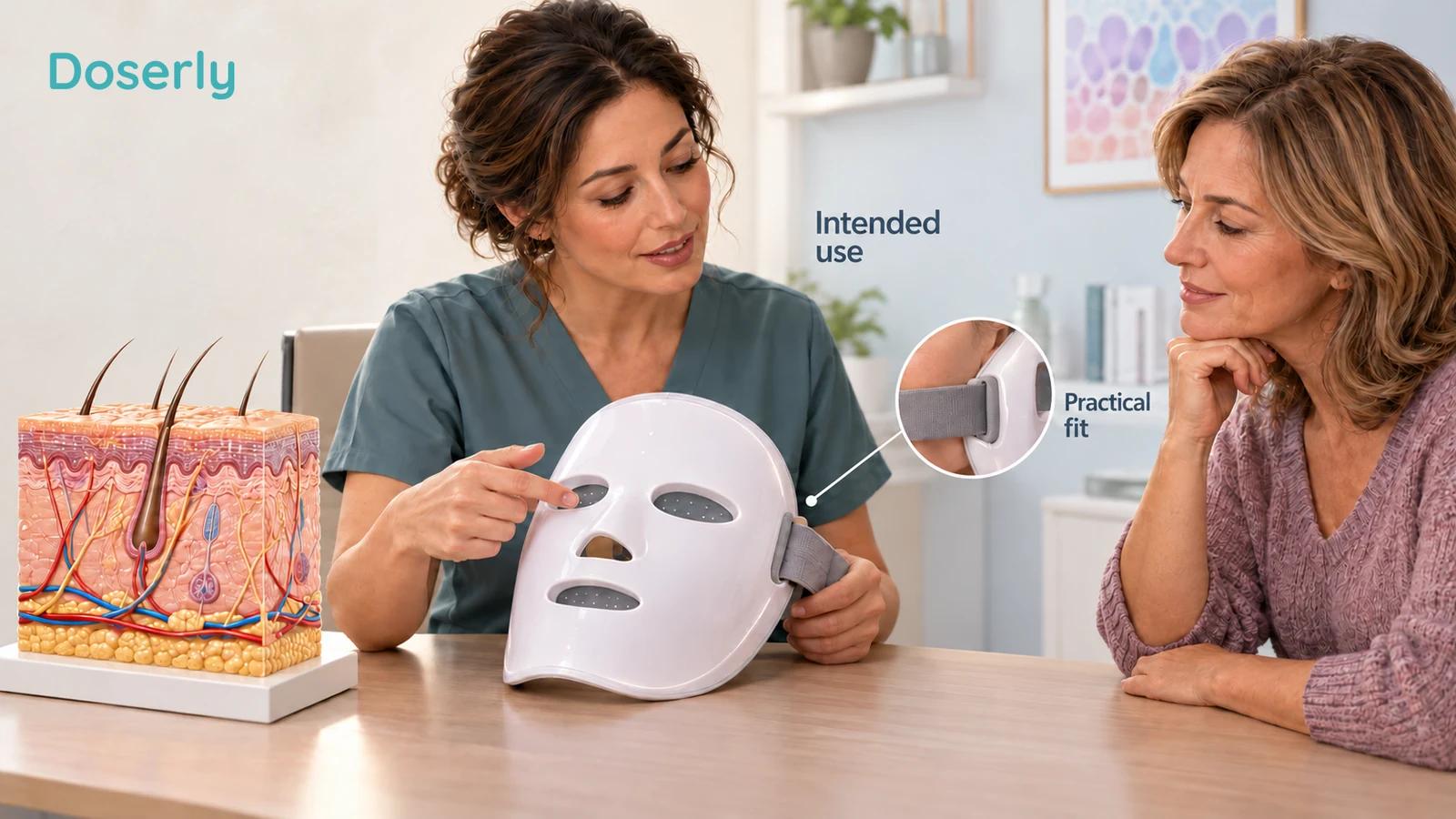
A good comparison can stay focused. Ask which condition the device is intended to address, whether the actual model was studied, what the primary outcome showed and how the treatment compared with sham or another appropriate control. Then ask whether the study population resembles the person who will use it.
Technical documentation should identify wavelengths, measured optical output, treatment area and positioning. Safety instructions should be clear about the intended body site and any eye protection. If protection is required, follow the specified approach; ordinary sunglasses are not an automatic substitute.
Finally, decide what result would make the routine worthwhile and how long the supporting research actually followed participants. A clear answer can support a purchase. An unclear answer can support waiting. Masks, panels and lasers are tools with different delivery patterns. Their value comes from a credible match between the device, the person and the outcome being sought.