
Red Light Therapy
October 17, 2026
Red and blue light for acne: where home devices fit into treatment
On this page
A light mask can look appealing when acne treatment has become a collection of drying creams, appointments and disappointing photographs. The idea is simple: sit with a device for a while, avoid another layer of product, and let light help. There is real human research behind that idea. There is also a considerable gap between reducing some inflammatory pimples and reliably controlling every form of acne.
The most reasonable place for a home red or blue light device is as a possible addition to care for selected mild-to-moderate inflammatory acne. It is less convincing as an answer to predominantly blocked pores, and it should not become a reason to postpone treatment of painful nodules, new scars or severe disease. A device can be useful without being the main treatment.
The colors matter, but they do not settle the decision. Blue light and red light are studied for different biological effects. Combining them is plausible. Whether a particular combination adds a worthwhile benefit has to be tested in people, using that device and a fair comparison. A small 2026 home-device trial makes this distinction especially clear.
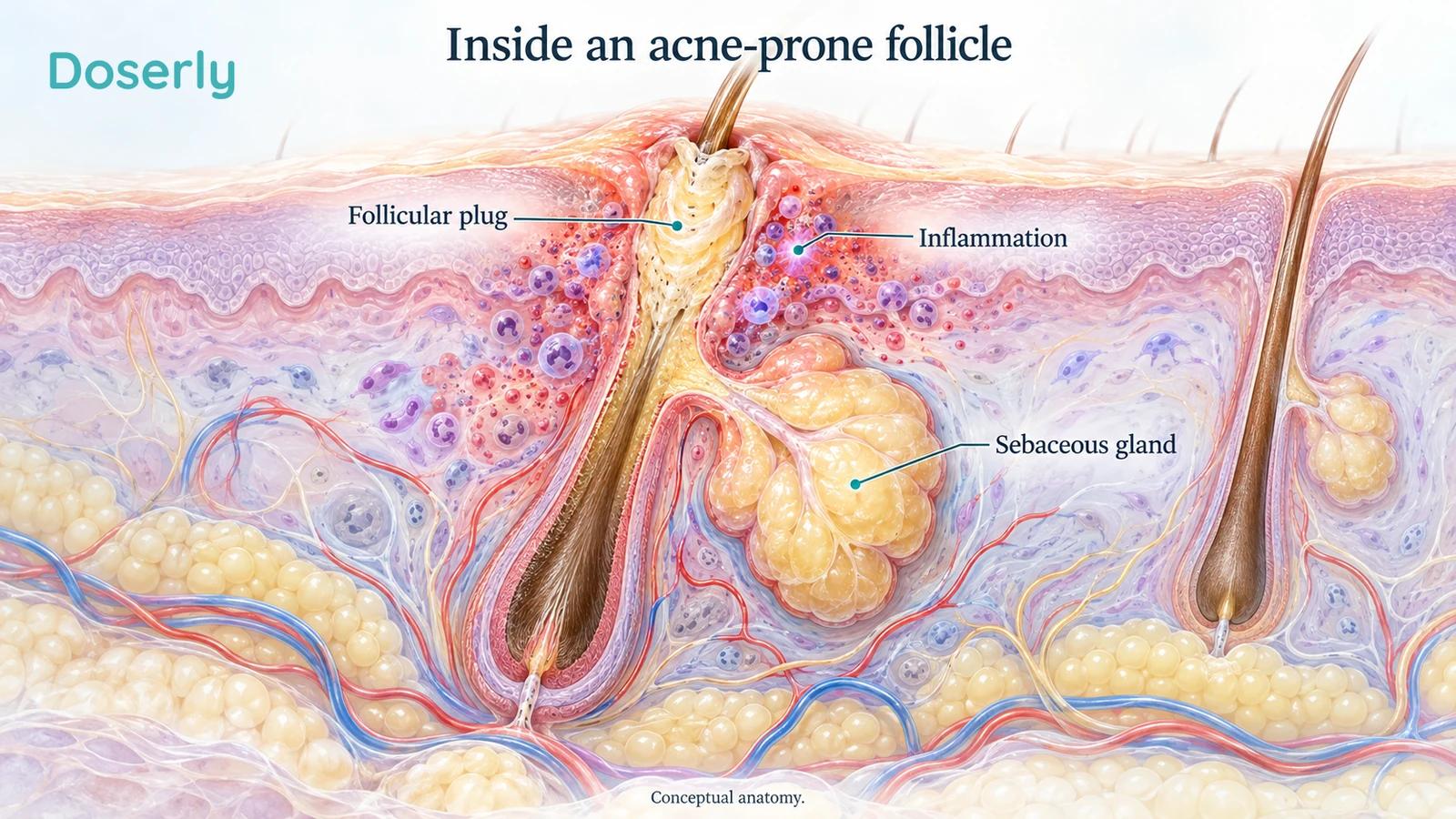
Conceptual anatomy of an acne-prone follicle. This is not a patient biopsy, a treatment response or a prediction of which lesions will improve.
Start with the acne, then consider the device
The word acne covers several things that can coexist on the same face. Comedones are blocked follicles: open comedones are blackheads, while closed comedones are whiteheads. Inflammatory papules are raised inflamed bumps; pustules contain visible pus. Nodules involve deeper inflammation and can be painful. The brown, purple or red mark left after a spot settles is a different outcome from the active spot itself.
That distinction changes what success should mean. Someone with frequent inflamed pimples might value fewer new bumps and less tenderness. Someone whose main problem is old dark marks might see little benefit from a treatment that only changes active lesion counts. A person developing deep lesions needs a plan that addresses the risk of lasting damage, not just the appearance of surface redness.
The American Academy of Dermatology's patient guidance on light treatments places visible red and blue devices mainly in the treatment of pimples. It does not present them as reliable treatments for blackheads, whiteheads, cysts or nodules. It also explains that light treatments rarely clear acne completely on their own. Some individual trials report improvements in comedones, but that is not a consistent enough finding to make a broad promise.
A useful first question is therefore more specific than whether red light works: which of the things bothering you was actually measured in the study? A device trial enrolling people with inflammatory facial acne cannot automatically answer a question about deep back acne, persistent pigmentation or an itchy eruption that has not been diagnosed.
Why researchers study blue and red together
Blue light research often focuses on porphyrins, light-absorbing substances made by acne-associated bacteria. When those substances absorb suitable light, photochemical reactions can affect the bacteria. Early clinical research used ultraviolet-free blue light around 405–420 nanometers, including a 2003 report of three small studies. Those studies included a dose-response experiment, an open study and a controlled split-face experiment, with 10, 13 and 23 participants respectively. Inflammatory lesions improved, providing an early clinical signal rather than evidence for every modern mask.
The bacterial explanation needs some care. Cutibacterium acnes, formerly called Propionibacterium acnes, is also a normal member of the skin microbiome. Acne is not simply a dirty surface that needs to be sterilized. In laboratory research published in 2020, investigators found differences in porphyrin production and regulation among cutaneous bacterial species and C. acnes strain groups. That complexity helps explain why a single antibacterial story cannot describe every person's acne. The laboratory findings do not identify which home device will work for an individual.
Red light is commonly investigated for effects on the skin's own inflammatory and cellular responses. That is a different question from whether blue light can affect bacterial porphyrins. Proposed complementary effects are a reason to compare combination treatment with each color alone. They are not proof that the combination must be better.
There is also no automatic clinical ranking in which deeper-reaching light is always more useful. Acne involves a follicle, its contents and its surrounding tissue. An intervention has to produce a useful effect at an acceptable exposure, not merely penetrate farther. The marketing phrase “works at a deeper level” does not tell you whether fewer new pimples developed.
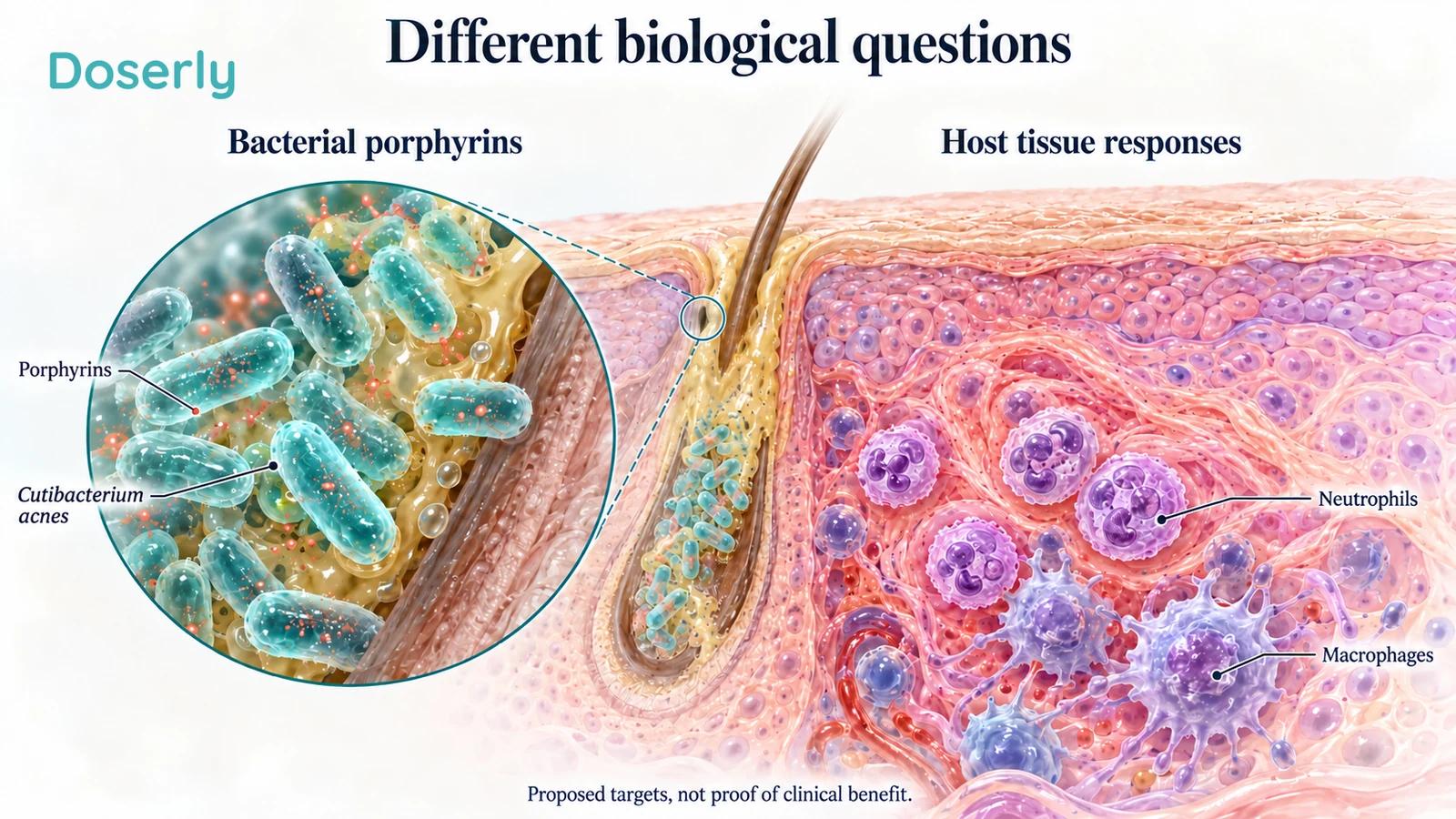
Conceptual bacterial and host-tissue targets. The symbols are schematic, not molecular structures; no bacterial killing, reduced inflammation or proven treatment benefit is depicted.
What the foundational combination trials found
One frequently cited randomized study from 2000 assigned 107 people with mild-to-moderate acne to blue light, combined blue-red light, cool white light or benzoyl peroxide. Over 12 weeks, inflammatory lesions in the combination group improved by an average of 76% from baseline. That number describes change within the group, not an additional 76% benefit over every alternative.
Combination light was superior to blue alone at weeks four and eight, but not at week twelve. It also outperformed the benzoyl peroxide arm at some assessments, although the observers could not be blinded to that cream comparison in the same way as the light comparisons. Differences between active treatments for comedones were not statistically significant. The trial supports a possible inflammatory-acne benefit, with important qualifications about comparator, timing and lesion type.
A 2013 double-blind trial in Korea randomized 35 people with mild-to-moderate acne to a home blue-red LED device or a sham device. Treatment lasted four weeks, with assessment extending to twelve weeks. The active group had substantial reductions in both inflammatory and noninflammatory lesions, while the sham group did not show a significant change.
That study also examined tissue and sebum-related findings, including reduced inflammatory infiltrates and smaller sebaceous glands in the treated group. Those observations make the clinical findings more biologically interesting. They do not establish permanent gland suppression or prove that a different mask will produce the same result. The small sample and specific Korean study population remain relevant to how broadly the findings can be applied.
Together, these studies explain why combination light is more than a purely theoretical idea. They also explain why a confident-looking percentage on a product page needs its original context. Different studies used different devices, participants and assessments. A result obtained at twelve weeks is not a promise of what will happen after the first few sessions.
The 2026 comparison that deserves a careful reading
A 2026 randomized home-treatment trial compared a device combining 660-nanometer red and 415-nanometer blue light with an existing 415-nanometer blue device. Twenty-three participants completed the eight-week study: fourteen in the combination group and nine in the blue-only group. The study was open label, so participants knew which device they used.
Inflammatory lesions improved within both groups. Total lesions improved significantly within the combination group, but the difference between groups in total, inflammatory or noninflammatory lesion reduction was not statistically significant at any assessment. An investigator's overall severity rating favored the combination at eight weeks.
The balanced reading is that the combination produced encouraging results and a favorable overall rating, but did not establish a clear lesion-count advantage over blue alone. The small sample also cannot establish that the devices are equivalent. Most importantly, a significant improvement in one group and a nonsignificant improvement in another is not, by itself, evidence that the groups differ.
For a shopper, that changes the conversation. Paying more for an additional color may or may not be worthwhile, but the claim needs an actual added-benefit comparison. Two colors on the specification sheet are not themselves two proven increments of benefit. The same applies when a device adds near-infrared light to a red-blue arrangement: evidence for a simpler combination does not automatically establish the value of the added wavelength.
More frequent use has not been shown to be universally better
A 2021 randomized study of thirty people with moderate-to-severe acne compared two schedules using blue and red LEDs. One group received the colors in separate visits on alternating treatment days; the other received both colors consecutively during one weekly visit. The study found no significant difference between schedules. Improvements were mainly in inflammatory lesions, with follow-up extending eight weeks beyond the treatment course.
This does not supply a schedule for a different home device. It does show why doubling the number of sessions is not automatically an improvement. The tested device, delivery arrangement and total treatment course matter. The study also prohibited conventional acne treatments, which limits how directly it answers the more practical question of adding a device to an existing routine.
A mask's instructions should be treated as instructions for that product, not as a starting point for increasing exposure until the skin feels something. Visible brightness and warmth are not measures of acne benefit. Nor is a sensation of tingling necessary evidence that treatment is working.
For someone deciding whether a device is manageable, frequency is also a practical burden. A routine that is difficult to maintain can be poor value even when a study found an average benefit. Consider fit, cleaning, eye protection requirements, the ability to follow the actual instructions, and whether using it will crowd out treatments already helping. Those details are more useful than chasing the largest advertised power figure.
Where guidelines put light therapy
The AAD's 2024 acne guideline announcement states that the available evidence was insufficient to develop recommendations for procedures including laser and light-based devices. That is not a declaration that every light treatment is ineffective. It means the evidence did not support the same level of general treatment guidance available for several established options.
The guideline supports treatments such as benzoyl peroxide, topical retinoids and appropriate antibiotic combinations. It recommends limiting oral antibiotic use when possible and using benzoyl peroxide alongside antibiotics to reduce resistance. Hormonal treatments are options for suitable patients, and isotretinoin is recommended for severe acne or failure of standard treatment. These are clinician-guided choices, not interchangeable items in a shopping list.
The practical role of a device should follow from the remaining problem. Are inflammatory lesions persisting despite a tolerable routine? Is a prescription causing irritation that needs adjustment? Is the main concern scarring, or a treatment that is difficult to use consistently? Buying a mask before answering those questions can add expense without addressing why the current plan is falling short.
This is especially relevant for adults whose acne keeps returning. A device trial does not establish that light corrects hormonal drivers. In the 2023 SAFA trial, 410 adult women with persistent facial acne were randomized to spironolactone or placebo, while topical treatment could continue. The primary quality-of-life symptom outcome favored spironolactone at twelve weeks, with larger differences at twenty-four weeks. Participant-reported improvement at twenty-four weeks was 82% versus 63%. This was not a comparison with light therapy, and it does not mean the drug is suitable for everyone. It illustrates why the underlying treatment options and the time needed to assess them belong in the discussion.
A severe-acne combination study is not a home-mask cure
A study published in January 2026 retrospectively compared treatment records from twenty-eight people with acne conglobata, a severe form of inflammatory acne. Fifteen received red-blue LEDs plus oral minocycline; thirteen received a different, heterogeneous medication regimen. The authors reported better short-term clinical outcomes in the LED-plus-minocycline group.
Several features prevent a light-only conclusion. Treatment was not randomly assigned. Both groups received medication, but the regimens and durations differed. Primary symptom assessments ran for eight weeks, with recurrence tracked for twelve months. Some historical comparators combined isotretinoin and minocycline, a contraindicated pairing the authors acknowledge as a major limitation. The paper used a symptom-score threshold to classify “cure,” which is not proof of permanent remission. Irritation was common in both groups, even though it was described as mild and transient.
This is a possible combination-treatment signal for further research, not evidence that a home mask can replace severe-acne care or that anyone should shorten antibiotics themselves. A stronger study would hold the background treatment constant and randomly assign the light component. Until then, the contribution of the LEDs cannot be cleanly separated from the rest of the care.
The lesson is particularly useful when a product page cites a paper with a dramatic result. Read the actual intervention. “Light plus a prescription regimen under clinical care” and “this mask used alone at home” are different proposals, even when the colors look similar.
Photodynamic therapy is a different treatment
Photodynamic therapy, usually shortened to PDT, pairs light with an applied photosensitizing agent. The agent changes how tissue responds to illumination. The lamp's color can resemble a home red-light device, but the treatment is not simply a stronger version of a mask.
A 2025 randomized trial in twenty-six patients studied two ways of delivering red light after application of 5-aminolevulinic acid. Starting with a lower irradiance before increasing it reduced reported pain compared with the conventional delivery schedule. The groups did not differ significantly in the reported clinical efficacy measures. The study's question was how to make a particular photosensitizer-assisted clinical procedure more tolerable, not whether plain red light alone cleared acne.
This distinction matters when searching the literature. A headline containing “red light” may describe PDT, an LED intervention without a photosensitizer, or another procedure altogether. Evidence from one cannot be transferred by color alone. The associated preparation, pain, aftercare and clinical supervision also differ.
It is not sensible to recreate PDT by applying an unfamiliar product before a home mask. A cosmetic serum and a medically used photosensitizer are not equivalent, and making skin more reactive to light is not a general strategy for improving a device's results. Combination treatment needs evidence for the combination itself.
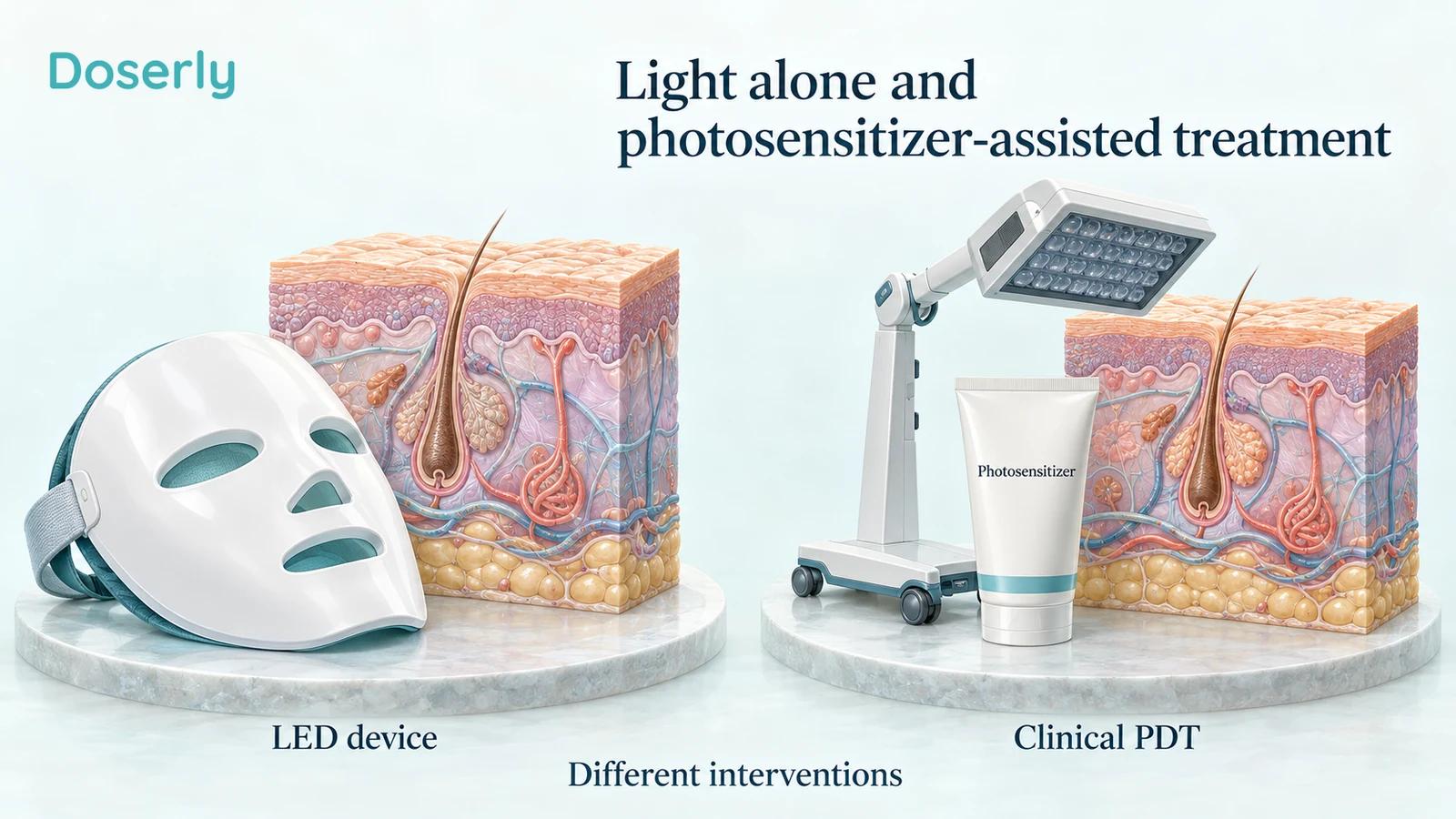
Conceptual equipment comparison. Clinical photodynamic therapy includes a photosensitizer; the image is not a treatment sequence, exposure instruction or efficacy comparison.
Skin tone and persistent marks deserve separate attention
Fewer pimples and fewer dark marks are related goals, but they should not be assumed to move together. The color left by inflammation can remain after a lesion is no longer active. A photograph may therefore look disappointing even when the number of new inflammatory lesions has fallen. Conversely, a change in lighting can make marks look lighter without changing acne activity.
Visible light can also affect pigmentation under some exposure conditions. In a 2014 experimental human study, blue-violet light at 415 nanometers produced dose-related pigmentation in skin types III and IV, while the tested 630-nanometer red exposure did not. Pigmentation after blue-violet exposure could persist for months. These were controlled experimental exposures on healthy volunteers, not a trial establishing the probability of darkening from every commercial acne mask.
The appropriate conclusion is neither that all blue devices cause pigmentation nor that all red devices are automatically suitable for pigment-prone skin. It is that wavelength, exposure and individual susceptibility matter. Someone with melasma or a strong tendency to develop persistent marks should bring that history into the device discussion, rather than treating skin tone as a cosmetic detail absent from the decision.
It also helps to ask whether a study included people with skin similar to yours and whether pigment changes were actually assessed. Reporting no severe adverse events in a small trial is different from carefully measuring subtle darkening over months. Representation and outcome selection affect how reassuring a safety claim can be.
How to judge a personal trial without chasing every photograph
Before starting any new addition, decide what you want to observe. New inflammatory pimples, deep painful lesions, existing marks, irritation and treatment burden should be recorded separately. Combining them into one impression of “better skin” makes it harder to understand what changed.
A simple record can include consistent photographs and brief notes about new lesions, discomfort and changes in other treatments. Keep the camera, lighting, distance and facial angle as similar as practical. Avoid judging progress from a brightly lit photograph immediately after removing a device. Photographs are useful context, but they do not diagnose the cause of redness or distinguish every lesion accurately.
Record when other things changed. Starting a retinoid, changing hormonal treatment and adding a mask at the same time makes attribution difficult. That does not mean necessary care should be delayed for the sake of an experiment. It means an improvement should be credited to the overall plan unless there is a fair basis for separating its parts.
Ask the clinician overseeing your care when to reassess and what would make the device worth continuing. A reasonable review considers both benefit and burden: fewer troublesome lesions, tolerability, time, cost, and whether the main concern is being addressed. A device that produces no meaningful improvement does not become more useful because its mechanism sounds sophisticated.
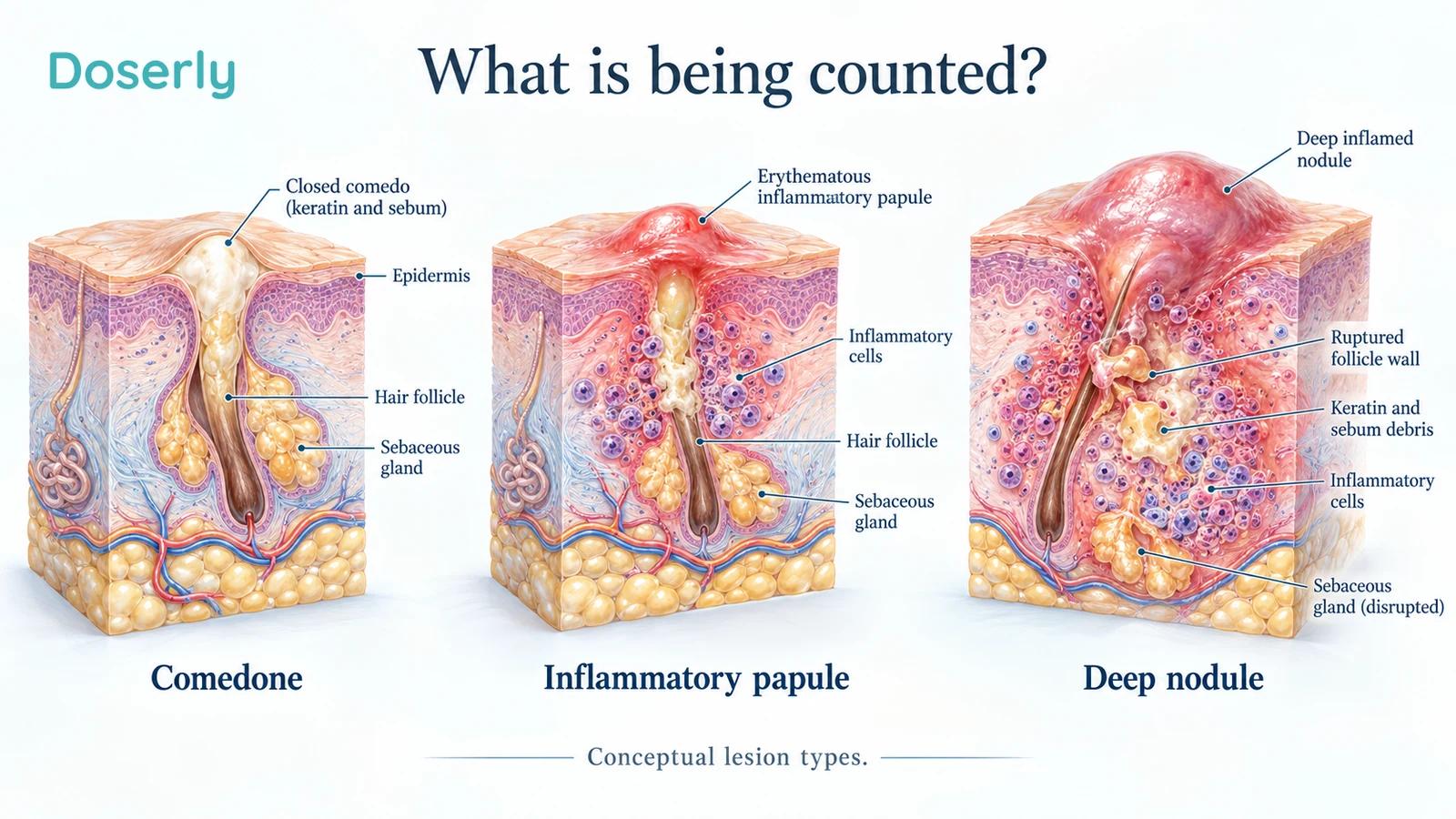
Conceptual lesion types, not a progression sequence or before-and-after comparison. Different lesions require different assessment, and deep nodules are not an appropriate reason to delay clinical care.
What to ask before buying or continuing
The most useful questions are concrete:
- Was this exact device studied for the kind of acne I have, or is the seller citing a different light treatment?
- Was it tested alone, against a sham, against another active device, or alongside medication?
- Did the study count inflammatory lesions, blocked pores, overall severity, pigment changes or something else?
- Were the improvements greater than the comparison group, and how long were people followed?
- What eye protection, medication precautions and skin-condition restrictions appear in the actual instructions?
- What is the plan if painful lesions, irritation, pigment changes or new scars continue?
Bring the device's name and instructions to the discussion. “Red light” is too broad a description to evaluate a combination safely. Follow the product's eye-protection requirements, and do not assume closed eyelids substitute for specified protection. Persistent burning, swelling or visual symptoms should prompt stopping the exposure and seeking appropriate assessment rather than extending the session to see whether the reaction settles.
A home light device can have a place in an acne routine when the diagnosis, target and expectations are clear. The research is most encouraging for inflammatory lesions, while the added value of particular colors and combinations remains device-specific. Keep the goal grounded in fewer troublesome breakouts and a tolerable long-term plan. Deep acne, scarring and persistent pigment problems deserve their own treatment decisions, even if a mask helps with some of the surface pimples.