
Supplements
October 16, 2026
Quercetin and immunity: prevention, symptoms and blood tests differ
On this page
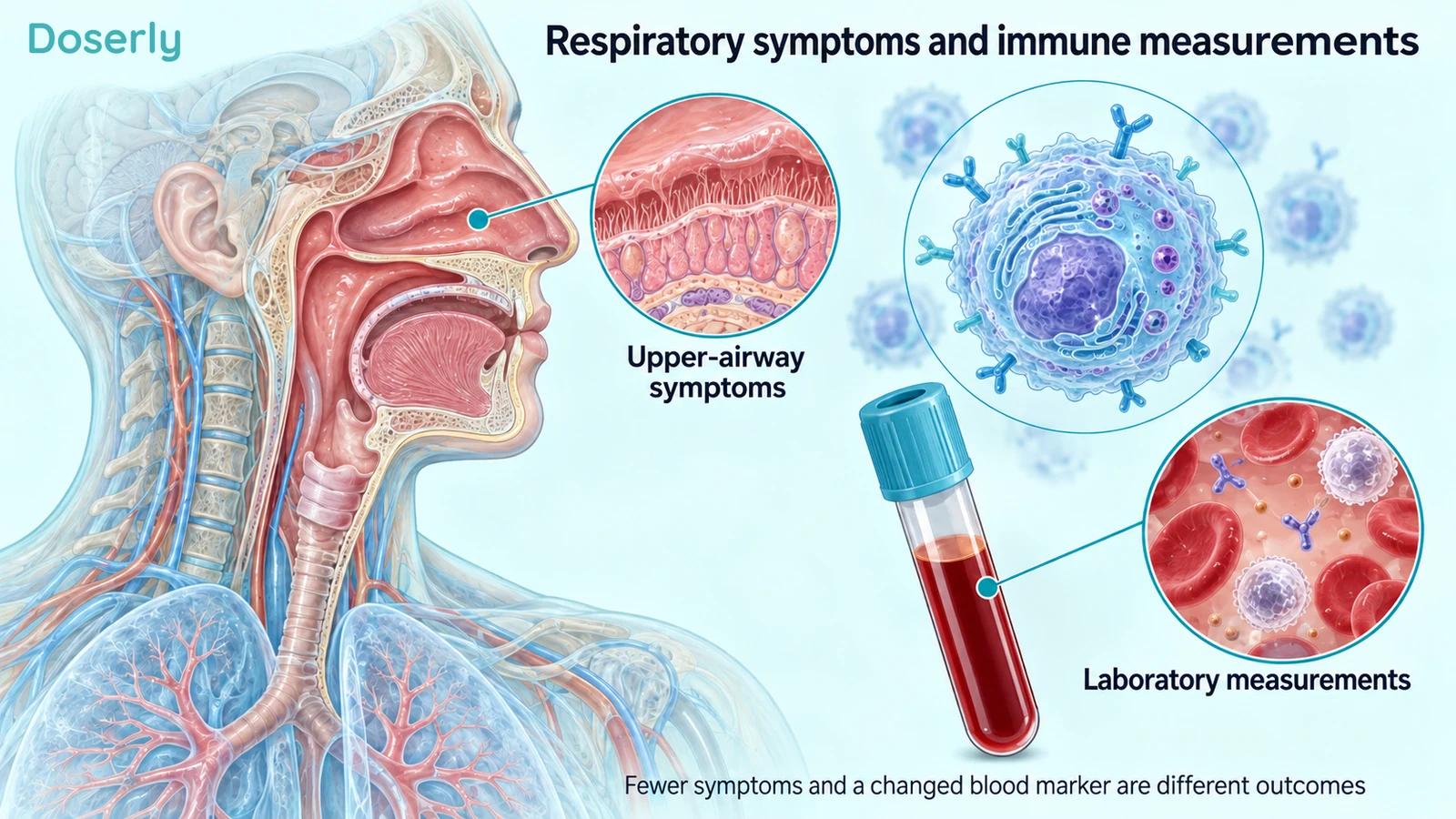
“Supports immunity” can mean several different things on a quercetin label. A study might ask whether fewer people become ill, whether symptoms resolve sooner, whether hospitalized patients deteriorate, or whether an immune measurement changes after vaccination. Those are separate questions, and their answers are not interchangeable.
The largest community trial discussed here found no overall reduction in upper-respiratory illness outcomes. A small study of cyclists reported fewer illnesses after unusually demanding training. More recent trials have investigated vaccine responses and treatment during COVID-19, including a combination product with a promising clinical result. None of these findings establishes a universal immune-boosting effect.
Our quercetin guide covers the compound's broader uses. This article explains how to read the respiratory and immune research without turning a narrow finding into a claim about every infection.
The question comes before the result
An infection-prevention study begins with people who are not being treated for the illness of interest and measures subsequent events. A treatment study begins after illness has developed. A laboratory study might not count illnesses at all: it can measure antibody concentrations, cytokines or the behavior of isolated immune cells.
Even clinical outcomes differ. The number of people reporting symptoms is not the same as the number of laboratory-confirmed infections. Total sick days combines how often illness happens and how long it lasts. A severity score concerns how bad symptoms feel. Hospitalization and respiratory deterioration concern more serious consequences in a different setting.
A claim becomes misleading when it moves between those outcomes without saying so. Fewer sick days in a selected subgroup cannot be restated as prevention of all infections. A lower inflammatory marker cannot establish that someone is less likely to catch a respiratory virus.
What happened in the large community trial?
A 2010 randomized, double-blind trial recruited adults aged 18–85, with 1,002 completing a 12-week comparison. Participants received products providing 500 mg or 1,000 mg quercetin daily, or placebo, and recorded respiratory symptoms using the Wisconsin Upper Respiratory Symptom Survey. Overall, the groups did not differ significantly in upper-respiratory illness rates or symptom outcomes. Community trial
The active chews also contained vitamin C and niacin. That formulation detail matters when comparing the experiment with a bottle of quercetin alone. The result concerns the studied products, population and duration, not every possible preparation.
This was a symptom-surveillance study, not a program of identifying the responsible virus for every reported illness. It offers useful evidence about the ordinary experience of respiratory symptoms in a community setting. It does not answer whether quercetin prevents a specific laboratory-confirmed pathogen in a particular high-risk group.
The main finding deserves priority because it reflects the broad comparison the study was designed to make. A large study can still leave unanswered questions, but a null overall result should not disappear when a more appealing subgroup result is quoted.
The favorable subgroup was narrower than the headline
Researchers separately examined 325 participants aged 40 or older who rated their fitness in the upper half of the study population. In this selected subgroup, the higher-quercetin group had lower reported illness severity and fewer total sick days than placebo. Those differences were not the result for the whole sample. Subgroup analysis
Subgroup findings can identify an important possibility: perhaps benefit differs by age, fitness or some correlated characteristic. They can also occur by chance, particularly when several possible dividing lines are examined. A useful next step is a trial that defines the subgroup in advance and tests the finding directly.
“Physically fit” here was a self-rating, not a diagnosis or a threshold on a standardized exercise test. Readers therefore cannot reliably decide that this result applies to them simply because they exercise regularly. Nor does it establish that increasing the dose will convert the overall null result into a benefit for everyone.
The honest interpretation preserves both findings: no overall effect, with a favorable selected subgroup that needs confirmation. That is more informative than describing the study as entirely positive or entirely irrelevant.
Why the cyclist trial is interesting—and limited
A 2007 double-blind trial involved 40 trained male cyclists. They received quercetin or placebo around a demanding period of three hours of cycling daily for three days. During the following two weeks, respiratory illness was reported in 1 of 20 quercetin recipients and 9 of 20 placebo recipients. Cyclist trial
That is a striking difference in a small, unusually stressed athletic population. The same trial did not find significant between-group differences in the exercise-related changes of several immune-function measures, including natural-killer-cell activity and salivary IgA output.
The combination of findings is instructive. A favorable illness result does not automatically validate a proposed immune mechanism. Conversely, unchanged laboratory measures do not erase a clinical observation. The two kinds of evidence need to be reported separately.
Only ten illness events occurred across both groups. A few additional events would materially change the apparent size of the difference, and trained male cyclists after concentrated exertion are not representative of every adult during cold season. This study supports a specific research question; it does not override the larger community trial or establish a general preventive regimen.
More quercetin in blood is not itself an immune benefit
A companion analysis of the large community study found that supplementation raised fasting plasma quercetin, with substantial variation among participants. That confirms exposure to the supplement and helps researchers study absorption. It does not independently establish fewer infections or better immune function. Plasma-response study
This distinction is especially relevant to enhanced-absorption products. A preparation that produces a higher blood concentration may differ pharmacologically from another formulation. The next question remains whether that difference improves a clinically important outcome at an acceptable risk.
A blood concentration is not a personal target for “optimal immunity.” The community findings show why: exposure increased, while the overall respiratory outcomes did not significantly improve. It is possible to demonstrate delivery without demonstrating the desired benefit.
What did the 2026 vaccine-response trial find?
A 2026 randomized, double-blind trial tested a quercetin glycoside complex for four weeks before an mRNA COVID-19 booster, then followed immune responses after vaccination. Fifty participants were included in the analysis. Antibody responses rose after the booster in both groups, but quercetin did not significantly change neutralizing-antibody responses, spike-specific IgG, or measured spike-specific T-cell responses. Vaccine-response trial
Local and systemic vaccine reactions were also similar. A numerical difference in peak temperature was not statistically significant. It should not be promoted as established prevention of vaccine side effects.
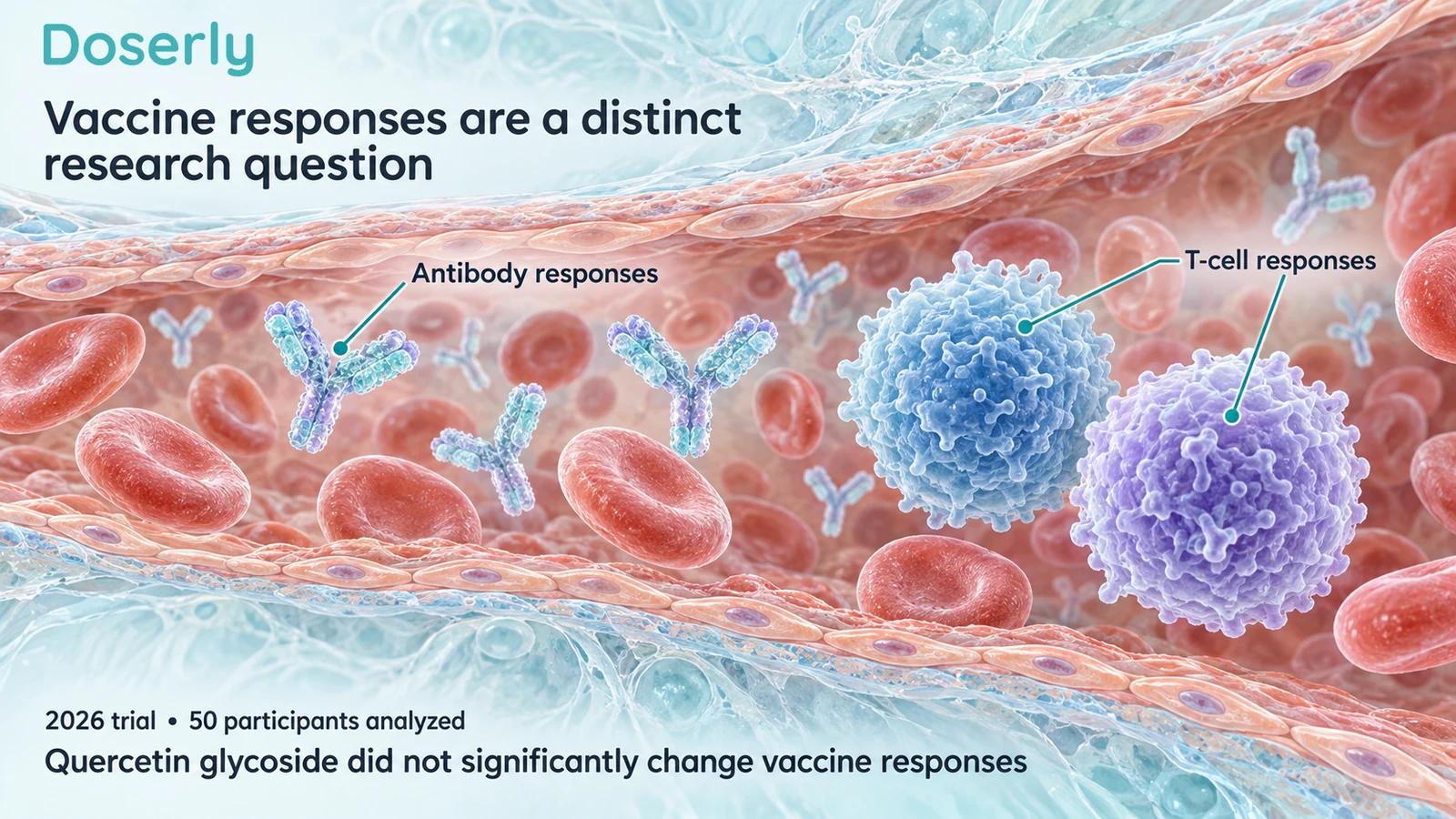
The study addresses an immune response to vaccination, not routine respiratory-infection prevention. Its small size leaves uncertainty about modest effects, but uncertainty is not a positive result. It also provides no reason to replace or delay vaccination in favor of supplementation.
Early COVID-19 treatment research had important design limits
A 2023 report described an open-label randomized trial in outpatients with mild-to-moderate COVID-19. Among the 100 patients reported in the comparison, those receiving a quercetin phytosome product alongside standard care were more likely to have a negative viral test and resolved symptoms after one week than those receiving standard care alone. Outpatient treatment trial
The study was not blinded and did not use a matching placebo. The phytosome product was a defined formulation rather than an interchangeable amount of any quercetin powder. These limitations matter particularly for symptom outcomes and for translating the result to products on the market.
A negative PCR result is also a specific laboratory endpoint. It is not equivalent to showing that treatment reduces hospitalization, mortality or transmission. Those outcomes require their own measurements and adequate numbers of events.
This research is best understood as a signal for further controlled testing. It does not establish an at-home substitute for evidence-based COVID-19 assessment and treatment, especially for someone at increased risk of complications.
A newly published combination trial adds a clinical signal
An October 2026 early publication reported a randomized, double-blind, placebo-controlled trial in 244 hospitalized adults with COVID-19. The intervention combined quercetin and bromelain alongside standard care. Respiratory deterioration occurred in 9.0% of the combination group versus 21.3% of the placebo group. Hospitalized combination trial
That outcome is clinically more direct than an inflammatory marker. However, the study found no statistically significant difference in in-hospital mortality or length of stay. The registration was retrospective, and the publisher identified the available article as an early accepted version subject to further editing.
The combination is an essential limitation: the study cannot identify quercetin's separate contribution. It also concerns people already hospitalized, not healthy people deciding whether to take a daily supplement to avoid infection. The authors called for larger, prospectively registered multicenter trials.
The finding deserves attention without becoming a recommendation to reproduce the regimen independently. Hospital supportive care, patient selection and monitoring are part of the experiment. Removing those conditions changes the question substantially.
Safety depends on the person and the whole product
Being present in foods does not make concentrated quercetin supplements interchangeable with eating fruit and vegetables. Supplement formulations can contain much larger amounts and additional active ingredients. Short clinical studies also have limited ability to detect uncommon harms or interactions.
Memorial Sloan Kettering's clinical resource describes a reported increase in INR after quercetin was added to stable warfarin treatment. It also notes laboratory and preclinical interaction concerns whose clinical significance remains uncertain. Those evidence levels should not be treated as equally established, but they justify reviewing the product with a pharmacist or clinician when medicines are involved. Clinical interaction resource
This is particularly relevant to combination products: quercetin, bromelain, vitamin C and other ingredients each add information that needs to be considered. The amounts mentioned in studies identify the research and are not a dosing recommendation. Pregnancy, breastfeeding and treatment for a serious illness require individualized advice rather than extrapolation from healthy-adult trials.
How to judge the next immunity claim
Read the claim as a specific question: fewer infections, shorter illness, milder symptoms, less respiratory deterioration, or a different blood-test result? Then check whether the study actually measured that outcome in people resembling the intended users.
Look for the comparison. A before-and-after improvement can occur because an infection naturally resolves. A subgroup difference may be exploratory. A combination cannot establish the effect of one ingredient. A result in hospitalized patients cannot establish prevention in healthy adults.
Finally, keep the practical goal separate from a broad label. A dated record of symptoms, testing, treatments and supplement changes can help explain what happened during an illness. It cannot determine that a supplement prevented an infection that never occurred, and it should not delay medical care for worsening symptoms.
Quercetin research contains meaningful positive signals and meaningful null results. Its usefulness depends on preserving the question each study asked. “Immunity” is too broad a word to do that work on its own.
Sources
- Community respiratory-symptom trial
- Cyclist respiratory-illness trial
- Plasma quercetin response
- 2026 vaccine-response trial
- Outpatient COVID-19 trial
- 2026 quercetin–bromelain trial
- Clinical interaction resource