
Peptides
October 16, 2026
PT-141 approval: who bremelanotide is actually for
On this page
PT-141, also called bremelanotide, acts on a family of receptors involved in signaling between cells. Its connection with sexual desire has made it a popular subject of online discussion. The prescription medicine containing it, Vyleesi, has a much more specific purpose: treating a particular form of distressing low sexual desire in premenopausal women. It is not approved as a general sexual-performance enhancer. US prescribing information
That distinction matters if you're trying to understand whether the research speaks to your own concern. Wanting sex less often than a partner, having difficulty with erections, experiencing pain during sex, and losing an interest in sex that you previously enjoyed are different situations. They may overlap, but a trial addressing one does not automatically answer the others.
The most useful starting point is therefore the condition, followed by the treatment. What does the approved diagnosis mean, what did the trials show, and where does the evidence stop? Our PT-141 guide provides broader background on the compound; here we'll focus on the boundaries of its approved use.
What does bremelanotide do?
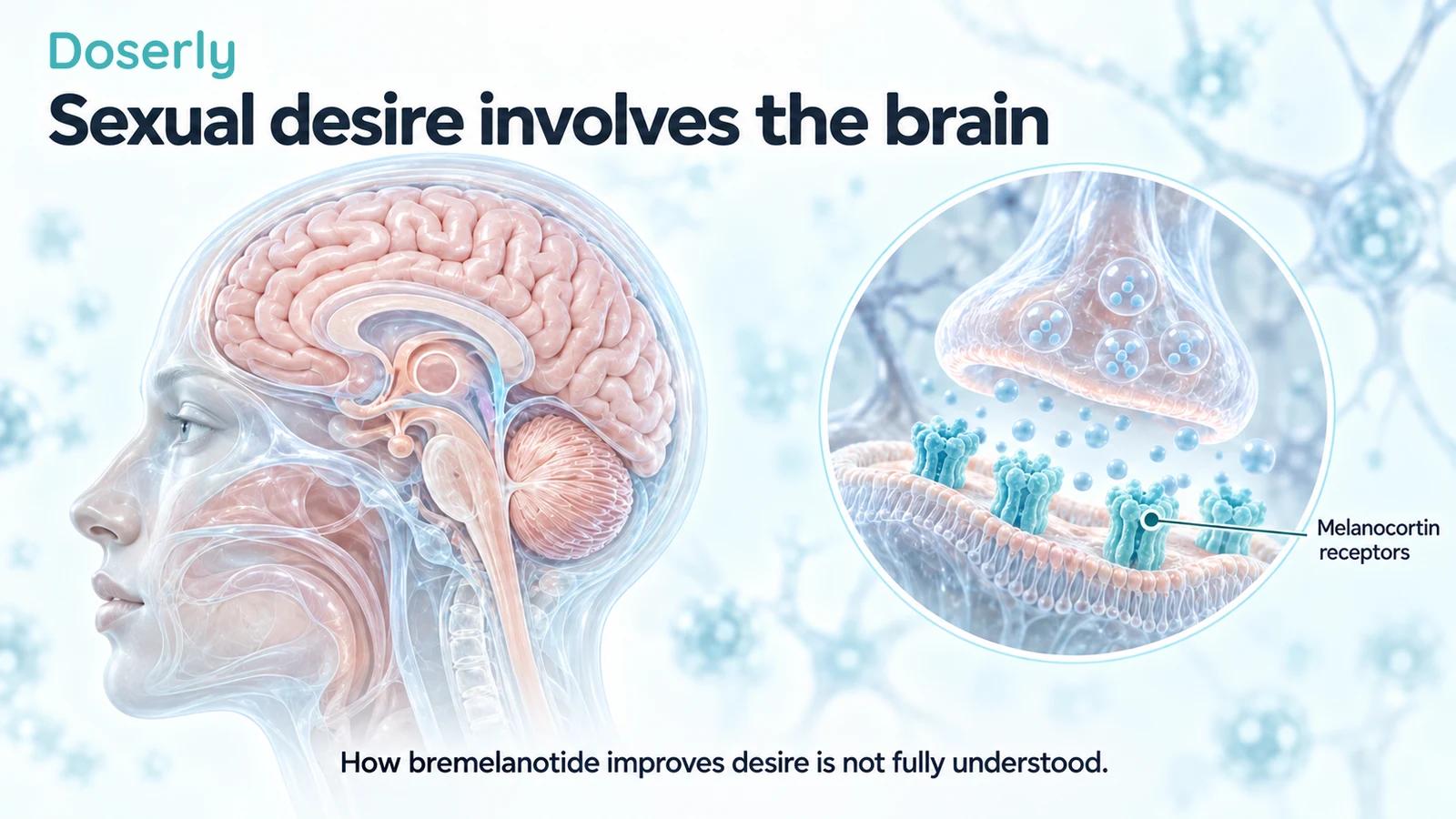
Bremelanotide is a synthetic peptide, a small molecule built from amino acids. It activates melanocortin receptors, proteins through which cells respond to chemical signals. The prescribing information describes activity at several melanocortin receptor types and explicitly states that the mechanism by which it improves low sexual desire is unknown. An explanation involving brain signaling is biologically plausible, but it is not a complete account of how treatment changes an individual's experience. Prescribing information, section 12.1
This also helps explain why calling it a libido hormone can mislead. The approved treatment is a drug acting on receptors, not a test-and-replace program for a demonstrated bremelanotide deficiency. The clinical studies selected participants through their symptoms and clinical history. They did not identify a blood concentration that separated people who needed treatment from those who didn't.
What the approved diagnosis means
The US indication is acquired, generalized hypoactive sexual desire disorder, usually shortened to HSDD. Each part narrows the question. Acquired means the low desire developed after a period without that problem. Generalized means it occurs across situations rather than being confined to a particular circumstance. HSDD includes distress or interpersonal difficulty associated with low desire; low interest alone is not the whole diagnosis. Vyleesi indication
Consider two hypothetical readers. One has always had relatively little interest in sex and is comfortable with that. Another used to enjoy sexual thoughts and activity but now feels a persistent, unwanted loss of interest across situations. Those are different clinical histories even if both would select “low desire” on a questionnaire. The medicine's acquired-HSDD indication speaks to the latter type of change, after a clinician assesses other explanations.
A partner's preferred frequency of sex is not a treatment target imposed on the patient. The clinical conversation should establish what the person experiencing the change wants help with. Professional guidance emphasizes the person's concerns, modifiable contributing factors, education, and individualized treatment goals. That can include interventions other than medication. ISSWSH process of care
This is one reason an appointment may involve questions that initially seem broader than libido. When did the change start? Does it occur in every setting? Is there pain, fatigue, anxiety, a relationship concern, or a new medication? These details help identify the problem that treatment should address. They are not a test of whether someone's concern is serious enough to deserve attention.
Why alternative explanations matter
The label excludes low desire due to an existing medical or psychiatric condition, relationship problems, or the effects of a medication or other drug. Those exclusions do not mean that people in these circumstances cannot need help. They mean the approved Vyleesi claim does not establish it as the answer to those causes. US label, section 1
For example, someone whose interest changed after starting a medicine needs a medication review. That conversation can address timing, the reason for the existing treatment, and possible alternatives. It would be a mistake to stop a prescribed medicine independently simply because sexual symptoms followed it. Likewise, when pain makes sexual activity unpleasant, measuring desire without addressing the pain could miss the reader's most important concern.
Different concerns can coexist. The practical question is not whether a person fits a single tidy category, but whether the proposed intervention addresses the difficulties actually present. A treatment can have an approved indication and still be poorly matched to a particular patient's priorities. Conversely, being outside this indication doesn't invalidate the symptom or eliminate other forms of care.
Who participated in the pivotal trials?
The two RECONNECT trials compared subcutaneous bremelanotide with a matching placebo over 24 weeks. The publication reports 1,267 women randomized, with 1,247 in the safety population and 1,202 in the efficacy analysis population. These are different denominators, not conflicting descriptions of the study's size. Participants were premenopausal women with acquired, generalized HSDD; the average age was about 39, and most were White and recruited at US sites. Original RECONNECT report
The selection matters. Results from a defined clinical group answer a more precise question than whether PT-141 improves everyone's sex life. The trials also used a specified pharmaceutical formulation, monitoring, and outcome assessments. An experience with an online vial cannot be assumed to reproduce those conditions because the ingredient has the same name.
The study was funded by the developer and commercial partner, and the sponsor participated in trial design and reporting. That is a relevant disclosure, not a reason to discard the results. It makes the independent regulatory assessment and the full pattern of benefits and harms especially useful when interpreting the findings. RECONNECT funding and methods
What improved, and what did not?
The main outcomes assessed sexual desire and distress about low desire. The label's clinical-study tables show mean improvements in desire of about 0.5–0.6 points with bremelanotide and about 0.2 with placebo. The corresponding distress item improved by about 0.7 points with bremelanotide and 0.4 with placebo. These are questionnaire-scale changes, not percentages of sexual function restored. Prescribing information, clinical studies
The studies did not show a significant treatment difference in the change in the number of satisfying sexual events. That result deserves to sit beside the positive desire and distress findings. Feeling more interested, feeling less troubled by low interest, and having more satisfying events are related experiences, but they are not interchangeable measures.
For an individual, a modest questionnaire change could still matter if it reflects a valued improvement. Someone else might judge the same average change insufficient, especially if treatment causes nausea or disrupts the evening. The trial average cannot decide that personal tradeoff. It provides a basis for a monitored treatment discussion, with a goal more specific than “better performance.”

What premenopausal means for this approval
The label specifies premenopausal women and states that Vyleesi is not indicated for HSDD in postmenopausal women or men. This is a boundary of the approved use. It should not be rewritten as proof that the drug can never have an effect outside that group, but neither should a possible effect be advertised as an established clinical benefit. Limitations of use
Menopause is particularly important because readers may encounter broad discussions of low desire that combine women at different life stages. A general symptom description can be useful, while treatment evidence remains population-specific. If a proposed treatment relies on a premenopausal trial, a postmenopausal reader deserves an explanation of what other evidence supports the recommendation.
The same principle applies to men's interest in PT-141. An erection response in an early experiment is not the same outcome as improved distressing low desire, and neither is a license to generalize the women's pivotal trials. This article does not provide an off-label treatment protocol; the important question is what direct evidence supports the actual condition being treated.
Approval belongs to a product and an indication
FDA approved Vyleesi in June 2019 under a specific new drug application. The approval concerns a prescription product supplied as a single-dose autoinjector. It does not approve every powder, nasal preparation, or mixed formulation sold under the PT-141 name. FDA approval letter
Compounded medicines also have a separate regulatory position. FDA explains that they are not FDA-approved and are not reviewed by the agency for safety, effectiveness, or quality before marketing. Compounding may meet an individual medical need, but that does not make a compounded preparation the product evaluated in an approval application. FDA explanation of compounded-drug risks
These distinctions answer different questions. “Does an approved bremelanotide medicine exist?” is not the same as “Is this particular product approved?” or “Is this proposed use included in its indication?” Asking for the exact product name, formulation, and reason for treatment makes those questions concrete. US approval also does not establish authorization in another country; local product and prescribing requirements need their own current check.
A narrow indication still includes meaningful safety limits
Matching the diagnosis is only part of deciding whether Vyleesi is suitable. It is contraindicated in uncontrolled high blood pressure and known cardiovascular disease. The label also warns about temporary blood-pressure increases, nausea, and localized skin darkening. Nausea occurred in 40% of treated participants in the controlled trials, and 8% stopped because of it. Those figures concern the studied product and population. Prescribing information, warnings and adverse reactions
Medication review matters because bremelanotide can slow stomach emptying and affect absorption of oral drugs. The label specifically advises avoiding it with oral naltrexone used for alcohol or opioid addiction. Pregnancy considerations also require discussion: effective contraception is advised, and treatment should be discontinued if pregnancy is suspected. An indication for premenopausal women is not evidence of pregnancy safety.
The prescribing information says to stop after eight weeks if symptoms have not improved. That gives the treatment discussion a practical reassessment point. Keeping a private record of desired changes, unwanted symptoms, and their timing can help describe the experience accurately. It should support a conversation, not become pressure to continue an uncomfortable treatment or meet someone else's sexual expectations.
Bringing the indication back to your own question
Before considering a drug, put the concern into everyday language: “I miss wanting sex,” “I'm avoiding it because it hurts,” or “My interest changed after a treatment change.” Those descriptions lead to different assessments. They are more informative than assuming every difficulty belongs under a single libido label.
For bremelanotide specifically, useful questions are whether the diagnosis matches the approved indication, which benefit would matter to you, how the proposed product relates to the trial formulation, and what would lead to stopping it. The evidence supports a focused discussion about acquired, generalized HSDD in premenopausal women. It does not support a blanket promise about desire, erections, satisfaction, or relationships. The human research section of our PT-141 guide explores the broader evidence alongside its limitations.
Sources
- Vyleesi US prescribing information: indication, clinical-study tables, contraindications and counseling.
- Kingsberg and colleagues, RECONNECT phase 3 trials, 2019: participant populations, design and sponsor disclosures.
- FDA approval letter, June 2019: approval of the specific prescription product.
- ISSWSH process of care, 2018: individualized assessment; historical treatment-approval statements are not used as current regulatory information.
- FDA: understanding the risks of compounded drugs: distinction between compounding and approval.