
Peptides
October 16, 2026
PT-141 versus sildenafil: desire and erections differ
On this page
PT-141 and sildenafil are often discussed as if they were two ways to achieve the same result. They are different medicines, with different approved uses and mechanisms. Sildenafil, sold as Viagra and generics, treats erectile dysfunction. Bremelanotide, the molecule called PT-141, is approved as Vyleesi for acquired, generalized hypoactive sexual desire disorder in premenopausal women. Vyleesi is not approved for men or for enhancing sexual performance. Viagra prescribing information, Vyleesi prescribing information
The comparison becomes useful when it begins with a person's difficulty. Is interest present but erections unreliable? Has sexual interest itself changed? Is pain, anxiety, a medication, or another health problem affecting the experience? Those questions may lead to different assessments, even when a person initially describes all of them as a libido problem.
Desire and erectile function can diverge
Sexual desire concerns interest or motivation. An erection is a physiological response involving nerves, blood vessels, smooth muscle, and erectile tissue. The two interact, but neither is a complete measurement of the other. Someone can want sexual activity and have difficulty obtaining an erection. Someone else can have erections without the interest or satisfaction they want.
This distinction is not a way to divide sexual difficulties into “physical” and “psychological” boxes. Both experience and physiology matter. It is a way to avoid treating a symptom with evidence drawn from a different outcome. A study showing more time above a penile-rigidity threshold does not establish a lasting improvement in unwanted low desire, and a desire questionnaire does not measure erectile reliability.
If both concerns are present, both deserve attention. Improving one may help the overall experience, but it should not be assumed to solve the other. A clinician can clarify when the change began, what still works comfortably, and what the patient wants to regain before choosing a treatment.

How sildenafil supports an erection
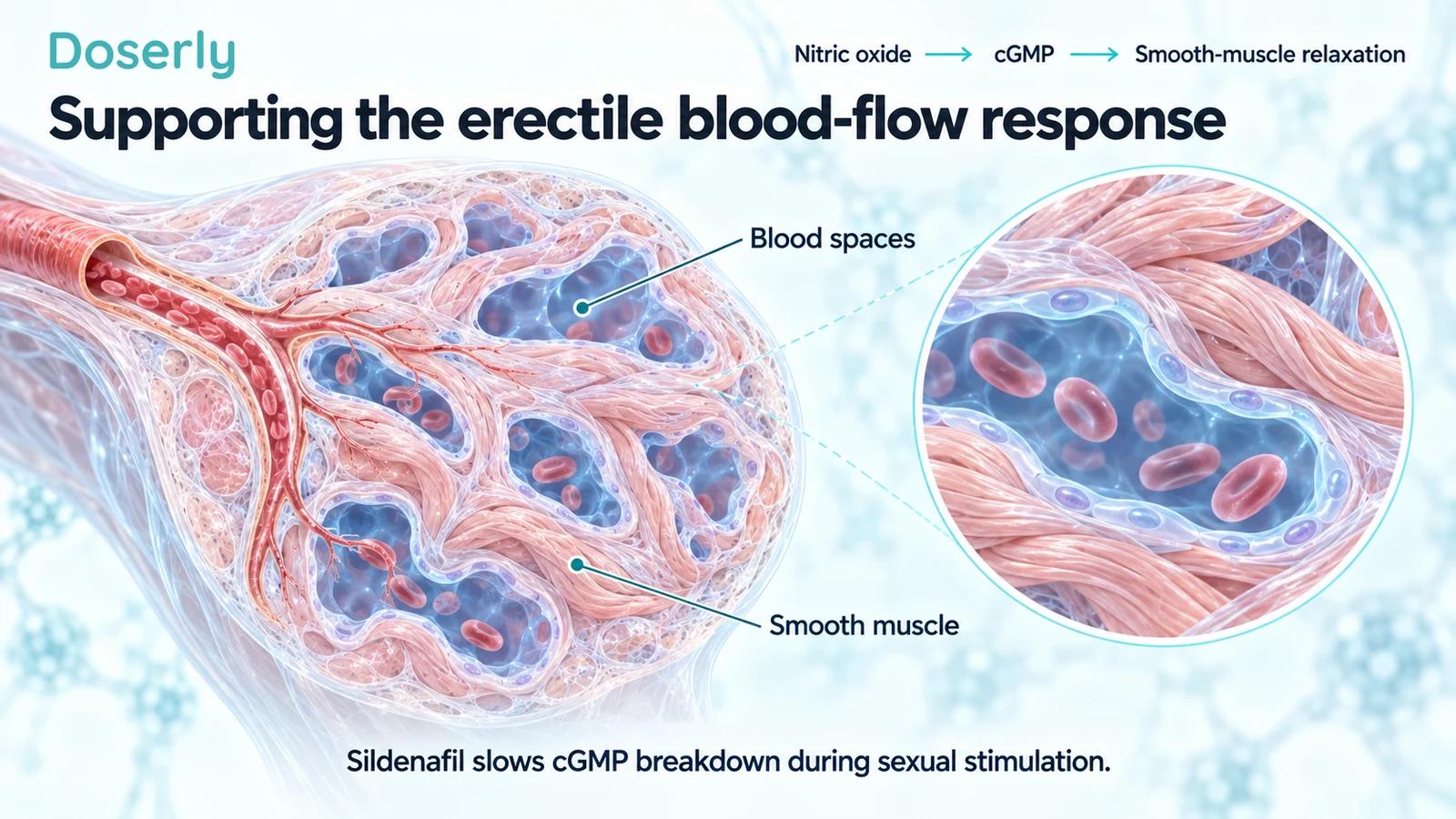
During sexual stimulation, nitric oxide signaling increases cyclic guanosine monophosphate, or cGMP, in erectile tissue. This helps smooth muscle relax, allowing blood to enter the spaces involved in an erection. An enzyme called phosphodiesterase type 5, or PDE5, breaks down cGMP. Sildenafil inhibits that enzyme, helping sustain the signal. Viagra clinical pharmacology
This is why sildenafil is not simply a pill that creates sexual interest. Its labeled mechanism supports the erectile response to stimulation. The presence of the drug does not replace the full experience of arousal, consent, comfort, or desire. It also does not mean that every cause of erectile dysfunction will respond equally.
The distinction can explain a frustrating experience: someone may obtain a firmer erection while still feeling little interest in sexual activity. That does not necessarily mean the drug failed at its intended physiological target. It may mean the person's larger concern includes something the treatment was not designed to address.
How bremelanotide differs
Bremelanotide activates melanocortin receptors rather than inhibiting PDE5. Researchers connect melanocortin signaling with central pathways involved in sexual response, but the Vyleesi label states that the mechanism of improvement in HSDD is unknown. It is therefore more accurate to describe the receptor pharmacology and clinical findings separately than to claim that PT-141 switches on a proven desire center. Vyleesi clinical pharmacology
In the two pivotal 24-week trials, the main outcomes were patient-reported desire and distress about low desire. Those outcomes improved relative to placebo; the number of satisfying sexual events did not show a significant treatment difference. The results concern premenopausal women with acquired, generalized HSDD, not a general comparison with sildenafil in men. RECONNECT report
Calling Vyleesi “female Viagra” can therefore obscure more than it explains. The phrase draws attention to sexual medicine but hides the different diagnoses, mechanisms, and endpoints. A reader needs to know which specific difficulty was treated, not just that both medicines appear in sexual-health discussions. Our PT-141 guide covers bremelanotide's clinical development in more detail.
Has PT-141 been studied in men?
Yes. Early male research investigated erectile responses to intranasal and subcutaneous PT-141, including laboratory measurements during visual sexual stimulation. That evidence is relevant to the history of the molecule. It should not be confused with the later approval trials in women or dismissed as if no male research existed. Early intranasal study
However, a laboratory erection study addresses a limited question. It can establish that a substance changes a measured response over the observation period. It does not by itself establish reliable intercourse outcomes over months, improved distressing low desire, long-term tolerability, or superiority to standard erectile-dysfunction treatment.
Route also matters. A nasal preparation and a subcutaneous autoinjector deliver drug differently. Comparing their amounts without considering absorption is not a valid dose conversion. The early experiments should not be copied into a personal treatment schedule, and an online preparation should not inherit the evidence of a different pharmaceutical formulation.
What the small combination study actually tested
A 2005 randomized crossover study enrolled 19 men with erectile dysfunction who reported responding to Viagra or Levitra. Each participant received different treatments at separate visits: low-dose sildenafil with intranasal PT-141, sildenafil with placebo spray, and matching placebos. Erectile activity was measured over six hours, including two periods of visual sexual stimulation. Diamond and colleagues
The combination produced a greater measured erectile response than sildenafil alone in that experiment. The publication reported that it was well tolerated without new or more frequent adverse events compared with monotherapy. But 19 selected participants and short observation cannot establish routine combination safety or detect uncommon harms. The participants were also self-reported responders to existing medication, not a general sample of men for whom every standard treatment had failed.
This study is sometimes used to suggest that different mechanisms automatically make an effective stack. Its actual finding is narrower: a particular combination changed a laboratory response under controlled conditions. It does not tell us which patients should receive a combination today, which preparation is appropriate, or how the long-term benefit compares with adjusting established treatment. No stacking protocol follows from this article.
A prominent sildenafil-failure paper has an editorial warning
A separate 2008 paper reported a randomized bremelanotide study in men with inadequate sildenafil response. Its title makes it especially attractive to readers looking for a next step. The journal subsequently issued an expression of concern in 2023. That notice must accompany discussion of the original report. Original paper, expression of concern
An expression of concern is an editorial warning, not the same label as a retraction. It is also not something to omit while quoting the result as dependable proof of rescue treatment. Here, the study is identified so readers can recognize the issue, but its claimed response rate is not used to estimate the chance that bremelanotide will help them.
The existence of this warning does not automatically invalidate every unrelated PT-141 experiment. It does mean that the paper cannot carry the weight of a reassuring general recommendation. The relevant next question is what reliable, directly applicable evidence remains after that limitation is acknowledged.
When sildenafil seems not to work
A report of poor response is a starting point for reassessment. European Association of Urology guidance recommends checking that a licensed product was correctly prescribed and used, including timing and the influence of food. High-fat meals can delay absorption of sildenafil. The guidance also emphasizes identifying the underlying cause of erectile dysfunction and reviewing medical and sexual history. EAU erectile-dysfunction guidance
That assessment is different from simply escalating to another compound. A clinician may need to clarify whether the main difficulty is obtaining an erection, maintaining it, interest, discomfort, or the circumstances of sexual activity. A treatment taken under conditions that limit its effect does not establish biological nonresponse; equally, repeated unsatisfactory experiences should not be brushed aside.
Persistent erectile dysfunction can also be relevant to broader vascular health. The EAU guidance incorporates cardiovascular assessment into care. That does not mean every episode signals heart disease, but it is a reason to discuss the symptom medically rather than treating it only as a product-selection problem.
Their safety profiles do not cancel each other
Sildenafil can lower blood pressure and is contraindicated with nitrates or nitrites and with guanylate-cyclase stimulators such as riociguat. These combinations can cause unsafe blood-pressure reductions. The prescribing information also addresses cardiovascular suitability for sexual activity, interactions that increase sildenafil exposure, and urgent assessment for an erection lasting more than four hours. Viagra safety information
Bremelanotide can temporarily increase pressure and reduce heart rate. Vyleesi is contraindicated in uncontrolled hypertension or known cardiovascular disease. Nausea is common, and other considerations include skin darkening and altered absorption of oral medicines. Those risks cannot be balanced safely by assuming one drug raises what the other lowers. Their timing and effects on the body are not simple equal-and-opposite quantities. Vyleesi safety information
Nor does a small study reporting no new safety signal prove an interaction cannot occur. A rare event might never appear in 19 people, and people with important conditions may have been excluded. The safest interpretation is the literal one: the limited study observed what it observed, while broader prescribing decisions require more information.
How to compare treatments meaningfully
A fair comparison begins with the same diagnosis, population, and outcome. To ask whether one treatment is better for erectile dysfunction, researchers would need an appropriate direct comparison in men with that condition, using outcomes that matter to those patients. Comparing a desire-score change in women with an erection endpoint in men cannot produce a meaningful winner.
The comparator also matters. A treatment that outperforms placebo has answered one question. A combination that changes a laboratory response more than a low dose of one component has answered another. Neither finding automatically shows superiority to well-managed standard care over time.
For a clinical conversation, describe the difficulty and the desired improvement before naming a preferred compound. Ask which evidence matches that goal, whether the exact product and route were studied, and how unwanted effects would be weighed. For bremelanotide, the human evidence section provides background; for erectile symptoms, a clinician can help connect treatment choices with the underlying problem.
The important distinction is not that desire and erections never influence each other. They do. It is that a useful treatment recommendation must show how the evidence relates to the actual difficulty someone wants help with.
Sources
- Viagra prescribing information.
- Vyleesi prescribing information.
- RECONNECT phase 3 report.
- Early intranasal PT-141 trial, 2004.
- PT-141 plus sildenafil crossover experiment, 2005.
- Sildenafil-failure report, 2008, read with its 2023 expression of concern.
- EAU management of erectile dysfunction.